
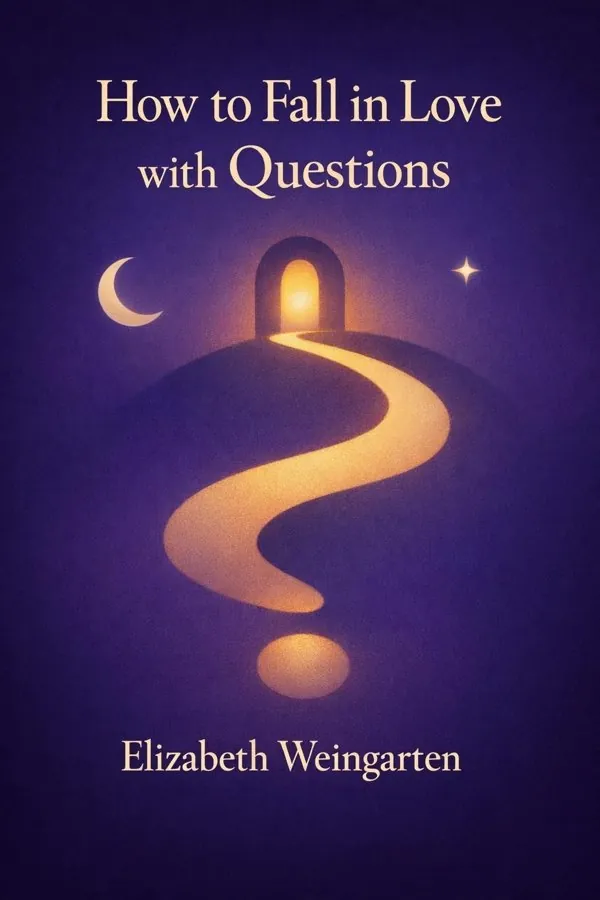
How to Fall in Love with Questions: Summary & Key Insights
 10 min8 chaptersAudio available
Key Takeaways from How to Fall in Love with Questions
We often treat a question like a temporary inconvenience, something to get rid of as quickly as possible.
Most people assume uncertainty is something to survive until clarity returns.
Certainty feels good because it offers closure, but curiosity is often more useful because it keeps us in contact with reality.
Many people imagine identity as something stable that must be discovered once and then defended forever.
Doubt is usually framed as a weakness, a lapse in confidence, or an obstacle to progress.
What Is How to Fall in Love with Questions About?
How to Fall in Love with Questions by Elizabeth Weingarten is a mindset book spanning 5 pages. What if the most meaningful progress in life does not come from finding better answers, but from learning how to live with better questions? In How to Fall in Love with Questions, journalist and applied behavioral scientist Elizabeth Weingarten argues that uncertainty is not a flaw in life to be eliminated, but a condition to be understood, navigated, and even appreciated. Instead of treating doubt as a sign of weakness or confusion as a temporary inconvenience, she shows how inquiry can become a source of resilience, wisdom, and deeper self-knowledge. Drawing on psychology, behavioral science, philosophy, and interviews with people who have faced major transitions, Weingarten explores how questions shape identity, relationships, work, and meaning. Her core insight is both simple and profound: when we stop demanding immediate certainty, we create room for curiosity, reflection, and transformation. In a world obsessed with hot takes, productivity, and instant clarity, that message feels especially urgent. Weingarten writes with the authority of a researcher and the warmth of a storyteller, offering not abstract inspiration but a practical mindset for anyone navigating change, loss, ambition, or the open-ended challenge of becoming more fully human.
This FizzRead summary covers all 8 key chapters of How to Fall in Love with Questions in approximately 10 minutes, distilling the most important ideas, arguments, and takeaways from Elizabeth Weingarten's work. Also available as an audio summary and Key Quotes Podcast.
How to Fall in Love with Questions
What if the most meaningful progress in life does not come from finding better answers, but from learning how to live with better questions? In How to Fall in Love with Questions, journalist and applied behavioral scientist Elizabeth Weingarten argues that uncertainty is not a flaw in life to be eliminated, but a condition to be understood, navigated, and even appreciated. Instead of treating doubt as a sign of weakness or confusion as a temporary inconvenience, she shows how inquiry can become a source of resilience, wisdom, and deeper self-knowledge.
Drawing on psychology, behavioral science, philosophy, and interviews with people who have faced major transitions, Weingarten explores how questions shape identity, relationships, work, and meaning. Her core insight is both simple and profound: when we stop demanding immediate certainty, we create room for curiosity, reflection, and transformation. In a world obsessed with hot takes, productivity, and instant clarity, that message feels especially urgent. Weingarten writes with the authority of a researcher and the warmth of a storyteller, offering not abstract inspiration but a practical mindset for anyone navigating change, loss, ambition, or the open-ended challenge of becoming more fully human.
Who Should Read How to Fall in Love with Questions?
This book is perfect for anyone interested in mindset and looking to gain actionable insights in a short read. Whether you're a student, professional, or lifelong learner, the key ideas from How to Fall in Love with Questions by Elizabeth Weingarten will help you think differently.
- ✓Readers who enjoy mindset and want practical takeaways
- ✓Professionals looking to apply new ideas to their work and life
- ✓Anyone who wants the core insights of How to Fall in Love with Questions in just 10 minutes
Want the full summary?
Get instant access to this book summary and 100K+ more with Fizz Moment.
Get Free SummaryAvailable on App Store • Free to download
Key Chapters
We often treat a question like a temporary inconvenience, something to get rid of as quickly as possible. Elizabeth Weingarten challenges that reflex. One of the book’s central insights is that questions are not simply gaps in knowledge; they are tools for perception. The questions we ask determine what we notice, how we interpret experience, and what possibilities we allow ourselves to imagine. In that sense, a good question is not a sign that we are lost. It is evidence that we are paying attention.
This shift matters because modern life rewards certainty. At work, in relationships, and online, people are often pressured to sound decisive even when reality is complex. But rushing to an answer can narrow thinking too early. If someone asks, “What career should I choose?” they may become trapped in a false search for a single perfect option. A more useful question might be, “What kind of life do I want my work to support?” That reframing opens new paths.
Weingarten shows that better questions help us move from panic to possibility. In moments of transition, instead of asking, “How do I fix this immediately?” we can ask, “What is this uncertainty trying to teach me?” In conflict, instead of “Who is right?” we might ask, “What is each person afraid of losing?” These questions do not erase discomfort, but they create insight.
Practically, this means slowing down the impulse to conclude. In journaling, meetings, and difficult conversations, spend more time identifying the real question before trying to solve it. Often the quality of the answer depends on the quality of the inquiry.
Actionable takeaway: When you feel pressure to decide fast, pause and write down three different versions of the question you are trying to answer. Choose the one that opens the most possibilities, not the one that merely reduces anxiety.
Most people assume uncertainty is something to survive until clarity returns. Weingarten makes a more radical argument: uncertainty itself can become a source of growth. The problem is not that life is unpredictable; the problem is that we are rarely taught how to remain psychologically steady when outcomes are unknown. As a result, ambiguity feels like danger rather than a normal feature of human experience.
The book invites readers to reframe uncertainty from an enemy into a training ground. When plans collapse, identities shift, or the future becomes blurry, the instinct is often to restore control through premature decisions. Yet many of life’s most important developments—falling in love, grieving, changing careers, becoming a parent, questioning beliefs—cannot be managed with perfect foresight. They require tolerance for not yet knowing.
Weingarten draws from behavioral science to show that humans are meaning-making creatures. We do better not when uncertainty disappears, but when we build habits that help us stay open inside it. For example, someone waiting to hear about a job may spiral by asking, “What if this ruins everything?” A more grounding approach is to ask, “What parts of this situation are within my control today?” Another person navigating divorce might stop demanding a full map of the future and instead focus on the next honest conversation, the next practical step, the next act of care.
This idea is especially useful in volatile times, when social, technological, and personal change arrive faster than our emotional habits can adapt. Strength no longer means knowing exactly what comes next. It means learning to act thoughtfully without certainty.
Actionable takeaway: The next time you face a major unknown, divide the situation into three columns: what you know, what you do not know, and what you can do now. Revisit the list whenever anxiety pushes you toward forced certainty.
Certainty feels good because it offers closure, but curiosity is often more useful because it keeps us in contact with reality. Weingarten emphasizes that curiosity is not a soft, optional trait reserved for artists or academics. It is a practical capacity that helps us adapt, learn, connect, and make wiser choices. When curiosity disappears, rigidity takes over. We stop exploring and start defending.
A curious mindset changes the emotional quality of difficult situations. Consider feedback at work. If you approach criticism with the hidden question, “How do I prove I’m competent?” you are likely to become defensive. But if you approach it with, “What can I learn here that I could not see on my own?” the same moment becomes developmental rather than threatening. Curiosity creates breathing room between ego and experience.
Weingarten also shows how curiosity strengthens relationships. In long-term partnerships or close friendships, people often assume they already know one another. That assumption deadens intimacy. Asking fresh questions—about fears, changing goals, private hopes, or unspoken disappointments—restores aliveness. Curiosity says, “I do not fully know you yet,” which is one of the most respectful things we can communicate.
There is also moral value in curiosity. In polarized environments, certainty turns people into categories. Curiosity invites complexity. It does not mean abandoning convictions, but it does mean staying interested in how others arrived at theirs. That stance can reduce contempt and increase understanding.
To practice this, Weingarten encourages replacing judgment with inquiry. Instead of “Why am I like this?” ask “What patterns am I repeating?” Instead of “Why would they do that?” ask “What need or fear might be driving them?” Curiosity moves us from reaction to reflection.
Actionable takeaway: Build a daily curiosity habit by asking one open-ended question in a conversation, one reflective question in your journal, and one exploratory question about a challenge you are facing.
Many people imagine identity as something stable that must be discovered once and then defended forever. Weingarten presents a more flexible and humane view: identity is shaped through ongoing inquiry. We become ourselves not by locking into fixed answers, but by repeatedly asking what matters, what is changing, and what kind of person we want to be under new conditions.
This matters because major life transitions often unsettle the stories we tell about who we are. A high achiever loses a job. A caregiver becomes the one needing care. A person long committed to one path starts questioning whether it still fits. These moments can feel like personal failure when identity has been built on certainty. But if identity is understood as evolving rather than fixed, such disruptions become invitations to revise rather than reasons to collapse.
Weingarten suggests that self-understanding grows through active questioning. Questions like “What values remain constant even as my roles change?” or “What part of this old identity am I ready to release?” can help people move through transition with greater coherence. For instance, someone leaving a prestigious profession may realize that what they loved was not the title, but the chance to solve meaningful problems. That insight can guide a more authentic next step.
Inquiry also helps people distinguish inherited identities from chosen ones. Many beliefs about success, gender, family, or ambition are absorbed long before they are examined. Asking where those assumptions came from can reveal whether they still deserve loyalty. In this way, questions become instruments of freedom.
Rather than waiting for a final answer to “Who am I?” Weingarten encourages readers to treat the self as something discovered in motion. Clarity often emerges after experimentation, reflection, and honest revision.
Actionable takeaway: Create an “identity audit” by writing down the roles, labels, and expectations that currently define you. For each one, ask: Does this still feel true, useful, and chosen?
Doubt is usually framed as a weakness, a lapse in confidence, or an obstacle to progress. Weingarten turns that assumption inside out. She shows that doubt, when approached skillfully, can be one of the most generative experiences in life. It forces us to reconsider inherited beliefs, test easy narratives, and confront the difference between what is socially rewarded and what is personally true.
The goal is not to glorify paralysis. Doubt becomes destructive when it loops endlessly without movement. But there is a crucial difference between corrosive indecision and reflective uncertainty. Reflective doubt creates depth. It asks whether our plans, ambitions, relationships, or beliefs are aligned with who we are becoming. In that sense, doubt is often the beginning of honesty.
For example, someone may doubt a successful career path that looks perfect from the outside. Instead of suppressing the discomfort, Weingarten would invite them to investigate it. Is the doubt signaling burnout, misalignment, fear of success, or a longing for a different kind of contribution? Likewise, spiritual or moral doubt can be painful, but it may also mark a transition from borrowed belief to examined conviction.
This perspective is especially valuable in cultures that mistake unwavering confidence for maturity. Real maturity often includes the ability to question oneself without disintegrating. It means saying, “I am not fully sure, and I am willing to learn from that.” Such humility makes better decisions possible.
To work productively with doubt, Weingarten encourages readers to notice its texture. Does this doubt feel like fear, wisdom, grief, exhaustion, or emerging truth? Naming it accurately can reveal what kind of response is needed—rest, research, conversation, or change.
Actionable takeaway: When doubt arises, do not silence it immediately. Spend ten minutes asking, “What is this doubt trying to protect, reveal, or correct?” Write the answer before making your next move.
A common fantasy is that meaning arrives once life finally makes sense. Weingarten offers a more realistic and consoling alternative: meaning often emerges not after uncertainty ends, but during the process of living and questioning itself. We do not always receive a tidy explanation for loss, disappointment, or change. Yet we can still build a meaningful life by how we respond to what we do not fully understand.
This insight matters because many people postpone their sense of purpose. They assume meaning will come after the right career appears, after a crisis is resolved, after the future becomes legible. But life rarely grants such clean resolution. Meaning is often found in attention, commitment, and interpretation—in how we care, what we return to, what questions we continue asking.
Weingarten’s approach resonates especially during painful or ambiguous periods. A person coping with grief may never get a satisfying answer to “Why did this happen?” But they may find meaning in questions like “How do I honor what I loved?” or “What does carrying this loss teach me about connection?” Similarly, someone in midlife may not uncover a single grand purpose, yet they can discover meaning by pursuing work, relationships, and practices that feel alive, ethical, and sustaining.
The book suggests that inquiry itself can be a spiritual practice. To remain open to wonder, complexity, and revision is to inhabit life more fully. Questions keep us awake. They keep us from shrinking mystery into cliché.
In practical terms, this means shifting from purpose as a destination to meaning as an activity. We create significance through repeated acts of reflection and engagement, not through one final revelation.
Actionable takeaway: At the end of each week, ask yourself not “Did I figure everything out?” but “What felt meaningful, and what questions helped me notice that meaning more clearly?”
Many relationship problems are not caused by a lack of love or intelligence, but by poor inquiry. Weingarten shows that the questions people bring into conversations shape whether those conversations become defensive, distant, or transformative. If your hidden question is “How do I win this argument?” you will listen differently than if your question is “What matters most to this person right now?”
This principle applies across intimate relationships, friendships, family systems, and professional teams. In conflict, people often ask narrow, blame-oriented questions: “Who started this?” “Why are they so unreasonable?” “How do I get them to change?” Such questions intensify polarization. More constructive questions widen perspective: “What are we each protecting?” “What assumptions are we making?” “What has not yet been said safely?” These do not erase disagreement, but they create the conditions for honest dialogue.
Weingarten also highlights the power of questions in deepening closeness. Long-term familiarity can become a trap when people stop updating their understanding of one another. A spouse, sibling, or colleague may be carrying new fears or aspirations that old scripts fail to capture. Asking fresh, generous questions restores complexity and makes connection feel alive again.
At work, this can mean a manager asking, “What kind of support helps you do your best thinking?” rather than assuming everyone is motivated the same way. In families, it may mean replacing “What’s wrong?” with “What feels hardest right now?” In friendship, it could be as simple as asking, “What are you rethinking lately?”
Questions also communicate care. They signal that another person is not a problem to solve or a role to manage, but a reality worth discovering. That stance can soften tension and build trust.
Actionable takeaway: In your next important conversation, prepare three open-ended questions aimed at understanding rather than persuading. Let those questions guide the exchange before offering your own conclusions.
Falling in love with questions does not mean getting stuck in permanent analysis. Weingarten is careful to distinguish healthy inquiry from rumination. Questions help when they open perspective, generate learning, and guide wise action. They harm when they become repetitive loops that intensify anxiety without producing insight. The challenge, then, is not simply to ask more questions, but to ask them in ways that are structured, purposeful, and embodied.
Rumination often has a circular quality. It asks, “Why am I failing?” or “What if everything goes wrong?” without creating movement. Productive inquiry, by contrast, asks questions that are specific, compassionate, and actionable. For example, instead of “Why can’t I ever make a decision?” a more useful question is “What information do I still need, and what uncertainty must I accept no matter what I choose?” The second question leads somewhere.
Weingarten’s approach encourages boundaries around reflection. This might mean journaling for twenty minutes rather than mentally rehearsing worries all day, seeking trusted conversation instead of solitary spiraling, or setting a deadline for a decision after sufficient exploration. Inquiry should help us live, not postpone living.
The body also matters. People often try to think their way out of uncertainty while ignoring exhaustion, fear, or overstimulation. Yet the quality of our questions is shaped by our physical and emotional state. A calm mind asks different questions than a flooded one. Rest, movement, and silence are therefore part of wise inquiry.
This idea is liberating because it offers a middle path. You do not have to choose between impulsive certainty and endless doubt. You can build a disciplined practice of questioning that leads to clearer action.
Actionable takeaway: When you are stuck in mental loops, write one question under each of these headings: understand, choose, and act. Then answer only those three, and take one concrete step before returning to further reflection.
All Chapters in How to Fall in Love with Questions
About the Author
Elizabeth Weingarten is a journalist and applied behavioral scientist whose work explores curiosity, identity, social change, and the human experience of uncertainty. She is known for translating complex ideas from psychology and behavioral research into clear, engaging insights that readers can use in everyday life. Her writing has appeared in major publications, and her professional work has focused on research, innovation, and the ways people make decisions and meaning under changing conditions. Weingarten brings together the instincts of a reporter and the rigor of a behavioral thinker, combining evidence with personal and cultural observation. In How to Fall in Love with Questions, she draws on that interdisciplinary background to help readers develop a more open, reflective, and resilient relationship with doubt, ambiguity, and life’s unanswered questions.
Get This Summary in Your Preferred Format
Read or listen to the How to Fall in Love with Questions summary by Elizabeth Weingarten anytime, anywhere. FizzRead offers multiple formats so you can learn on your terms — all free.
Available formats: App · Audio · PDF · EPUB — All included free with FizzRead
Download How to Fall in Love with Questions PDF and EPUB Summary
Key Quotes from How to Fall in Love with Questions
“We often treat a question like a temporary inconvenience, something to get rid of as quickly as possible.”
“Most people assume uncertainty is something to survive until clarity returns.”
“Certainty feels good because it offers closure, but curiosity is often more useful because it keeps us in contact with reality.”
“Many people imagine identity as something stable that must be discovered once and then defended forever.”
“Doubt is usually framed as a weakness, a lapse in confidence, or an obstacle to progress.”
Frequently Asked Questions about How to Fall in Love with Questions
How to Fall in Love with Questions by Elizabeth Weingarten is a mindset book that explores key ideas across 8 chapters. What if the most meaningful progress in life does not come from finding better answers, but from learning how to live with better questions? In How to Fall in Love with Questions, journalist and applied behavioral scientist Elizabeth Weingarten argues that uncertainty is not a flaw in life to be eliminated, but a condition to be understood, navigated, and even appreciated. Instead of treating doubt as a sign of weakness or confusion as a temporary inconvenience, she shows how inquiry can become a source of resilience, wisdom, and deeper self-knowledge. Drawing on psychology, behavioral science, philosophy, and interviews with people who have faced major transitions, Weingarten explores how questions shape identity, relationships, work, and meaning. Her core insight is both simple and profound: when we stop demanding immediate certainty, we create room for curiosity, reflection, and transformation. In a world obsessed with hot takes, productivity, and instant clarity, that message feels especially urgent. Weingarten writes with the authority of a researcher and the warmth of a storyteller, offering not abstract inspiration but a practical mindset for anyone navigating change, loss, ambition, or the open-ended challenge of becoming more fully human.
You Might Also Like

Browse by Category
Ready to read How to Fall in Love with Questions?
Get the full summary and 100K+ more books with Fizz Moment.