
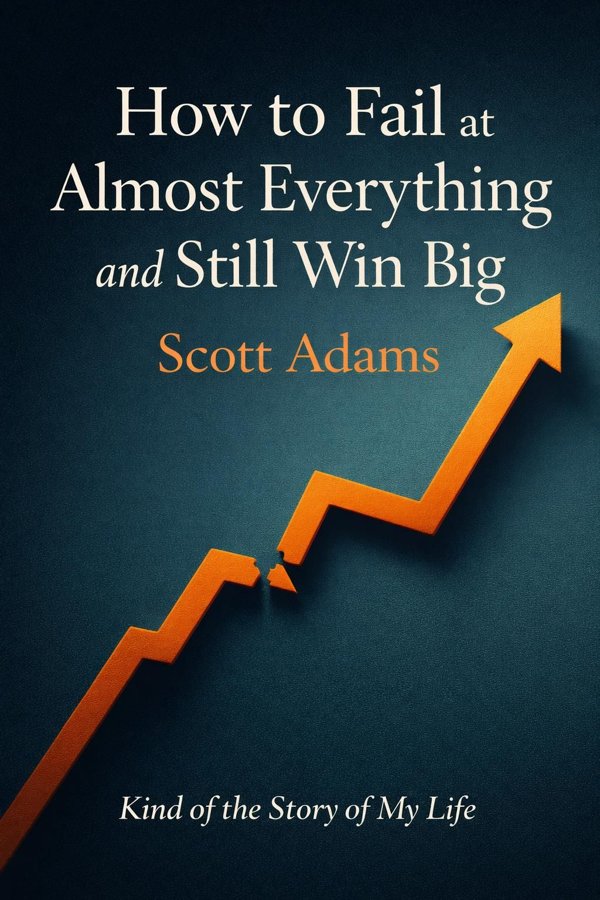
How to Fail at Almost Everything and Still Win Big: Kind of the Story of My Life: Summary & Key Insights
by Scott Adams
 10 min10 chaptersAudio available
What Is How to Fail at Almost Everything and Still Win Big: Kind of the Story of My Life About?
How to Fail at Almost Everything and Still Win Big: Kind of the Story of My Life by Scott Adams is a mindset book spanning 10 pages. In this humorous and insightful memoir, Scott Adams, the creator of the Dilbert comic strip, shares his unconventional philosophy on success. He argues that failure is not only inevitable but also essential for achieving big wins. Through personal anecdotes and practical advice, Adams explores topics such as systems versus goals, the importance of energy management, and how embracing failure can lead to unexpected success.
This FizzRead summary covers all 10 key chapters of How to Fail at Almost Everything and Still Win Big: Kind of the Story of My Life in approximately 10 minutes, distilling the most important ideas, arguments, and takeaways from Scott Adams's work. Also available as an audio summary and Key Quotes Podcast.
How to Fail at Almost Everything and Still Win Big: Kind of the Story of My Life
In this humorous and insightful memoir, Scott Adams, the creator of the Dilbert comic strip, shares his unconventional philosophy on success. He argues that failure is not only inevitable but also essential for achieving big wins. Through personal anecdotes and practical advice, Adams explores topics such as systems versus goals, the importance of energy management, and how embracing failure can lead to unexpected success.
Who Should Read How to Fail at Almost Everything and Still Win Big: Kind of the Story of My Life?
This book is perfect for anyone interested in mindset and looking to gain actionable insights in a short read. Whether you're a student, professional, or lifelong learner, the key ideas from How to Fail at Almost Everything and Still Win Big: Kind of the Story of My Life by Scott Adams will help you think differently.
- ✓Readers who enjoy mindset and want practical takeaways
- ✓Professionals looking to apply new ideas to their work and life
- ✓Anyone who wants the core insights of How to Fail at Almost Everything and Still Win Big: Kind of the Story of My Life in just 10 minutes
Want the full summary?
Get instant access to this book summary and 100K+ more with Fizz Moment.
Get Free SummaryAvailable on App Store • Free to download
Key Chapters
I started much like many ambitious professionals: filled with plans, driven by goals, and doomed to repeat the classic cycle of hope and disappointment. My early years were crowded with jobs that seemed promising but collapsed under their own contradictions. I tried the corporate world, only to realize that bureaucracy drained every ounce of creativity I had. Then I flirted with entrepreneurship, inventing gadgets and launching ventures, most of which never made it past the prototype stage. Each time something fell apart, I felt the sting—but also the incremental growth. Every failure contained lessons invisible at first glance.
When I worked in large companies, I learned how little individual brilliance could survive inside dysfunctional systems. When my inventions flopped, I discovered the importance of timing and exposure to opportunity. When my restaurant idea crashed, I learned how enthusiasm isn’t enough to compensate for bad execution. At first, these seemed like defeats; now I recognize them as training sessions that taught me to decode probability, persistence, and how to measure genuine progress.
Failure stripped me of illusions but never of curiosity. The secret was staying in motion, turning frustration into data and letting each misstep adjust the system. I began seeing my career not as a single path but as an experiment with multiple parallel tracks. One day, drawing cartoons for fun opened another door. Because my previous stumbles had taught me about business, communication, and psychology, I instinctively understood how to package humor for professionals. That’s how Dilbert was born—not from one triumphant leap but from dozens of misfires that mapped the landscape between mediocrity and breakthrough.
Through those early failures, I saw how persistence combines with adaptability. I was never waiting for one lucky break; I was building tolerance for failure and adjusting the system underneath my daily life. Those mistakes would later become my résumé’s hidden infrastructure—the part most people never see, but that holds everything together.
If I had to distill the entire philosophy of this book into one principle, it would be this: losers have goals, winners have systems. It sounds provocative, but the logic is simple. A goal is a future condition—you’re happy only when you reach it. A system is a design for continuous improvement—you can succeed every day just by running it. That emotional dynamic changes everything. When you’re focused on systems, you can feel successful right now, even before any major result appears.
I used to set huge goals: get rich, become famous, master this skill or that. Every time I’d fall short, I’d experience a sense of failure and fatigue that sabotaged the next attempt. Only when I replaced goals with systems did my trajectory stabilize. For example, my system for writing Dilbert wasn’t about getting syndicated or becoming a household name. It was simply about producing better jokes every day, reading widely, observing business life, and submitting content regularly. That system naturally pushed me into situations where opportunity could find me.
A system is repeatable. It influences habits, energy, and mindset. It teaches you to measure progress by consistency and development instead of milestones. If your goal is to lose twenty pounds, that’s a one-time condition; if your system is to eat right and exercise daily, you’ll continuously gain health—probably lose weight as a side effect. Systems are resilient because they don’t collapse under failure. You miss a workout? The system keeps going. You fail a project? The system adjusts the next one.
This shift freed me emotionally. I realized that optimism isn’t about faith—it’s about direction. Systems give you direction. They breed motion. When people ask how I succeeded after so many fiascos, I always answer: I designed my life around systems that kept generating opportunities until one exploded. The Dilbert comic wasn’t luck—it was a product of systematic persistence, skill stacking, and energy management. Once you start thinking in systems, even failure feels like maintenance rather than defeat.
+ 8 more chapters — available in the FizzRead app
All Chapters in How to Fail at Almost Everything and Still Win Big: Kind of the Story of My Life
About the Author
Scott Adams is an American cartoonist, author, and creator of the popular comic strip Dilbert. Born in 1957, Adams has written several books on business, success, and personal development, often blending humor with practical insights drawn from his own experiences in corporate life and creative pursuits.
Get This Summary in Your Preferred Format
Read or listen to the How to Fail at Almost Everything and Still Win Big: Kind of the Story of My Life summary by Scott Adams anytime, anywhere. FizzRead offers multiple formats so you can learn on your terms — all free.
Available formats: App · Audio · PDF · EPUB — All included free with FizzRead
Download How to Fail at Almost Everything and Still Win Big: Kind of the Story of My Life PDF and EPUB Summary
Key Quotes from How to Fail at Almost Everything and Still Win Big: Kind of the Story of My Life
“I started much like many ambitious professionals: filled with plans, driven by goals, and doomed to repeat the classic cycle of hope and disappointment.”
“If I had to distill the entire philosophy of this book into one principle, it would be this: losers have goals, winners have systems.”
Frequently Asked Questions about How to Fail at Almost Everything and Still Win Big: Kind of the Story of My Life
How to Fail at Almost Everything and Still Win Big: Kind of the Story of My Life by Scott Adams is a mindset book that explores key ideas across 10 chapters. In this humorous and insightful memoir, Scott Adams, the creator of the Dilbert comic strip, shares his unconventional philosophy on success. He argues that failure is not only inevitable but also essential for achieving big wins. Through personal anecdotes and practical advice, Adams explores topics such as systems versus goals, the importance of energy management, and how embracing failure can lead to unexpected success.
More by Scott Adams
You Might Also Like



Browse by Category
Ready to read How to Fail at Almost Everything and Still Win Big: Kind of the Story of My Life?
Get the full summary and 100K+ more books with Fizz Moment.