
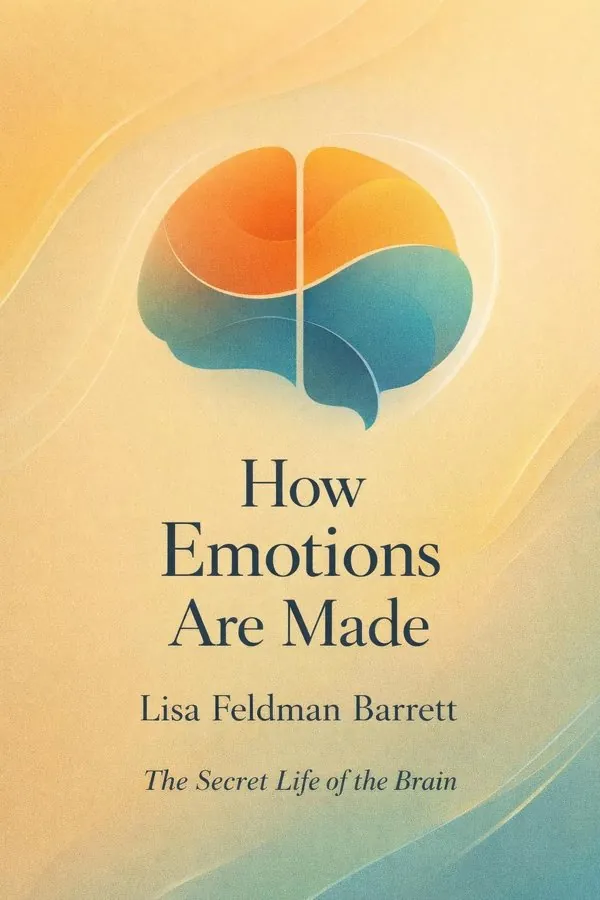
How Emotions Are Made: The Secret Life of the Brain: Summary & Key Insights
 10 min10 chaptersAudio available
What Is How Emotions Are Made: The Secret Life of the Brain About?
How Emotions Are Made: The Secret Life of the Brain by Lisa Feldman Barrett is a neuroscience book spanning 10 pages. In this groundbreaking work, psychologist and neuroscientist Lisa Feldman Barrett challenges the classical view of emotions as universal, biologically hardwired responses. Drawing on decades of research, she presents the theory of constructed emotion, arguing that emotions are not innate reactions but rather predictions made by the brain based on past experiences and cultural context. The book explores how this understanding reshapes our view of emotional intelligence, mental health, and human behavior.
This FizzRead summary covers all 10 key chapters of How Emotions Are Made: The Secret Life of the Brain in approximately 10 minutes, distilling the most important ideas, arguments, and takeaways from Lisa Feldman Barrett's work. Also available as an audio summary and Key Quotes Podcast.
How Emotions Are Made: The Secret Life of the Brain
In this groundbreaking work, psychologist and neuroscientist Lisa Feldman Barrett challenges the classical view of emotions as universal, biologically hardwired responses. Drawing on decades of research, she presents the theory of constructed emotion, arguing that emotions are not innate reactions but rather predictions made by the brain based on past experiences and cultural context. The book explores how this understanding reshapes our view of emotional intelligence, mental health, and human behavior.
Who Should Read How Emotions Are Made: The Secret Life of the Brain?
This book is perfect for anyone interested in neuroscience and looking to gain actionable insights in a short read. Whether you're a student, professional, or lifelong learner, the key ideas from How Emotions Are Made: The Secret Life of the Brain by Lisa Feldman Barrett will help you think differently.
- ✓Readers who enjoy neuroscience and want practical takeaways
- ✓Professionals looking to apply new ideas to their work and life
- ✓Anyone who wants the core insights of How Emotions Are Made: The Secret Life of the Brain in just 10 minutes
Want the full summary?
Get instant access to this book summary and 100K+ more with Fizz Moment.
Get Free SummaryAvailable on App Store • Free to download
Key Chapters
For centuries, Western science and philosophy have treated emotions as innate biological responses. This view begins with Charles Darwin, who believed emotional expressions evolved as universal signals — remnants of our animal past. Later, psychologists like Paul Ekman expanded this into the theory of basic emotions, claiming that a few core feelings — happiness, fear, anger, sadness, surprise, and disgust — are biologically hardwired and universally recognized. This idea became so influential that it seeped into nearly every layer of modern thought. Hollywood animators designed characters around it. Security agencies used facial coding systems based on it. Even the diagnostic models of psychiatry assumed emotions could be read directly from physiology.
Yet, despite its cultural power, the classical view faced an inconvenient truth: empirical evidence rarely matched the model. Across cultures, people didn’t consistently make or recognize the same emotional faces. Physiological measures varied wildly — no unique bodily pattern reliably indicated fear, anger, or happiness. Darwin’s legacy endured, not because of overwhelming evidence, but because it fit our intuitions. Emotions *feel* like they happen to us, as if they live in the body waiting to erupt. But feelings are deceptive narrators. What feels universal may in fact be deeply local — shaped by language, experience, and cultural context.
When I began challenging this paradigm, I found resistance, even incredulity. The notion of basic emotions feels comforting; it promises that we can peer into another’s face and know their mind. But this comfort comes at the cost of truth. To understand emotions scientifically, I had to let go of universality and look instead at variability — not as noise, but as the signal itself. That is where the real story of emotion begins.
Here lies the central idea of the book: emotions are not inborn modules, but brain-made constructions. Each instance of emotion is built in the moment by your brain, predicting and making sense of the world by drawing on past experience. The brain’s task is not to react but to anticipate. Every sensation in your body — a pounding heart, a tightening stomach, a flare of heat — must be explained. Your brain uses concepts you’ve learned, shaped by your culture and history, to give those sensations meaning. That meaning is what we call emotion.
When you say, “I feel angry,” your brain has constructed anger from a blend of bodily changes (perhaps a racing heartbeat), external contexts (a sense of unfairness), and conceptual knowledge (what anger typically means in your culture). But this construction does not reflect a pre-existing essence of anger hiding in your brain. It is a momentary synthesis, a best guess shaped by predictions. Another person with the same bodily sensations might interpret them as anxiety, excitement, or hunger, depending on context. This variability is not error; it is the very nature of how the brain works.
Understanding emotions as constructed does not mean they are imaginary or trivial. It means they are real but malleable — products of your brain’s effort to regulate itself and others efficiently. This insight gives you agency. If emotions are constructed, we can construct them differently. We can reshape our conceptual repertoire, cultivate more nuanced emotional categories, and hence change what we feel and how we act.
+ 8 more chapters — available in the FizzRead app
All Chapters in How Emotions Are Made: The Secret Life of the Brain
About the Author
Lisa Feldman Barrett is a professor of psychology at Northeastern University and holds appointments at Harvard Medical School and Massachusetts General Hospital. She is known for her pioneering research in affective neuroscience and the theory of constructed emotion. Her work has been widely published and recognized for transforming how scientists and the public understand emotions and the brain.
Get This Summary in Your Preferred Format
Read or listen to the How Emotions Are Made: The Secret Life of the Brain summary by Lisa Feldman Barrett anytime, anywhere. FizzRead offers multiple formats so you can learn on your terms — all free.
Available formats: App · Audio · PDF · EPUB — All included free with FizzRead
Download How Emotions Are Made: The Secret Life of the Brain PDF and EPUB Summary
Key Quotes from How Emotions Are Made: The Secret Life of the Brain
“For centuries, Western science and philosophy have treated emotions as innate biological responses.”
“Here lies the central idea of the book: emotions are not inborn modules, but brain-made constructions.”
Frequently Asked Questions about How Emotions Are Made: The Secret Life of the Brain
How Emotions Are Made: The Secret Life of the Brain by Lisa Feldman Barrett is a neuroscience book that explores key ideas across 10 chapters. In this groundbreaking work, psychologist and neuroscientist Lisa Feldman Barrett challenges the classical view of emotions as universal, biologically hardwired responses. Drawing on decades of research, she presents the theory of constructed emotion, arguing that emotions are not innate reactions but rather predictions made by the brain based on past experiences and cultural context. The book explores how this understanding reshapes our view of emotional intelligence, mental health, and human behavior.
More by Lisa Feldman Barrett
You Might Also Like
Anxious
Joseph LeDoux
10 min
Hallucinations
Oliver Sacks
10 min
The Biological Mind: How Brain, Body, and Environment Collaborate to Make Us Who We Are
Alan Jasanoff
10 min
The Feeling of Life Itself: Why Consciousness Is Widespread but Can't Be Computed
Christof Koch
10 min
The No-Nonsense Meditation Book
Steven Laureys
10 min
A General Theory of Love
Thomas Lewis, Fari Amini, Richard Lannon
10 minBrowse by Category
Ready to read How Emotions Are Made: The Secret Life of the Brain?
Get the full summary and 100K+ more books with Fizz Moment.