
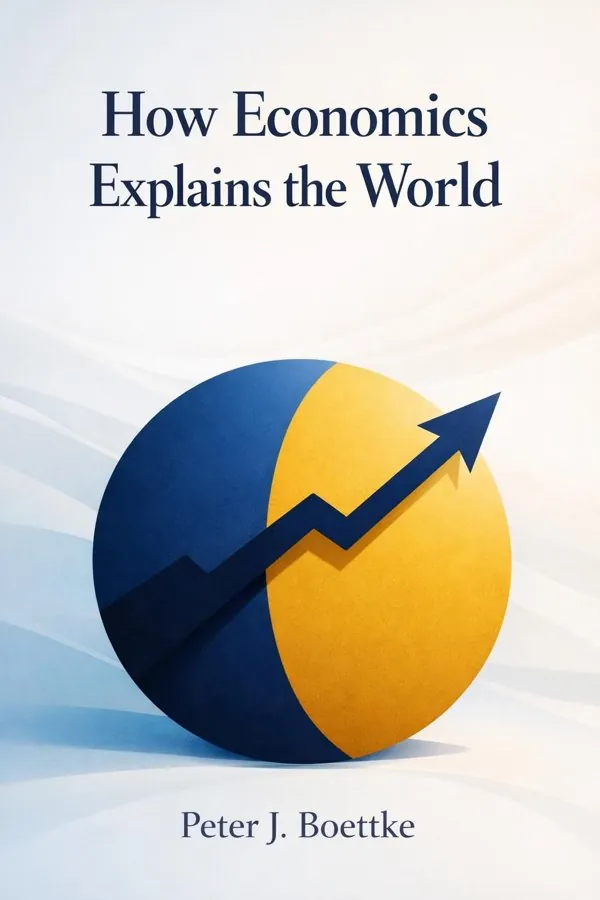
How Economics Explains the World: Lessons on the Power of Economic Principles to Shape Our Lives: Summary & Key Insights
 10 min11 chaptersAudio available
What Is How Economics Explains the World: Lessons on the Power of Economic Principles to Shape Our Lives About?
How Economics Explains the World: Lessons on the Power of Economic Principles to Shape Our Lives by Peter J. Boettke is a economics book spanning 11 pages. This book explores how fundamental economic principles can illuminate a wide range of human behaviors and social phenomena. Peter J. Boettke demonstrates how economic reasoning extends beyond markets to explain everyday life, institutions, and global issues. Through accessible examples, he shows how incentives, trade-offs, and spontaneous order shape the world we live in.
This FizzRead summary covers all 11 key chapters of How Economics Explains the World: Lessons on the Power of Economic Principles to Shape Our Lives in approximately 10 minutes, distilling the most important ideas, arguments, and takeaways from Peter J. Boettke's work. Also available as an audio summary and Key Quotes Podcast.
How Economics Explains the World: Lessons on the Power of Economic Principles to Shape Our Lives
This book explores how fundamental economic principles can illuminate a wide range of human behaviors and social phenomena. Peter J. Boettke demonstrates how economic reasoning extends beyond markets to explain everyday life, institutions, and global issues. Through accessible examples, he shows how incentives, trade-offs, and spontaneous order shape the world we live in.
Who Should Read How Economics Explains the World: Lessons on the Power of Economic Principles to Shape Our Lives?
This book is perfect for anyone interested in economics and looking to gain actionable insights in a short read. Whether you're a student, professional, or lifelong learner, the key ideas from How Economics Explains the World: Lessons on the Power of Economic Principles to Shape Our Lives by Peter J. Boettke will help you think differently.
- ✓Readers who enjoy economics and want practical takeaways
- ✓Professionals looking to apply new ideas to their work and life
- ✓Anyone who wants the core insights of How Economics Explains the World: Lessons on the Power of Economic Principles to Shape Our Lives in just 10 minutes
Want the full summary?
Get instant access to this book summary and 100K+ more with Fizz Moment.
Get Free SummaryAvailable on App Store • Free to download
Key Chapters
Every serious study of human affairs must begin with the fact of scarcity. There are more things desired than there are means to obtain them, and this unyielding reality compels us to make choices. Scarcity is not a condition to be eradicated but a universal constraint that defines existence. Because we cannot have it all, we must prioritize—and that is where economics begins.
I invite readers to imagine a world without scarcity. If everything were free and infinitely available, the very notion of choice would vanish, and with it, the necessity of decision-making, trade, or cooperation. It is the limitation of means relative to ends that gives rise to value, price, and planning. This insight, common to all traditions of economic thought, drives the logic of opportunity cost. When we choose one course of action, we forego another. Every decision carries a hidden cost—the value of what we give up. Once you internalize this truth, everyday life becomes an illustration of economics: choosing to study means giving up leisure; building hospitals requires diverting resources from housing; governments that spend on one priority must tax or borrow from another.
Understanding choice and opportunity cost is liberating because it clears away illusions about ‘free’ solutions. There are no policies without trade-offs, no actions without consequences. In my classroom, I often stress that good economics begins with asking: “Compared to what?” Only by considering alternatives can we assess the true cost of any decision.
This foundational reasoning lays the groundwork for everything that follows in the book. Economics, properly understood, is not about predicting the stock market but about tracing the logic of human action under constraint. It is a discipline that teaches humility—recognizing that our knowledge is limited, our resources finite, and that coordination among billions of individuals depends on systems that enable us to align diverse plans despite these limitations.
If scarcity defines the canvas of human life, incentives are the threads that shape its patterns. An incentive is simply a factor that changes the relative costs or benefits of a decision. Yet from this simplicity arises the extraordinary richness of the social world. People respond to incentives not because they are selfish automatons, but because incentives reflect the structure of our opportunities—the rules of the game.
In any setting—business, government, family—we act based on the perceived benefits and costs of our actions. Economists do not assume people are purely rational calculators; instead, we assume they are purposeful. They seek to achieve their own goals given the knowledge and constraints they face. This principle allows us to understand a wide range of behavior, from why firms innovate to why voters support certain policies. Change the incentives, and behavior shifts in predictable ways. Misalign the incentives, and even good intentions produce failure.
Examples abound. When social programs unintentionally discourage work, or when corporate bailouts insulate firms from losses, we see the moral hazard that emerges when the cost of choices is separated from responsibility. Conversely, when property rights are well-defined and individuals can reap the rewards of their effort, innovation and stewardship flourish. The invisible hand that Adam Smith described is, at its heart, an incentive mechanism aligning self-interest with the social good.
Understanding incentives equips us to design better policies and institutions, but it also encourages personal reflection. Every time we create rules—in a workplace, a classroom, or a household—we set incentives that shape behavior. The challenge is not to suppress human motives, but to channel them in productive directions.
+ 9 more chapters — available in the FizzRead app
All Chapters in How Economics Explains the World: Lessons on the Power of Economic Principles to Shape Our Lives
About the Author
Peter J. Boettke is an American economist and professor at George Mason University, known for his work in Austrian economics, institutional analysis, and political economy. He has authored and edited numerous books on economics and is a leading advocate for the study of market processes and the role of institutions in economic development.
Get This Summary in Your Preferred Format
Read or listen to the How Economics Explains the World: Lessons on the Power of Economic Principles to Shape Our Lives summary by Peter J. Boettke anytime, anywhere. FizzRead offers multiple formats so you can learn on your terms — all free.
Available formats: App · Audio · PDF · EPUB — All included free with FizzRead
Download How Economics Explains the World: Lessons on the Power of Economic Principles to Shape Our Lives PDF and EPUB Summary
Key Quotes from How Economics Explains the World: Lessons on the Power of Economic Principles to Shape Our Lives
“Every serious study of human affairs must begin with the fact of scarcity.”
“If scarcity defines the canvas of human life, incentives are the threads that shape its patterns.”
Frequently Asked Questions about How Economics Explains the World: Lessons on the Power of Economic Principles to Shape Our Lives
How Economics Explains the World: Lessons on the Power of Economic Principles to Shape Our Lives by Peter J. Boettke is a economics book that explores key ideas across 11 chapters. This book explores how fundamental economic principles can illuminate a wide range of human behaviors and social phenomena. Peter J. Boettke demonstrates how economic reasoning extends beyond markets to explain everyday life, institutions, and global issues. Through accessible examples, he shows how incentives, trade-offs, and spontaneous order shape the world we live in.
You Might Also Like

Business Adventures
John Brooks
10 min
Nudge
Richard H. Thaler, Cass R. Sunstein
10 min
The Hitchhiker"s Guide to the Galaxy
Douglas Adams
10 minThe Muqaddimah
Ibn Khaldun
10 minThe Outsiders
William N. Thorndike
10 min
A Little History of Economics
Niall Kishtainy
10 minBrowse by Category
Ready to read How Economics Explains the World: Lessons on the Power of Economic Principles to Shape Our Lives?
Get the full summary and 100K+ more books with Fizz Moment.