
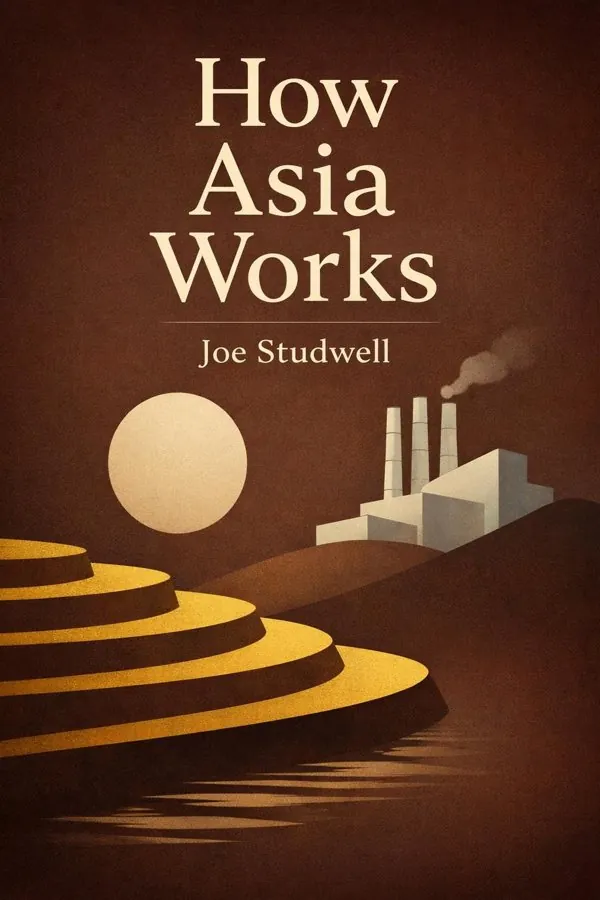
How Asia Works: Success and Failure in the World's Most Dynamic Region: Summary & Key Insights
by Joe Studwell
 10 min10 chaptersAudio available
What Is How Asia Works: Success and Failure in the World's Most Dynamic Region About?
How Asia Works: Success and Failure in the World's Most Dynamic Region by Joe Studwell is a economics book spanning 10 pages. In this influential work, Joe Studwell examines the economic development of East and Southeast Asia, focusing on how land reform, manufacturing policy, and financial systems shaped the region’s success stories and failures. Through comparative analysis of Japan, South Korea, Taiwan, and other nations, Studwell argues that pragmatic state intervention and disciplined industrial policy were key to sustained growth, challenging conventional Western economic wisdom.
This FizzRead summary covers all 10 key chapters of How Asia Works: Success and Failure in the World's Most Dynamic Region in approximately 10 minutes, distilling the most important ideas, arguments, and takeaways from Joe Studwell's work. Also available as an audio summary and Key Quotes Podcast.
How Asia Works: Success and Failure in the World's Most Dynamic Region
In this influential work, Joe Studwell examines the economic development of East and Southeast Asia, focusing on how land reform, manufacturing policy, and financial systems shaped the region’s success stories and failures. Through comparative analysis of Japan, South Korea, Taiwan, and other nations, Studwell argues that pragmatic state intervention and disciplined industrial policy were key to sustained growth, challenging conventional Western economic wisdom.
Who Should Read How Asia Works: Success and Failure in the World's Most Dynamic Region?
This book is perfect for anyone interested in economics and looking to gain actionable insights in a short read. Whether you're a student, professional, or lifelong learner, the key ideas from How Asia Works: Success and Failure in the World's Most Dynamic Region by Joe Studwell will help you think differently.
- ✓Readers who enjoy economics and want practical takeaways
- ✓Professionals looking to apply new ideas to their work and life
- ✓Anyone who wants the core insights of How Asia Works: Success and Failure in the World's Most Dynamic Region in just 10 minutes
Want the full summary?
Get instant access to this book summary and 100K+ more with Fizz Moment.
Get Free SummaryAvailable on App Store • Free to download
Key Chapters
Modern development, I argue, begins with what happens in the fields. Japan, Korea, and Taiwan proved that equitable land reform is not a moral exercise alone—it is an economic catalyst. These economies recognized that growth cannot flourish atop feudal land ownership, where absentee landlords siphon wealth and leave peasants disincentivized. By redistributing land, governments unlocked an extraordinary transformation. Smallholders, owning what they cultivated, had both incentive and security to invest effort and innovation. Agricultural productivity rose sharply, and, just as crucially, rural stability emerged.
Consider Japan’s postwar land redistribution: tenants received ownership rights under policies implemented by the American occupation authorities, drastically reducing landlord dominance. In South Korea and Taiwan, similar reforms in the 1950s broke old hierarchies. These acts were not just social engineering—they created a structural base for industrial takeoff. Peasants turned into consumers and future factory workers. A rural population that was self-sufficient and productive provided a domestic platform for national savings and demand.
Contrast this with Southeast Asia, where reform rarely reached the soil. In the Philippines, land concentration remained severe. Productivity languished; rural unrest simmered. Indonesia’s post-independence system never empowered small farmers, depending instead on plantation economies and resource extraction. These nations lacked the agricultural surplus and human foundation that feed industrialization. When the countryside fails, the nation’s economic engine lacks fuel.
Land reform, therefore, was the first discipline—it proved that progress requires equality of opportunity at the base. Without it, later industrial and financial measures lose coherence. This chapter, and the examples within, are a call to understand agriculture not as an old sector to be bypassed but as the wellspring of development itself.
Japan’s story demonstrates that disciplined state coordination can reconstruct an entire economy within a generation. After World War II, Japan lay devastated, its industries shattered and its population anxious. Yet through strategic industrial planning, Japan reinvented itself. Ministries such as MITI (the Ministry of International Trade and Industry) took center stage—not by owning enterprises, but by orchestrating them. The government identified key sectors, protected nascent firms until they were competitive, and demanded measurable improvement in productivity.
This wasn’t protectionism for comfort; it was protectionism for learning. Firms were shielded on the condition that they strive for export competitiveness. The result was a manufacturing culture obsessed with refinement. Whether in steel, automotive, or electronics, Japanese producers internalized the logic of long-term quality and technological mastering.
At the same time, Japan kept tight reins on finance. Banks were directed to channel credit toward industrial expansion rather than speculative ventures. The symbiosis between state policy, banking systems, and industrial learning created what I call the 'development triad.' It wasn’t laissez-faire—it was performance-based intervention. Japan’s success revealed that the most dynamic growth emerges where ambition meets discipline.
The visible outcomes—Toyota’s production system, Sony’s innovation path, and Hitachi’s modernization—were all grounded in these policies. Every great Japanese brand is, in essence, a testament to collective focus sustained over decades. Japan taught that market forces alone cannot guide early development; structured ambition must precede market freedom.
+ 8 more chapters — available in the FizzRead app
All Chapters in How Asia Works: Success and Failure in the World's Most Dynamic Region
About the Author
Joe Studwell is a British journalist and researcher specializing in Asian economics and development. He has written extensively on China and East Asia, and is known for his incisive analysis of regional economic models. Studwell is also the founder of the China Economic Quarterly and has contributed to numerous international publications.
Get This Summary in Your Preferred Format
Read or listen to the How Asia Works: Success and Failure in the World's Most Dynamic Region summary by Joe Studwell anytime, anywhere. FizzRead offers multiple formats so you can learn on your terms — all free.
Available formats: App · Audio · PDF · EPUB — All included free with FizzRead
Download How Asia Works: Success and Failure in the World's Most Dynamic Region PDF and EPUB Summary
Key Quotes from How Asia Works: Success and Failure in the World's Most Dynamic Region
“Modern development, I argue, begins with what happens in the fields.”
“Japan’s story demonstrates that disciplined state coordination can reconstruct an entire economy within a generation.”
Frequently Asked Questions about How Asia Works: Success and Failure in the World's Most Dynamic Region
How Asia Works: Success and Failure in the World's Most Dynamic Region by Joe Studwell is a economics book that explores key ideas across 10 chapters. In this influential work, Joe Studwell examines the economic development of East and Southeast Asia, focusing on how land reform, manufacturing policy, and financial systems shaped the region’s success stories and failures. Through comparative analysis of Japan, South Korea, Taiwan, and other nations, Studwell argues that pragmatic state intervention and disciplined industrial policy were key to sustained growth, challenging conventional Western economic wisdom.
You Might Also Like

Business Adventures
John Brooks
10 min
Nudge
Richard H. Thaler, Cass R. Sunstein
10 min
The Hitchhiker"s Guide to the Galaxy
Douglas Adams
10 minThe Muqaddimah
Ibn Khaldun
10 minThe Outsiders
William N. Thorndike
10 min
A Little History of Economics
Niall Kishtainy
10 minBrowse by Category
Ready to read How Asia Works: Success and Failure in the World's Most Dynamic Region?
Get the full summary and 100K+ more books with Fizz Moment.