
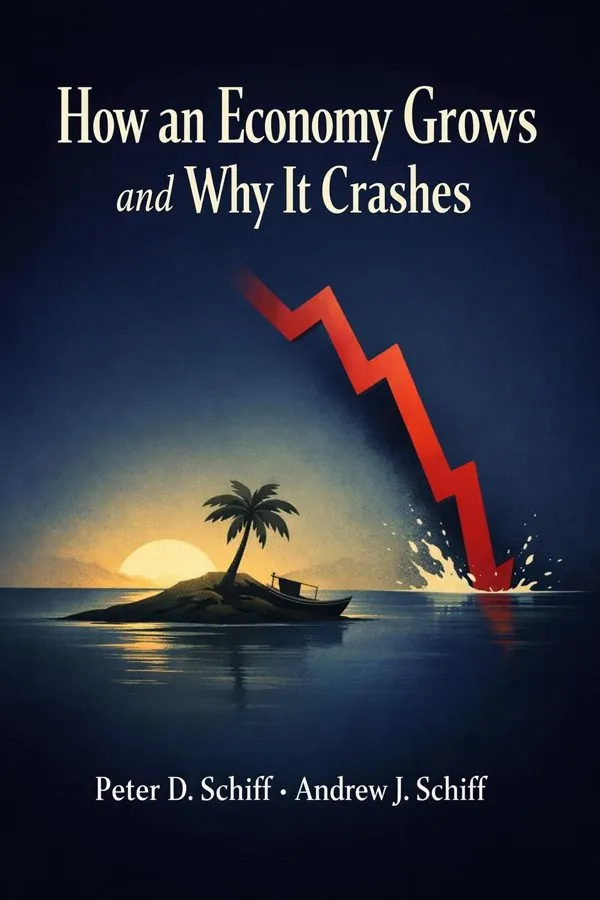
How an Economy Grows and Why It Crashes: Summary & Key Insights
by Peter D. Schiff, Andrew J. Schiff
 10 min9 chaptersAudio available
What Is How an Economy Grows and Why It Crashes About?
How an Economy Grows and Why It Crashes by Peter D. Schiff, Andrew J. Schiff is a economics book spanning 9 pages. This book uses a simple allegory about a small island economy to explain fundamental economic principles such as production, savings, investment, and trade. Through humor and storytelling, the authors illustrate how economies grow, why they sometimes collapse, and how government policies can influence both outcomes. It serves as an accessible introduction to macroeconomic concepts and critiques of modern fiscal and monetary policy.
This FizzRead summary covers all 9 key chapters of How an Economy Grows and Why It Crashes in approximately 10 minutes, distilling the most important ideas, arguments, and takeaways from Peter D. Schiff, Andrew J. Schiff's work. Also available as an audio summary and Key Quotes Podcast.
How an Economy Grows and Why It Crashes
This book uses a simple allegory about a small island economy to explain fundamental economic principles such as production, savings, investment, and trade. Through humor and storytelling, the authors illustrate how economies grow, why they sometimes collapse, and how government policies can influence both outcomes. It serves as an accessible introduction to macroeconomic concepts and critiques of modern fiscal and monetary policy.
Who Should Read How an Economy Grows and Why It Crashes?
This book is perfect for anyone interested in economics and looking to gain actionable insights in a short read. Whether you're a student, professional, or lifelong learner, the key ideas from How an Economy Grows and Why It Crashes by Peter D. Schiff, Andrew J. Schiff will help you think differently.
- ✓Readers who enjoy economics and want practical takeaways
- ✓Professionals looking to apply new ideas to their work and life
- ✓Anyone who wants the core insights of How an Economy Grows and Why It Crashes in just 10 minutes
Want the full summary?
Get instant access to this book summary and 100K+ more with Fizz Moment.
Get Free SummaryAvailable on App Store • Free to download
Key Chapters
In the beginning, our island is a closed, simple system—a place of pure necessity. Three fishermen, Able, Baker, and Charlie, live day to day by catching just enough fish to survive. Each must spend all his time fishing because every caught fish is immediately consumed. There are no savings; hence, no reserves or potential for change. This scene paints the essence of a primitive economy: production equals consumption, with nothing left over for growth.
From my perspective as an economist, this opening scene represents the ultimate test of self-sufficiency. When people produce only enough to consume, they tie their future to the immediate present. There’s no possibility of investment, because investment demands the willingness to delay gratification. In real-world terms, this is what happens when people or nations spend every resource they generate, leaving nothing to prepare for tomorrow.
This simple island story allows us to visualize the first economic building block: all wealth begins with production. You must make before you can spend; and until productivity increases, prosperity is frozen. Every economy, large or small, must start from the same basic energy—the conversion of labor into consumable goods.
The moment of transformation comes when Able decides to take a bold risk. He chooses to go hungry for one day, skipping immediate consumption in order to use his time to weave a fishing net. That net, once built, allows him to catch two fish each day instead of one. His sacrifice—the act of saving—creates capital. From this moment, the island’s economy is no longer static. Production can exceed consumption.
In this pivotal chapter, the book illustrates how savings are the foundation of growth. The fish Able forgoes represent deferred consumption. By investing that time and energy into a productive tool, he multiplies his future returns. This allegory captures what economists call capital formation—the process by which labor and resources are transformed into tools that expand productivity.
Soon, Able’s success inspires his peers. Baker and Charlie recognize that they too can build nets—but they must first save a fish or borrow one. Through this interplay of sacrifice and reward, the concept of saving becomes a shared wisdom. It allows society to accumulate wealth, not by consuming more, but by producing more. Here, I want readers to understand deeply: consumption is the result of production, not its cause. The modern confusion that spending stimulates growth completely reverses reality. Real expansion begins with investment and innovation born of savings.
+ 7 more chapters — available in the FizzRead app
All Chapters in How an Economy Grows and Why It Crashes
About the Authors
Peter D. Schiff is an American investment broker, financial commentator, and author known for his economic forecasts and advocacy of free-market principles. Andrew J. Schiff is a communications professional and co-author who collaborated with Peter Schiff to make complex economic ideas understandable to general readers.
Get This Summary in Your Preferred Format
Read or listen to the How an Economy Grows and Why It Crashes summary by Peter D. Schiff, Andrew J. Schiff anytime, anywhere. FizzRead offers multiple formats so you can learn on your terms — all free.
Available formats: App · Audio · PDF · EPUB — All included free with FizzRead
Download How an Economy Grows and Why It Crashes PDF and EPUB Summary
Key Quotes from How an Economy Grows and Why It Crashes
“In the beginning, our island is a closed, simple system—a place of pure necessity.”
“The moment of transformation comes when Able decides to take a bold risk.”
Frequently Asked Questions about How an Economy Grows and Why It Crashes
How an Economy Grows and Why It Crashes by Peter D. Schiff, Andrew J. Schiff is a economics book that explores key ideas across 9 chapters. This book uses a simple allegory about a small island economy to explain fundamental economic principles such as production, savings, investment, and trade. Through humor and storytelling, the authors illustrate how economies grow, why they sometimes collapse, and how government policies can influence both outcomes. It serves as an accessible introduction to macroeconomic concepts and critiques of modern fiscal and monetary policy.
You Might Also Like
Business Adventures
John Brooks
10 min
Nudge
Richard H. Thaler, Cass R. Sunstein
10 min
The Hitchhiker"s Guide to the Galaxy
Douglas Adams
10 minThe Muqaddimah
Ibn Khaldun
10 minThe Outsiders
William N. Thorndike
10 min
A Little History of Economics
Niall Kishtainy
10 minBrowse by Category
Ready to read How an Economy Grows and Why It Crashes?
Get the full summary and 100K+ more books with Fizz Moment.