
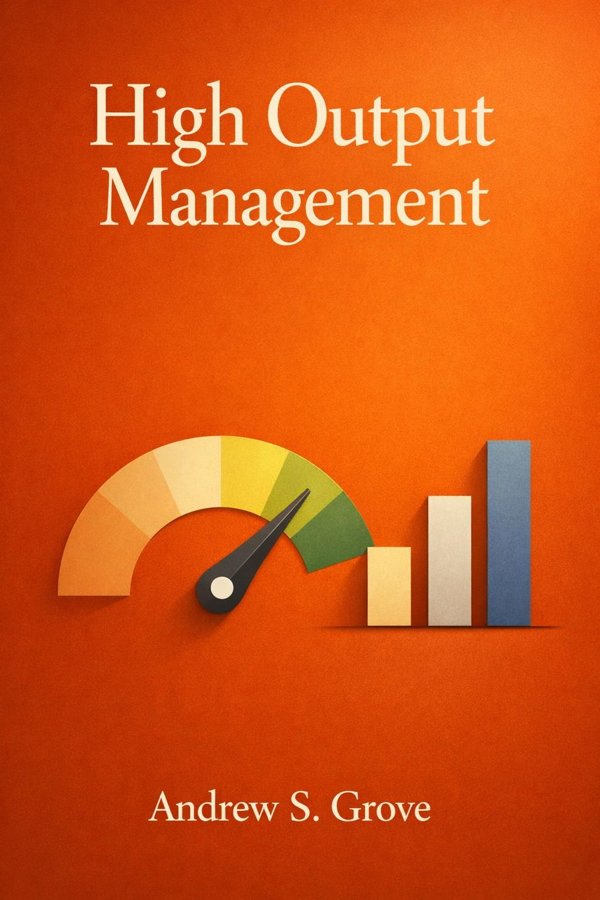
High Output Management: Summary & Key Insights
 10 min9 chaptersAudio available
Key Takeaways from High Output Management
A manager’s real job begins when work stops looking random and starts looking like a process.
The value of a manager is measured less by personal effort than by the results achieved through others.
You cannot improve output consistently if you do not know what output looks like.
A badly run meeting wastes collective energy, but a well-run meeting is one of a manager’s highest-leverage tools.
People are not motivated by pressure alone; they are energized when they can achieve, grow, and see the connection between effort and results.
What Is High Output Management About?
High Output Management by Andrew S. Grove is a leadership book spanning 6 pages. High Output Management is one of the most practical leadership books ever written because it treats management not as charisma, intuition, or abstract theory, but as a system that can be designed, measured, and improved. In this classic, Andrew S. Grove—former Intel CEO and one of the most respected operating leaders in business history—explains how managers create value by increasing the output of the people and teams around them. Rather than focusing on inspirational slogans, Grove shows how to run meetings, set performance indicators, train employees, make decisions, and build structures that scale. What makes the book endure is its blend of rigor and realism. Grove draws heavily on manufacturing logic, using clear analogies to show that work flows through processes, bottlenecks reduce performance, and managerial time must be invested where it creates the most leverage. His ideas are especially powerful because they apply far beyond factories: they work in startups, remote teams, product organizations, nonprofits, and large enterprises alike. If you want to become a more effective leader, build high-performing teams, and think in terms of measurable results, High Output Management remains an essential guide.
This FizzRead summary covers all 9 key chapters of High Output Management in approximately 10 minutes, distilling the most important ideas, arguments, and takeaways from Andrew S. Grove's work. Also available as an audio summary and Key Quotes Podcast.
High Output Management
High Output Management is one of the most practical leadership books ever written because it treats management not as charisma, intuition, or abstract theory, but as a system that can be designed, measured, and improved. In this classic, Andrew S. Grove—former Intel CEO and one of the most respected operating leaders in business history—explains how managers create value by increasing the output of the people and teams around them. Rather than focusing on inspirational slogans, Grove shows how to run meetings, set performance indicators, train employees, make decisions, and build structures that scale.
What makes the book endure is its blend of rigor and realism. Grove draws heavily on manufacturing logic, using clear analogies to show that work flows through processes, bottlenecks reduce performance, and managerial time must be invested where it creates the most leverage. His ideas are especially powerful because they apply far beyond factories: they work in startups, remote teams, product organizations, nonprofits, and large enterprises alike. If you want to become a more effective leader, build high-performing teams, and think in terms of measurable results, High Output Management remains an essential guide.
Who Should Read High Output Management?
This book is perfect for anyone interested in leadership and looking to gain actionable insights in a short read. Whether you're a student, professional, or lifelong learner, the key ideas from High Output Management by Andrew S. Grove will help you think differently.
- ✓Readers who enjoy leadership and want practical takeaways
- ✓Professionals looking to apply new ideas to their work and life
- ✓Anyone who wants the core insights of High Output Management in just 10 minutes
Want the full summary?
Get instant access to this book summary and 100K+ more with Fizz Moment.
Get Free SummaryAvailable on App Store • Free to download
Key Chapters
A manager’s real job begins when work stops looking random and starts looking like a process. Grove opens with his famous breakfast example because making a simple meal reveals something profound: output depends on inputs, sequence, quality standards, timing, and coordination. If toast is ready before eggs, quality drops. If one cook handles too many tasks, the whole system slows. The same is true in teams. Most performance problems are not caused by lazy people but by poorly designed workflows.
Grove encourages managers to think like production designers. Every team turns inputs into outputs: a sales team converts leads into revenue, a software team turns requirements into features, and a support team turns requests into resolved cases. Once you see work this way, you can identify bottlenecks, handoff failures, rework, and hidden delays. The point is not to make office work mechanical, but to make it visible. Visibility allows improvement.
A practical application is to map one recurring process in your team from beginning to end. For example, if product launches are often chaotic, break the process into stages: planning, design, engineering, QA, marketing, and release. Then ask where information gets lost, where approvals stall, and where quality breaks down. Small process fixes often create large gains.
Actionable takeaway: Choose one repeatable activity your team performs often, map its steps, identify the main bottleneck, and improve that point first rather than trying to optimize everything at once.
The value of a manager is measured less by personal effort than by the results achieved through others. That is Grove’s idea of managerial leverage, and it remains one of the book’s most powerful concepts. A manager has limited time, so the central question is always: which activities produce the greatest impact on organizational output? High-leverage work creates effects that spread through many people or persist over time.
Examples of high-leverage activities include making a key decision, designing a better process, hiring an excellent employee, coaching someone who then performs better for years, or running a meeting that aligns multiple teams. By contrast, low-leverage activities absorb time without changing outcomes much—unnecessary status updates, excessive approvals, and work the team could do without the manager. Grove does not say managers should be detached. He says they should intervene where their contribution changes the system.
This idea is especially relevant for leaders who feel overworked. Often, exhaustion is not the result of too much responsibility but of misallocated attention. A manager who spends hours solving routine problems may feel productive while actually reducing team capability. A better approach is to fix the conditions that cause those problems to recur.
Actionable takeaway: Audit your calendar for one week and classify every activity as high, medium, or low leverage. Then eliminate, delegate, or redesign at least two low-leverage commitments and reinvest that time into coaching, hiring, planning, or process improvement.
You cannot improve output consistently if you do not know what output looks like. Grove argues that managers need indicators the way pilots need instruments: not because they replace judgment, but because they make judgment more accurate. Performance indicators turn vague impressions into actionable information. They help managers detect trends early, compare expected and actual results, and intervene before a small issue becomes a serious breakdown.
Good indicators are not just lagging results like quarterly revenue or annual turnover. Grove emphasizes leading indicators as well—signals that predict future performance. In a sales organization, pipeline quality may matter more than revenue this month. In engineering, bug backlog, cycle time, and release stability may tell you more than hours worked. In customer support, resolution time, repeat contact rate, and customer satisfaction can reveal whether the team is improving or merely working harder.
Meetings play a central role here. Grove sees many meetings not as distractions but as necessary managerial tools when they are structured well. One-on-ones surface hidden issues, staff meetings spread operational information, and decision meetings create clarity. The problem is not meetings themselves; it is meetings without purpose, data, or follow-through.
Actionable takeaway: Define three to five indicators that best reflect your team’s output, review them regularly in a structured meeting, and pair every metric discussion with one concrete decision or next step so measurement leads to action.
A badly run meeting wastes collective energy, but a well-run meeting is one of a manager’s highest-leverage tools. Grove makes the counterintuitive point that meetings are not what prevent managers from doing their jobs; for managers, meetings are the job when they transfer information, make decisions, align priorities, and develop people. The mistake is to treat every gathering as equal. Different meetings serve different purposes, and each should be designed accordingly.
Grove distinguishes among one-on-ones, staff meetings, operational reviews, and decision-making sessions. One-on-ones are especially important because they allow employees to bring agenda items upward, not just receive instructions downward. They help managers understand what is really happening, discover obstacles early, and coach effectively. Staff meetings share information across a team, reducing silos. Operational reviews focus on performance data. Decision meetings exist to choose among alternatives and assign accountability.
For example, if a marketing team keeps revisiting the same campaign debate, the issue may not be disagreement but meeting design. A weekly sync will not solve a strategic decision. That requires a dedicated meeting with options, criteria, and a clear decider. Likewise, if a direct report appears disengaged, a proper one-on-one may reveal unclear expectations, lack of support, or blocked career growth.
Actionable takeaway: Review your recurring meetings and rewrite each one’s purpose in a single sentence. Remove any meeting without a clear role, and redesign the rest so attendees know whether the goal is information sharing, problem solving, coaching, or decision-making.
People are not motivated by pressure alone; they are energized when they can achieve, grow, and see the connection between effort and results. Grove rejects simplistic assumptions about human motivation. Compensation matters, but it is not enough. Managers must create conditions in which people understand expectations, believe performance is recognized, and feel capable of succeeding. Motivation is not a speech; it is a system.
Grove draws on theories of motivation and links them to management practice. If someone is underperforming, the problem may lie in one of several places: they may not know what good performance looks like, may not have the skills, may not have the resources, or may not believe better performance will lead to meaningful outcomes. This framework helps managers avoid lazy conclusions. Instead of saying an employee “doesn’t care,” a better manager diagnoses the cause.
Training is one of the most underrated tools in this system. Grove treats training not as an HR formality but as a central managerial responsibility. Every hour spent teaching a skill can produce many hours of improved output later. This applies equally to onboarding a new hire, teaching a junior manager how to run one-on-ones, or standardizing how a team handles incidents.
Actionable takeaway: The next time someone struggles, diagnose before judging. Ask: Is the issue clarity, skill, resources, or incentives? Then address the specific cause—especially through targeted training—rather than assuming motivation is the sole problem.
Great management is not rigid consistency; it is adapting your approach to the readiness of the person doing the work. Grove introduces the idea of task-relevant maturity, meaning an employee’s competence and confidence for a specific task. Someone may be highly capable in one area and inexperienced in another. That means a manager should not use the same style with everyone all the time.
When task-relevant maturity is low, people often need more structure, direction, and close follow-up. When it is high, they need autonomy, challenge, and trust. Trouble begins when managers mismatch style and situation. Micromanaging a highly capable employee creates frustration and slows execution. Giving complete freedom to someone who lacks context or skill leads to confusion and poor results. Effective management is therefore situational, not ideological.
This concept is especially useful in fast-growing companies where employees are constantly taking on new responsibilities. A strong engineer promoted into management may suddenly have low maturity in giving feedback, delegating, or hiring. Treating them as fully developed in every dimension is unfair and risky. The manager above them should temporarily provide more structure until competence grows.
Actionable takeaway: For each direct report, identify one key responsibility and assess their task-relevant maturity on that specific work. Then adjust your management style—more direction where maturity is low, more delegation where maturity is high—rather than managing everyone with the same default approach.
Many organizations suffer not from bad ideas but from vague decisions. Grove shows that decision-making is only useful when it produces clear action, ownership, and follow-through. Endless discussion feels thoughtful, yet without commitment it becomes a hidden form of indecision. Managers must create processes that help teams debate honestly, decide explicitly, and execute consistently.
One reason decisions fail is that groups confuse participation with consensus. It is often wise to gather many perspectives, especially from those closest to the work. But after input has been collected, someone must decide. Another reason is that decisions are announced without ensuring understanding. People may nod in a meeting while leaving with different interpretations of what was agreed. Grove’s operating discipline reduces this risk by insisting on specifics: what will be done, by whom, and by when.
A practical example is a product team choosing between shipping quickly and delaying for more testing. If the decision is left in vague language—“let’s be careful but move fast”—conflict will continue. A real decision would state the chosen priority, the acceptance criteria, the owner, and the review date. Clarity reduces friction because it transforms ambiguity into coordinated action.
Actionable takeaway: At the end of every important decision meeting, document the decision in plain language, assign a single owner, define the next milestone, and circulate the note quickly so there is no gap between discussion and execution.
As organizations grow, yesterday’s informal habits become today’s operational failures. Grove argues that management structures should evolve with the size, complexity, and speed of the business. What works for a ten-person startup—constant ad hoc communication, loosely defined roles, heroic effort—often breaks down at fifty or two hundred people. Growth demands structure, not as bureaucracy for its own sake, but as a way to preserve output and coordination.
This means clarifying reporting lines, decision rights, planning rhythms, and cross-functional interfaces. If nobody knows who owns pricing, customer onboarding, or technical quality, execution slows and conflicts multiply. Structure creates a framework within which talented people can move faster. The best structure is not the most elaborate one; it is the one that reduces confusion and supports performance.
Planning is part of this. Grove favors disciplined planning that connects strategy to operational reality. Plans should not be static documents forgotten after approval. They should help managers allocate resources, set priorities, and monitor whether assumptions remain valid. In volatile environments, the value of planning lies partly in forcing teams to think clearly before acting and to revisit assumptions when conditions change.
Actionable takeaway: If your team is growing or struggling with overlap, list the top five recurring decisions or responsibilities that cause confusion. Clarify ownership, communication paths, and review cadence for each one before adding more people or more process.
Culture is not built mainly through slogans on walls; it is shaped by what managers measure, reward, correct, and consistently model. Grove’s output-oriented philosophy leads to a powerful cultural insight: people learn what truly matters by observing how leaders spend time and what behavior gets reinforced. If leaders praise teamwork but reward individual heroics, the real culture favors heroics. If managers say quality matters but ignore recurring defects to hit deadlines, the culture learns that speed beats standards.
An output-oriented culture is not cold or purely numerical. It combines performance discipline with clarity, candor, and continuous improvement. Teams in such cultures understand the mission, know how success is measured, and are expected to confront problems directly rather than hide them. This creates trust because reality is discussable. It also creates adaptability because errors are treated as signals for learning, not merely occasions for blame.
Consider a customer service organization with rising complaints. A low-accountability culture might explain poor results away or shift blame between departments. An output-oriented culture would examine the process, identify where failures occur, review the data openly, and assign improvements without drama. Over time, this creates a norm of responsible problem solving.
Actionable takeaway: Identify one behavior your team says it values but does not consistently reinforce. Then change one management practice—such as what you review in meetings, celebrate publicly, or correct immediately—so daily behavior aligns with stated culture.
All Chapters in High Output Management
About the Author
Andrew S. Grove (1936–2016) was a Hungarian-American engineer, business executive, and influential management thinker. After surviving Nazi occupation and later fleeing communist Hungary, he immigrated to the United States, where he studied chemical engineering and eventually joined Intel in its early years. Grove became one of the key leaders behind the company’s rise, serving as president, CEO, and chairman. He was widely admired for his discipline, analytical mindset, and operational focus, which helped Intel become a dominant force in the semiconductor industry. Beyond his corporate achievements, Grove earned lasting respect as a writer on leadership, management, and strategy. His books, especially High Output Management and Only the Paranoid Survive, continue to shape how managers, founders, and executives think about execution, organizational performance, and leadership under pressure.
Get This Summary in Your Preferred Format
Read or listen to the High Output Management summary by Andrew S. Grove anytime, anywhere. FizzRead offers multiple formats so you can learn on your terms — all free.
Available formats: App · Audio · PDF · EPUB — All included free with FizzRead
Download High Output Management PDF and EPUB Summary
Key Quotes from High Output Management
“A manager’s real job begins when work stops looking random and starts looking like a process.”
“The value of a manager is measured less by personal effort than by the results achieved through others.”
“You cannot improve output consistently if you do not know what output looks like.”
“A badly run meeting wastes collective energy, but a well-run meeting is one of a manager’s highest-leverage tools.”
“People are not motivated by pressure alone; they are energized when they can achieve, grow, and see the connection between effort and results.”
Frequently Asked Questions about High Output Management
High Output Management by Andrew S. Grove is a leadership book that explores key ideas across 9 chapters. High Output Management is one of the most practical leadership books ever written because it treats management not as charisma, intuition, or abstract theory, but as a system that can be designed, measured, and improved. In this classic, Andrew S. Grove—former Intel CEO and one of the most respected operating leaders in business history—explains how managers create value by increasing the output of the people and teams around them. Rather than focusing on inspirational slogans, Grove shows how to run meetings, set performance indicators, train employees, make decisions, and build structures that scale. What makes the book endure is its blend of rigor and realism. Grove draws heavily on manufacturing logic, using clear analogies to show that work flows through processes, bottlenecks reduce performance, and managerial time must be invested where it creates the most leverage. His ideas are especially powerful because they apply far beyond factories: they work in startups, remote teams, product organizations, nonprofits, and large enterprises alike. If you want to become a more effective leader, build high-performing teams, and think in terms of measurable results, High Output Management remains an essential guide.
You Might Also Like

Extreme Ownership
Jocko Willink
10 min
Dare to Lead
Brene Brown
10 min
Leaders Eat Last
Simon Sinek
10 min
The 21 Irrefutable Laws of Leadership
John Maxwell
10 min
Start With Why
Simon Sinek
10 min
How to Lead When You're Not in Charge
Clay Scroggins
10 minBrowse by Category
Ready to read High Output Management?
Get the full summary and 100K+ more books with Fizz Moment.