
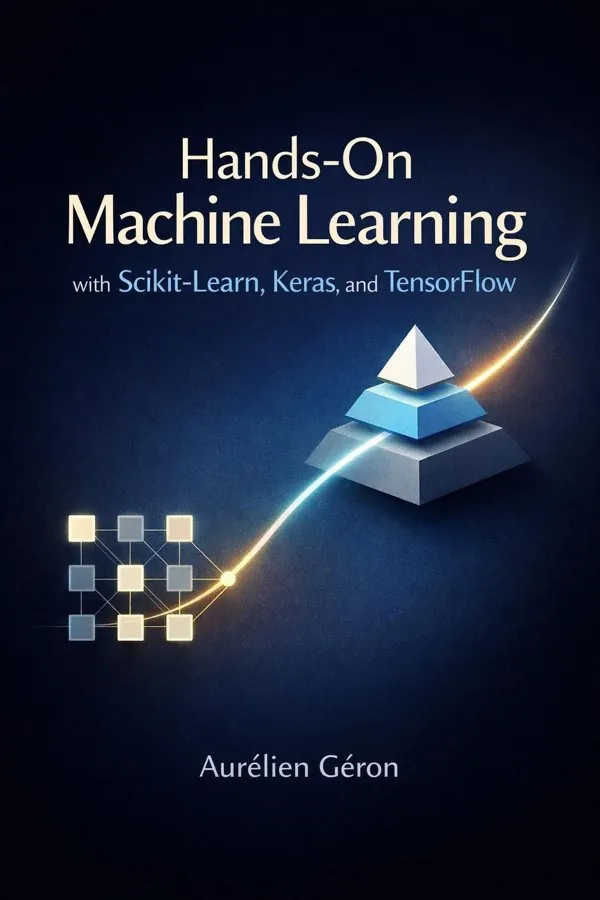
Hands-On Machine Learning with Scikit-Learn, Keras, and TensorFlow: Concepts, Tools, and Techniques to Build Intelligent Systems: Summary & Key Insights
 10 min5 chapters
What Is Hands-On Machine Learning with Scikit-Learn, Keras, and TensorFlow: Concepts, Tools, and Techniques to Build Intelligent Systems About?
Hands-On Machine Learning with Scikit-Learn, Keras, and TensorFlow: Concepts, Tools, and Techniques to Build Intelligent Systems by Aurélien Géron is a ai_ml book spanning 5 pages. Hands-On Machine Learning with Scikit-Learn, Keras, and TensorFlow is a practical guide that teaches readers how to build intelligent systems using Python’s most popular machine learning libraries. It covers fundamental concepts such as supervised and unsupervised learning, model evaluation, and deep learning architectures, providing step-by-step examples and exercises to help practitioners apply machine learning techniques effectively.
This FizzRead summary covers all 5 key chapters of Hands-On Machine Learning with Scikit-Learn, Keras, and TensorFlow: Concepts, Tools, and Techniques to Build Intelligent Systems in approximately 10 minutes, distilling the most important ideas, arguments, and takeaways from Aurélien Géron's work.
Hands-On Machine Learning with Scikit-Learn, Keras, and TensorFlow: Concepts, Tools, and Techniques to Build Intelligent Systems
Hands-On Machine Learning with Scikit-Learn, Keras, and TensorFlow is a practical guide that teaches readers how to build intelligent systems using Python’s most popular machine learning libraries. It covers fundamental concepts such as supervised and unsupervised learning, model evaluation, and deep learning architectures, providing step-by-step examples and exercises to help practitioners apply machine learning techniques effectively.
Who Should Read Hands-On Machine Learning with Scikit-Learn, Keras, and TensorFlow: Concepts, Tools, and Techniques to Build Intelligent Systems?
This book is perfect for anyone interested in ai_ml and looking to gain actionable insights in a short read. Whether you're a student, professional, or lifelong learner, the key ideas from Hands-On Machine Learning with Scikit-Learn, Keras, and TensorFlow: Concepts, Tools, and Techniques to Build Intelligent Systems by Aurélien Géron will help you think differently.
- ✓Readers who enjoy ai_ml and want practical takeaways
- ✓Professionals looking to apply new ideas to their work and life
- ✓Anyone who wants the core insights of Hands-On Machine Learning with Scikit-Learn, Keras, and TensorFlow: Concepts, Tools, and Techniques to Build Intelligent Systems in just 10 minutes
Want the full summary?
Get instant access to this book summary and 100K+ more with Fizz Moment.
Get Free SummaryAvailable on App Store • Free to download
Key Chapters
To begin, it’s essential to clarify what machine learning really means. At its core, machine learning is about enabling computers to improve their performance at a task through experience — that is, through data. Rather than programming a fixed set of rules, we provide algorithms that adjust parameters in response to examples, gradually discovering patterns that generalize beyond the training data.
In this first conceptual chapter, I introduce the three broad families of machine learning: supervised, unsupervised, and reinforcement learning. Supervised learning operates through labeled data — examples where the desired output is known, such as predicting house prices or classifying handwritten digits. The algorithms learn to map inputs to outputs by minimizing error over many examples. In contrast, unsupervised learning finds hidden patterns without explicit labels. Here, clustering and dimensionality reduction help us uncover structure, like grouping customers by behavior profiles. Reinforcement learning, the third paradigm, is closer to how we learn through trial and feedback: an agent interacts with an environment and learns policies that maximize rewards over time.
These categories are not isolated; real-world problems often combine them. For instance, a recommendation engine may cluster users (unsupervised) then predict ratings (supervised). I emphasize throughout that understanding these distinctions is crucial for choosing the right approach. More than knowing algorithms, you must learn to think about data as information in context: what is known, what can be inferred, and how feedback helps models evolve.
Beyond these definitions, I introduce the idea of generalization. A model’s true strength lies not in memorizing data, but in capturing underlying relationships that allow accurate predictions on unseen samples. Achieving this balance — between fitting and generalizing — is the heart of machine learning. You’ll revisit this concept repeatedly as we explore bias-variance trade-offs, cross-validation, and regularization.
A common misconception is that machine learning starts with model selection. In truth, it starts with problem definition and data understanding. In this section, I walk through the complete project workflow as practiced in real environments. Every ML pipeline begins with collecting relevant data — structured or unstructured — and exploring its characteristics. Through visualizations and statistical summaries, we identify trends, distributions, and possible issues.
Data preparation is the most time-consuming, yet most critical stage. Missing values, inconsistent types, and irrelevant attributes can distort model performance. Using Python’s pandas and Scikit-Learn preprocessing utilities, you learn to impute missing data, scale features to comparable ranges, and encode categorical variables. I emphasize that good preprocessing is not glamorous, but it is the secret to stability and reliable performance.
Once your data is ready, the workflow proceeds to model selection and training. Here, I guide you through a cycle that includes splitting data into training and test sets, performing cross-validation, and evaluating predictions with suitable metrics. The process is iterative: results are not final on first try. By adjusting hyperparameters and revisiting feature engineering, you refine performance incrementally.
Importantly, we also discuss the ethical responsibility of data usage. Your choices about which features to include, how to sample data, and how to evaluate outcomes have direct implications on fairness and interpretability. A machine learning model is an approximation of reality — never neutral, never perfect — and understanding its limitations is integral to deploying it responsibly.
The goal of this section is to help you adopt a disciplined project mindset. Every model, no matter how sophisticated, depends on the rigor of its preparation pipeline. Master this workflow, and every future project becomes a manageable, repeatable process.
+ 3 more chapters — available in the FizzRead app
All Chapters in Hands-On Machine Learning with Scikit-Learn, Keras, and TensorFlow: Concepts, Tools, and Techniques to Build Intelligent Systems
About the Author
Aurélien Géron is a machine learning consultant and former lead of the YouTube video classification team at Google. He specializes in applied machine learning and artificial intelligence, and has extensive experience in software engineering and data science.
Get This Summary in Your Preferred Format
Read or listen to the Hands-On Machine Learning with Scikit-Learn, Keras, and TensorFlow: Concepts, Tools, and Techniques to Build Intelligent Systems summary by Aurélien Géron anytime, anywhere. FizzRead offers multiple formats so you can learn on your terms — all free.
Available formats: App · Audio · PDF · EPUB — All included free with FizzRead
Download Hands-On Machine Learning with Scikit-Learn, Keras, and TensorFlow: Concepts, Tools, and Techniques to Build Intelligent Systems PDF and EPUB Summary
Key Quotes from Hands-On Machine Learning with Scikit-Learn, Keras, and TensorFlow: Concepts, Tools, and Techniques to Build Intelligent Systems
“To begin, it’s essential to clarify what machine learning really means.”
“A common misconception is that machine learning starts with model selection.”
Frequently Asked Questions about Hands-On Machine Learning with Scikit-Learn, Keras, and TensorFlow: Concepts, Tools, and Techniques to Build Intelligent Systems
Hands-On Machine Learning with Scikit-Learn, Keras, and TensorFlow: Concepts, Tools, and Techniques to Build Intelligent Systems by Aurélien Géron is a ai_ml book that explores key ideas across 5 chapters. Hands-On Machine Learning with Scikit-Learn, Keras, and TensorFlow is a practical guide that teaches readers how to build intelligent systems using Python’s most popular machine learning libraries. It covers fundamental concepts such as supervised and unsupervised learning, model evaluation, and deep learning architectures, providing step-by-step examples and exercises to help practitioners apply machine learning techniques effectively.
More by Aurélien Géron
You Might Also Like
Life 3.0
Max Tegmark
10 min
Superintelligence
Nick Bostrom
10 min
TensorFlow in Action
Thushan Ganegedara
10 min
AI Made Simple: A Beginner’s Guide to Generative AI, ChatGPT, and the Future of Work
Rajeev Kapur
10 min
AI Snake Oil
Arvind Narayanan, Sayash Kapoor
10 min
AI Superpowers: China, Silicon Valley, and the New World Order
Kai-Fu Lee
10 minBrowse by Category
Ready to read Hands-On Machine Learning with Scikit-Learn, Keras, and TensorFlow: Concepts, Tools, and Techniques to Build Intelligent Systems?
Get the full summary and 100K+ more books with Fizz Moment.