
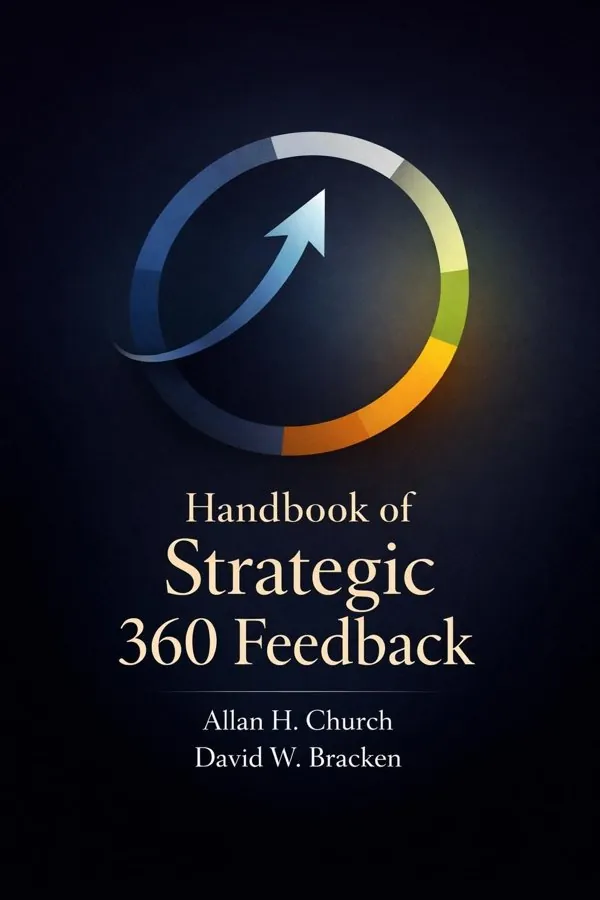
Handbook of Strategic 360 Feedback: Summary & Key Insights
by Allan H. Church, David W. Bracken
 10 min9 chaptersAudio available
Key Takeaways from Handbook of Strategic 360 Feedback
The most important shift in 360 feedback is this: it is no longer just about helping one manager “learn something useful” about themselves.
Feedback becomes credible when it reflects patterns, not isolated opinions.
A 360 process succeeds or fails long before anyone sees a report.
Data does not create change; meaning does.
Most feedback fades because insight alone rarely changes behavior.
What Is Handbook of Strategic 360 Feedback About?
Handbook of Strategic 360 Feedback by Allan H. Church, David W. Bracken is a leadership book spanning 6 pages. Most leaders think they know how they are perceived—until a well-designed 360 feedback process shows them the gap between intention and impact. Handbook of Strategic 360 Feedback explains how organizations can use multi-rater feedback not merely as a development exercise, but as a strategic system that strengthens leadership, aligns behavior with business goals, and improves talent decisions. Rather than treating feedback as a one-off survey, the book shows how 360 processes can be tied to culture, succession planning, coaching, and long-term organizational change. What makes this handbook especially valuable is its blend of research, practical guidance, and real-world experience. Allan H. Church and David W. Bracken are respected voices in organizational psychology and leadership assessment, with deep expertise in how feedback systems succeed—or fail—inside complex companies. Their perspective moves beyond theory to address difficult implementation questions: what to measure, who should rate, how to ensure credibility, how to support recipients, and how to convert ratings into sustained growth. For HR leaders, coaches, executives, and anyone building stronger leadership pipelines, this book offers a rigorous and highly usable roadmap.
This FizzRead summary covers all 9 key chapters of Handbook of Strategic 360 Feedback in approximately 10 minutes, distilling the most important ideas, arguments, and takeaways from Allan H. Church, David W. Bracken's work. Also available as an audio summary and Key Quotes Podcast.
Handbook of Strategic 360 Feedback
Most leaders think they know how they are perceived—until a well-designed 360 feedback process shows them the gap between intention and impact. Handbook of Strategic 360 Feedback explains how organizations can use multi-rater feedback not merely as a development exercise, but as a strategic system that strengthens leadership, aligns behavior with business goals, and improves talent decisions. Rather than treating feedback as a one-off survey, the book shows how 360 processes can be tied to culture, succession planning, coaching, and long-term organizational change.
What makes this handbook especially valuable is its blend of research, practical guidance, and real-world experience. Allan H. Church and David W. Bracken are respected voices in organizational psychology and leadership assessment, with deep expertise in how feedback systems succeed—or fail—inside complex companies. Their perspective moves beyond theory to address difficult implementation questions: what to measure, who should rate, how to ensure credibility, how to support recipients, and how to convert ratings into sustained growth. For HR leaders, coaches, executives, and anyone building stronger leadership pipelines, this book offers a rigorous and highly usable roadmap.
Who Should Read Handbook of Strategic 360 Feedback?
This book is perfect for anyone interested in leadership and looking to gain actionable insights in a short read. Whether you're a student, professional, or lifelong learner, the key ideas from Handbook of Strategic 360 Feedback by Allan H. Church, David W. Bracken will help you think differently.
- ✓Readers who enjoy leadership and want practical takeaways
- ✓Professionals looking to apply new ideas to their work and life
- ✓Anyone who wants the core insights of Handbook of Strategic 360 Feedback in just 10 minutes
Want the full summary?
Get instant access to this book summary and 100K+ more with Fizz Moment.
Get Free SummaryAvailable on App Store • Free to download
Key Chapters
The most important shift in 360 feedback is this: it is no longer just about helping one manager “learn something useful” about themselves. In high-performing organizations, 360 feedback becomes a strategic mechanism for defining what leadership looks like, reinforcing culture, and guiding development investments. That evolution is one of the book’s central contributions.
Early 360 programs were often narrow in scope. Leaders received anonymous feedback from bosses, peers, and direct reports, then reviewed the report privately. The primary goal was self-awareness. While valuable, that limited view underestimated the broader organizational potential of the method. Church and Bracken show that 360 feedback becomes far more powerful when it is linked to strategy. If a company says it values collaboration, innovation, inclusion, or customer focus, then its feedback system should measure those capabilities and hold leaders accountable for demonstrating them.
This strategic framing changes everything. Competencies are no longer generic; they are tailored to the business model and leadership expectations. Reports are no longer isolated documents; they become inputs for coaching, succession planning, and development programs. Participation is no longer optional symbolism; it is part of how the organization learns what effective leadership actually looks like in practice.
Imagine a company undergoing digital transformation. It cannot rely only on financial targets to judge leadership. It also needs leaders who empower teams, adapt quickly, communicate change, and work across silos. A strategic 360 process can assess those behaviors directly and reveal where the leadership bench is strong or weak.
Actionable takeaway: Before launching a 360 process, define exactly which strategic priorities it is meant to support, and build the feedback model around those priorities rather than around generic leadership traits.
Feedback becomes credible when it reflects patterns, not isolated opinions. One reason 360 feedback has endured is that it rests on a strong foundation of psychological theory and empirical evidence rather than on management fashion alone. The book explains that people behave differently across relationships and situations, so relying on a single evaluator—usually the boss—creates a narrow and sometimes distorted picture.
A manager may appear decisive to senior leaders but dismissive to direct reports. A peer may experience someone as collaborative, while another sees territorial behavior. These differences are not noise to be ignored; they are meaningful data about how leadership is experienced from multiple vantage points. Multi-rater systems work because they capture these perspectives systematically.
The authors also emphasize that self-ratings matter. One of the most powerful insights in 360 feedback comes from comparing how people see themselves with how others see them. Overrating oneself may signal blind spots, while underrating may reflect insecurity or excessive humility. Neither pattern is trivial. Both affect development, confidence, and effectiveness.
Research supports several benefits when 360 feedback is properly designed: increased self-awareness, stronger development planning, more targeted coaching, and better alignment between leadership behavior and organizational expectations. However, the phrase “properly designed” is crucial. Weak items, poor rater selection, lack of confidentiality, or no follow-up can quickly undermine trust and usefulness.
Consider a senior leader who receives consistently low ratings on listening from peers and direct reports, while rating themselves highly. That discrepancy provides a precise development target. A coach can then test specific behaviors: asking more open questions, pausing before responding, and summarizing others’ ideas.
Actionable takeaway: Treat 360 results as patterns of perception with diagnostic value, and pay special attention to gaps between self-ratings and others’ ratings.
A 360 process succeeds or fails long before anyone sees a report. Its true fate is decided in design. Church and Bracken make clear that strategic impact does not come from simply buying a survey platform and emailing questionnaires. It comes from disciplined choices about competencies, rating scales, rater groups, administration, and purpose.
The first design question is what to measure. Many organizations overload surveys with broad, vague, or trendy competencies. That creates fatigue and weakens interpretability. Effective systems focus on behaviors people can actually observe, such as giving clear direction, involving others in decisions, handling conflict constructively, or following through on commitments. Observable behaviors produce more reliable ratings and more actionable feedback.
The second issue is audience and purpose. A development-focused 360 should be built differently from a process tied to talent decisions. If participants fear the data will be used punitively, they may game the system, and raters may become less honest. The book stresses that clarity around purpose is essential to both ethics and usefulness.
Rater selection is equally important. Too few raters create unstable data; the wrong raters produce biased results. A balanced mix of manager, peers, direct reports, and sometimes customers offers the richest perspective. Confidentiality also matters deeply. People provide more candid feedback when they trust that individual responses cannot be traced back to them.
For example, if an organization wants to evaluate inclusive leadership, it must define it behaviorally: inviting dissenting views, distributing opportunities fairly, and responding respectfully across differences. These items will yield far more useful feedback than a generic prompt like “is inclusive.”
Actionable takeaway: Build your 360 around a short set of observable, strategically relevant behaviors, and make the purpose, rater model, and confidentiality rules explicit from the start.
Data does not create change; meaning does. One of the most overlooked truths about 360 feedback is that a report full of graphs and averages is not development in itself. Without careful interpretation, recipients may fixate on one low score, dismiss criticism as unfair, or fail to identify the few issues that matter most.
The handbook shows that interpretation should focus on patterns across rater groups, consistency across items, and the gap between strengths and priorities. Numbers only become useful when they answer practical questions: What do others rely on me for? Where is my impact falling short? Which behavior, if improved, would have the biggest effect on team performance?
The emotional side of interpretation is just as important as the analytical side. Feedback can trigger defensiveness, embarrassment, relief, or confusion. Skilled debriefing helps leaders move beyond emotional reaction into reflective learning. Rather than debating every item, they can ask: What themes keep repeating? Which comments surprise me? What would my strongest critics and strongest supporters both agree on?
Written comments often add nuance that scores cannot capture. A rating may indicate that a leader is weak on empowerment, but comments reveal whether the issue is micromanagement, unclear delegation, or lack of trust in the team. That distinction matters because development actions will differ.
Imagine a director who scores moderately well overall but receives consistently lower marks from direct reports on communication and recognition. The headline is not “average leader.” The real insight is that upward communication may be undermining morale and engagement. A focused development plan becomes possible once that pattern is recognized.
Actionable takeaway: Review 360 feedback thematically, not defensively—identify two or three repeating patterns, and translate each into a specific behavior change goal.
Most feedback fades because insight alone rarely changes behavior. People may understand what others are telling them and still return to old habits within days. The book therefore emphasizes coaching as a critical bridge between awareness and sustained improvement.
A good coach does more than explain the report. They help the recipient process emotions, challenge rationalizations, prioritize issues, and convert broad findings into concrete experiments. If the report says a leader is low on collaboration, the coach asks what that looks like in meetings, decision-making, and stakeholder relationships. If the report suggests weak delegation, the coach works with the leader to identify which tasks they can release, how they will clarify expectations, and how they will avoid taking work back too quickly.
Coaching also supports accountability. Many 360 programs fail because people receive the report and then move on. When coaching is built into the process, feedback becomes part of a development cycle: reflect, plan, act, review, and adjust. This is especially important for senior leaders, whose habits are deeply embedded and whose behavior influences large systems.
Practical follow-through might include monthly check-ins, stakeholder interviews, or “feedforward” conversations where the leader asks colleagues for suggestions on future behavior rather than explanations of past weaknesses. A leader working on listening, for instance, might commit to speaking last in key meetings, summarizing others’ views before responding, and requesting feedback after each major discussion.
The authors’ broader point is simple: 360 feedback should launch development, not conclude it. Coaching is what helps leaders convert static data into living practice.
Actionable takeaway: Never treat a 360 report as the finish line; pair it with structured coaching and a 60- to 90-day behavior plan tied to real workplace situations.
A standalone feedback tool may help individuals, but an integrated feedback system helps the whole organization learn. One of the strongest themes in the handbook is that 360 feedback delivers its greatest value when embedded within broader talent and leadership processes.
Integration means linking feedback to leadership models, development programs, succession planning, high-potential identification, onboarding, and culture initiatives. When the same leadership expectations appear across these systems, the organization sends a coherent message about what matters. Employees are not left guessing whether collaboration, integrity, or coaching others are truly valued. The feedback process makes those expectations visible and measurable.
This integration also enables smarter investment. If aggregated 360 data shows that mid-level leaders across the business are weak in strategic thinking or cross-functional influence, learning teams can design targeted development offerings rather than generic programs. If executives score highly on results but poorly on talent development, that becomes an organizational signal, not just an individual issue.
At the same time, the authors warn against careless integration. If development-oriented 360 data is suddenly repurposed for compensation or performance ratings, trust can collapse. People need to know which data is confidential, which may be aggregated, and how results will and will not be used. Strategic integration requires governance, transparency, and consistency.
For example, a company undergoing rapid global growth might use aggregate 360 findings to identify a widespread need for stronger cultural agility and team leadership across regions. That insight can then shape enterprise learning priorities and succession criteria.
Actionable takeaway: Connect 360 feedback to your broader leadership architecture, but define usage boundaries clearly so participants trust the process and the organization gains meaningful talent insights.
The technical quality of a 360 process matters, but the moral quality matters too. People participate honestly only when they believe the system is fair, confidential, and intended to help rather than punish. The handbook repeatedly underscores that credibility is as much an ethical issue as a methodological one.
Confidentiality is central. Direct reports and peers are more likely to offer candid feedback when they know their ratings will be grouped and anonymized. If they suspect retaliation or identification, they may inflate scores or avoid participation altogether. Likewise, recipients need confidence that results will not be used in ways they were not told about. Hidden agendas destroy trust quickly.
Fairness also involves equal standards and cultural sensitivity. A competency model designed for one context may not translate cleanly to another. Behaviors seen as assertive in one culture may be perceived as abrasive in another; deference in one context may be interpreted as passivity elsewhere. Strategic 360 systems must be alert to such differences to avoid misleading conclusions.
Bias is another concern. Gender stereotypes, halo effects, recency effects, and political dynamics can influence ratings. The goal is not to pretend bias can be eliminated entirely, but to design systems that reduce it through clear behavioral items, enough raters, strong instructions, and thoughtful interpretation.
Consider a leader who receives mixed feedback after a contentious restructuring. Some ratings may reflect actual shortcomings, while others may reflect resentment about the decision itself. A skilled process acknowledges context rather than accepting every number at face value.
Actionable takeaway: Protect confidentiality, communicate usage rules clearly, and review results with an eye to context and bias so the process remains trusted, fair, and developmentally useful.
The same feedback process can inspire growth in one organization and create anxiety in another. Why? Because culture determines how feedback is given, received, and acted upon. Church and Bracken show that 360 feedback is never culturally neutral; it enters a living environment shaped by trust, hierarchy, openness, and prior experience.
In a feedback-rich culture, people are accustomed to candid conversations, managers discuss development regularly, and errors are treated as learning opportunities. In such settings, 360 feedback often feels like a natural extension of existing practice. In low-trust cultures, however, employees may fear hidden motives, ratings may be politicized, and recipients may avoid honest reflection.
Hierarchy also matters. In organizations with strong power distance, direct reports may hesitate to rate senior leaders honestly, even if anonymity is promised. Similarly, in fast-moving, results-obsessed cultures, leaders may value strengths tied to delivery while dismissing relationship-oriented feedback as secondary—even when those relational issues are damaging retention and collaboration.
This means implementation cannot be copy-pasted. A company with little feedback maturity may need to begin with pilot programs, manager education, and coaching support before attempting enterprise-wide adoption. Communication should address not just logistics but purpose: why the organization is doing this, how it supports growth, and what participants can expect.
For example, a newly merged company might use 360 feedback to build a common leadership language, but only after creating enough psychological safety that employees believe their input will be respected rather than weaponized.
Actionable takeaway: Assess your organization’s feedback culture before launch, and adapt communication, rollout, and support mechanisms to the level of trust and openness that actually exists.
The future of 360 feedback is not bigger surveys—it is sharper, more agile insight. The handbook points toward an evolution in which feedback systems become more integrated, technology-enabled, and continuous while still preserving rigor and human judgment.
Traditional 360 programs often happen annually or even less often, producing a large report that can quickly feel outdated. As organizations move faster, leaders need development data that is timelier and more connected to current priorities. This does not necessarily mean constant formal surveying, but it does mean blending structured assessments with ongoing feedback, pulse tools, coaching conversations, and development analytics.
Technology expands what is possible. Digital platforms can simplify administration, improve reporting, and generate tailored development suggestions. Aggregate dashboards can help organizations spot enterprise trends without exposing individual confidentiality. At the same time, the authors’ logic reminds us that sophistication in tools does not replace sound design. A bad model delivered through elegant software is still a bad model.
Another future direction is stronger linkage between feedback and measurable outcomes. Organizations increasingly want to know whether improvements in leadership behavior connect to engagement, retention, customer experience, team effectiveness, or business performance. Strategic 360 systems are well positioned to support that inquiry when implemented thoughtfully.
Imagine a company using periodic mini-assessments after major development interventions, allowing leaders to track progress in coaching, inclusion, or change leadership over time. That makes feedback less of an event and more of a developmental rhythm.
Actionable takeaway: Modernize 360 feedback by making it more continuous, technology-supported, and outcome-linked—but preserve the essentials of behavioral clarity, confidentiality, and skilled interpretation.
All Chapters in Handbook of Strategic 360 Feedback
About the Authors
Allan H. Church and David W. Bracken are leading authorities in the fields of organizational psychology, leadership assessment, and talent management. Allan H. Church is widely known for his work as a senior HR executive, consultant, and scholar focused on executive assessment, organizational development, and strategic talent practices. David W. Bracken is an industrial-organizational psychologist recognized for his influential contributions to 360-degree feedback, performance management, and leadership measurement. Together, they combine deep research knowledge with extensive real-world experience helping organizations design feedback systems that are both scientifically sound and practically effective. Their work has shaped how many companies think about leadership development, multi-rater assessment, and the strategic use of feedback in complex organizational settings.
Get This Summary in Your Preferred Format
Read or listen to the Handbook of Strategic 360 Feedback summary by Allan H. Church, David W. Bracken anytime, anywhere. FizzRead offers multiple formats so you can learn on your terms — all free.
Available formats: App · Audio · PDF · EPUB — All included free with FizzRead
Download Handbook of Strategic 360 Feedback PDF and EPUB Summary
Key Quotes from Handbook of Strategic 360 Feedback
“The most important shift in 360 feedback is this: it is no longer just about helping one manager “learn something useful” about themselves.”
“Feedback becomes credible when it reflects patterns, not isolated opinions.”
“A 360 process succeeds or fails long before anyone sees a report.”
“Data does not create change; meaning does.”
“Most feedback fades because insight alone rarely changes behavior.”
Frequently Asked Questions about Handbook of Strategic 360 Feedback
Handbook of Strategic 360 Feedback by Allan H. Church, David W. Bracken is a leadership book that explores key ideas across 9 chapters. Most leaders think they know how they are perceived—until a well-designed 360 feedback process shows them the gap between intention and impact. Handbook of Strategic 360 Feedback explains how organizations can use multi-rater feedback not merely as a development exercise, but as a strategic system that strengthens leadership, aligns behavior with business goals, and improves talent decisions. Rather than treating feedback as a one-off survey, the book shows how 360 processes can be tied to culture, succession planning, coaching, and long-term organizational change. What makes this handbook especially valuable is its blend of research, practical guidance, and real-world experience. Allan H. Church and David W. Bracken are respected voices in organizational psychology and leadership assessment, with deep expertise in how feedback systems succeed—or fail—inside complex companies. Their perspective moves beyond theory to address difficult implementation questions: what to measure, who should rate, how to ensure credibility, how to support recipients, and how to convert ratings into sustained growth. For HR leaders, coaches, executives, and anyone building stronger leadership pipelines, this book offers a rigorous and highly usable roadmap.
You Might Also Like

Extreme Ownership
Jocko Willink
10 min
Dare to Lead
Brene Brown
10 min
Leaders Eat Last
Simon Sinek
10 min
The 21 Irrefutable Laws of Leadership
John Maxwell
10 min
Start With Why
Simon Sinek
10 min
How to Lead When You're Not in Charge
Clay Scroggins
10 minBrowse by Category
Ready to read Handbook of Strategic 360 Feedback?
Get the full summary and 100K+ more books with Fizz Moment.