
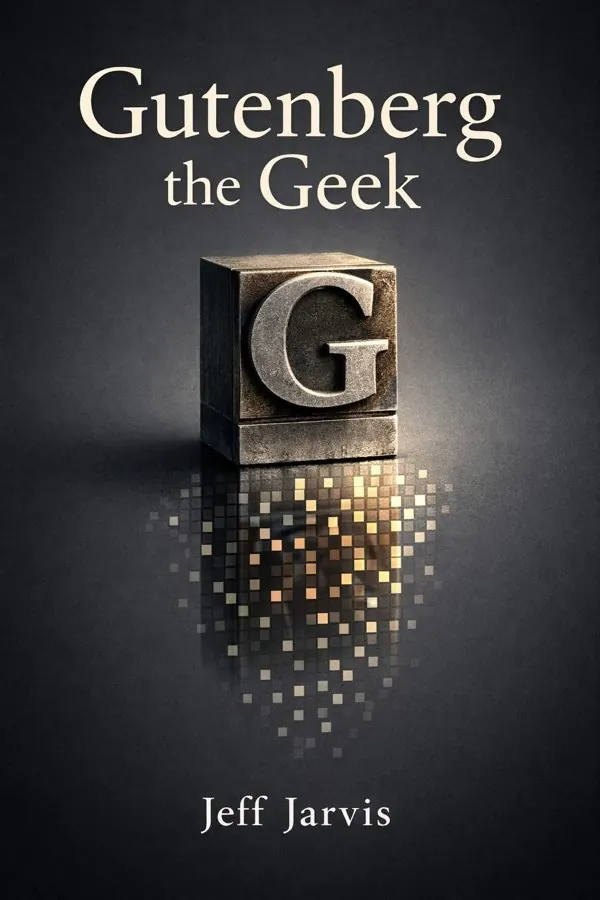
Gutenberg the Geek: Summary & Key Insights
by Jeff Jarvis
 10 min4 chaptersAudio available
What Is Gutenberg the Geek About?
Gutenberg the Geek by Jeff Jarvis is a digital_culture book spanning 4 pages. In this essay, Jeff Jarvis explores Johannes Gutenberg not merely as the inventor of the printing press but as the first true technology entrepreneur. Jarvis draws parallels between Gutenberg’s disruptive innovation and the modern digital revolution, arguing that Gutenberg’s struggles and triumphs mirror those of today’s tech pioneers. The work reflects on how technological change reshapes society, communication, and business models.
This FizzRead summary covers all 4 key chapters of Gutenberg the Geek in approximately 10 minutes, distilling the most important ideas, arguments, and takeaways from Jeff Jarvis's work. Also available as an audio summary and Key Quotes Podcast.
Gutenberg the Geek
In this essay, Jeff Jarvis explores Johannes Gutenberg not merely as the inventor of the printing press but as the first true technology entrepreneur. Jarvis draws parallels between Gutenberg’s disruptive innovation and the modern digital revolution, arguing that Gutenberg’s struggles and triumphs mirror those of today’s tech pioneers. The work reflects on how technological change reshapes society, communication, and business models.
Who Should Read Gutenberg the Geek?
This book is perfect for anyone interested in digital_culture and looking to gain actionable insights in a short read. Whether you're a student, professional, or lifelong learner, the key ideas from Gutenberg the Geek by Jeff Jarvis will help you think differently.
- ✓Readers who enjoy digital_culture and want practical takeaways
- ✓Professionals looking to apply new ideas to their work and life
- ✓Anyone who wants the core insights of Gutenberg the Geek in just 10 minutes
Want the full summary?
Get instant access to this book summary and 100K+ more with Fizz Moment.
Get Free SummaryAvailable on App Store • Free to download
Key Chapters
To understand Gutenberg’s leap, we must step into the fragmented and uncertain world of 15th-century Europe—a place defined by trade guilds, religious authority, and a hunger for knowledge restrained by scarcity. Books were rare objects, copied painstakingly by monks on parchment, accessible only to the elite. Knowledge was power, and that power was centralized. Into this world walked Johann Gutenberg, a goldsmith by training and a dreamer by temperament. He didn’t invent printing from scratch; people had pressed words and images before. What he invented was a scalable system—a technology stack, in today’s terms—that combined mechanical precision with mass replication.
His movable type was more than a set of letters. It was a software-like interface allowing infinite combinations. He designed durable metal alloys, formulated inks of the right viscosity, and devised presses that could handle the stress of repeated impressions. He solved complex production problems—the kind that every modern engineer or coder would recognize as debugging, iteration, and prototyping. The Gutenberg Bible wasn’t just a masterpiece of design; it was a proof of concept, the public launch of a platform that could disrupt everything.
The innovation lay not just in the device but in the mindset. Gutenberg understood scalability before the term existed. He saw how the mechanical multiplication of words could change business, religion, and education. Just as startup founders today imagine platforms that connect billions, Gutenberg imagined books that could connect minds beyond walls and borders. His workshop was his startup incubator; his investors, often skeptical merchants; his risk, total personal bankruptcy. What he built was the 15th-century equivalent of a tech startup attempting the impossible—creating information abundance in a world structured around its scarcity.
I see his process as a metaphor for the broader rhythm of innovation. Every new technology emerges at the intersection of creativity and crisis. Gutenberg’s moment was shaped by social hunger for knowledge and dissatisfaction with authority. He met that moment not as a monk but as a maker—a creator who believed technology could make society freer. In doing so, he prefigured our digital revolution. His press was the first network, his printed Bible the first viral content, his ambition the first entrepreneurial moonshot.
The romantic notion of the lone genius often hides the brutal truth of innovation: it is hard, it is lonely, and it is expensive. Gutenberg’s path was littered with every kind of entrepreneurial struggle. He faced funding shortages, legal disputes, and betrayal from partners—particularly Johann Fust, who invested in the press but ultimately seized control of the venture. Gutenberg’s workshop was not a palace of prosperity but a crucible of debt and pressure. He experimented ceaselessly, refining alloys, adjusting presses, testing inks. To finance his dreams, he borrowed heavily, mortgaging not just his property but his dignity. When the press finally proved viable, he lost it to creditors.
Yet this failure, viewed through the lens of today’s startup culture, was not the end but the prototype of entrepreneurial persistence. Gutenberg dared to build without any guarantee of success, just like today’s founders risking everything for an idea. His drive was fueled not by profit alone but by conviction. He saw the potential of his invention to reshape humanity’s way of knowing. In those dimly lit workshops and through those bitter legal struggles lay the seed of every modern narrative of disruption—risk, iteration, failure, recovery. Every entrepreneur who has watched a prototype crash, who has bootstrapped their dream against public indifference, would recognize Gutenberg’s plight.
He encountered what I call the Innovator’s Paradox: technological change creates value but destroys existing structures—even the innovator’s own stability. By rupturing the old system of manuscript production, Gutenberg triggered a revolution that financial institutions, religious powers, and political authorities could not yet grasp. His downfall speaks to a universal truth: the act of invention always comes at a price. Like modern entrepreneurs, he changed the world but could not control the direction it took afterward.
And still, his legacy is irreversible. The press rolled forward, the idea escaped its maker, knowledge multiplied. Gutenberg’s life reminds us that technological progress does not wait for perfect conditions—it demands their creation through persistence. We learn from him that every revolutionary technology must pass through the crucible of failure, and that true innovation lies less in possession than in contribution.
+ 2 more chapters — available in the FizzRead app
All Chapters in Gutenberg the Geek
About the Author
Jeff Jarvis is an American journalist, professor, and media commentator known for his work on the future of news and digital media. He teaches journalism at the City University of New York and is the author of several books on technology and media innovation, including 'Public Parts' and 'What Would Google Do?'.
Get This Summary in Your Preferred Format
Read or listen to the Gutenberg the Geek summary by Jeff Jarvis anytime, anywhere. FizzRead offers multiple formats so you can learn on your terms — all free.
Available formats: App · Audio · PDF · EPUB — All included free with FizzRead
Download Gutenberg the Geek PDF and EPUB Summary
Key Quotes from Gutenberg the Geek
“Books were rare objects, copied painstakingly by monks on parchment, accessible only to the elite.”
“The romantic notion of the lone genius often hides the brutal truth of innovation: it is hard, it is lonely, and it is expensive.”
Frequently Asked Questions about Gutenberg the Geek
Gutenberg the Geek by Jeff Jarvis is a digital_culture book that explores key ideas across 4 chapters. In this essay, Jeff Jarvis explores Johannes Gutenberg not merely as the inventor of the printing press but as the first true technology entrepreneur. Jarvis draws parallels between Gutenberg’s disruptive innovation and the modern digital revolution, arguing that Gutenberg’s struggles and triumphs mirror those of today’s tech pioneers. The work reflects on how technological change reshapes society, communication, and business models.
More by Jeff Jarvis

You Might Also Like
An Ugly Truth: Inside Facebook’s Battle for Domination
Sheera Frenkel, Cecilia Kang
10 min
Cyber Citizens
Ian Goodfellow
10 min
Digital Minimalism: Choosing a Focused Life in a Noisy World
Cal Newport
10 min
E‑Books & Beyond
Various Authors
10 min
The Future of Media
Various Authors
10 min
This Is Why We Can't Have Nice Things
Whitney Phillips
10 minBrowse by Category
Ready to read Gutenberg the Geek?
Get the full summary and 100K+ more books with Fizz Moment.