
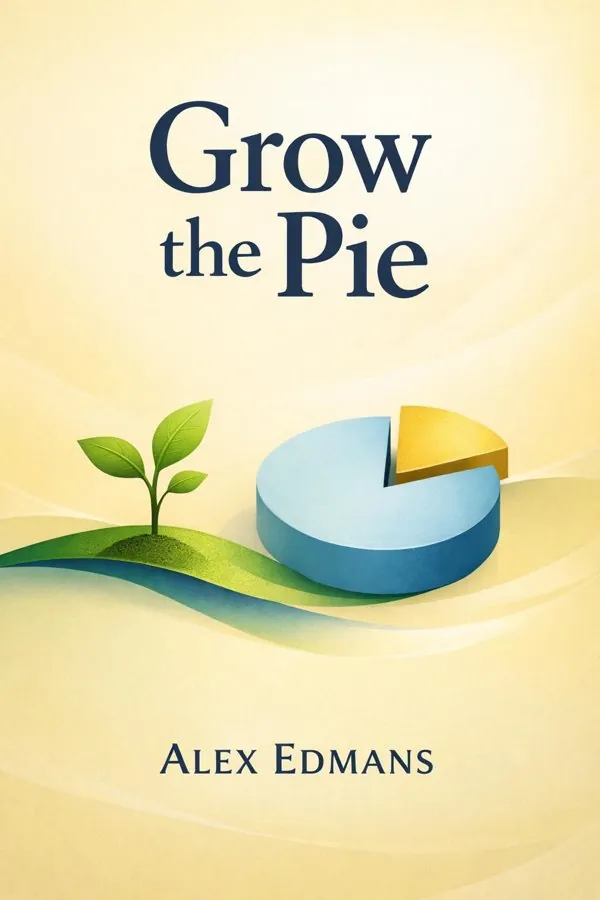
Grow the Pie: How Great Companies Deliver Both Purpose and Profit: Summary & Key Insights
by Alex Edmans
 10 min8 chaptersAudio available
What Is Grow the Pie: How Great Companies Deliver Both Purpose and Profit About?
Grow the Pie: How Great Companies Deliver Both Purpose and Profit by Alex Edmans is a leadership book spanning 8 pages. Grow the Pie explains how companies can create value for society while also delivering sustainable profits for shareholders. Alex Edmans argues that purpose and profit are not in conflict but mutually reinforcing, and he provides evidence-based insights and practical frameworks for leaders to build organizations that serve all stakeholders—employees, customers, communities, and investors alike.
This FizzRead summary covers all 8 key chapters of Grow the Pie: How Great Companies Deliver Both Purpose and Profit in approximately 10 minutes, distilling the most important ideas, arguments, and takeaways from Alex Edmans's work. Also available as an audio summary and Key Quotes Podcast.
Grow the Pie: How Great Companies Deliver Both Purpose and Profit
Grow the Pie explains how companies can create value for society while also delivering sustainable profits for shareholders. Alex Edmans argues that purpose and profit are not in conflict but mutually reinforcing, and he provides evidence-based insights and practical frameworks for leaders to build organizations that serve all stakeholders—employees, customers, communities, and investors alike.
Who Should Read Grow the Pie: How Great Companies Deliver Both Purpose and Profit?
This book is perfect for anyone interested in leadership and looking to gain actionable insights in a short read. Whether you're a student, professional, or lifelong learner, the key ideas from Grow the Pie: How Great Companies Deliver Both Purpose and Profit by Alex Edmans will help you think differently.
- ✓Readers who enjoy leadership and want practical takeaways
- ✓Professionals looking to apply new ideas to their work and life
- ✓Anyone who wants the core insights of Grow the Pie: How Great Companies Deliver Both Purpose and Profit in just 10 minutes
Want the full summary?
Get instant access to this book summary and 100K+ more with Fizz Moment.
Get Free SummaryAvailable on App Store • Free to download
Key Chapters
One of the most harmful myths in modern capitalism is the idea that companies face an inevitable trade-off between purpose and profit. According to conventional theory, managers act as agents of shareholders whose sole interest is financial return. Every pound spent on reducing pollution, training employees, or supporting communities means less money for investors. Yet this mind-set rests on outdated assumptions about human motivation and economic value.
When I analyzed decades of data across different industries, I found a very different story. Take the example of employee satisfaction. Using metrics such as Fortune’s '100 Best Companies to Work For,' I discovered that firms scoring higher on employee engagement outperformed their peers by more than two percent per year over a 25-year period. These results held even after controlling for size, industry, and prior performance. Far from eroding shareholder value, investing in people created it.
Why does this happen? Because human beings are not just cost centers; they are sources of creativity, problem-solving, and innovation. When employees feel part of a mission larger than themselves, they contribute energy and ideas that cannot be compelled by contract or compensation alone. Customers sense this authenticity and reward it with loyalty; communities grant companies the trust that lubricates long-term success. In short, serving stakeholders enlarges the pie rather than slicing it thinner.
The trade-off mentality, I argue, fails because it frames business as a tug-of-war rather than a team sport. It encourages short-term signaling to shareholders instead of strategic investment in relationships that sustain growth. The world’s most admired companies — from Unilever under Paul Polman to Microsoft under Satya Nadella — show that stakeholder focus is profitable not despite its generosity but because of it. Purpose aligns everyone behind a shared ambition, creating resilience and innovation that purely financial models miss.
By replacing the language of sacrifice with the language of synergy, we liberate businesses to ask a better question. Not ‘How do we take our share of a fixed pie?’ but ‘How can we grow the pie for all?’ This shift in thinking marks the foundation of every chapter that follows.
Purpose is a word that’s become fashionable, but too often it is misunderstood. Many companies publish vague mission statements that sound inspiring but fail to guide decisions. To truly grow the pie, purpose must be authentic, specific, and evidence-driven. It defines why the company exists — not what products it makes, but what problem it seeks to solve for society.
An effective purpose answers the question: whose lives are we improving, and how? Take the example of Vodafone, whose mission to 'connect for a better future' leads it to expand access to mobile communication in underserved regions. Or consider IKEA’s purpose to 'create a better everyday life for the many people,' which shapes its business model around affordable, sustainable design. These are not marketing slogans; they are operational principles that inform investments, product development, and culture.
Purpose also serves as a compass when trade-offs arise. A company cannot satisfy every stakeholder simultaneously. Constraints are inevitable — financial, temporal, ethical. Purpose helps leaders decide where to allocate energy, which opportunities align with the firm’s reason for being, and which temptations to resist. When pursued with clarity, purpose anchors the company amid market turbulence and reinforces trust both internally and externally.
Furthermore, purpose is not imposed by CEOs or consultants. It emerges through dialogue with employees, customers, and society. Leaders must listen, reflect, and allow purpose to evolve with time. That humility turns purpose into a living practice rather than a static declaration. As I emphasize throughout *Grow the Pie*, when purpose drives decisions consistently, financial results follow naturally. The alignment between values and performance transforms businesses from instruments of profit extraction into engines of shared prosperity.
+ 6 more chapters — available in the FizzRead app
All Chapters in Grow the Pie: How Great Companies Deliver Both Purpose and Profit
About the Author
Alex Edmans is a Professor of Finance at London Business School and a leading expert on corporate governance, purpose, and responsible business. He has published extensively in top academic journals and is a sought-after speaker on how companies can align purpose with profit.
Get This Summary in Your Preferred Format
Read or listen to the Grow the Pie: How Great Companies Deliver Both Purpose and Profit summary by Alex Edmans anytime, anywhere. FizzRead offers multiple formats so you can learn on your terms — all free.
Available formats: App · Audio · PDF · EPUB — All included free with FizzRead
Download Grow the Pie: How Great Companies Deliver Both Purpose and Profit PDF and EPUB Summary
Key Quotes from Grow the Pie: How Great Companies Deliver Both Purpose and Profit
“One of the most harmful myths in modern capitalism is the idea that companies face an inevitable trade-off between purpose and profit.”
“Purpose is a word that’s become fashionable, but too often it is misunderstood.”
Frequently Asked Questions about Grow the Pie: How Great Companies Deliver Both Purpose and Profit
Grow the Pie: How Great Companies Deliver Both Purpose and Profit by Alex Edmans is a leadership book that explores key ideas across 8 chapters. Grow the Pie explains how companies can create value for society while also delivering sustainable profits for shareholders. Alex Edmans argues that purpose and profit are not in conflict but mutually reinforcing, and he provides evidence-based insights and practical frameworks for leaders to build organizations that serve all stakeholders—employees, customers, communities, and investors alike.
You Might Also Like

Extreme Ownership
Jocko Willink
10 min
Dare to Lead
Brene Brown
10 min
Leaders Eat Last
Simon Sinek
10 min
The 21 Irrefutable Laws of Leadership
John Maxwell
10 min
Start With Why
Simon Sinek
10 min
How to Lead When You're Not in Charge
Clay Scroggins
10 minBrowse by Category
Ready to read Grow the Pie: How Great Companies Deliver Both Purpose and Profit?
Get the full summary and 100K+ more books with Fizz Moment.