
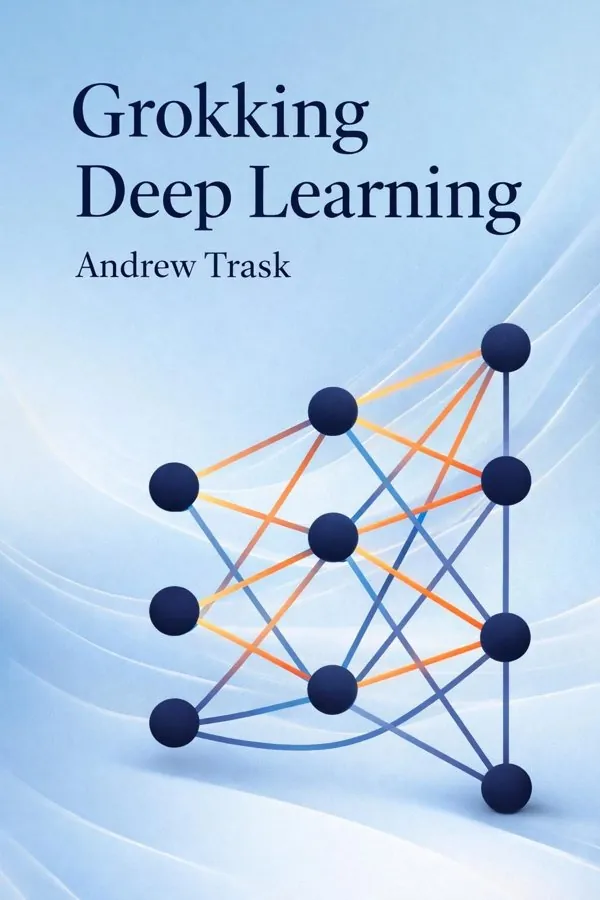
Grokking Deep Learning: Summary & Key Insights
by Andrew Trask
 10 min11 chaptersAudio available
What Is Grokking Deep Learning About?
Grokking Deep Learning by Andrew Trask is a ai_ml book spanning 11 pages. Grokking Deep Learning is an accessible introduction to the fundamentals of deep learning. Written for readers with minimal mathematical background, it explains neural networks from first principles, showing how they learn and make predictions. The book guides readers through building their own neural networks from scratch in Python, helping them understand the underlying mechanics of backpropagation, gradient descent, and other core concepts.
This FizzRead summary covers all 11 key chapters of Grokking Deep Learning in approximately 10 minutes, distilling the most important ideas, arguments, and takeaways from Andrew Trask's work. Also available as an audio summary and Key Quotes Podcast.
Grokking Deep Learning
Grokking Deep Learning is an accessible introduction to the fundamentals of deep learning. Written for readers with minimal mathematical background, it explains neural networks from first principles, showing how they learn and make predictions. The book guides readers through building their own neural networks from scratch in Python, helping them understand the underlying mechanics of backpropagation, gradient descent, and other core concepts.
Who Should Read Grokking Deep Learning?
This book is perfect for anyone interested in ai_ml and looking to gain actionable insights in a short read. Whether you're a student, professional, or lifelong learner, the key ideas from Grokking Deep Learning by Andrew Trask will help you think differently.
- ✓Readers who enjoy ai_ml and want practical takeaways
- ✓Professionals looking to apply new ideas to their work and life
- ✓Anyone who wants the core insights of Grokking Deep Learning in just 10 minutes
Want the full summary?
Get instant access to this book summary and 100K+ more with Fizz Moment.
Get Free SummaryAvailable on App Store • Free to download
Key Chapters
In the beginning, all learning—human or machine—starts with a question: how can we make predictions from experience? When a child learns to recognize a cat, they are unconsciously forming a mapping between sensory inputs and conceptual outputs. Machines, too, must learn such mappings. In this chapter, I explore the foundational idea that data reflects experience, and learning is the process of extracting patterns from it.
I first explain the essential difference between traditional programming and learning systems. Traditional programs are explicit: developers write rules that describe exactly how the computer should behave. Learning systems, by contrast, infer those rules themselves. They take examples and internally discover the structure that best fits them. This shift—from manually defining to automatically discovering—marks the birth of deep learning.
To motivate the discussion, I introduce a simple learning task: predicting the number of hot dogs someone will eat based on how hungry they are. It’s a trivial problem, but perfect for conceptual grounding. We can describe this relationship with a mathematical function, showing how changing parameters allows our model to match data more accurately. This process mirrors how learning happens—by adjusting internal beliefs until they better explain observed reality.
This chapter establishes a mindset. Deep learning is not magic; it’s mathematics tuned by feedback. Machines minimize error by noticing the mismatch between prediction and truth, and adjusting themselves accordingly. The seed of intelligence lies in that humble process.
The heart of all machine learning, and indeed all modeling, rests on mathematical functions. A function is a relationship—input goes in, output comes out. In this chapter, I guide you through how even the simplest functions can model real-world phenomena, and how they become the bricks from which neural networks are built.
We start with linear functions, the old y = mx + b, showing how they capture proportional relationships. A function maps hunger to hot dog consumption, hours studied to test scores, or temperature to electricity usage. I stress that the beauty of functions lies in their universality—any relationship can, in principle, be described by a function. The complexity arises from finding the right form and parameters.
As we move forward, we add layers of intuition about weights and biases. Weights determine how strongly an input influences output, while biases adjust the overall baseline. These concepts correspond to how neurons weigh and integrate signals. Through interactive Python examples, I show how small changes in these values affect the model’s behavior—and how learning is nothing more than adjusting weights and biases to minimize prediction error.
This chapter teaches you to see functions not as equations on paper, but as living entities translating experience into expectation. Once you understand that all learning machines are just adaptive sets of functions, the entire landscape of AI begins to look beautifully simple.
+ 9 more chapters — available in the FizzRead app
All Chapters in Grokking Deep Learning
About the Author
Andrew Trask is a researcher in machine learning and artificial intelligence. He has worked on privacy-preserving deep learning and is known for his contributions to the OpenMined community. Trask’s work focuses on making AI more understandable and accessible to a broad audience.
Get This Summary in Your Preferred Format
Read or listen to the Grokking Deep Learning summary by Andrew Trask anytime, anywhere. FizzRead offers multiple formats so you can learn on your terms — all free.
Available formats: App · Audio · PDF · EPUB — All included free with FizzRead
Download Grokking Deep Learning PDF and EPUB Summary
Key Quotes from Grokking Deep Learning
“In the beginning, all learning—human or machine—starts with a question: how can we make predictions from experience?”
“The heart of all machine learning, and indeed all modeling, rests on mathematical functions.”
Frequently Asked Questions about Grokking Deep Learning
Grokking Deep Learning by Andrew Trask is a ai_ml book that explores key ideas across 11 chapters. Grokking Deep Learning is an accessible introduction to the fundamentals of deep learning. Written for readers with minimal mathematical background, it explains neural networks from first principles, showing how they learn and make predictions. The book guides readers through building their own neural networks from scratch in Python, helping them understand the underlying mechanics of backpropagation, gradient descent, and other core concepts.
You Might Also Like
Life 3.0
Max Tegmark
10 min
Superintelligence
Nick Bostrom
10 min
TensorFlow in Action
Thushan Ganegedara
10 min
AI Made Simple: A Beginner’s Guide to Generative AI, ChatGPT, and the Future of Work
Rajeev Kapur
10 min
AI Snake Oil
Arvind Narayanan, Sayash Kapoor
10 min
AI Superpowers: China, Silicon Valley, and the New World Order
Kai-Fu Lee
10 minBrowse by Category
Ready to read Grokking Deep Learning?
Get the full summary and 100K+ more books with Fizz Moment.