
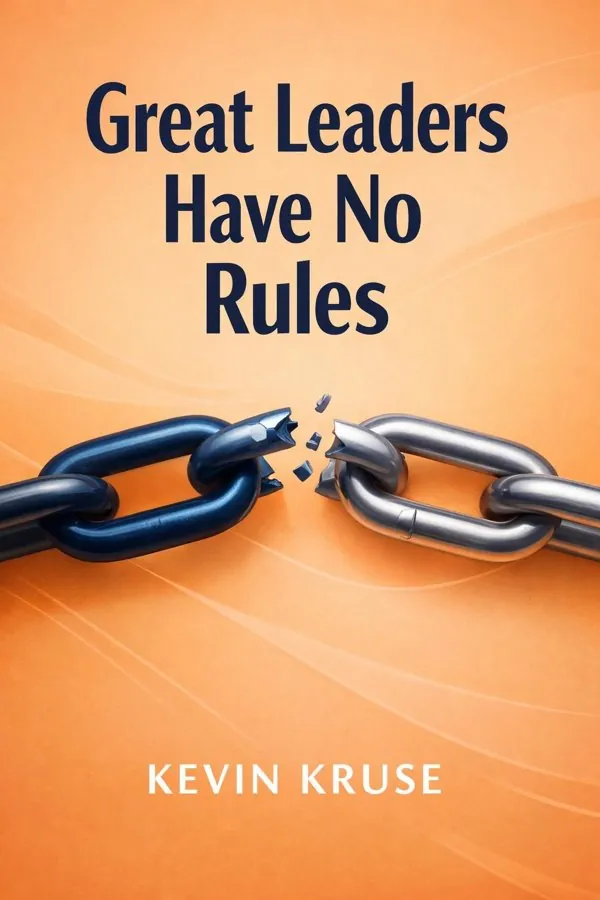
Great Leaders Have No Rules: Contrarian Leadership Principles to Transform Your Team and Business: Summary & Key Insights
by Kevin Kruse
 10 min10 chaptersAudio available
Key Takeaways from Great Leaders Have No Rules: Contrarian Leadership Principles to Transform Your Team and Business
Constant access feels generous, but it often creates dependence instead of leadership.
When communication breaks down, most organizations respond by writing more rules.
Titles can clarify responsibility, but when leaders overemphasize hierarchy, they accidentally suppress initiative.
Rules multiply when mission clarity disappears.
People rarely act like owners when they are treated like outsiders.
What Is Great Leaders Have No Rules: Contrarian Leadership Principles to Transform Your Team and Business About?
Great Leaders Have No Rules: Contrarian Leadership Principles to Transform Your Team and Business by Kevin Kruse is a leadership book spanning 10 pages. In Great Leaders Have No Rules, Kevin Kruse argues that many familiar management practices are not signs of strong leadership but remnants of an outdated industrial mindset. Policies, approvals, rigid hierarchies, annual reviews, and constant managerial availability may look responsible on paper, yet they often slow decision-making, weaken accountability, and reduce trust. Kruse makes the case that truly effective leaders replace control with clarity, bureaucracy with transparency, and supervision with ownership. What makes this book especially useful is that it is not an abstract manifesto against rules. Kruse draws on research, leadership case studies, and his own experience as an entrepreneur to show how high-performing teams actually function. The best leaders do not abandon standards; they create environments where people understand the mission, have the information they need, and are trusted to act like adults. That shift can unlock better execution, stronger engagement, and more innovation. For managers trying to lead knowledge workers, hybrid teams, or fast-changing organizations, this book matters because it challenges deeply ingrained habits and offers a more modern model of leadership built on trust, candor, and autonomy.
This FizzRead summary covers all 10 key chapters of Great Leaders Have No Rules: Contrarian Leadership Principles to Transform Your Team and Business in approximately 10 minutes, distilling the most important ideas, arguments, and takeaways from Kevin Kruse's work. Also available as an audio summary and Key Quotes Podcast.
Great Leaders Have No Rules: Contrarian Leadership Principles to Transform Your Team and Business
In Great Leaders Have No Rules, Kevin Kruse argues that many familiar management practices are not signs of strong leadership but remnants of an outdated industrial mindset. Policies, approvals, rigid hierarchies, annual reviews, and constant managerial availability may look responsible on paper, yet they often slow decision-making, weaken accountability, and reduce trust. Kruse makes the case that truly effective leaders replace control with clarity, bureaucracy with transparency, and supervision with ownership.
What makes this book especially useful is that it is not an abstract manifesto against rules. Kruse draws on research, leadership case studies, and his own experience as an entrepreneur to show how high-performing teams actually function. The best leaders do not abandon standards; they create environments where people understand the mission, have the information they need, and are trusted to act like adults. That shift can unlock better execution, stronger engagement, and more innovation.
For managers trying to lead knowledge workers, hybrid teams, or fast-changing organizations, this book matters because it challenges deeply ingrained habits and offers a more modern model of leadership built on trust, candor, and autonomy.
Who Should Read Great Leaders Have No Rules: Contrarian Leadership Principles to Transform Your Team and Business?
This book is perfect for anyone interested in leadership and looking to gain actionable insights in a short read. Whether you're a student, professional, or lifelong learner, the key ideas from Great Leaders Have No Rules: Contrarian Leadership Principles to Transform Your Team and Business by Kevin Kruse will help you think differently.
- ✓Readers who enjoy leadership and want practical takeaways
- ✓Professionals looking to apply new ideas to their work and life
- ✓Anyone who wants the core insights of Great Leaders Have No Rules: Contrarian Leadership Principles to Transform Your Team and Business in just 10 minutes
Want the full summary?
Get instant access to this book summary and 100K+ more with Fizz Moment.
Get Free SummaryAvailable on App Store • Free to download
Key Chapters
Constant access feels generous, but it often creates dependence instead of leadership. Kruse challenges the traditional open-door policy by arguing that unlimited interruptions may signal approachability while quietly destroying focus, decision quality, and team ownership. When employees can drop in at any moment for answers, leaders become bottlenecks. Worse, teams learn to seek permission rather than exercise judgment.
The deeper issue is not whether leaders should be available. It is whether availability is structured in a way that helps people grow. A leader who is always interruptible teaches employees to escalate every issue upward. A leader who creates deliberate communication rhythms teaches them to think, prioritize, and solve problems more independently. Kruse suggests replacing vague accessibility with intentional touchpoints such as weekly one-on-ones, team office hours, decision frameworks, and clear escalation criteria.
Imagine a manager who spends the day reacting to messages, hallway questions, and ad hoc requests. By evening, strategic work is unfinished. Compare that with a manager who blocks time for coaching conversations, clarifies which issues require immediate attention, and asks employees to bring proposed solutions instead of just problems. The second leader remains supportive while preserving time for high-value thinking.
This principle is especially relevant in remote and hybrid workplaces, where digital interruptions can multiply even faster than in-person ones. Being responsive does not require being constantly reachable. It requires creating systems that improve communication and reduce unnecessary dependency.
Actionable takeaway: Replace an always-open approach with clear communication norms, scheduled check-ins, and a rule that team members bring recommendations, not just problems.
When communication breaks down, most organizations respond by writing more rules. Kruse argues that this instinct usually treats symptoms rather than causes. Bans on after-hours email, mandatory copying practices, rigid templates, and overly detailed etiquette guidelines may create the illusion of order, but they rarely improve judgment. In many cases, they simply add friction, encourage passive compliance, and make communication less human.
Kruse’s point is not that email norms are useless. It is that leaders should focus on intent, clarity, and context instead of trying to regulate every possible behavior. Adults do not become better communicators because they are handed a longer policy. They improve when leaders model concise writing, clarify priorities, and choose the right channel for the right message.
For example, if a team struggles with overflowing inboxes, the real problem may be unclear decision rights or a culture of fear that encourages excessive copying for self-protection. If employees send messages late at night, the issue may be poor workload planning or unspoken expectations around responsiveness. A mature leader addresses these root causes by clarifying when response is actually required, distinguishing urgent from non-urgent channels, and publicly valuing thoughtful communication over performative busyness.
This approach also builds trust. Instead of assuming people will misuse tools unless constrained, it assumes they can learn to use them responsibly. That shift matters because communication tools change constantly, while judgment remains the real leadership need.
Actionable takeaway: Audit your team’s communication pain points and replace unnecessary email rules with three simple norms around urgency, channel choice, and expected response times.
Titles can clarify responsibility, but when leaders overemphasize hierarchy, they accidentally suppress initiative. Kruse challenges the assumption that stronger authority lines always produce better performance. In modern organizations, valuable ideas often come from the front lines, not from the top of the org chart. If employees believe status matters more than insight, they will hesitate to challenge assumptions, raise concerns, or propose bold improvements.
The point is not to eliminate structure altogether. Organizations still need accountability, role definition, and decision ownership. Kruse’s argument is that great leaders reduce the emotional weight of hierarchy. They do not hide behind titles, demand deference, or make rank the center of every interaction. Instead, they create an environment where the best idea can win and where influence comes from contribution as much as position.
A practical example is how meetings are run. In status-heavy cultures, junior employees wait for the senior person to speak first, then align with that opinion. In healthier cultures, leaders invite dissent, ask newer employees for input before executives weigh in, and reward truth-telling over agreement. Similarly, leaders can reduce hierarchy by sharing information broadly, involving people in decisions that affect their work, and using language that signals partnership rather than command.
This principle is especially powerful in fast-moving industries where speed and innovation matter. Bureaucratic deference slows learning. Psychological safety accelerates it.
Actionable takeaway: Keep role clarity, but flatten day-to-day interactions by inviting input across levels, asking junior voices to speak first, and rewarding useful disagreement instead of obedient silence.
Rules multiply when mission clarity disappears. Kruse argues that the strongest organizations do not rely on thick manuals because people already understand the larger purpose guiding their choices. When the mission is vivid and frequently reinforced, employees can make smart decisions without waiting for instructions. When the mission is vague, leaders compensate with controls, approvals, and policies.
This is one of the book’s central ideas: replace compliance management with meaning management. A rule can tell people what not to do in a narrow situation. A mission helps them decide what to do in countless situations the rulebook never anticipated. In dynamic environments, that difference is critical. No policy set can keep pace with changing customer expectations, technology, and competition.
Consider a service company whose mission is genuinely centered on customer trust. An employee facing an unusual client problem may not find the answer in a handbook. But if the mission is clear, they can ask: what action best protects the customer relationship while honoring our values and business goals? That question leads to judgment, not box-checking.
Kruse encourages leaders to communicate mission constantly, not just during onboarding or annual meetings. Teams should see how daily work connects to broader impact. Priorities, metrics, and recognition systems should all reinforce the mission. Without that alignment, mission statements become wall art while rules do the real governing.
A mission-driven culture does not mean anything goes. It means boundaries are anchored in purpose, and decisions are evaluated by whether they advance the organization’s core aim.
Actionable takeaway: Test every policy against your mission and remove or simplify rules that exist only because people lack clarity about the organization’s purpose and priorities.
People rarely act like owners when they are treated like outsiders. Kruse argues that trust is not built through slogans or team-building exercises alone; it grows when leaders share real information, explain decisions honestly, and reduce secrecy wherever possible. Radical transparency signals respect. It tells employees they are capable of understanding the business and contributing to it.
Many leaders withhold information because they fear confusion, panic, or misuse. But Kruse suggests the opposite often happens. Secrecy creates rumors, politics, and disengagement. When people do not know what is happening, they fill the gaps with assumptions. Transparent leaders reduce that uncertainty by sharing financial realities, strategic shifts, performance challenges, and the reasoning behind major decisions.
For example, instead of announcing a cost-cutting initiative with vague language, a transparent leader might explain revenue pressures, customer trends, and why certain tradeoffs are necessary. Even when the news is difficult, employees are more likely to trust leaders who tell the truth than those who communicate in sanitized fragments. Transparency also enables better decisions at every level because people have the context needed to act intelligently.
Of course, transparency should be responsible, not reckless. Confidential legal, personal, or customer information still requires protection. But too many organizations label ordinary business context as confidential simply because sharing it feels uncomfortable.
Kruse’s broader point is simple: trust is reciprocal. If leaders want initiative, honesty, and accountability, they must first offer openness.
Actionable takeaway: Share more context than feels comfortable in meetings and updates, especially around strategy, numbers, and decision rationale, while protecting only truly sensitive information.
Micromanagement is often disguised as high standards. Kruse argues that when leaders tightly control how work gets done, they may achieve short-term consistency at the expense of long-term engagement and innovation. People feel ownership when they have real discretion. They feel like hired hands when every method, choice, and timeline must be approved from above.
Autonomy does not mean abandoning support or lowering expectations. It means defining the outcome clearly while giving capable people space to determine the best path. This shift reflects a deeper belief: that adults do their best work when they are trusted. When employees can make decisions, experiment, and solve problems using their own judgment, motivation becomes more intrinsic and performance often improves.
A practical example is project leadership. A controlling manager might dictate every meeting agenda, tool, and communication draft. An autonomy-oriented leader would clarify the desired result, constraints, and checkpoints, then let the team shape execution. If mistakes happen, they become coaching moments rather than proof that control must be tightened.
Autonomy also builds leadership capacity. Organizations often complain that people do not think strategically, yet those same organizations rarely allow employees to practice strategic thinking. Ownership grows through use. The more people are trusted with meaningful decisions, the stronger their judgment becomes.
This principle is especially valuable in creative, technical, and knowledge-based work, where rigid instruction can undermine the very expertise the organization hired.
Actionable takeaway: In your next delegation, define the goal, deadline, and non-negotiable constraints, then explicitly hand over discretion on how the work will be completed.
Few corporate rituals are as widely accepted and as quietly resented as the annual performance review. Kruse argues that these formal, infrequent evaluations are poor tools for growth because they turn development into a backward-looking event instead of an ongoing conversation. By the time feedback arrives, the moment to learn from it has often passed.
Traditional reviews also tend to distort behavior. Employees become anxious, managers procrastinate, and ratings overshadow useful coaching. In many organizations, the process becomes more about documentation and compensation than improvement. Kruse advocates replacing this outdated model with frequent, candid, low-drama feedback woven into normal work.
Continuous feedback means managers address issues when they are small, recognize progress in real time, and coach people based on current priorities rather than stale annual objectives. It also creates a healthier relationship between leader and employee because performance conversations stop feeling like courtroom proceedings. Instead, they become collaborative check-ins about what is working, what needs adjustment, and what support is required.
For example, after a presentation, a leader can immediately discuss what landed well and what could be sharper next time. During a project, weekly conversations can identify obstacles before deadlines are missed. This style of leadership requires courage and consistency, but it produces better performance because learning happens while the work is still alive.
Organizations may still need formal mechanisms for compensation or promotion decisions. Kruse’s point is that development should not depend on a yearly ritual.
Actionable takeaway: Start a rhythm of brief monthly growth conversations focused on strengths, obstacles, and one improvement priority instead of saving meaningful feedback for annual review season.
Innovation does not thrive in environments where mistakes are punished more than stagnation. Kruse emphasizes that leaders who want adaptability must normalize experimentation. If every new idea requires excessive approval or carries heavy career risk, employees will default to the familiar. Organizations then become efficient at preserving yesterday’s success while missing tomorrow’s opportunities.
A culture of experimentation begins with how leaders frame failure. Not every failed initiative is valuable, but thoughtful experiments that produce learning should not be treated as incompetence. When teams can test, measure, and iterate, they discover what works faster than teams waiting for certainty. This is especially important in markets shaped by rapid change, where perfect information is impossible.
Practical application might include pilot programs, limited-scope trials, post-project retrospectives, and decision reviews that ask what was learned rather than only who was right. Leaders can encourage this by allocating time and budget for testing, celebrating intelligent risk-taking, and publicly sharing lessons from their own mistakes. That last part matters: if leaders pretend infallibility, employees will hide errors instead of learning from them.
Experimentation still needs discipline. Teams should define hypotheses, success metrics, and boundaries. Otherwise, experimentation becomes random activity rather than purposeful learning. Kruse’s message is not to be reckless but to reduce the fear that keeps people from trying better ways of working.
The real competitive advantage is not avoiding all mistakes. It is building an organization that learns faster than others.
Actionable takeaway: Introduce one small, low-risk experiment this month with a clear hypothesis, measurement plan, and debrief so your team practices learning through action.
Employees can usually tell when leadership is scripted. Kruse argues that authenticity is not a soft trait but a practical advantage because trust grows when leaders act in ways that are consistent, candid, and human. Leaders who constantly perform authority, optimism, or certainty create distance. Teams may comply with them, but they are less likely to confide in them, challenge them, or follow them wholeheartedly.
Authentic leadership does not mean oversharing every emotion or abandoning professionalism. It means being real about what you know, what you do not know, what matters to you, and how you make decisions. It also means aligning words with behavior. A leader who talks about work-life balance but sends urgent messages every weekend is not authentic, no matter how inspiring their speeches sound.
Kruse’s emphasis on authenticity connects directly to trust and culture. When leaders admit mistakes, ask for input, and communicate in plain language, they create psychological safety. People feel less pressure to posture and more freedom to contribute honestly. Authenticity also strengthens resilience. In uncertain periods, teams prefer grounded truth over polished spin.
For example, during a difficult quarter, an authentic leader might say: here is where we are struggling, here is what we are doing about it, and here is where I need your help. That approach is more credible than vague reassurance detached from reality.
Leadership is relational, and relationships weaken when one side feels artificial. Authenticity is what makes influence durable.
Actionable takeaway: In your next team update, replace polished corporate language with direct, honest communication about one challenge, one priority, and one area where you want input.
Rules can coordinate behavior, but they cannot create commitment. Kruse highlights that exceptional teams are not held together by policy alone; they are strengthened by belonging, shared identity, and meaningful connection. People work harder, collaborate better, and stay longer when they feel seen as contributors and as human beings.
Belonging is often misunderstood as mere friendliness. In reality, it emerges when people feel respected, included, and valued for their perspective. Leaders build this by listening seriously, recognizing contributions fairly, connecting work to purpose, and creating environments where individuals can speak without fear of embarrassment or exclusion. In contrast, cultures driven purely by efficiency can become emotionally thin. Work gets done, but loyalty and creativity suffer.
This matters because rule-heavy organizations often substitute process for relationship. They assume consistency can be engineered solely through systems. But trust and effort are deeply social. A team member who feels isolated may follow instructions while withholding ideas, concerns, and discretionary effort. A team member who feels connected is more likely to help others, surface problems early, and persevere through difficulty.
Practical ways to build belonging include thoughtful onboarding, regular recognition, inclusive meeting practices, peer mentoring, and leader behaviors that show curiosity about people’s goals and experiences. In distributed teams, connection requires even more intentionality because informal interactions happen less naturally.
Kruse’s broader insight is that mature leadership is not just about strategy and execution. It is also about creating the social conditions in which people can do their best work together.
Actionable takeaway: Identify one routine in your team this week where you can increase inclusion and recognition, such as inviting quieter voices in meetings or publicly acknowledging unseen contributions.
All Chapters in Great Leaders Have No Rules: Contrarian Leadership Principles to Transform Your Team and Business
About the Author
Kevin Kruse is an American entrepreneur, bestselling author, keynote speaker, and leadership expert known for his work on productivity, employee engagement, and modern management. He has founded and led multiple companies, giving him firsthand experience with the challenges of scaling teams and building culture. Kruse is especially recognized for combining business research with practical leadership advice that executives and managers can apply immediately. His writing often challenges conventional workplace wisdom and encourages leaders to rethink how they motivate people, structure organizations, and create accountability. Through his books, articles, and speaking, he has helped popularize evidence-based ideas about high performance, trust, and engagement. In Great Leaders Have No Rules, he draws on this entrepreneurial and research-driven background to advocate for a more transparent, empowering, and human-centered approach to leadership.
Get This Summary in Your Preferred Format
Read or listen to the Great Leaders Have No Rules: Contrarian Leadership Principles to Transform Your Team and Business summary by Kevin Kruse anytime, anywhere. FizzRead offers multiple formats so you can learn on your terms — all free.
Available formats: App · Audio · PDF · EPUB — All included free with FizzRead
Download Great Leaders Have No Rules: Contrarian Leadership Principles to Transform Your Team and Business PDF and EPUB Summary
Key Quotes from Great Leaders Have No Rules: Contrarian Leadership Principles to Transform Your Team and Business
“Constant access feels generous, but it often creates dependence instead of leadership.”
“When communication breaks down, most organizations respond by writing more rules.”
“Titles can clarify responsibility, but when leaders overemphasize hierarchy, they accidentally suppress initiative.”
“Rules multiply when mission clarity disappears.”
“People rarely act like owners when they are treated like outsiders.”
Frequently Asked Questions about Great Leaders Have No Rules: Contrarian Leadership Principles to Transform Your Team and Business
Great Leaders Have No Rules: Contrarian Leadership Principles to Transform Your Team and Business by Kevin Kruse is a leadership book that explores key ideas across 10 chapters. In Great Leaders Have No Rules, Kevin Kruse argues that many familiar management practices are not signs of strong leadership but remnants of an outdated industrial mindset. Policies, approvals, rigid hierarchies, annual reviews, and constant managerial availability may look responsible on paper, yet they often slow decision-making, weaken accountability, and reduce trust. Kruse makes the case that truly effective leaders replace control with clarity, bureaucracy with transparency, and supervision with ownership. What makes this book especially useful is that it is not an abstract manifesto against rules. Kruse draws on research, leadership case studies, and his own experience as an entrepreneur to show how high-performing teams actually function. The best leaders do not abandon standards; they create environments where people understand the mission, have the information they need, and are trusted to act like adults. That shift can unlock better execution, stronger engagement, and more innovation. For managers trying to lead knowledge workers, hybrid teams, or fast-changing organizations, this book matters because it challenges deeply ingrained habits and offers a more modern model of leadership built on trust, candor, and autonomy.
More by Kevin Kruse

You Might Also Like

Extreme Ownership
Jocko Willink
10 min
Dare to Lead
Brene Brown
10 min
Leaders Eat Last
Simon Sinek
10 min
The 21 Irrefutable Laws of Leadership
John Maxwell
10 min
Start With Why
Simon Sinek
10 min
How to Lead When You're Not in Charge
Clay Scroggins
10 minBrowse by Category
Ready to read Great Leaders Have No Rules: Contrarian Leadership Principles to Transform Your Team and Business?
Get the full summary and 100K+ more books with Fizz Moment.