
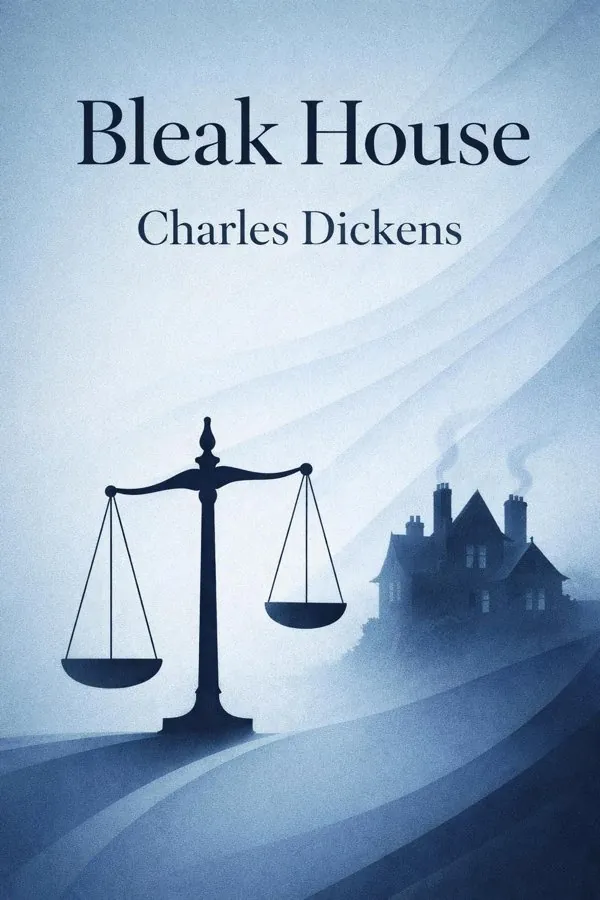
Bleak House: Summary & Key Insights
 10 min9 chaptersAudio available
Key Takeaways from Bleak House
A society often reveals its deepest failures not in its crimes but in its procedures.
The most powerful people in a broken world are not always the loudest.
In a harsh society, a home can become a moral idea.
Secrets become most destructive when a society makes honesty unbearable.
Not all optimism is healthy; some hope quietly ruins a life.
What Is Bleak House About?
Bleak House by Charles Dickens is a classics book spanning 6 pages. Bleak House is Charles Dickens at his most ambitious: a vast, haunting novel that turns a legal case into a portrait of an entire society. First published in serial form between 1852 and 1853, it revolves around the infamous lawsuit of Jarndyce and Jarndyce, a case in the Court of Chancery so old, complicated, and expensive that it consumes fortunes, hopes, and lives. But the novel is far more than a satire of law. Dickens uses this endless case to connect aristocrats and street children, lawyers and debtors, philanthropists and hypocrites, showing how institutions shape private suffering. What makes Bleak House especially powerful is its double narration: the calm, humane voice of Esther Summerson and the broader, darker voice that surveys London’s fog, poverty, and moral decay. Together they create both intimacy and social sweep. Dickens writes with unmatched authority because he knew firsthand the anxieties of debt, bureaucracy, and class insecurity, and he transformed those experiences into fiction with extraordinary emotional and political force. Bleak House remains one of the great novels of modern systems gone wrong—and of the human kindness that resists them.
This FizzRead summary covers all 9 key chapters of Bleak House in approximately 10 minutes, distilling the most important ideas, arguments, and takeaways from Charles Dickens's work. Also available as an audio summary and Key Quotes Podcast.
Bleak House
Bleak House is Charles Dickens at his most ambitious: a vast, haunting novel that turns a legal case into a portrait of an entire society. First published in serial form between 1852 and 1853, it revolves around the infamous lawsuit of Jarndyce and Jarndyce, a case in the Court of Chancery so old, complicated, and expensive that it consumes fortunes, hopes, and lives. But the novel is far more than a satire of law. Dickens uses this endless case to connect aristocrats and street children, lawyers and debtors, philanthropists and hypocrites, showing how institutions shape private suffering. What makes Bleak House especially powerful is its double narration: the calm, humane voice of Esther Summerson and the broader, darker voice that surveys London’s fog, poverty, and moral decay. Together they create both intimacy and social sweep. Dickens writes with unmatched authority because he knew firsthand the anxieties of debt, bureaucracy, and class insecurity, and he transformed those experiences into fiction with extraordinary emotional and political force. Bleak House remains one of the great novels of modern systems gone wrong—and of the human kindness that resists them.
Who Should Read Bleak House?
This book is perfect for anyone interested in classics and looking to gain actionable insights in a short read. Whether you're a student, professional, or lifelong learner, the key ideas from Bleak House by Charles Dickens will help you think differently.
- ✓Readers who enjoy classics and want practical takeaways
- ✓Professionals looking to apply new ideas to their work and life
- ✓Anyone who wants the core insights of Bleak House in just 10 minutes
Want the full summary?
Get instant access to this book summary and 100K+ more with Fizz Moment.
Get Free SummaryAvailable on App Store • Free to download
Key Chapters
A society often reveals its deepest failures not in its crimes but in its procedures. Dickens opens Bleak House with one of the most memorable images in English literature: fog everywhere, thick over London, thick in the streets, thick in the Court of Chancery. This fog is not just weather. It is the atmosphere of confusion, delay, obscurity, and institutional paralysis. At the center of this haze stands Jarndyce and Jarndyce, a lawsuit over an inheritance so prolonged that generations have grown up and died within its shadow. No one seems fully to understand it, yet everyone is damaged by it.
Dickens’s target is the legal system’s ability to turn justice into a machine of postponement. The court does not merely fail to solve conflict; it feeds on it. Lawyers profit, paperwork multiplies, and the people whose lives are supposedly being judged become secondary to the process itself. Richard Carstone becomes obsessed with the idea that the case will secure his future, while others learn to live under its curse. The law here is not a neutral institution. It becomes a culture, one that rewards vagueness and punishes urgency.
This idea remains strikingly modern. Any bureaucratic system can produce a similar fog when forms matter more than outcomes, when complexity protects insiders, and when people begin serving procedure instead of purpose. We see it in stalled legal disputes, delayed public services, and organizations that confuse activity with progress.
The practical lesson is simple: whenever a system becomes so complicated that no one can explain how it helps the people it exists to serve, danger has already begun. Ask hard questions about incentives, clarity, and accountability. Actionable takeaway: identify one process in your work or life that feels unnecessarily opaque, and simplify or challenge it before delay becomes its own form of harm.
The most powerful people in a broken world are not always the loudest. Esther Summerson, one of the novel’s two narrators, enters Bleak House without social prestige, inherited confidence, or dramatic self-assertion. She speaks modestly, often undervaluing herself, yet over time she emerges as the book’s moral center. In a novel crowded with vanity, manipulation, and social performance, Esther’s humility allows her to see others clearly and care for them without calculation.
Dickens uses Esther to show that goodness is not passivity. She is practical, observant, and emotionally resilient. She helps create warmth in Bleak House, tends the sick, comforts the distressed, and responds to uncertainty without surrendering to bitterness. Even when confronted with painful revelations about her origins, she does not become self-absorbed. Instead, she continues to act with steadiness and compassion. That consistency gives her a quiet authority that many socially superior characters lack.
Her example also complicates Victorian ideals of femininity. Esther may appear self-effacing, but she is not weak. She organizes, mediates, nurtures, and endures. Dickens suggests that social life depends less on grand declarations than on sustained acts of care. In families, workplaces, and communities, much of what holds people together is built by those who do essential labor without demanding applause.
In modern terms, Esther represents the often overlooked value of emotional reliability. Teams need it. Friendships need it. Families survive because of it. The novel reminds us that competence joined with kindness is a form of leadership.
Actionable takeaway: practice one act of unobtrusive usefulness today—solve a problem, ease someone’s burden, or bring clarity where there is confusion. Moral strength often begins in small, consistent actions rather than dramatic gestures.
In a harsh society, a home can become a moral idea. John Jarndyce’s Bleak House is more than a country residence; it is Dickens’s vision of what human life can look like when it is organized around generosity rather than competition. Jarndyce himself is one of the novel’s most appealing figures: humorous, kind, self-aware, and determined not to let the poisonous lawsuit define his relationships. Around him gathers a household shaped not by bloodline or rigid status but by welcome, patience, and mutual care.
This matters because Bleak House stands in deliberate contrast to the institutions that dominate the novel. The Court of Chancery is cold, abstract, and devouring. Aristocratic homes are full of secrecy and performance. Urban poverty is marked by neglect. Against all this, Jarndyce creates a space where people can recover from fear and confusion. Esther, Ada, and even the volatile Richard find temporary security there. Conversation is humane, routines are comforting, and affection is expressed in practical ways.
Dickens is not naive. Bleak House cannot solve every problem. It cannot prevent Richard’s decline, erase social inequality, or undo the harms inflicted by law and class. Yet it offers something indispensable: an environment where damaged people are treated as persons rather than cases. This is one of Dickens’s deepest convictions—that while systems often fail, individuals can still build local forms of justice through hospitality, decency, and responsibility.
The modern application is powerful. We may not be able to repair every institution immediately, but we can shape the smaller worlds we influence: a family culture, a team climate, a classroom, a friendship circle. Spaces of trust do not happen accidentally; they are built through habits of welcome and fairness.
Actionable takeaway: choose one environment you influence and improve its emotional climate through consistency, kindness, and clear support. A refuge is created by repeated acts, not good intentions alone.
Secrets become most destructive when a society makes honesty unbearable. Lady Dedlock appears at first as a grand, remote aristocrat, wrapped in elegance and emotional distance. But beneath her composure lies one of the novel’s central tragedies: a hidden past involving a youthful relationship and a child she was forced to lose. Her secrecy is personal, yet it is also social. She lives in a world where reputation matters more than truth, where a woman’s past can destroy not only her standing but her very sense of identity.
Dickens treats Lady Dedlock with unusual sympathy. She is not merely guilty or proud; she is trapped. Her silence has lasted so long that it shapes her entire existence. When the lawyer Tulkinghorn begins to uncover the truth, secrecy turns into terror. What makes her story tragic is not just concealment itself but the conditions that required it: rigid class codes, gendered judgment, and a culture of appearances. The aristocratic world preserves dignity outwardly while crushing emotional reality inwardly.
Her story also intersects with Esther’s, revealing the human cost of decisions made under social pressure. Dickens asks us to consider how many lives are bent out of shape when institutions punish vulnerability and reward performance. People do not always hide because they are immoral; often they hide because the environment offers no merciful path toward truth.
This insight remains relevant wherever shame governs relationships—families that avoid painful conversations, workplaces that punish candid mistakes, communities that value image over reality. Secrecy grows when confession feels more dangerous than deception.
Actionable takeaway: create at least one relationship or environment in your life where honesty is safer than performance. If a truth needs to be faced, approach it early and with compassion, before silence hardens into tragedy.
Not all optimism is healthy; some hope quietly ruins a life. Richard Carstone begins Bleak House as charming, affectionate, and full of potential. Yet he lacks inner steadiness. He moves from one possible career to another—medicine, the military, the law—without committing to any path. What finally captures him is the fantasy of Jarndyce and Jarndyce. He comes to believe that the lawsuit will eventually reward him, solve his uncertainty, and justify waiting rather than building a life.
Dickens shows how institutions exploit the vulnerable not only through force but through promise. Richard’s downfall is not caused by laziness alone. It emerges from a blend of ambition, insecurity, and manipulation by those who profit from the case continuing. The lawsuit gives shape to his restlessness: instead of doing difficult, ordinary work in the present, he invests emotionally in a future windfall. That illusion becomes addictive. As his obsession grows, it erodes his judgment, harms his relationship with Ada, and drains both his finances and health.
This is one of the novel’s most psychologically acute portraits. People often cling to grand eventual solutions because daily discipline feels less glamorous. We can see modern versions in speculative schemes, endless litigation, career fantasies without effort, or dependence on one breakthrough event to make everything right. Dickens warns that deferred life can become a form of self-destruction.
Richard’s tragedy is also a moral one: he confuses expectation with agency. He waits for a case to deliver what only character, labor, and patience could build.
Actionable takeaway: examine any major hope you are relying on. Ask whether it is grounded in concrete action or sustained mainly by fantasy. Shift at least one important goal from waiting mode into daily practice before delay consumes your future.
When formal systems fail, what remains to guide human life? Dickens’s answer in Bleak House is not sentimental optimism but practical compassion. By the novel’s end, legal structures have exposed their hollowness, ambitions have collapsed, secrets have exacted their price, and fortunes have dissolved into dust. Jarndyce and Jarndyce, the case that seemed to govern so many destinies, ends absurdly: the estate is consumed by legal costs. The machinery of justice has devoured the thing it existed to distribute.
Yet the novel does not end in total despair. What survives is not wealth, prestige, or procedure, but relationships shaped by fidelity and care. Esther’s steadiness, John Jarndyce’s generosity, Ada’s love, Allan Woodcourt’s devotion, and small acts of protection toward the vulnerable carry more moral weight than all the pomp of Chancery. Dickens does not claim that kindness solves structural injustice by itself. He is too honest for that. But he insists that without compassion, no institution can truly be just, and without humane conduct, life becomes unlivable even when rules are followed.
This is the deepest resolution of the novel. Law may be necessary, but it is insufficient. Systems need a moral spirit, and individuals need habits of mercy, honesty, and responsibility. Dickens asks readers not only to condemn corruption but to practice an alternative in daily life.
That lesson remains urgent in professional, civic, and personal settings. Efficiency without humanity becomes cruelty. Procedure without empathy becomes absurdity. Rules should protect life, not replace concern for it.
Actionable takeaway: in your next difficult decision, do not ask only what is permitted or efficient. Ask what response is most humane, most responsible, and most likely to preserve another person’s dignity.
All Chapters in Bleak House
About the Author
Charles Dickens (1812–1870) was an English novelist, journalist, and social critic whose work helped define Victorian literature. Born in Portsmouth, he experienced financial instability early in life, including the imprisonment of his father for debt and his own period of labor in a blacking factory. These experiences shaped his lifelong concern with poverty, bureaucracy, and social injustice. Dickens became famous through serialized novels that combined vivid storytelling with memorable characters and moral urgency. His best-known works include Oliver Twist, David Copperfield, A Christmas Carol, Great Expectations, A Tale of Two Cities, and Bleak House. Admired for his humor, emotional power, and reformist energy, he remains one of the most influential and widely read authors in the English language.
Get This Summary in Your Preferred Format
Read or listen to the Bleak House summary by Charles Dickens anytime, anywhere. FizzRead offers multiple formats so you can learn on your terms — all free.
Available formats: App · Audio · PDF · EPUB — All included free with FizzRead
Download Bleak House PDF and EPUB Summary
Key Quotes from Bleak House
“A society often reveals its deepest failures not in its crimes but in its procedures.”
“The most powerful people in a broken world are not always the loudest.”
“In a harsh society, a home can become a moral idea.”
“Secrets become most destructive when a society makes honesty unbearable.”
“Not all optimism is healthy; some hope quietly ruins a life.”
Frequently Asked Questions about Bleak House
Bleak House by Charles Dickens is a classics book that explores key ideas across 9 chapters. Bleak House is Charles Dickens at his most ambitious: a vast, haunting novel that turns a legal case into a portrait of an entire society. First published in serial form between 1852 and 1853, it revolves around the infamous lawsuit of Jarndyce and Jarndyce, a case in the Court of Chancery so old, complicated, and expensive that it consumes fortunes, hopes, and lives. But the novel is far more than a satire of law. Dickens uses this endless case to connect aristocrats and street children, lawyers and debtors, philanthropists and hypocrites, showing how institutions shape private suffering. What makes Bleak House especially powerful is its double narration: the calm, humane voice of Esther Summerson and the broader, darker voice that surveys London’s fog, poverty, and moral decay. Together they create both intimacy and social sweep. Dickens writes with unmatched authority because he knew firsthand the anxieties of debt, bureaucracy, and class insecurity, and he transformed those experiences into fiction with extraordinary emotional and political force. Bleak House remains one of the great novels of modern systems gone wrong—and of the human kindness that resists them.
More by Charles Dickens


You Might Also Like





Browse by Category
Ready to read Bleak House?
Get the full summary and 100K+ more books with Fizz Moment.