
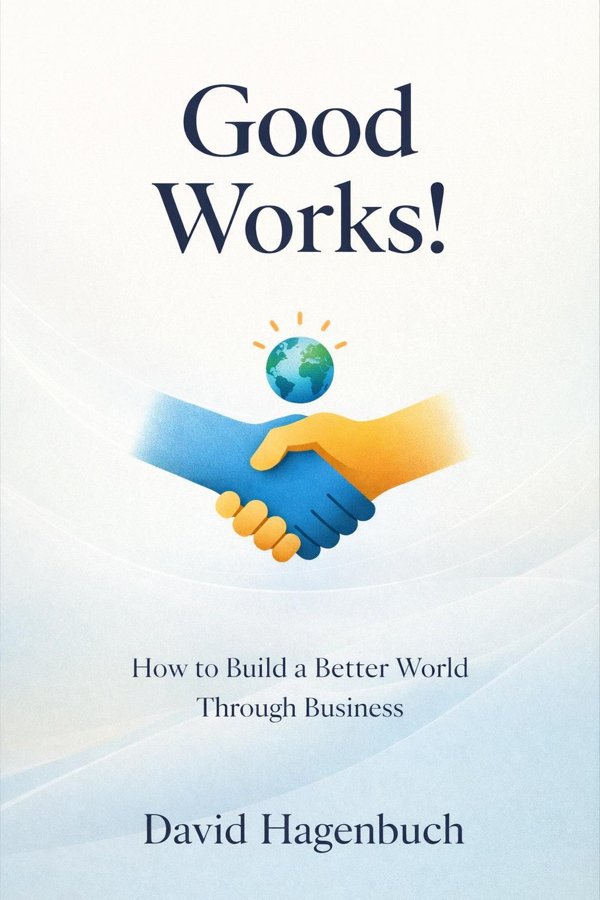
Good Works!: How to Build a Better World Through Business: Summary & Key Insights
 10 min6 chaptersAudio available
What Is Good Works!: How to Build a Better World Through Business About?
Good Works!: How to Build a Better World Through Business by David Hagenbuch is a marketing book spanning 6 pages. Good Works! explores how businesses can integrate social responsibility and ethical practices into their operations while maintaining profitability. The book provides case studies and actionable strategies for companies seeking to make a positive impact on society through their core business activities.
This FizzRead summary covers all 6 key chapters of Good Works!: How to Build a Better World Through Business in approximately 10 minutes, distilling the most important ideas, arguments, and takeaways from David Hagenbuch's work. Also available as an audio summary and Key Quotes Podcast.
Good Works!: How to Build a Better World Through Business
Good Works! explores how businesses can integrate social responsibility and ethical practices into their operations while maintaining profitability. The book provides case studies and actionable strategies for companies seeking to make a positive impact on society through their core business activities.
Who Should Read Good Works!: How to Build a Better World Through Business?
This book is perfect for anyone interested in marketing and looking to gain actionable insights in a short read. Whether you're a student, professional, or lifelong learner, the key ideas from Good Works!: How to Build a Better World Through Business by David Hagenbuch will help you think differently.
- ✓Readers who enjoy marketing and want practical takeaways
- ✓Professionals looking to apply new ideas to their work and life
- ✓Anyone who wants the core insights of Good Works!: How to Build a Better World Through Business in just 10 minutes
Want the full summary?
Get instant access to this book summary and 100K+ more with Fizz Moment.
Get Free SummaryAvailable on App Store • Free to download
Key Chapters
To understand where we are today, we must appreciate how far we’ve come. Corporate social responsibility once meant writing checks to charities or planting trees after a quarterly profit surge. In its early decades, CSR emerged as a defensive maneuver—an effort to correct or offset the harm companies caused through industrial expansion. Business leaders treated social good as peripheral to their core mission, not as part of their identity.
But the twenty-first century redefined this relationship. Consumers grew more informed and interconnected; they demanded transparency and integrity from the brands they patronized. Rather than settling for gestures, they wanted to see evidence that companies genuinely cared for social welfare, environmental health, and ethical labor. Governments and NGOs added their voices, emphasizing that business could not continue in isolation from society.
We started witnessing the birth of conscious capitalism—enterprises that viewed profit as a means to serve rather than dominate. The idea evolved from compliance to conviction. Firms like Patagonia, Ben & Jerry’s, and Interface began embedding ethical responsibility into every choice they made—from supply chain decisions to product design. Their success stories exposed the myth that social commitment weakens competitiveness.
As I reflect on this evolution, what stands out most is the realization that CSR is no longer an add-on, but a core strategy. When a company aligns its purpose with moral principles, it builds resilience against the volatility of global markets. It also nurtures meaning in its workforce; employees who identify with a higher mission contribute more creatively and loyally. This holistic approach forms the foundation of ‘Good Works’—ethics integrated seamlessly with business objectives.
As you guide your organization through a world of complex expectations, remember that social responsibility is not a fad; it is the future of business strategy. The transition from reactive CSR to proactive purpose-driven enterprise defines the landscape in which true leaders operate today.
I often remind my students that marketing, at its heart, is relational—it’s about connecting human needs with meaningful solutions. Yet somewhere along the way, many marketers began treating consumers as targets rather than partners. They learned how to influence but forgot how to listen. The ethical foundation of marketing begins with rediscovering that relationship.
The first principle is respect: seeing the customer not as a transaction but as a person with rights, dignity, and values. Every advertisement, every product claim, every pricing decision should honor that respect. Marketing that manipulates emotions or distorts facts betrays its very purpose; marketing that informs, inspires, and improves lives embodies ethical integrity.
The second principle is truthfulness. Transparency builds bridges of trust that no amount of promotion can substitute. When a company communicates authentically, customers reciprocate with loyalty. Consider the difference between a business that conceals its practices behind vague “eco-friendly” labels and one that publicly shares the sourcing and lifecycle impact of its materials. The latter may face scrutiny, but it earns credibility—the cornerstone of sustainable success.
Ethical marketing also involves stewardship—recognizing our shared responsibility for the social and environmental consequences of commerce. This means choosing suppliers who uphold fair labor, packaging that minimizes waste, and narratives that respect cultural sensitivity. Each of these decisions, though small, signals the moral orientation of an organization.
To sell with conscience, we must shift from asking, ‘Will this campaign make us more profit?’ to ‘Will this campaign make us more valuable to society?’ Ironically, answering the latter often delivers the former. Ethical marketing is not idealistic; it’s practical wisdom applied to human-centered design and communication. When customers sense authenticity, they become advocates—not merely purchasers. The world needs marketers who treat truth not as a constraint but as a competitive advantage.
+ 4 more chapters — available in the FizzRead app
All Chapters in Good Works!: How to Build a Better World Through Business
About the Author
David Hagenbuch is a professor of marketing and founder of Mindful Marketing. He writes and speaks on topics related to ethics, social responsibility, and marketing strategy, encouraging organizations to pursue both moral and market success.
Get This Summary in Your Preferred Format
Read or listen to the Good Works!: How to Build a Better World Through Business summary by David Hagenbuch anytime, anywhere. FizzRead offers multiple formats so you can learn on your terms — all free.
Available formats: App · Audio · PDF · EPUB — All included free with FizzRead
Download Good Works!: How to Build a Better World Through Business PDF and EPUB Summary
Key Quotes from Good Works!: How to Build a Better World Through Business
“To understand where we are today, we must appreciate how far we’ve come.”
“I often remind my students that marketing, at its heart, is relational—it’s about connecting human needs with meaningful solutions.”
Frequently Asked Questions about Good Works!: How to Build a Better World Through Business
Good Works!: How to Build a Better World Through Business by David Hagenbuch is a marketing book that explores key ideas across 6 chapters. Good Works! explores how businesses can integrate social responsibility and ethical practices into their operations while maintaining profitability. The book provides case studies and actionable strategies for companies seeking to make a positive impact on society through their core business activities.
You Might Also Like
Captivology: The Science of Capturing People's Attention
Ben Parr
10 min
Marketing 5.0: Technology for Humanity
Philip Kotler, Hermawan Kartajaya, Iwan Setiawan
10 min
Marketing Strategy
Paul Fifield
10 min
UnMarketing: Stop Marketing. Start Engaging.
Scott Stratten
10 min
$100M Leads: How to Get Strangers to Want to Buy Your Stuff
Alex Hormozi
10 min
80/20 Sales and Marketing: The Definitive Guide to Working Less and Making More
Perry Marshall
10 minBrowse by Category
Ready to read Good Works!: How to Build a Better World Through Business?
Get the full summary and 100K+ more books with Fizz Moment.