
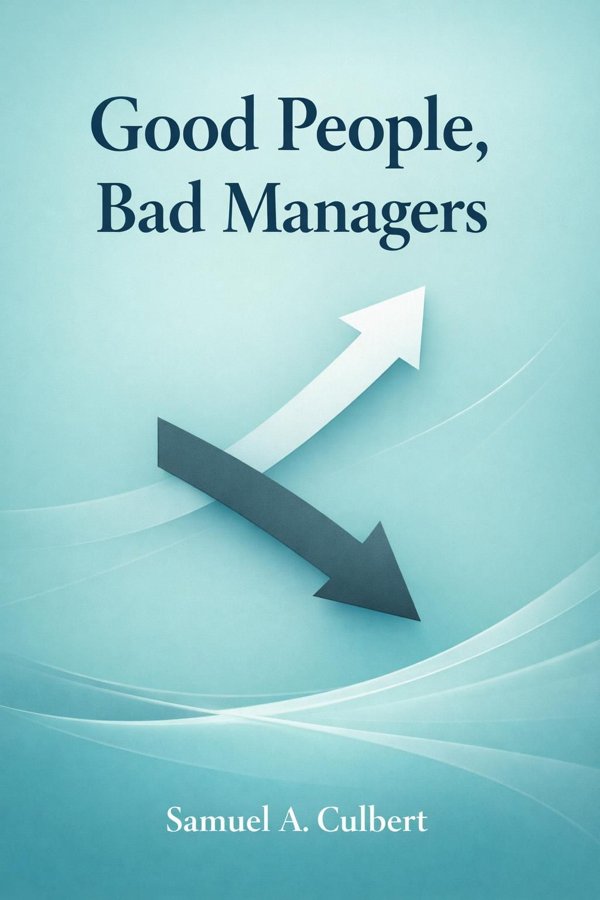
Good People, Bad Managers: How to Be a Better Leader: Summary & Key Insights
 10 min10 chaptersAudio available
What Is Good People, Bad Managers: How to Be a Better Leader About?
Good People, Bad Managers: How to Be a Better Leader by Samuel A. Culbert is a leadership book spanning 10 pages. In this book, Samuel A. Culbert explores how well-intentioned individuals often become ineffective or even harmful managers due to systemic organizational flaws and misguided management practices. He offers insights into how leaders can cultivate authenticity, trust, and accountability to create healthier workplace cultures.
This FizzRead summary covers all 10 key chapters of Good People, Bad Managers: How to Be a Better Leader in approximately 10 minutes, distilling the most important ideas, arguments, and takeaways from Samuel A. Culbert's work. Also available as an audio summary and Key Quotes Podcast.
Good People, Bad Managers: How to Be a Better Leader
In this book, Samuel A. Culbert explores how well-intentioned individuals often become ineffective or even harmful managers due to systemic organizational flaws and misguided management practices. He offers insights into how leaders can cultivate authenticity, trust, and accountability to create healthier workplace cultures.
Who Should Read Good People, Bad Managers: How to Be a Better Leader?
This book is perfect for anyone interested in leadership and looking to gain actionable insights in a short read. Whether you're a student, professional, or lifelong learner, the key ideas from Good People, Bad Managers: How to Be a Better Leader by Samuel A. Culbert will help you think differently.
- ✓Readers who enjoy leadership and want practical takeaways
- ✓Professionals looking to apply new ideas to their work and life
- ✓Anyone who wants the core insights of Good People, Bad Managers: How to Be a Better Leader in just 10 minutes
Want the full summary?
Get instant access to this book summary and 100K+ more with Fizz Moment.
Get Free SummaryAvailable on App Store • Free to download
Key Chapters
In the opening chapters, I tackle the heart of the dysfunction that turns good people into bad managers: systemic structures that reward self‑protection over honesty. Most organizations are built on performance metrics that measure people individually, isolate accountability, and therefore pit colleagues against one another. Managers operating under these systems quickly learn that admitting uncertainty or vulnerability is dangerous. They protect themselves through pretense.
I describe how the traditional model of management teaches people to behave inauthentically. It’s not that managers wake up wanting to be disingenuous. It’s that the organization punishes them for honesty. Performance ratings, rigid hierarchies, and artificial notions of objectivity all drive individuals to craft calculated images rather than cultivate genuine relationships. Good managers become bad because the environment demands conformity, not conscience.
Through years of consulting and observation, I’ve seen how these systems breed cynicism. A manager who tries to question the metrics or defend a struggling team member risks being labeled “not tough enough.” The result is a subtle but pervasive moral drift: people begin measuring success not by contribution, but by how smoothly they avoid blame. What we need, therefore, is a fundamental shift in perspective—from systems built on control to systems that reward truth telling and mutual trust.
Fear, I believe, is the silent killer of authentic management. In most workplaces, compliance masquerades as cooperation. Employees and managers alike learn the unspoken rule: do not contradict authority, do not reveal weakness, and certainly do not challenge the evaluation process. The organization thrives on predictability, but that predictability costs us innovation and honesty.
In this section, I examine how fear-based management techniques suppress the very creativity necessary for progress. Managers often rationalize coercive or overly directive behavior in the name of accountability. But true accountability cannot flourish where speaking the truth risks reprisal. When people stop communicating openly, problems get buried instead of solved. The organization begins to look like it’s functioning efficiently, but underneath, morale deteriorates and talent withers.
I encourage managers to see compliance not as loyalty but as an early warning sign. Teams that agree with everything, that stop arguing constructively, signal a deeply unhealthy dynamic. Only when managers model candor and tolerance for dissent can employees feel safe enough to innovate. Fear may keep the trains running on time, but it never sends them anywhere new.
+ 8 more chapters — available in the FizzRead app
All Chapters in Good People, Bad Managers: How to Be a Better Leader
About the Author
Samuel A. Culbert is a professor of management and organization at the UCLA Anderson School of Management. He is known for his research and writings on organizational behavior, management practices, and workplace dynamics, advocating for more honest and human-centered approaches to leadership.
Get This Summary in Your Preferred Format
Read or listen to the Good People, Bad Managers: How to Be a Better Leader summary by Samuel A. Culbert anytime, anywhere. FizzRead offers multiple formats so you can learn on your terms — all free.
Available formats: App · Audio · PDF · EPUB — All included free with FizzRead
Download Good People, Bad Managers: How to Be a Better Leader PDF and EPUB Summary
Key Quotes from Good People, Bad Managers: How to Be a Better Leader
“In the opening chapters, I tackle the heart of the dysfunction that turns good people into bad managers: systemic structures that reward self‑protection over honesty.”
“Fear, I believe, is the silent killer of authentic management.”
Frequently Asked Questions about Good People, Bad Managers: How to Be a Better Leader
Good People, Bad Managers: How to Be a Better Leader by Samuel A. Culbert is a leadership book that explores key ideas across 10 chapters. In this book, Samuel A. Culbert explores how well-intentioned individuals often become ineffective or even harmful managers due to systemic organizational flaws and misguided management practices. He offers insights into how leaders can cultivate authenticity, trust, and accountability to create healthier workplace cultures.
You Might Also Like

Extreme Ownership
Jocko Willink
10 min
Dare to Lead
Brene Brown
10 min
Leaders Eat Last
Simon Sinek
10 min
The 21 Irrefutable Laws of Leadership
John Maxwell
10 min
Start With Why
Simon Sinek
10 min
How to Lead When You're Not in Charge
Clay Scroggins
10 minBrowse by Category
Ready to read Good People, Bad Managers: How to Be a Better Leader?
Get the full summary and 100K+ more books with Fizz Moment.