
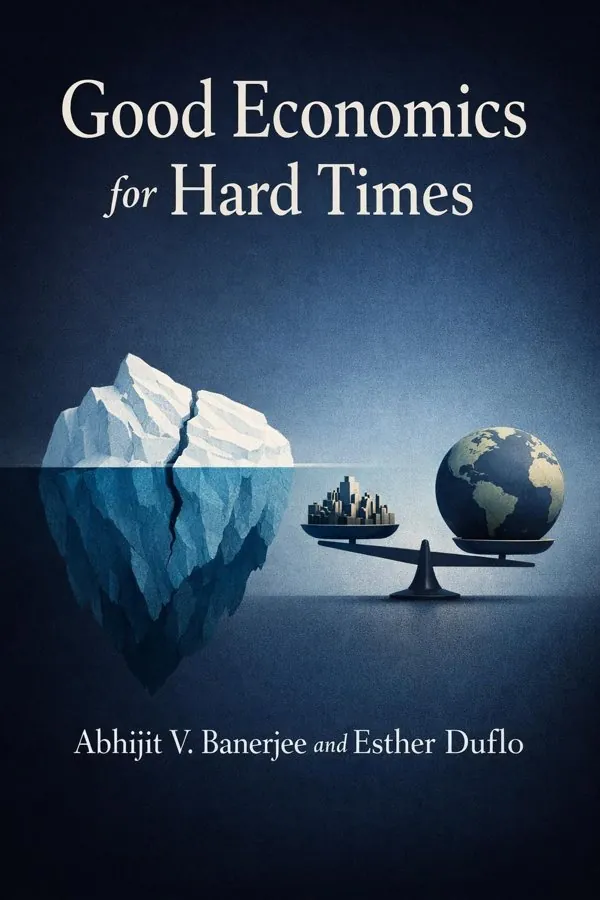
Good Economics for Hard Times: Better Answers to Our Biggest Problems: Summary & Key Insights
by Abhijit V. Banerjee, Esther Duflo
 10 min9 chaptersAudio available
What Is Good Economics for Hard Times: Better Answers to Our Biggest Problems About?
Good Economics for Hard Times: Better Answers to Our Biggest Problems by Abhijit V. Banerjee and Esther Duflo is a economics book spanning 9 pages. In this book, Nobel laureates Abhijit V. Banerjee and Esther Duflo explore pressing global economic issues such as inequality, immigration, trade, and climate change. Drawing on rigorous empirical research, they challenge conventional wisdom and propose evidence-based solutions to improve policy and human welfare. The authors argue for a more humane and realistic approach to economics that acknowledges complexity and uncertainty while focusing on what truly benefits people.
This FizzRead summary covers all 9 key chapters of Good Economics for Hard Times: Better Answers to Our Biggest Problems in approximately 10 minutes, distilling the most important ideas, arguments, and takeaways from Abhijit V. Banerjee and Esther Duflo's work. Also available as an audio summary and Key Quotes Podcast.
Good Economics for Hard Times: Better Answers to Our Biggest Problems
In this book, Nobel laureates Abhijit V. Banerjee and Esther Duflo explore pressing global economic issues such as inequality, immigration, trade, and climate change. Drawing on rigorous empirical research, they challenge conventional wisdom and propose evidence-based solutions to improve policy and human welfare. The authors argue for a more humane and realistic approach to economics that acknowledges complexity and uncertainty while focusing on what truly benefits people.
Who Should Read Good Economics for Hard Times: Better Answers to Our Biggest Problems?
This book is perfect for anyone interested in economics and looking to gain actionable insights in a short read. Whether you're a student, professional, or lifelong learner, the key ideas from Good Economics for Hard Times: Better Answers to Our Biggest Problems by Abhijit V. Banerjee and Esther Duflo will help you think differently.
- ✓Readers who enjoy economics and want practical takeaways
- ✓Professionals looking to apply new ideas to their work and life
- ✓Anyone who wants the core insights of Good Economics for Hard Times: Better Answers to Our Biggest Problems in just 10 minutes
Want the full summary?
Get instant access to this book summary and 100K+ more with Fizz Moment.
Get Free SummaryAvailable on App Store • Free to download
Key Chapters
For decades, the dominant story of economics was that growth was the tide that lifts all boats. If nations could expand their GDP fast enough, inequality would eventually shrink. Yet, as we look around the world today, that story rings hollow. Growth has not delivered for everyone. Median wages in many advanced economies are stagnant. Wealth increasingly concentrates at the top. Something fundamental is broken.
In this chapter, we confront the comforting myth that growth automatically produces inclusion. The relationship is far more complicated. Growth matters, yes, but the way it is generated and shared matters even more. In the United States, productivity has risen dramatically since the 1970s, yet most of those gains went to capital and top earners. People at the bottom saw little improvement in real income. In India, rapid growth has not eliminated poverty as thoroughly as many predicted, because structural barriers — from poor education to social exclusion — prevent equal participation.
The evidence tells us that inequality, once thought to be a necessary byproduct of growth, can in fact hinder it. When inequality becomes extreme, it erodes social trust, weakens demand, and breeds political instability. We argue that policies focusing solely on growth rates ignore the health of the economic ecosystem — the distribution of opportunity. The challenge is not choosing between growth and fairness, but designing growth that is inclusive and sustainable.
What economics must learn is empathy — the ability to see beyond aggregates to the experiences of individuals. When we listen to workers, small entrepreneurs, and families struggling to make ends meet, we discover that well-intentioned reforms often fail because they overlook human constraints. People respond not only to prices and incentives but to dignity, uncertainty, and social context. Real progress begins when we treat inequality not as an afterthought, but as the core problem to solve.
Immigration is perhaps the issue most clouded by fear and misinformation. In many countries, people believe immigrants take jobs from natives, depress wages, and strain public services. Yet decades of empirical research tell a different story. When economists trace the data carefully — studying cities before and after large inflows of migrants — they find little evidence of widespread harm to native workers. The opposite often occurs: immigrants complement local labor, creating new opportunities and fueling dynamism.
We invite readers to look past the rhetoric of scarcity. Jobs are not a fixed pie; economies adapt. Immigrants often take roles that natives avoid, enabling others to specialize and innovate. For example, when an influx of new workers enters a region, businesses reorganize, industries expand, and productivity increases. Wages may adjust temporarily, but the long-run effects are modest. What truly determines job security is not immigration but the overall strength of the labor market and the quality of institutions supporting workers during transitions.
Most importantly, we argue that immigration is about more than economics — it is a moral test. Societies that welcome strangers reveal their confidence in the future; those that fear them expose their fragility. Migrants bring skills, energy, and diversity, but above all, they bring renewal. When we reduce them to numbers in a balance sheet, we lose sight of our shared humanity. Evidence teaches us this: openness, managed wisely, enriches us all.
+ 7 more chapters — available in the FizzRead app
All Chapters in Good Economics for Hard Times: Better Answers to Our Biggest Problems
About the Authors
Abhijit V. Banerjee and Esther Duflo are professors of economics at the Massachusetts Institute of Technology and recipients of the 2019 Nobel Prize in Economic Sciences. They are co-founders of the Abdul Latif Jameel Poverty Action Lab (J-PAL) and are known for their pioneering work in development economics and poverty alleviation.
Get This Summary in Your Preferred Format
Read or listen to the Good Economics for Hard Times: Better Answers to Our Biggest Problems summary by Abhijit V. Banerjee and Esther Duflo anytime, anywhere. FizzRead offers multiple formats so you can learn on your terms — all free.
Available formats: App · Audio · PDF · EPUB — All included free with FizzRead
Download Good Economics for Hard Times: Better Answers to Our Biggest Problems PDF and EPUB Summary
Key Quotes from Good Economics for Hard Times: Better Answers to Our Biggest Problems
“For decades, the dominant story of economics was that growth was the tide that lifts all boats.”
“Immigration is perhaps the issue most clouded by fear and misinformation.”
Frequently Asked Questions about Good Economics for Hard Times: Better Answers to Our Biggest Problems
Good Economics for Hard Times: Better Answers to Our Biggest Problems by Abhijit V. Banerjee and Esther Duflo is a economics book that explores key ideas across 9 chapters. In this book, Nobel laureates Abhijit V. Banerjee and Esther Duflo explore pressing global economic issues such as inequality, immigration, trade, and climate change. Drawing on rigorous empirical research, they challenge conventional wisdom and propose evidence-based solutions to improve policy and human welfare. The authors argue for a more humane and realistic approach to economics that acknowledges complexity and uncertainty while focusing on what truly benefits people.
You Might Also Like

Business Adventures
John Brooks
10 min
Nudge
Richard H. Thaler, Cass R. Sunstein
10 min
The Hitchhiker"s Guide to the Galaxy
Douglas Adams
10 minThe Muqaddimah
Ibn Khaldun
10 minThe Outsiders
William N. Thorndike
10 min
A Little History of Economics
Niall Kishtainy
10 minBrowse by Category
Ready to read Good Economics for Hard Times: Better Answers to Our Biggest Problems?
Get the full summary and 100K+ more books with Fizz Moment.