
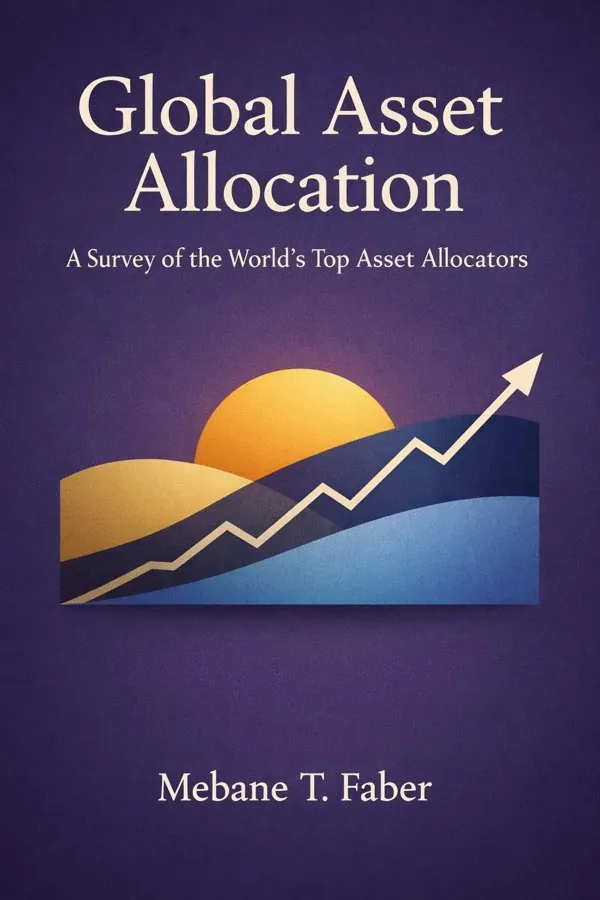
Global Asset Allocation: A Survey of the World's Top Asset Allocators: Summary & Key Insights
 10 min5 chaptersAudio available
What Is Global Asset Allocation: A Survey of the World's Top Asset Allocators About?
Global Asset Allocation: A Survey of the World's Top Asset Allocators by Mebane T. Faber is a finance book spanning 5 pages. This book by Mebane T. Faber examines the historical performance of major asset classes such as stocks, bonds, and cash, and explores how inflation affects investment returns. It surveys the asset allocation strategies of leading investors and institutions worldwide, comparing their long-term results and risk profiles. Faber provides insights into diversification principles and practical approaches to building globally balanced portfolios.
This FizzRead summary covers all 5 key chapters of Global Asset Allocation: A Survey of the World's Top Asset Allocators in approximately 10 minutes, distilling the most important ideas, arguments, and takeaways from Mebane T. Faber's work. Also available as an audio summary and Key Quotes Podcast.
Global Asset Allocation: A Survey of the World's Top Asset Allocators
This book by Mebane T. Faber examines the historical performance of major asset classes such as stocks, bonds, and cash, and explores how inflation affects investment returns. It surveys the asset allocation strategies of leading investors and institutions worldwide, comparing their long-term results and risk profiles. Faber provides insights into diversification principles and practical approaches to building globally balanced portfolios.
Who Should Read Global Asset Allocation: A Survey of the World's Top Asset Allocators?
This book is perfect for anyone interested in finance and looking to gain actionable insights in a short read. Whether you're a student, professional, or lifelong learner, the key ideas from Global Asset Allocation: A Survey of the World's Top Asset Allocators by Mebane T. Faber will help you think differently.
- ✓Readers who enjoy finance and want practical takeaways
- ✓Professionals looking to apply new ideas to their work and life
- ✓Anyone who wants the core insights of Global Asset Allocation: A Survey of the World's Top Asset Allocators in just 10 minutes
Want the full summary?
Get instant access to this book summary and 100K+ more with Fizz Moment.
Get Free SummaryAvailable on App Store • Free to download
Key Chapters
When we look at history, patterns emerge with remarkable consistency. Over the past century, investors have primarily relied on three core asset classes: stocks, bonds, and cash. Each plays a distinct role in a portfolio, each masking deep lessons about risk, reward, and time. Stocks, for instance, are the growth engine—volatile, often frighteningly so, but unmatched in long-term compounding power. Bonds serve as the counterweight, offering stability and income when equities falter. Cash, though seemingly inert, anchors liquidity and helps investors remain disciplined during storms.
When I examined historical returns stretching back over a hundred years, one truth stood out: returns cluster around patience. Stocks, across global markets, have delivered annualized real returns around 4–6% after inflation. Bonds tend to trail slightly, and cash typically just treads water when adjusted for purchasing power. But these numbers tell only part of the story. The real insight comes from volatility—how much pain an investor must endure to capture those returns. Stocks can lose half their value in a crisis; bonds rarely do. That asymmetry is vital. A portfolio that combines these assets thoughtfully doesn’t just survive—it endures.
I wanted readers to see how these assets behave not only individually but in relation to each other. When one zigged, the other often zagged. This natural tension is the beating heart of diversification. You are not diversifying merely for comfort; you are ensuring survival against the unknowable winds of inflation, deflation, and crisis. The global perspective is essential. A U.S.-centric investor might feel secure owning only domestic equities and bonds, but history is filled with examples—Japan’s lost decades, Europe’s financial shocks—where concentration became catastrophe. A global investor, by contrast, spreads risk across currencies, economies, and political regimes. You are not betting on any one story; you are investing in the collective narrative of human progress.
Inflation is the silent tax that erodes wealth over time, and unless we confront it head-on, even a positive nominal return can mask a real loss. Throughout my research, I’ve examined how inflation impacts every major asset class. Stocks tend to adjust over time, since companies can raise prices. Bonds, particularly nominal government bonds, are far more vulnerable—they promise fixed payments in a world where money’s value changes. Cash, the supposed safe haven, quietly loses purchasing power every single year.
Real returns—those adjusted for inflation—tell the true story. Without factoring inflation into your analysis, you’re reading markets through frosted glass. During eras like the 1970s, high inflation devastated traditional bondholders but rewarded owners of hard assets such as real estate, commodities, and gold. The lesson: to truly protect wealth, a portfolio must include assets that respond differently to changing inflation regimes.
Inflation is not predictable. No economist, no central bank, and certainly no investor can foresee its future path with accuracy. The only rational defense is preparation. A globally balanced portfolio acknowledges this uncertainty and incorporates assets with distinct inflation sensitivities. Stocks, bonds, real estate, and commodities together form a tapestry durable enough to withstand whatever economic weather comes our way. When inflation accelerates, hard assets counterbalance the drag. When deflation hits, bonds cushion the fall. This interplay is the engine of steady compounding over decades.
+ 3 more chapters — available in the FizzRead app
All Chapters in Global Asset Allocation: A Survey of the World's Top Asset Allocators
About the Author
Mebane T. Faber is the co-founder and Chief Investment Officer of Cambria Investment Management, LP. He manages Cambria’s ETFs and separate accounts and is known for his research on quantitative investment strategies and global asset allocation.
Get This Summary in Your Preferred Format
Read or listen to the Global Asset Allocation: A Survey of the World's Top Asset Allocators summary by Mebane T. Faber anytime, anywhere. FizzRead offers multiple formats so you can learn on your terms — all free.
Available formats: App · Audio · PDF · EPUB — All included free with FizzRead
Download Global Asset Allocation: A Survey of the World's Top Asset Allocators PDF and EPUB Summary
Key Quotes from Global Asset Allocation: A Survey of the World's Top Asset Allocators
“When we look at history, patterns emerge with remarkable consistency.”
“Inflation is the silent tax that erodes wealth over time, and unless we confront it head-on, even a positive nominal return can mask a real loss.”
Frequently Asked Questions about Global Asset Allocation: A Survey of the World's Top Asset Allocators
Global Asset Allocation: A Survey of the World's Top Asset Allocators by Mebane T. Faber is a finance book that explores key ideas across 5 chapters. This book by Mebane T. Faber examines the historical performance of major asset classes such as stocks, bonds, and cash, and explores how inflation affects investment returns. It surveys the asset allocation strategies of leading investors and institutions worldwide, comparing their long-term results and risk profiles. Faber provides insights into diversification principles and practical approaches to building globally balanced portfolios.
You Might Also Like





Browse by Category
Ready to read Global Asset Allocation: A Survey of the World's Top Asset Allocators?
Get the full summary and 100K+ more books with Fizz Moment.