
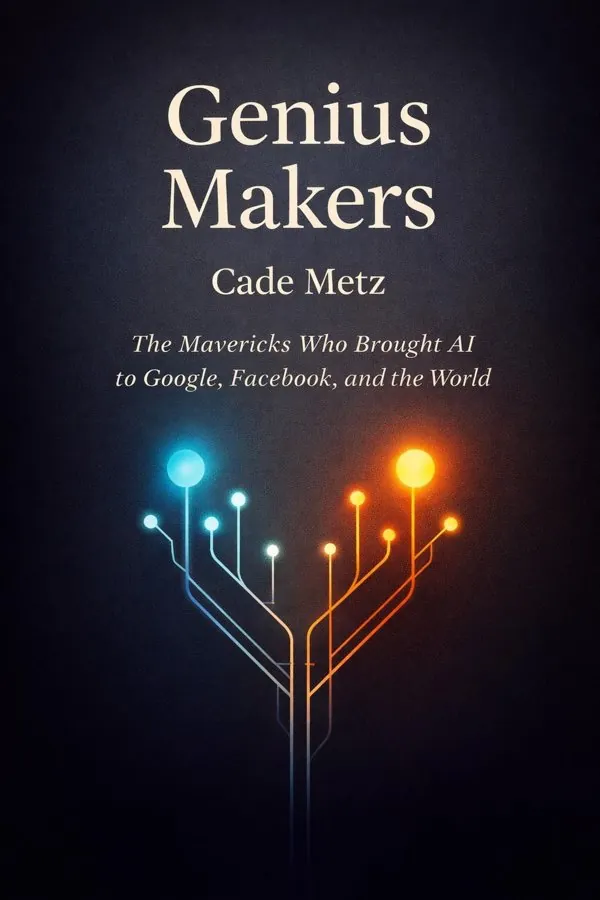
Genius Makers: The Mavericks Who Brought AI to Google, Facebook, and the World: Summary & Key Insights
by Cade Metz
 10 min4 chaptersAudio available
What Is Genius Makers: The Mavericks Who Brought AI to Google, Facebook, and the World About?
Genius Makers: The Mavericks Who Brought AI to Google, Facebook, and the World by Cade Metz is a ai_ml book spanning 4 pages. Genius Makers is a nonfiction account of the rise of artificial intelligence, chronicling the scientists, engineers, and entrepreneurs who transformed AI from a niche academic pursuit into a global technological revolution. Cade Metz explores the rivalries, breakthroughs, and ethical dilemmas that shaped the field, focusing on key figures at Google, Facebook, and other major institutions.
This FizzRead summary covers all 4 key chapters of Genius Makers: The Mavericks Who Brought AI to Google, Facebook, and the World in approximately 10 minutes, distilling the most important ideas, arguments, and takeaways from Cade Metz's work. Also available as an audio summary and Key Quotes Podcast.
Genius Makers: The Mavericks Who Brought AI to Google, Facebook, and the World
Genius Makers is a nonfiction account of the rise of artificial intelligence, chronicling the scientists, engineers, and entrepreneurs who transformed AI from a niche academic pursuit into a global technological revolution. Cade Metz explores the rivalries, breakthroughs, and ethical dilemmas that shaped the field, focusing on key figures at Google, Facebook, and other major institutions.
Who Should Read Genius Makers: The Mavericks Who Brought AI to Google, Facebook, and the World?
This book is perfect for anyone interested in ai_ml and looking to gain actionable insights in a short read. Whether you're a student, professional, or lifelong learner, the key ideas from Genius Makers: The Mavericks Who Brought AI to Google, Facebook, and the World by Cade Metz will help you think differently.
- ✓Readers who enjoy ai_ml and want practical takeaways
- ✓Professionals looking to apply new ideas to their work and life
- ✓Anyone who wants the core insights of Genius Makers: The Mavericks Who Brought AI to Google, Facebook, and the World in just 10 minutes
Want the full summary?
Get instant access to this book summary and 100K+ more with Fizz Moment.
Get Free SummaryAvailable on App Store • Free to download
Key Chapters
Artificial intelligence began in the 1950s with bold ambition. Researchers like Marvin Minsky and John McCarthy dreamed of creating machines that could think, yet progress faltered under the weight of unrealistic expectations. The early enthusiasm was followed by what came to be known as the AI winters — barren decades when funding vanished and once‑promising scientists abandoned the field. The dream of thinking machines never died completely, but it was buried beneath layers of skepticism.
In the late twentieth century, a few loyalists quietly nurtured the flame. Among them was Geoffrey Hinton, a British cognitive psychologist turned computer scientist. Hinton inherited an unusual legacy: his great‑grandfather George Boole had invented Boolean logic, the mathematical bedrock of computing. But Geoffrey’s vision was not logic; it was biology. He believed intelligence arose from patterns of activation across vast networks of neurons, and that computers could be built the same way. For decades, his faith in neural networks was almost a professional liability. Colleagues dismissed it as naïve, and even friendly peers warned him to move on.
That endurance defined a generation. Yoshua Bengio in Montreal and Yann LeCun in New York shared similar convictions, though often isolated from one another. They traded ideas at obscure conferences, published papers that few read, and maintained a belief in “deep learning” long before it had a name. In the 1980s and 1990s, the computing power and data required to make these networks useful simply didn’t exist. The trio’s careers became exercises in patience and intellectual resilience. They kept refining theories and teaching students who might, someday, have faster machines to test them.
The breakthrough, when it came, was as much cultural as technical. By the early 2000s, data from the burgeoning internet and the exponential rise in computing power finally converged. Neural networks no longer seemed fanciful; they began outperforming traditional systems on problems like speech recognition and image classification. For Hinton, Bengio, and LeCun, the long winter was thawing. Their perseverance — and a willingness to swim against scientific consensus — reopened the gates of AI research. The world was about to notice.
The defining moment of the AI renaissance arrived in 2012, when Hinton and two of his graduate students at the University of Toronto — Alex Krizhevsky and Ilya Sutskever — achieved a stunning victory in an international image recognition contest. Their algorithm, built on deep convolutional neural networks, crushed previous competitors. The achievement was proof that neural networks could not just match but decisively outperform traditional methods. That victory rippled through academia and industry, igniting a fire that would soon engulf Silicon Valley.
Google moved quickly. The company, already a temple of data, recognized that deep learning could revolutionize search, speech, and image tools. In 2013, it acquired Hinton’s startup, DNNresearch, and brought his small team into its fold. This wasn’t merely an acquisition of code but of vision: Google bet its future on the notion that computers could teach themselves from data. Deep learning began migrating into Gmail’s spam filters, YouTube’s recommendations, and later into the development of autonomous cars and intelligent assistants.
Facebook, unwilling to be left behind, made its own bold move. It recruited Yann LeCun to lead an ambitious new AI laboratory. LeCun, with his signature combination of rebellious intellect and charm, built a research culture that prized both scientific purity and practical deployment. At Facebook, deep learning powered facial recognition and content curation, transforming how billions experienced their digital lives. Similar efforts blossomed at Microsoft and Baidu, while OpenAI — the emerging nonprofit backed by Elon Musk and Sam Altman — dedicated itself to ensuring that artificial intelligence would develop safely for humanity.
This corporate competition reshaped science itself. Where once AI work had languished in academic obscurity, it now attracted multimillion‑dollar salaries and entire teams of researchers. The same individuals once dismissed as dreamers became top prizes in a global talent war. Universities felt the drain of their brightest minds moving to industry, yet the collaboration also accelerated ideas. For a brief period, science and commerce shared a common horizon: building machines that could learn, perceive, and adapt almost like living beings.
But amid the triumph, deeper questions emerged. Could these systems ever truly “understand”? Would progress inevitably lead toward superintelligent machines beyond human control? Even within this new generation of AI pioneers, the answers diverged sharply.
+ 2 more chapters — available in the FizzRead app
All Chapters in Genius Makers: The Mavericks Who Brought AI to Google, Facebook, and the World
About the Author
Cade Metz is a technology correspondent for The New York Times, covering artificial intelligence, driverless cars, robotics, virtual reality, and other emerging technologies. Before joining the Times, he wrote for Wired magazine and has been recognized for his in-depth reporting on the tech industry.
Get This Summary in Your Preferred Format
Read or listen to the Genius Makers: The Mavericks Who Brought AI to Google, Facebook, and the World summary by Cade Metz anytime, anywhere. FizzRead offers multiple formats so you can learn on your terms — all free.
Available formats: App · Audio · PDF · EPUB — All included free with FizzRead
Download Genius Makers: The Mavericks Who Brought AI to Google, Facebook, and the World PDF and EPUB Summary
Key Quotes from Genius Makers: The Mavericks Who Brought AI to Google, Facebook, and the World
“Artificial intelligence began in the 1950s with bold ambition.”
“Their algorithm, built on deep convolutional neural networks, crushed previous competitors.”
Frequently Asked Questions about Genius Makers: The Mavericks Who Brought AI to Google, Facebook, and the World
Genius Makers: The Mavericks Who Brought AI to Google, Facebook, and the World by Cade Metz is a ai_ml book that explores key ideas across 4 chapters. Genius Makers is a nonfiction account of the rise of artificial intelligence, chronicling the scientists, engineers, and entrepreneurs who transformed AI from a niche academic pursuit into a global technological revolution. Cade Metz explores the rivalries, breakthroughs, and ethical dilemmas that shaped the field, focusing on key figures at Google, Facebook, and other major institutions.
You Might Also Like
Life 3.0
Max Tegmark
10 min
Superintelligence
Nick Bostrom
10 min
TensorFlow in Action
Thushan Ganegedara
10 min
AI Made Simple: A Beginner’s Guide to Generative AI, ChatGPT, and the Future of Work
Rajeev Kapur
10 min
AI Snake Oil
Arvind Narayanan, Sayash Kapoor
10 min
AI Superpowers: China, Silicon Valley, and the New World Order
Kai-Fu Lee
10 minBrowse by Category
Ready to read Genius Makers: The Mavericks Who Brought AI to Google, Facebook, and the World?
Get the full summary and 100K+ more books with Fizz Moment.