
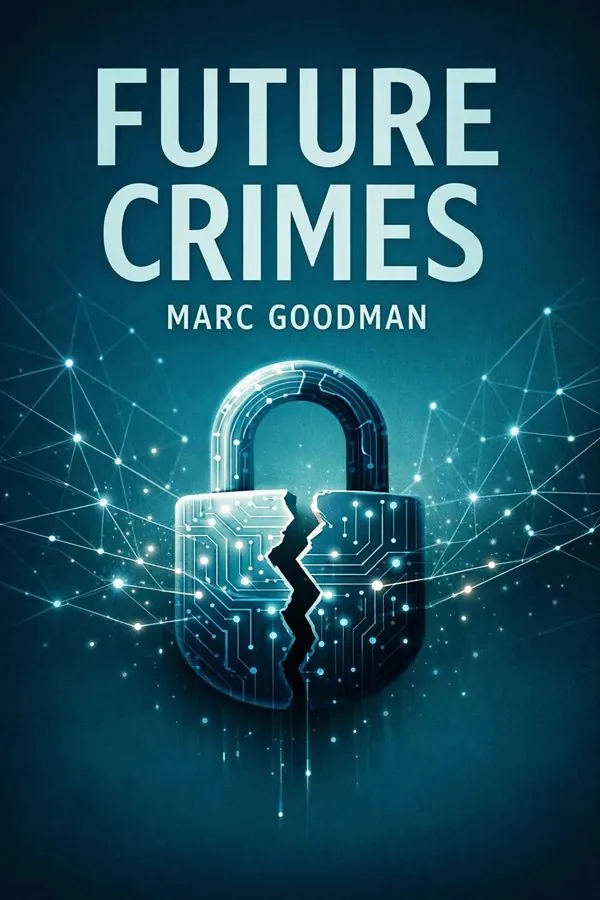
Future Crimes: Everything Is Connected, Everyone Is Vulnerable, and What We Can Do About It: Summary & Key Insights
by Marc Goodman
 10 min12 chaptersAudio available
What Is Future Crimes: Everything Is Connected, Everyone Is Vulnerable, and What We Can Do About It About?
Future Crimes: Everything Is Connected, Everyone Is Vulnerable, and What We Can Do About It by Marc Goodman is a digital_culture book spanning 12 pages. Future Crimes es una exploración profunda del lado oscuro de la innovación tecnológica. Marc Goodman, experto en seguridad global, revela cómo los delincuentes, las corporaciones y los gobiernos están utilizando las nuevas tecnologías para explotar vulnerabilidades en nuestra vida digital. El libro ofrece una mirada inquietante a los riesgos del mundo conectado y propone estrategias para protegernos en la era de la información.
This FizzRead summary covers all 12 key chapters of Future Crimes: Everything Is Connected, Everyone Is Vulnerable, and What We Can Do About It in approximately 10 minutes, distilling the most important ideas, arguments, and takeaways from Marc Goodman's work. Also available as an audio summary and Key Quotes Podcast.
Future Crimes: Everything Is Connected, Everyone Is Vulnerable, and What We Can Do About It
Future Crimes es una exploración profunda del lado oscuro de la innovación tecnológica. Marc Goodman, experto en seguridad global, revela cómo los delincuentes, las corporaciones y los gobiernos están utilizando las nuevas tecnologías para explotar vulnerabilidades en nuestra vida digital. El libro ofrece una mirada inquietante a los riesgos del mundo conectado y propone estrategias para protegernos en la era de la información.
Who Should Read Future Crimes: Everything Is Connected, Everyone Is Vulnerable, and What We Can Do About It?
This book is perfect for anyone interested in digital_culture and looking to gain actionable insights in a short read. Whether you're a student, professional, or lifelong learner, the key ideas from Future Crimes: Everything Is Connected, Everyone Is Vulnerable, and What We Can Do About It by Marc Goodman will help you think differently.
- ✓Readers who enjoy digital_culture and want practical takeaways
- ✓Professionals looking to apply new ideas to their work and life
- ✓Anyone who wants the core insights of Future Crimes: Everything Is Connected, Everyone Is Vulnerable, and What We Can Do About It in just 10 minutes
Want the full summary?
Get instant access to this book summary and 100K+ more with Fizz Moment.
Get Free SummaryAvailable on App Store • Free to download
Key Chapters
If you could visualize all the digital threads tying your life together, you’d see a glittering web stretching across continents. Your smartphone, thermostat, credit card, car — all of it feeds into the Internet of Things, creating a data portrait richer than any spy agency could dream of a generation ago. In *Future Crimes*, I describe this web as both miraculous and perilous. Each connection is an entry point; every sensor, camera, and app broadens the attack surface for those seeking exploitation. Criminals don’t hack walls anymore; they hack people, habits, systems.
When I speak of systemic vulnerability, I mean the inherent fragility built into networked living. Most people trust their devices implicitly, believing updates and passwords suffice. But beneath that veneer lies a digital ecosystem never designed with security as its foundation. The creators of early computing were pioneers aiming for functionality, not fortress-level defense. Now, billions of devices built on their open-ended architecture share personal data promiscuously. The same openness that fueled innovation also created unguarded gateways.
I recall interviewing experts who demonstrated how baby monitors could be hijacked, how pacemakers were remotely accessible, and how traffic systems could be diverted from afar. These aren’t paranoid hypotheticals — they happened. The irony is that as we strive for seamless interconnectivity, we weave a net that captures ourselves. My goal in unveiling these examples isn’t to shun technology but to demand awareness: every connection is a responsibility. The convenience of connection must be matched by the discipline of protection.
Innovation, in its purest form, is liberation. It unleashes creativity, democratizes voice, and accelerates progress. But as I argue in *Future Crimes*, the darker corollary is equally powerful: every innovation can be twisted into exploitation. Social media promises connection yet enables manipulation; cloud computing offers efficiency yet becomes a vault of personal secrets vulnerable to intrusion; big data seeks insight but often morphs into surveillance. The same algorithms predicting consumer behavior can weaponize misinformation.
Throughout my career, I witnessed how technological optimism blinds society to risk. Silicon Valley’s mantra of ‘move fast and break things’ reverberates far beyond app development. When those broken things are privacy, trust, or identity, the costs transcend profit margins. The fragility of the digital ecosystem isn’t just a technical issue — it’s cultural. We applaud convenience without questioning consequence, valuing free services without realizing we pay with data.
The lesson I emphasize is accountability. Innovation must carry ethical ballast, a recognition that capability alone isn’t virtue. When humans design systems, they embed human biases and vulnerabilities. To safeguard our future, innovation must evolve with conscience. If not, the dark side — the exploitation, manipulation, and misuse — will continue to outpace our moral development.
+ 10 more chapters — available in the FizzRead app
All Chapters in Future Crimes: Everything Is Connected, Everyone Is Vulnerable, and What We Can Do About It
About the Author
Marc Goodman es un experto en seguridad global y tecnología, con experiencia en el FBI, Interpol y la ONU. Ha asesorado a gobiernos y empresas sobre ciberseguridad y el impacto de la tecnología en la seguridad pública. Future Crimes es su obra más conocida, donde combina su experiencia en criminología y tecnología para alertar sobre los peligros del futuro digital.
Get This Summary in Your Preferred Format
Read or listen to the Future Crimes: Everything Is Connected, Everyone Is Vulnerable, and What We Can Do About It summary by Marc Goodman anytime, anywhere. FizzRead offers multiple formats so you can learn on your terms — all free.
Available formats: App · Audio · PDF · EPUB — All included free with FizzRead
Download Future Crimes: Everything Is Connected, Everyone Is Vulnerable, and What We Can Do About It PDF and EPUB Summary
Key Quotes from Future Crimes: Everything Is Connected, Everyone Is Vulnerable, and What We Can Do About It
“If you could visualize all the digital threads tying your life together, you’d see a glittering web stretching across continents.”
“Innovation, in its purest form, is liberation.”
Frequently Asked Questions about Future Crimes: Everything Is Connected, Everyone Is Vulnerable, and What We Can Do About It
Future Crimes: Everything Is Connected, Everyone Is Vulnerable, and What We Can Do About It by Marc Goodman is a digital_culture book that explores key ideas across 12 chapters. Future Crimes es una exploración profunda del lado oscuro de la innovación tecnológica. Marc Goodman, experto en seguridad global, revela cómo los delincuentes, las corporaciones y los gobiernos están utilizando las nuevas tecnologías para explotar vulnerabilidades en nuestra vida digital. El libro ofrece una mirada inquietante a los riesgos del mundo conectado y propone estrategias para protegernos en la era de la información.
You Might Also Like
An Ugly Truth: Inside Facebook’s Battle for Domination
Sheera Frenkel, Cecilia Kang
10 min
Cyber Citizens
Ian Goodfellow
10 min
Digital Minimalism: Choosing a Focused Life in a Noisy World
Cal Newport
10 min
E‑Books & Beyond
Various Authors
10 min
The Future of Media
Various Authors
10 min
This Is Why We Can't Have Nice Things
Whitney Phillips
10 minBrowse by Category
Ready to read Future Crimes: Everything Is Connected, Everyone Is Vulnerable, and What We Can Do About It?
Get the full summary and 100K+ more books with Fizz Moment.