
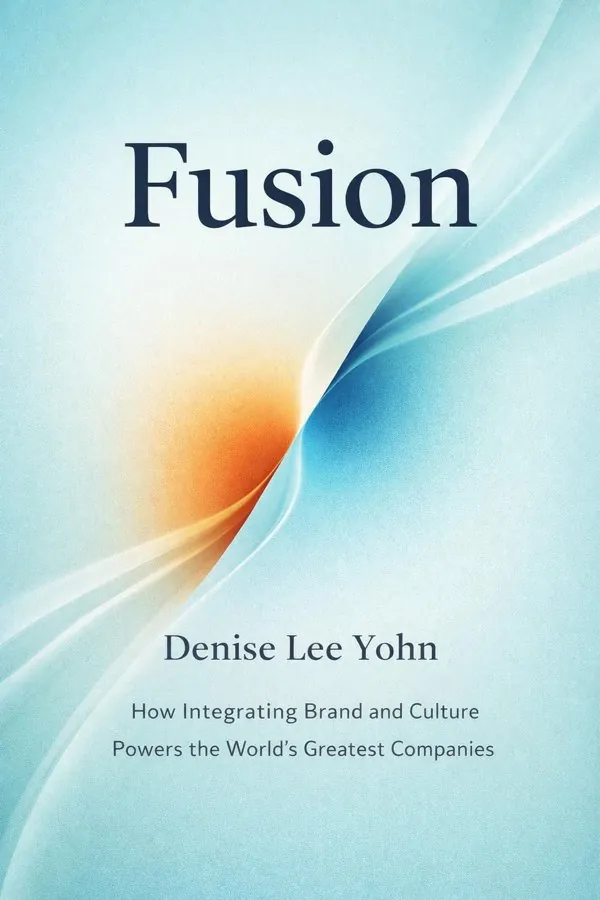
Fusion: How Integrating Brand and Culture Powers the World's Greatest Companies: Summary & Key Insights
 10 min9 chaptersAudio available
Key Takeaways from Fusion: How Integrating Brand and Culture Powers the World's Greatest Companies
The most dangerous gap in business is often invisible: the distance between what a company says and what its people actually experience.
A company cannot align what it has never clearly defined.
Misalignment rarely announces itself dramatically at first; it appears as friction.
People do their best work when they know not just what they are doing, but why it matters.
Customers are not the only audience a brand serves; employees experience the brand first.
What Is Fusion: How Integrating Brand and Culture Powers the World's Greatest Companies About?
Fusion: How Integrating Brand and Culture Powers the World's Greatest Companies by Denise Lee Yohn is a leadership book spanning 12 pages. Most companies work on brand and culture as if they were separate projects: marketing defines the message, while HR shapes the workplace. Denise Lee Yohn argues that this split is one of the most expensive mistakes leaders make. In Fusion, she shows that the world’s strongest organizations win because their external brand promise and internal employee experience reinforce each other. Customers trust them more, employees perform with greater clarity, and leaders make decisions with stronger consistency. This idea matters because people now experience companies from every angle at once. Employees post online, customers compare promises with reality instantly, and reputation is shaped as much by internal behavior as by advertising. A polished brand cannot survive a broken culture, and a healthy culture cannot create full value if it does not support a distinctive market identity. Yohn writes with unusual authority. A respected brand expert and consultant to major companies, she combines strategic insight with practical tools leaders can apply across hiring, onboarding, operations, leadership, and performance management. Fusion is a leadership guide for anyone who wants to build an organization that is coherent, credible, and built to endure.
This FizzRead summary covers all 9 key chapters of Fusion: How Integrating Brand and Culture Powers the World's Greatest Companies in approximately 10 minutes, distilling the most important ideas, arguments, and takeaways from Denise Lee Yohn's work. Also available as an audio summary and Key Quotes Podcast.
Fusion: How Integrating Brand and Culture Powers the World's Greatest Companies
Most companies work on brand and culture as if they were separate projects: marketing defines the message, while HR shapes the workplace. Denise Lee Yohn argues that this split is one of the most expensive mistakes leaders make. In Fusion, she shows that the world’s strongest organizations win because their external brand promise and internal employee experience reinforce each other. Customers trust them more, employees perform with greater clarity, and leaders make decisions with stronger consistency.
This idea matters because people now experience companies from every angle at once. Employees post online, customers compare promises with reality instantly, and reputation is shaped as much by internal behavior as by advertising. A polished brand cannot survive a broken culture, and a healthy culture cannot create full value if it does not support a distinctive market identity.
Yohn writes with unusual authority. A respected brand expert and consultant to major companies, she combines strategic insight with practical tools leaders can apply across hiring, onboarding, operations, leadership, and performance management. Fusion is a leadership guide for anyone who wants to build an organization that is coherent, credible, and built to endure.
Who Should Read Fusion: How Integrating Brand and Culture Powers the World's Greatest Companies?
This book is perfect for anyone interested in leadership and looking to gain actionable insights in a short read. Whether you're a student, professional, or lifelong learner, the key ideas from Fusion: How Integrating Brand and Culture Powers the World's Greatest Companies by Denise Lee Yohn will help you think differently.
- ✓Readers who enjoy leadership and want practical takeaways
- ✓Professionals looking to apply new ideas to their work and life
- ✓Anyone who wants the core insights of Fusion: How Integrating Brand and Culture Powers the World's Greatest Companies in just 10 minutes
Want the full summary?
Get instant access to this book summary and 100K+ more with Fizz Moment.
Get Free SummaryAvailable on App Store • Free to download
Key Chapters
The most dangerous gap in business is often invisible: the distance between what a company says and what its people actually experience. Many organizations invest heavily in brand campaigns, customer messaging, and visual identity, yet neglect the internal environment that should make those promises real. Denise Lee Yohn’s central argument is that when brand and culture drift apart, the organization begins to fracture. Employees grow cynical, customers sense inconsistency, and leaders spend increasing energy managing problems that should never have emerged.
Brand, in Yohn’s view, is not just a logo or a slogan. It is the promise a company makes to the market about the value and experience it intends to deliver. Culture is the system of values, norms, assumptions, and behaviors that shape how employees work every day. Fusion happens when these two forces are deliberately integrated so employees can naturally deliver the brand promise through their decisions and behavior.
Consider a company that markets itself as innovative but punishes risk-taking internally. Or one that promotes personalized service while measuring employees only on speed and efficiency. In both cases, the brand promise collapses under operational reality. By contrast, companies with strong fusion create a clear through-line: what they say externally is supported by how they hire, train, lead, reward, and organize internally.
The practical implication is simple but profound: do not ask whether your brand strategy and culture strategy are both strong. Ask whether they strengthen each other. Audit your customer promise against employee reality, identify where they conflict, and prioritize alignment as a leadership responsibility.
A company cannot align what it has never clearly defined. One reason brand-culture efforts fail is that leaders use both terms loosely. Brand gets reduced to marketing communications, while culture gets treated as morale, perks, or office atmosphere. Yohn cuts through this confusion by giving each concept strategic weight. Brand is the external expression of your purpose and value. Culture is the internal engine that determines whether your people can consistently deliver it.
This distinction matters because many executives believe they already have both. They have a brand guide, a mission statement, and maybe a list of values on the wall. But documents are not definitions unless they guide action. A useful brand definition identifies what you stand for, whom you serve, what experience you intend to create, and why customers should believe you. A useful culture definition identifies the mindsets and behaviors employees must embody to make that promise real.
For example, if a hospitality brand promises warmth and effortless service, its culture cannot be built around rigid hierarchy and script-following alone. It must encourage attentiveness, judgment, empathy, and responsiveness. If a company positions itself as a low-cost, no-frills provider, its culture should prize efficiency, discipline, and smart resource use rather than excessive complexity or bureaucracy.
Leaders should translate both ideas into observable, operational language. Instead of saying, “We value excellence,” define what excellence looks like in sales calls, meetings, product reviews, and customer recovery. Instead of claiming, “Our brand is innovative,” identify what kinds of experimentation are expected, how risk is evaluated, and what behaviors earn recognition.
Action step: write one short statement describing your brand promise and one describing the employee behaviors required to fulfill it. If those statements do not connect naturally, your work on fusion has not yet begun.
Misalignment rarely announces itself dramatically at first; it appears as friction. Customers feel one thing, employees feel another, and leaders explain away the disconnect as temporary. Yohn warns that the brand-culture gap tends to widen unless it is addressed deliberately. Over time, it produces customer disappointment, disengaged employees, mixed decision-making, and a reputation that no amount of marketing can repair.
The gap usually emerges in predictable ways. Leadership may launch a bold brand repositioning without changing internal processes. A company may grow quickly through acquisition and inherit multiple subcultures that contradict the parent brand. Incentives may reward behaviors that undermine the customer promise. Sometimes the problem is symbolic: executives promote collaboration while operating in silos, or celebrate empowerment while requiring multiple layers of approval.
To close the gap, Yohn suggests leaders diagnose both sides of the equation. What does the company promise customers? What do employees actually believe is rewarded? What stories circulate internally? What experiences do customers consistently report? Surveys, interviews, onboarding feedback, customer complaints, performance metrics, and even informal language can reveal hidden contradictions.
Imagine a retailer that promises effortless shopping but burdens store employees with cumbersome systems and conflicting directives. The customer sees long lines and disengaged staff. The solution is not a new ad campaign; it is redesigning tools, roles, expectations, and leadership behavior so employees can create the ease the brand promises.
A useful exercise is to map the customer journey alongside the employee journey. At each stage, ask: what employee behavior creates this customer experience, and what in our culture supports or blocks that behavior? Action takeaway: identify your top three brand promises and test whether current management practices make them easier or harder to deliver.
People do their best work when they know not just what they are doing, but why it matters. Yohn emphasizes that fusion starts with a clearly articulated brand purpose and a coherent set of core values. Purpose gives the organization meaning beyond transactions. Values convert that meaning into decision rules. Without them, brand and culture become vague aspirations rather than a practical operating system.
A strong purpose is specific enough to guide choices and broad enough to inspire. It should explain the difference the organization seeks to make in customers’ lives and the market. Core values should then identify the principles and behaviors that support that purpose. The mistake many companies make is choosing generic values such as integrity, teamwork, and excellence without defining how those ideas uniquely connect to the brand.
Suppose a health company’s purpose is to make wellness simple and accessible. Its values might include clarity, empathy, and accountability. But those words only matter if they are translated into expectations: communications must be understandable, services must reduce friction, employees must proactively solve customer problems, and leaders must remove complexity from internal processes as well.
Precision also helps when trade-offs arise. Values should not merely describe admirable traits; they should guide difficult decisions. If speed is central to the brand, teams may be expected to prefer progress over perfection in some contexts. If craftsmanship defines the brand, the culture must defend quality even under pressure.
Yohn’s insight is that purpose and values must be operationalized across recruiting, onboarding, evaluation, and daily rituals. Action takeaway: revisit your stated values and rewrite each one as a behavior standard. If employees cannot explain what a value looks like in practice, it is too abstract to support fusion.
Customers are not the only audience a brand serves; employees experience the brand first. Yohn argues that if organizations want workers to deliver a distinct customer experience, they must design a correspondingly distinct employee experience. Culture is shaped not just by speeches and values statements, but by what it feels like to be recruited, trained, managed, developed, and recognized inside the company.
This means every people process should reflect the brand. Hiring should screen for traits that fit the promise. Onboarding should immerse new employees in the company’s purpose, standards, and stories. Training should teach not just tasks, but how to make brand-aligned decisions. Internal communications, workspace design, rituals, and recognition systems should all reinforce what the organization stands for.
For example, a premium service brand should not onboard employees through a rushed, impersonal, checkbox process. A company that claims to be creative should avoid excessive bureaucracy in approvals and experimentation. A business known for reliability should ensure employees experience consistency, clarity, and follow-through from their leaders. Employees absorb what the company truly values by how it treats them, not by what appears on posters.
Yohn’s broader point is that employee experience is not a separate HR concern. It is part of brand strategy. If workers feel confused, undervalued, or constrained, the customer will eventually feel the effects too. When employee experience mirrors customer experience, staff can deliver the brand authentically rather than mechanically.
A practical way to apply this is to map the employee lifecycle from recruiting to exit and ask at each stage: what should this experience communicate about who we are? Action takeaway: choose one employee touchpoint this quarter, such as onboarding or performance reviews, and redesign it so it visibly expresses your brand promise.
Employees do not learn culture from value statements alone; they learn it by watching leaders. Yohn stresses that brand-culture fusion rises or falls with leadership alignment. When executives, managers, and frontline leaders behave inconsistently with the brand, employees receive a more powerful message than any official communication could deliver. The organization’s real culture becomes whatever leadership repeatedly tolerates and rewards.
Aligned leaders do three things well. First, they embody the brand personally. Their decisions, communication style, priorities, and treatment of others should reflect the organization’s stated identity. Second, they translate the brand into the language of their teams. A finance leader, operations manager, and HR partner may support the same brand in different ways, but all must connect their function to the same promise. Third, they reinforce alignment through accountability. When behaviors contradict the brand, leaders address them instead of excusing results-only performance.
This is especially important during growth, change, and crisis. Under pressure, organizations revert to their true operating norms. If leadership alignment is weak, departments pull in different directions and employees become confused about what matters. If alignment is strong, the company can move quickly without losing coherence.
Consider a business that claims to empower employees but whose managers override every decision. Staff will quickly conclude that control, not empowerment, is the real norm. Conversely, when leaders consistently trust teams within clear guardrails, the cultural message becomes believable.
Yohn makes leadership a structural issue, not just a personal virtue. Leaders must be selected, developed, and evaluated based on their ability to carry the brand through culture. Action takeaway: ask each senior leader to explain how their team directly advances the brand promise and what behaviors they expect from managers. If answers differ sharply, alignment needs work.
Fusion is not an exercise in symbolism; it is a performance system. Yohn argues that integrating brand and culture produces measurable business results because it reduces internal friction and improves execution. When employees understand the brand and experience a culture that supports it, they make better decisions faster. They require less supervision, serve customers more consistently, and contribute to a clearer market position.
This matters because strategy often fails in the space between intention and execution. Leaders may define ambitious growth plans, customer experience targets, or innovation goals, but if the culture does not support the required behavior, outcomes fall short. Fusion closes that execution gap by ensuring people know what kind of company they are building and how to act accordingly.
The benefits show up across multiple dimensions. Customers receive a more reliable experience, which strengthens trust and loyalty. Employees experience meaning and clarity, which can improve engagement and retention. Managers make trade-offs with greater consistency because the brand provides a filter. Investors and partners gain confidence when the organization demonstrates coherence rather than contradiction.
Yohn also highlights that fusion helps companies stand out in crowded markets. Competitors can imitate products and campaigns more easily than they can replicate a deeply integrated culture. A company whose internal norms naturally produce its external advantage builds a more defensible position.
To apply this idea, leaders should connect fusion to strategic priorities rather than treating it as an abstract initiative. If your company wants faster innovation, ask whether the culture supports experimentation that fits the brand. If you want premium service, ask whether staffing, incentives, and management practices make that possible.
Action takeaway: choose one major business KPI, such as retention, customer satisfaction, or speed to market, and identify the brand and culture behaviors that most directly influence it. Then manage those behaviors as seriously as the metric itself.
A compelling idea becomes transformative only when it is built into systems. Yohn is careful not to present fusion as a one-time workshop or inspiring message from the CEO. It must be implemented through structures, processes, metrics, and routines that make alignment repeatable. Otherwise, momentum fades and the organization slides back into compartmentalized thinking.
Implementation starts with cross-functional ownership. Brand cannot remain in marketing, and culture cannot remain in HR. Leaders from operations, finance, people, customer experience, and communications all influence whether the company lives its promise. Shared governance helps organizations identify contradictions early and maintain alignment as they scale.
Measurement is equally important. Companies should track both internal and external indicators to understand whether fusion is working. On the external side, this may include customer satisfaction, brand perception, loyalty, and service consistency. On the internal side, leaders can monitor engagement, retention, quality of hiring, onboarding effectiveness, manager capability, and the extent to which employees understand and can act on the brand.
Qualitative signals matter too. What stories are employees telling? Do customers describe the experience in the language the brand intends? Are managers using values in decision-making, or only in ceremonial settings? These clues often reveal the health of fusion before financial results do.
Sustaining fusion requires periodic recalibration. As markets evolve, the brand may sharpen or expand. As the company grows, culture becomes harder to preserve through informal means alone. That is why Yohn encourages organizations to revisit alignment regularly, especially after leadership changes, acquisitions, rapid hiring, or strategy shifts.
Action takeaway: build a simple fusion dashboard with a few employee, customer, and operational measures. Review it quarterly with senior leadership and ask not just how the business is performing, but whether brand and culture are reinforcing each other.
The real test of organizational alignment is not whether it exists during a launch or rebrand, but whether it survives success, growth, and disruption. Yohn shows that fusion is not a destination a company reaches once. It is an ongoing discipline of protecting coherence while adapting to change. The strongest companies continually renew the connection between what they promise and how they operate.
Sustaining fusion requires vigilance against drift. As companies expand, add new leaders, enter new markets, or acquire other businesses, different interpretations of the brand and culture emerge. Legacy habits can reappear. Teams may optimize locally in ways that weaken the broader identity. What once felt obvious becomes diluted unless leaders reinforce shared standards and common language.
Case studies in Yohn’s work illustrate that organizations known for strong brands do not leave culture to chance. They invest in storytelling, training, rituals, leadership modeling, and customer-experience design to keep alignment alive. They also make hard choices, including declining opportunities, removing leaders, or redesigning processes when those elements undermine the brand.
This long-term view is especially relevant in hybrid work environments and digitally transparent markets. Employees and customers compare reality with rhetoric instantly. A company’s culture now influences its brand in public view, and brand expectations increasingly shape the employee experience. Fusion therefore becomes a strategic necessity, not a nice ideal.
The enduring lesson of the book is that great companies do not merely communicate who they are. They organize themselves so that their people can live it. Action takeaway: schedule an annual brand-culture review that examines hiring, leadership behavior, employee experience, customer feedback, and strategy changes. Treat alignment not as maintenance work, but as one of the core responsibilities of leadership.
All Chapters in Fusion: How Integrating Brand and Culture Powers the World's Greatest Companies
About the Author
Denise Lee Yohn is a respected brand leadership expert, consultant, speaker, and author specializing in the intersection of brand strategy, organizational culture, and customer experience. She has advised major companies across a range of industries, helping leaders build stronger, more differentiated businesses by aligning what they promise externally with how they operate internally. Before becoming a consultant and author, Yohn held leadership roles in brand-building and marketing, giving her both strategic and hands-on business experience. She is widely known for translating branding concepts into actionable leadership practices, particularly around culture, employee behavior, and organizational identity. In Fusion, she draws on that expertise to show how companies can create lasting advantage by integrating their brand and culture into a single, coherent system.
Get This Summary in Your Preferred Format
Read or listen to the Fusion: How Integrating Brand and Culture Powers the World's Greatest Companies summary by Denise Lee Yohn anytime, anywhere. FizzRead offers multiple formats so you can learn on your terms — all free.
Available formats: App · Audio · PDF · EPUB — All included free with FizzRead
Download Fusion: How Integrating Brand and Culture Powers the World's Greatest Companies PDF and EPUB Summary
Key Quotes from Fusion: How Integrating Brand and Culture Powers the World's Greatest Companies
“The most dangerous gap in business is often invisible: the distance between what a company says and what its people actually experience.”
“A company cannot align what it has never clearly defined.”
“Misalignment rarely announces itself dramatically at first; it appears as friction.”
“People do their best work when they know not just what they are doing, but why it matters.”
“Customers are not the only audience a brand serves; employees experience the brand first.”
Frequently Asked Questions about Fusion: How Integrating Brand and Culture Powers the World's Greatest Companies
Fusion: How Integrating Brand and Culture Powers the World's Greatest Companies by Denise Lee Yohn is a leadership book that explores key ideas across 9 chapters. Most companies work on brand and culture as if they were separate projects: marketing defines the message, while HR shapes the workplace. Denise Lee Yohn argues that this split is one of the most expensive mistakes leaders make. In Fusion, she shows that the world’s strongest organizations win because their external brand promise and internal employee experience reinforce each other. Customers trust them more, employees perform with greater clarity, and leaders make decisions with stronger consistency. This idea matters because people now experience companies from every angle at once. Employees post online, customers compare promises with reality instantly, and reputation is shaped as much by internal behavior as by advertising. A polished brand cannot survive a broken culture, and a healthy culture cannot create full value if it does not support a distinctive market identity. Yohn writes with unusual authority. A respected brand expert and consultant to major companies, she combines strategic insight with practical tools leaders can apply across hiring, onboarding, operations, leadership, and performance management. Fusion is a leadership guide for anyone who wants to build an organization that is coherent, credible, and built to endure.
More by Denise Lee Yohn
You Might Also Like

Extreme Ownership
Jocko Willink
10 min
Dare to Lead
Brene Brown
10 min
Leaders Eat Last
Simon Sinek
10 min
The 21 Irrefutable Laws of Leadership
John Maxwell
10 min
Start With Why
Simon Sinek
10 min
How to Lead When You're Not in Charge
Clay Scroggins
10 minBrowse by Category
Ready to read Fusion: How Integrating Brand and Culture Powers the World's Greatest Companies?
Get the full summary and 100K+ more books with Fizz Moment.