
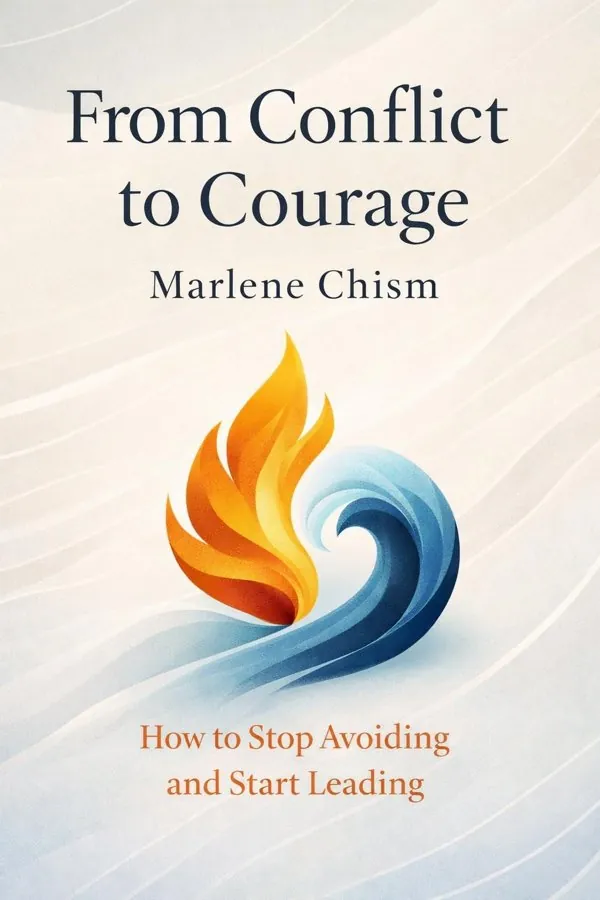
From Conflict to Courage: How to Stop Avoiding and Start Leading: Summary & Key Insights
 10 min9 chaptersAudio available
Key Takeaways from From Conflict to Courage: How to Stop Avoiding and Start Leading
What leaders refuse to address does not disappear; it becomes part of the culture.
Many workplace conflicts are not caused by bad intentions but by vague expectations.
Leadership is tested less by calm days than by emotionally charged moments.
Conflict is shaped not only by events but by interpretation.
Leaders who fear conflict often become overly accommodating, and over-accommodation invites dysfunction.
What Is From Conflict to Courage: How to Stop Avoiding and Start Leading About?
From Conflict to Courage: How to Stop Avoiding and Start Leading by Marlene Chism is a leadership book spanning 9 pages. In From Conflict to Courage, Marlene Chism argues that the greatest threat to leadership is not open disagreement but the quiet habit of avoidance. When leaders postpone hard conversations, soften expectations, or tolerate recurring dysfunction, they may preserve short-term comfort, but they also create long-term confusion, resentment, and disengagement. This book is a practical guide for replacing that pattern with courage, clarity, and accountability. Chism shows that conflict, handled well, is not a disruption to leadership; it is one of leadership’s core responsibilities. What makes this book especially valuable is its focus on the inner work behind external communication. Chism does not simply offer scripts for difficult conversations. She explores the mindset, emotional maturity, and personal integrity required to lead with steadiness under pressure. Drawing on her experience as a leadership consultant and workplace communication expert, she provides frameworks leaders can use immediately to address tension, set boundaries, and create cultures where issues are discussed directly instead of acted out indirectly. For managers, executives, entrepreneurs, and anyone responsible for guiding others, this is a concise but powerful reminder that courage is not a personality trait. It is a leadership practice.
This FizzRead summary covers all 9 key chapters of From Conflict to Courage: How to Stop Avoiding and Start Leading in approximately 10 minutes, distilling the most important ideas, arguments, and takeaways from Marlene Chism's work. Also available as an audio summary and Key Quotes Podcast.
From Conflict to Courage: How to Stop Avoiding and Start Leading
In From Conflict to Courage, Marlene Chism argues that the greatest threat to leadership is not open disagreement but the quiet habit of avoidance. When leaders postpone hard conversations, soften expectations, or tolerate recurring dysfunction, they may preserve short-term comfort, but they also create long-term confusion, resentment, and disengagement. This book is a practical guide for replacing that pattern with courage, clarity, and accountability. Chism shows that conflict, handled well, is not a disruption to leadership; it is one of leadership’s core responsibilities.
What makes this book especially valuable is its focus on the inner work behind external communication. Chism does not simply offer scripts for difficult conversations. She explores the mindset, emotional maturity, and personal integrity required to lead with steadiness under pressure. Drawing on her experience as a leadership consultant and workplace communication expert, she provides frameworks leaders can use immediately to address tension, set boundaries, and create cultures where issues are discussed directly instead of acted out indirectly. For managers, executives, entrepreneurs, and anyone responsible for guiding others, this is a concise but powerful reminder that courage is not a personality trait. It is a leadership practice.
Who Should Read From Conflict to Courage: How to Stop Avoiding and Start Leading?
This book is perfect for anyone interested in leadership and looking to gain actionable insights in a short read. Whether you're a student, professional, or lifelong learner, the key ideas from From Conflict to Courage: How to Stop Avoiding and Start Leading by Marlene Chism will help you think differently.
- ✓Readers who enjoy leadership and want practical takeaways
- ✓Professionals looking to apply new ideas to their work and life
- ✓Anyone who wants the core insights of From Conflict to Courage: How to Stop Avoiding and Start Leading in just 10 minutes
Want the full summary?
Get instant access to this book summary and 100K+ more with Fizz Moment.
Get Free SummaryAvailable on App Store • Free to download
Key Chapters
What leaders refuse to address does not disappear; it becomes part of the culture. One of Chism’s core insights is that avoidance is often mistaken for patience, diplomacy, or emotional intelligence, when in reality it is frequently a coping strategy for discomfort. Leaders avoid because they feel overwhelmed, uncertain, or afraid of escalation. In the moment, saying nothing can feel efficient. It saves energy, delays tension, and preserves the illusion of peace. But the price of that temporary relief is usually much higher than leaders expect.
When difficult issues go unspoken, employees fill the silence with assumptions. A missed deadline that goes unaddressed becomes permission for future sloppiness. A disrespectful interaction that is overlooked signals that standards are flexible. A poor performer who is never confronted creates frustration among stronger contributors. Avoidance does not create neutrality; it communicates approval, confusion, or indifference. Over time, it erodes trust because people sense that the leader sees the problem but lacks the courage to name it.
Chism encourages leaders to examine the patterns they excuse. Are they postponing feedback because they want more evidence, or because they want less discomfort? Are they calling themselves understanding when they are actually being unclear? Consider a manager who repeatedly rewrites an employee’s work instead of discussing expectations directly. The manager stays busy, the employee stays dependent, and the team never improves. The real problem is not competence alone but the leader’s reluctance to intervene cleanly.
The practical shift is to treat avoidance as data. Every issue you keep postponing points to a conversation, boundary, or decision that leadership requires. Instead of asking, “How do I make this easier?” ask, “What am I teaching by not addressing this now?” Actionable takeaway: identify one unresolved issue you have been tolerating and schedule a direct conversation within the next week.
Many workplace conflicts are not caused by bad intentions but by vague expectations. Chism emphasizes that clarity is not a minor communication skill; it is the backbone of effective leadership. When goals, roles, standards, and decision rights are fuzzy, people improvise. They make assumptions about what matters most, what success looks like, and who owns which responsibility. The resulting friction often looks personal, but its roots are structural.
Leaders sometimes avoid clarity because they fear sounding controlling or inflexible. Yet the absence of clarity is far more damaging than clear standards. Without it, people waste energy interpreting mixed signals. One employee believes initiative is rewarded; another has learned that every decision must be approved. A team hears that quality matters most, then gets praised only for speed. These contradictions generate anxiety and conflict because people are trying to win a game whose rules keep changing.
Chism invites leaders to become precise in both thought and language. Instead of saying, “I need this soon,” define a deadline. Instead of saying, “Please be more professional,” specify the behavior that needs to change. Instead of assuming your team understands strategic priorities, repeat them in practical terms: what matters, what can wait, and how success will be measured. Clarity reduces drama because it replaces guesswork with alignment.
A simple example is performance feedback. Telling an employee to “communicate better” is too abstract to be useful. Clarifying that they should respond to client emails within 24 hours, summarize action items after meetings, and flag delays early turns a vague complaint into a manageable standard. That kind of specificity protects relationships because it keeps the conversation grounded in observable behavior rather than personality.
Actionable takeaway: review one recurring team frustration and ask whether the real issue is behavior or lack of clarity. Then rewrite the expectation in concrete, measurable language.
Leadership is tested less by calm days than by emotionally charged moments. Chism argues that courageous leadership requires emotional maturity: the ability to regulate reactions, separate facts from stories, and respond intentionally rather than impulsively. This is not about suppressing emotions or becoming distant. It is about refusing to let irritation, anxiety, or defensiveness drive decisions.
In conflict, immature patterns appear quickly. A leader may personalize disagreement, withdraw when challenged, overexplain to gain approval, or lash out to regain control. These responses are understandable, but they make conflict harder to resolve because they shift attention away from the issue and toward emotional management. Teams become preoccupied with the leader’s mood instead of the real problem. Emotional reactivity also weakens credibility. People may comply in the short term, but they stop bringing forward difficult truths if they expect volatility.
Chism encourages leaders to build self-awareness around triggers. Which situations reliably hook you? Being questioned in public? Hearing bad news late? Feeling ignored? Once you know your triggers, you can interrupt the pattern. Pause before responding. Ask clarifying questions. Name what you know and what you do not know. If needed, take time to think rather than forcing a rushed conversation from a flooded emotional state. Emotional maturity is visible in restraint, curiosity, and consistency.
Imagine a department head learning that a project is behind schedule. A reactive response might be blame: “Why wasn’t I told?” A mature response would address accountability without escalation: “Let’s clarify what happened, what risks we face now, and what decisions need to be made today.” The second approach preserves standards while keeping the conversation productive.
Actionable takeaway: the next time you feel triggered, delay your first instinctive response. Write down the facts, the story you are telling yourself, and the outcome you actually want before you speak.
Conflict is shaped not only by events but by interpretation. Chism highlights the importance of mindset shifts because leaders often react to the meaning they assign to a situation rather than to the situation itself. A missed commitment becomes “disrespect.” A challenge in a meeting becomes “insubordination.” Silence becomes “lack of engagement.” These stories may be partly true, but when leaders treat assumptions as facts, they narrow their options and intensify conflict.
A more courageous mindset begins with intellectual humility. Instead of assuming intent, effective leaders get curious about context. Was the deadline missed because of carelessness, competing priorities, unclear authority, or skill gaps? Did the employee push back because they were resistant, or because they saw a risk others missed? This shift does not excuse poor behavior. It creates enough mental space to diagnose the problem accurately before prescribing a solution.
Chism also challenges the belief that harmony is the goal of leadership. The real goal is honesty with forward movement. If leaders define success as everyone feeling comfortable, they will avoid necessary tension. If they define success as clarity, accountability, and alignment, they can tolerate discomfort in service of better outcomes. This mindset turns conflict from a threat into a source of information.
A practical application is to replace judgmental internal language with diagnostic questions. Instead of “She is impossible,” ask, “What expectation has not been clarified, enforced, or agreed upon?” Instead of “They never take ownership,” ask, “What system rewards passivity or allows ambiguity?” This reframing helps leaders move from blame to problem-solving.
Actionable takeaway: when facing a conflict, identify one assumption you may be making about motives. Replace it with a question that could open a more accurate and constructive conversation.
Leaders who fear conflict often become overly accommodating, and over-accommodation invites dysfunction. Chism makes the case that accountability depends on boundaries: clear limits around behavior, responsibility, and consequences. Without boundaries, leaders drift into rescuing, over-functioning, and tolerating patterns they resent. They work harder than their teams, absorb responsibilities that belong to others, and then feel frustrated that people do not step up.
A boundary is not a punishment or a wall. It is a statement of what is acceptable, what is not, and what will happen next. Healthy boundaries reduce drama because they remove the need for repeated emotional negotiations. If attendance at a weekly operations meeting is mandatory, the leader does not need to beg for commitment each week. If client complaints must be escalated within a day, everyone knows the standard. Boundaries make accountability less personal because they establish shared expectations ahead of time.
Chism warns that many leaders sabotage boundaries by setting them vaguely or inconsistently. They say, “Please keep me informed,” but never define what counts as important information. They address a problem once, then let it slide the next three times. Inconsistency teaches people that standards are flexible and that consequences depend more on the leader’s mood than on the behavior itself.
Consider a supervisor whose team repeatedly sends incomplete reports. Instead of fixing them personally and complaining later, the supervisor can establish a boundary: reports missing required fields will be returned for completion before review. This preserves quality while making responsibility visible. The key is calm enforcement, not irritation.
Actionable takeaway: choose one area where you are over-functioning for others. Define the boundary in one sentence, explain the expectation, and follow through consistently the next time the issue appears.
Indirect communication is one of the most expensive habits in organizations. Chism argues that leaders often create unnecessary complexity by hinting, softening, overexplaining, or speaking around the issue rather than naming it. They hope people will infer the message without anyone feeling uncomfortable. But indirectness usually creates more discomfort because it leaves room for denial, confusion, and repeated misunderstandings.
Clean communication is respectful, specific, and focused on behavior rather than character. It avoids loaded language, mind-reading, and emotional clutter. Instead of saying, “People are getting frustrated with your attitude,” a leader might say, “In the last two meetings, you interrupted colleagues several times and dismissed their suggestions before hearing them fully. That behavior is affecting collaboration.” This approach gives the other person something tangible to respond to.
Chism’s emphasis is not on being blunt for its own sake but on reducing distortion. Leaders should prepare for difficult conversations by identifying the facts, the impact, and the requested change. They should also avoid stacking grievances into one emotional release. If the issue is a missed commitment, discuss the missed commitment. If the issue is tone, discuss tone. Precision helps people hear feedback without becoming overwhelmed or defensive.
Direct communication also includes listening. Courageous leaders do not deliver monologues; they create dialogue. After stating the issue, they ask for the other person’s perspective and test for understanding. This does not mean surrendering standards. It means giving the conversation enough structure and openness to produce accountability instead of just compliance.
Actionable takeaway: before your next difficult conversation, write down three things only: the observable facts, the impact on the team or business, and the specific change you need. Use those as your guide instead of improvising emotionally.
A difficult conversation is often the shortest path to relief, but only if it is handled with courage and purpose. Chism presents courageous conversations as a defining practice of leadership because they turn hidden tension into workable reality. These conversations do not guarantee immediate agreement, but they do create the conditions for honesty, alignment, and movement.
What makes a conversation courageous is not aggression. It is the willingness to say what needs to be said without controlling how it will be received. Leaders often delay because they want certainty: the perfect timing, the perfect wording, the assurance that the other person will respond well. Chism challenges this fantasy. Growth rarely comes with those guarantees. Courage means entering the conversation with clarity about your intention and enough steadiness to stay engaged if the response is emotional or resistant.
A productive framework is simple: state the issue, describe the impact, listen to the response, and clarify expectations moving forward. For example, a leader might say, “I want to talk about the pattern of missed handoffs between your team and operations. It is causing delays and rework. I’d like to understand what is getting in the way and agree on a process that prevents this.” This opening is honest, non-accusatory, and oriented toward resolution.
These conversations are also opportunities to model culture. When leaders speak directly, listen carefully, and hold standards calmly, they teach others how conflict should be handled. Over time, teams become less dependent on gossip, triangulation, and passive resistance because they see that direct conversation is both possible and expected.
Actionable takeaway: choose one conversation you have been postponing and prepare a four-part opening: the issue, the impact, a question for understanding, and the expectation for next steps.
Organizational culture is not built primarily through slogans, values posters, or one-time training sessions. Chism emphasizes that culture is formed by what leaders repeatedly reward, ignore, and confront. If avoidance is common at the top, indirectness spreads throughout the system. If leaders tolerate gossip, blame-shifting, and unclear ownership, those behaviors become normalized no matter what the company says it values.
Transforming culture therefore begins with leadership behavior. Teams watch how leaders respond under pressure. Do they address issues directly or complain privately? Do they clarify expectations or rely on assumptions? Do they enforce standards consistently or make exceptions to avoid discomfort? Every one of these choices sends signals about what is safe, what is expected, and what gets results.
Chism’s contribution here is practical: culture improves when leaders replace drama with structure. That means fewer personality-driven interpretations and more explicit agreements. It means reducing triangulation by sending people back to the source of the issue instead of mediating every tension. It means normalizing feedback, decision clarity, and ownership. For example, if an employee complains about a colleague, a drama-based culture invites side conversations. A courageous culture asks, “Have you spoken directly with them? What outcome are you seeking? How can I support a constructive next step?”
Over time, these small interventions reshape norms. People learn that problems are discussed where they belong, accountability is part of respect, and conflict is not a sign of failure. It is part of healthy functioning when handled well. Culture shifts not through intensity but through consistency.
Actionable takeaway: identify one recurring cultural pattern on your team, such as gossip or unclear ownership, and decide what leadership behavior you must change first if you want the team’s behavior to change.
Leadership courage is not a one-time breakthrough. Chism closes the loop by stressing that sustainable growth comes from repeated practice. Many leaders read a book, attend a workshop, or have one successful difficult conversation and expect a lasting transformation. But under pressure, people revert to familiar habits. If avoidance has been your default for years, courage must be built deliberately through repetition.
This requires reflection as much as action. After a challenging interaction, effective leaders review what happened. Where did they stay grounded? Where did they become defensive or vague? What assumptions did they make? What do they need to clarify next time? This kind of disciplined self-examination turns everyday leadership moments into training opportunities. It also helps leaders avoid perfectionism. The goal is not flawless communication. The goal is increasing honesty, consistency, and effectiveness over time.
Chism encourages leaders to create systems that support new behaviors. Schedule regular one-on-ones so issues do not pile up. Define decision rights before projects begin. Document expectations after key conversations. Ask for feedback from trusted peers on how you come across in conflict. Practice scripts for difficult conversations before entering them. Small structures reduce the likelihood that courage will depend on mood or convenience.
A useful example is a manager who has historically delayed feedback until annual reviews. To sustain growth, the manager might implement a weekly check-in rhythm where concerns are raised in real time. This changes the process, not just the intention. With repetition, direct communication becomes less dramatic and more normal.
Actionable takeaway: select one leadership habit to practice for the next 30 days, such as addressing issues within 48 hours, and build a simple routine that makes follow-through visible and measurable.
All Chapters in From Conflict to Courage: How to Stop Avoiding and Start Leading
About the Author
Marlene Chism is a leadership consultant, speaker, and author specializing in workplace communication, accountability, and organizational culture. She is widely known for helping leaders reduce drama, clarify expectations, and handle conflict with more confidence and effectiveness. Chism has worked with a range of organizations, including Fortune 500 companies, bringing practical insight to the everyday challenges managers and executives face. Her approach combines personal responsibility with clear communication systems, making her work especially relevant for leaders trying to improve performance without damaging relationships. Across her writing and consulting, she focuses on the idea that strong leadership begins with self-awareness, emotional maturity, and the willingness to address difficult issues directly. In From Conflict to Courage, she distills these principles into an accessible guide for leaders who want to replace avoidance with honesty, clarity, and sustainable influence.
Get This Summary in Your Preferred Format
Read or listen to the From Conflict to Courage: How to Stop Avoiding and Start Leading summary by Marlene Chism anytime, anywhere. FizzRead offers multiple formats so you can learn on your terms — all free.
Available formats: App · Audio · PDF · EPUB — All included free with FizzRead
Download From Conflict to Courage: How to Stop Avoiding and Start Leading PDF and EPUB Summary
Key Quotes from From Conflict to Courage: How to Stop Avoiding and Start Leading
“What leaders refuse to address does not disappear; it becomes part of the culture.”
“Many workplace conflicts are not caused by bad intentions but by vague expectations.”
“Leadership is tested less by calm days than by emotionally charged moments.”
“Conflict is shaped not only by events but by interpretation.”
“Leaders who fear conflict often become overly accommodating, and over-accommodation invites dysfunction.”
Frequently Asked Questions about From Conflict to Courage: How to Stop Avoiding and Start Leading
From Conflict to Courage: How to Stop Avoiding and Start Leading by Marlene Chism is a leadership book that explores key ideas across 9 chapters. In From Conflict to Courage, Marlene Chism argues that the greatest threat to leadership is not open disagreement but the quiet habit of avoidance. When leaders postpone hard conversations, soften expectations, or tolerate recurring dysfunction, they may preserve short-term comfort, but they also create long-term confusion, resentment, and disengagement. This book is a practical guide for replacing that pattern with courage, clarity, and accountability. Chism shows that conflict, handled well, is not a disruption to leadership; it is one of leadership’s core responsibilities. What makes this book especially valuable is its focus on the inner work behind external communication. Chism does not simply offer scripts for difficult conversations. She explores the mindset, emotional maturity, and personal integrity required to lead with steadiness under pressure. Drawing on her experience as a leadership consultant and workplace communication expert, she provides frameworks leaders can use immediately to address tension, set boundaries, and create cultures where issues are discussed directly instead of acted out indirectly. For managers, executives, entrepreneurs, and anyone responsible for guiding others, this is a concise but powerful reminder that courage is not a personality trait. It is a leadership practice.
You Might Also Like

Extreme Ownership
Jocko Willink
10 min
Dare to Lead
Brene Brown
10 min
Leaders Eat Last
Simon Sinek
10 min
The 21 Irrefutable Laws of Leadership
John Maxwell
10 min
Start With Why
Simon Sinek
10 min
How to Lead When You're Not in Charge
Clay Scroggins
10 minBrowse by Category
Ready to read From Conflict to Courage: How to Stop Avoiding and Start Leading?
Get the full summary and 100K+ more books with Fizz Moment.