
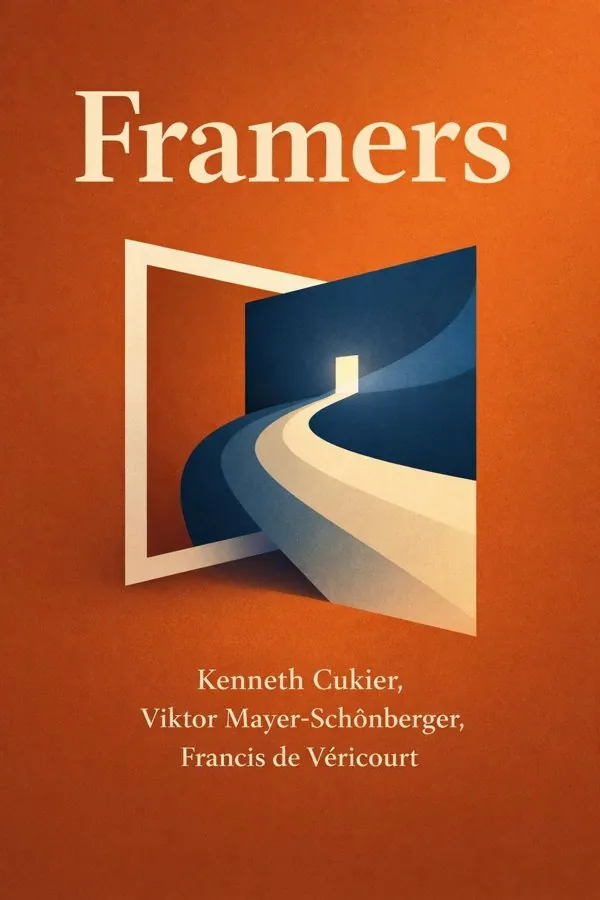
Framers: Human Advantage in an Age of Technology and Turmoil: Summary & Key Insights
by Kenneth Cukier, Viktor Mayer-Schönberger, Francis de Véricourt
 10 min10 chaptersAudio available
What Is Framers: Human Advantage in an Age of Technology and Turmoil About?
Framers: Human Advantage in an Age of Technology and Turmoil by Kenneth Cukier, Viktor Mayer-Schönberger, Francis de Véricourt is a mindset book spanning 10 pages. Framers explores how humans use mental models—frames—to make sense of the world and make decisions. The authors argue that the ability to reframe problems is a uniquely human skill that will remain essential in an era dominated by artificial intelligence and automation. Through examples from history, business, and science, the book shows how reframing can lead to innovation, resilience, and better leadership.
This FizzRead summary covers all 10 key chapters of Framers: Human Advantage in an Age of Technology and Turmoil in approximately 10 minutes, distilling the most important ideas, arguments, and takeaways from Kenneth Cukier, Viktor Mayer-Schönberger, Francis de Véricourt's work. Also available as an audio summary and Key Quotes Podcast.
Framers: Human Advantage in an Age of Technology and Turmoil
Framers explores how humans use mental models—frames—to make sense of the world and make decisions. The authors argue that the ability to reframe problems is a uniquely human skill that will remain essential in an era dominated by artificial intelligence and automation. Through examples from history, business, and science, the book shows how reframing can lead to innovation, resilience, and better leadership.
Who Should Read Framers: Human Advantage in an Age of Technology and Turmoil?
This book is perfect for anyone interested in mindset and looking to gain actionable insights in a short read. Whether you're a student, professional, or lifelong learner, the key ideas from Framers: Human Advantage in an Age of Technology and Turmoil by Kenneth Cukier, Viktor Mayer-Schönberger, Francis de Véricourt will help you think differently.
- ✓Readers who enjoy mindset and want practical takeaways
- ✓Professionals looking to apply new ideas to their work and life
- ✓Anyone who wants the core insights of Framers: Human Advantage in an Age of Technology and Turmoil in just 10 minutes
Want the full summary?
Get instant access to this book summary and 100K+ more with Fizz Moment.
Get Free SummaryAvailable on App Store • Free to download
Key Chapters
Framing is the silent force behind every human judgment. Before we weigh options or analyze data, we must first decide what the problem even is—that is the act of framing. In this sense, frames are mental blueprints that define where our attention falls and what we exclude. They are neither objective nor fixed; they evolve from culture, experience, and imagination. When behavioral economists spoke of irrational choices, what they were often observing was a clash of frames: individuals seeing the same situation through different conceptual filters.
This process shapes perception itself. Two people can observe the same event yet arrive at oppositional conclusions simply because their mental frames highlight different aspects of reality. For decision-making, this means that logic is never exercised in a vacuum; it always operates within the philosophical perimeter of a given frame. Understanding this gives us both power and responsibility—to become aware of the frames guiding us, to challenge them when they narrow our view, and to cultivate new ones when the old no longer serve.
We show that the most advanced algorithms still depend on frames—but they inherit those from humans. Algorithms can optimize within a prescribed definition of the problem, but redefining that problem remains our domain.
The rise of big data and artificial intelligence tempts us to believe that with enough information, any problem can be solved. Yet this vision is incomplete. Data informs decisions, but it does not define the questions worth asking. Algorithms rely on historical inputs; they are inherently backward-looking. Human framing, by contrast, is forward-looking—it allows us to imagine alternatives and form hypotheses about what could be rather than what was.
In our analysis, even the most sophisticated neural networks cannot ‘reframe’; they can only execute within the contours of human-designated parameters. When an AI recommends a medical treatment, the boundaries of its search space—the possible responses—were defined by human framing of what counts as success or failure. This is not a limitation of technology but an unavoidable truth of cognition. Data only yields meaning through the frame applied to interpret it. Thus, as the world turns toward machine assistance, the demand for human framing intelligence only intensifies.
+ 8 more chapters — available in the FizzRead app
All Chapters in Framers: Human Advantage in an Age of Technology and Turmoil
About the Authors
Kenneth Cukier is a senior editor at The Economist specializing in technology and data. Viktor Mayer-Schönberger is a professor at Oxford University known for his work on digital governance and data. Francis de Véricourt is a professor of management science at ESMT Berlin focusing on decision-making and operations research.
Get This Summary in Your Preferred Format
Read or listen to the Framers: Human Advantage in an Age of Technology and Turmoil summary by Kenneth Cukier, Viktor Mayer-Schönberger, Francis de Véricourt anytime, anywhere. FizzRead offers multiple formats so you can learn on your terms — all free.
Available formats: App · Audio · PDF · EPUB — All included free with FizzRead
Download Framers: Human Advantage in an Age of Technology and Turmoil PDF and EPUB Summary
Key Quotes from Framers: Human Advantage in an Age of Technology and Turmoil
“Framing is the silent force behind every human judgment.”
“The rise of big data and artificial intelligence tempts us to believe that with enough information, any problem can be solved.”
Frequently Asked Questions about Framers: Human Advantage in an Age of Technology and Turmoil
Framers: Human Advantage in an Age of Technology and Turmoil by Kenneth Cukier, Viktor Mayer-Schönberger, Francis de Véricourt is a mindset book that explores key ideas across 10 chapters. Framers explores how humans use mental models—frames—to make sense of the world and make decisions. The authors argue that the ability to reframe problems is a uniquely human skill that will remain essential in an era dominated by artificial intelligence and automation. Through examples from history, business, and science, the book shows how reframing can lead to innovation, resilience, and better leadership.
You Might Also Like




Browse by Category
Ready to read Framers: Human Advantage in an Age of Technology and Turmoil?
Get the full summary and 100K+ more books with Fizz Moment.