
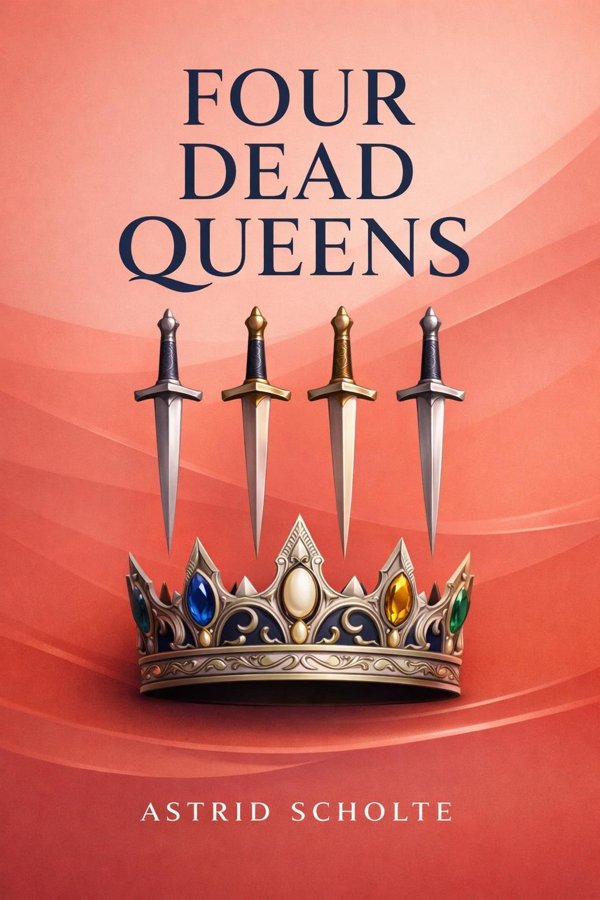
Four Dead Queens: Summary & Key Insights
 10 min9 chaptersAudio available
Key Takeaways from Four Dead Queens
A kingdom can look unified on a map while remaining emotionally and morally fragmented in practice.
Heroes do not always begin as noble people; sometimes they begin as survivors.
Institutions often seem strongest right before they collapse.
The most dangerous lies are often built from partial truths.
People inherit beliefs from their environment long before they consciously choose them.
What Is Four Dead Queens About?
Four Dead Queens by Astrid Scholte is a bestsellers book spanning 4 pages. What happens when a kingdom built on balance is shattered in a single night? In Four Dead Queens, Astrid Scholte blends fantasy, political intrigue, and murder mystery into a fast-moving young adult novel set in the divided realm of Quadara, where four queens rule four distinct quadrants according to four radically different value systems. When Keralie Corrington, a streetwise thief from the technology-driven quadrant of Toria, intercepts a coded message, she is pulled into a deadly conspiracy that ends with the assassination of all four queens. Suddenly, survival depends not only on uncovering the killer, but also on understanding a kingdom whose hidden fractures run deeper than anyone admits. What makes the novel matter is its sharp use of worldbuilding to explore power, propaganda, inequality, and the danger of isolation between cultures that share a border but not a worldview. Scholte, an Australian author with a background in film and visual storytelling, brings cinematic pacing and vivid design to every page. The result is an accessible yet layered fantasy thriller that asks timely questions: who controls truth, what happens when leaders become symbols, and can a divided society rebuild after betrayal?
This FizzRead summary covers all 9 key chapters of Four Dead Queens in approximately 10 minutes, distilling the most important ideas, arguments, and takeaways from Astrid Scholte's work. Also available as an audio summary and Key Quotes Podcast.
Four Dead Queens
What happens when a kingdom built on balance is shattered in a single night? In Four Dead Queens, Astrid Scholte blends fantasy, political intrigue, and murder mystery into a fast-moving young adult novel set in the divided realm of Quadara, where four queens rule four distinct quadrants according to four radically different value systems. When Keralie Corrington, a streetwise thief from the technology-driven quadrant of Toria, intercepts a coded message, she is pulled into a deadly conspiracy that ends with the assassination of all four queens. Suddenly, survival depends not only on uncovering the killer, but also on understanding a kingdom whose hidden fractures run deeper than anyone admits.
What makes the novel matter is its sharp use of worldbuilding to explore power, propaganda, inequality, and the danger of isolation between cultures that share a border but not a worldview. Scholte, an Australian author with a background in film and visual storytelling, brings cinematic pacing and vivid design to every page. The result is an accessible yet layered fantasy thriller that asks timely questions: who controls truth, what happens when leaders become symbols, and can a divided society rebuild after betrayal?
Who Should Read Four Dead Queens?
This book is perfect for anyone interested in bestsellers and looking to gain actionable insights in a short read. Whether you're a student, professional, or lifelong learner, the key ideas from Four Dead Queens by Astrid Scholte will help you think differently.
- ✓Readers who enjoy bestsellers and want practical takeaways
- ✓Professionals looking to apply new ideas to their work and life
- ✓Anyone who wants the core insights of Four Dead Queens in just 10 minutes
Want the full summary?
Get instant access to this book summary and 100K+ more with Fizz Moment.
Get Free SummaryAvailable on App Store • Free to download
Key Chapters
A kingdom can look unified on a map while remaining emotionally and morally fragmented in practice. That insight sits at the heart of Quadara, a nation divided into four quadrants, each ruled by a queen and shaped by a guiding creed. Archia prizes simplicity, honesty, and agricultural labor. Eonia values intellect, logic, and efficiency. Ludia celebrates pleasure, beauty, and emotional expression. Toria is driven by invention, commerce, and technological ambition. Together, these quadrants create a fascinating political experiment: can one nation survive when its people are taught to prioritize different truths?
Scholte uses this structure for more than decorative worldbuilding. Each quadrant reflects a recognizable human instinct. Some societies elevate productivity, others tradition, others innovation, others pleasure. By separating those instincts into distinct regions, the novel exposes both their strengths and their blind spots. Archia’s integrity can become rigidity. Eonia’s logic can drift into cold detachment. Ludia’s freedom can hide excess. Toria’s progress can mask exploitation. None of the quadrants is wholly right or wholly wrong, which gives the story its tension and realism.
This idea has practical relevance beyond fantasy. In real life, families, workplaces, and nations often fracture because people mistake their preferred value system for the only valid one. One person prizes discipline, another creativity, another compassion, another ambition. Conflict grows when those differences are not understood. Four Dead Queens invites readers to ask what happens when identity is built more on division than on dialogue.
As you read, notice which quadrant feels most attractive to you and which feels least comfortable. That reaction can reveal your own biases. Actionable takeaway: when faced with disagreement, try identifying the value behind another person’s position before arguing against it.
Heroes do not always begin as noble people; sometimes they begin as survivors. Keralie Corrington is introduced not as a chosen one, royal heir, or celebrated warrior, but as a talented thief making her way through Toria’s bustling streets. She lies, steals, and trusts very few people. Yet that morally gray beginning makes her compelling, because she understands systems from the ground level. She knows how power affects ordinary lives, how secrets circulate, and how vulnerable people adapt when institutions fail them.
Her involvement in the queens’ murders begins almost accidentally. After intercepting a message that points to conspiracy, Keralie becomes entangled with Varin, a messenger whose discipline and idealism contrast sharply with her cynicism. Their uneasy alliance drives much of the novel’s momentum. Keralie is forced to move from self-protection toward responsibility, from opportunism toward moral choice. That evolution feels earned because Scholte does not erase her flaws. Keralie remains impulsive, defensive, and shaped by a difficult past, but she gradually learns that seeing corruption and ignoring it are not morally neutral acts.
The concept resonates because many people assume meaningful action belongs to the obviously virtuous or officially powerful. The novel challenges that belief. Sometimes the person best positioned to expose a lie is the one who has spent years navigating lies. Practical examples appear everywhere: whistleblowers often come from inside broken systems, and people with unconventional skills can become essential in moments of crisis.
Keralie’s story suggests that character is not fixed by your worst habits or survival strategies. It is shaped by what you do once the stakes become larger than yourself. Actionable takeaway: do not dismiss your rough edges or complicated past as disqualifications; ask how your hard-earned skills could be redirected toward something honest and useful.
The most dangerous lies are often built from partial truths. In Four Dead Queens, information is fragmented across social classes, political institutions, and geographic boundaries. Messengers carry coded communications. Citizens know their own quadrants but remain ignorant of the others. Leaders manage narratives carefully. Keralie’s theft of a message becomes significant because it disrupts this controlled flow of knowledge. Once information escapes its intended channel, hidden connections begin to appear.
This is one of the novel’s strongest themes: secrecy is not only about concealment, but about compartmentalization. People can remain honest within a narrow circle while still participating in a broader culture of deception. Quadara’s design encourages such blindness. Each quadrant sees itself clearly and the others selectively. That makes manipulation easier. If no one has the whole picture, conspiracy becomes harder to detect and easier to deny.
The modern application is immediate. In workplaces, one team may know strategy, another may know execution, and another may deal with consequences, but no one fully understands the system. In public life, media bubbles create the illusion of knowledge while reinforcing ignorance. Even in personal relationships, people can share facts without sharing context, leading to misunderstandings that deepen over time.
Scholte turns this abstract problem into suspense. Every clue matters because every clue exists within an incomplete framework. Readers are invited to become detectives, but also to recognize how difficult truth becomes when institutions reward selective understanding.
The novel encourages intellectual humility. We are all tempted to believe that what we know is enough. Yet many failures in judgment come not from bad intentions but from overconfidence based on incomplete evidence. Actionable takeaway: before drawing a strong conclusion, ask what information might be missing, who benefits from the current narrative, and whose perspective has been excluded.
People inherit beliefs from their environment long before they consciously choose them. Four Dead Queens makes this visible through its quadrant-based society, where customs, priorities, and even emotional habits are shaped by geography and governance. Keralie’s instincts are Torian: quick, pragmatic, adaptive, and comfortable with moral ambiguity in a competitive world. Varin, by contrast, has been trained in a system that values order, protocol, and duty. Their conflict is not just personal chemistry; it is cultural conditioning colliding in real time.
What makes the novel richer is that it does not reduce identity to background alone. Characters are influenced by their quadrant, but not imprisoned by it. They can question inherited beliefs, form cross-cultural alliances, and revise their understanding of loyalty. This matters because fantasy often treats factions as fixed personality types. Scholte instead suggests that culture shapes us powerfully, but growth begins when experience tests what we have been taught.
This idea is useful in everyday life. People often interpret differences in communication style or priorities as moral failings rather than contextual habits. Someone raised in scarcity may approach risk differently from someone raised with security. A person trained in strict discipline may seem cold to someone who values emotional openness. Recognizing these influences does not erase accountability, but it creates room for empathy and better judgment.
In the novel, progress happens when characters stop seeing one another as stereotypes of their quadrants and start paying attention to individual motives and pain. That shift is essential for solving the mystery and imagining a more livable future for Quadara.
Actionable takeaway: when someone’s behavior frustrates you, ask which part may come from conditioning rather than malice, and then decide how to respond with both clarity and compassion.
Trust becomes meaningful only when there is a real reason not to give it. The relationship at the center of Four Dead Queens develops under pressure, suspicion, and unequal disclosure. Keralie and Varin do not begin as natural allies. Their values, histories, and instincts clash repeatedly. Yet because both are drawn into the same deadly conspiracy, they must decide how much of themselves to reveal and how much risk to take on another person’s behalf.
Scholte handles this dynamic well because trust here is not sentimental. It is negotiated through action. Characters observe one another under stress, revise assumptions, and slowly discover that reliability is more persuasive than promises. This creates emotional tension that supports the mystery rather than distracting from it. In a story full of deception, every act of honesty carries extra weight.
There is a practical lesson in that structure. Real trust rarely appears fully formed. It grows when people behave consistently across difficult moments. A friend who shows up when plans collapse earns more trust than one who speaks beautifully but disappears under pressure. A coworker who shares credit and owns mistakes builds confidence faster than one who simply claims good intentions.
The novel also highlights the cost of withholding too much for too long. Self-protection may feel wise, especially for those who have been hurt, but complete emotional isolation can leave people vulnerable to manipulation and unable to recognize genuine support. Keralie’s growth includes learning that dependence and weakness are not the same thing.
For readers, this idea offers a balanced view: trust should not be naïve, but neither should skepticism become identity. Actionable takeaway: if you want stronger relationships, look for one small opportunity to be honestly vulnerable with someone who has already shown steady reliability.
The problem with power is not simply that people want it; it is that systems often fail to question how it operates. Four Dead Queens explores this through monarchy, bureaucracy, class divisions, and the hidden networks beneath public governance. The four-queen structure appears balanced on paper, yet the novel gradually reveals how influence can be manipulated behind the scenes. Formal authority is only one layer. Access, information, technology, and proximity to decision-making all shape who truly controls events.
This theme makes the book more than a murder mystery. The assassinations are not isolated acts of evil but symptoms of a broader political environment in which secrecy, hierarchy, and inherited roles leave room for abuse. Characters are constrained not just by individual villains but by systems that normalize silence and reward obedience. Scholte’s world reminds readers that corruption thrives when institutions are treated as sacred rather than scrutinized.
The relevance is obvious in contemporary life. A workplace may have policies but still protect harmful leaders. A government may have checks and balances but still allow concentrated power through patronage or misinformation. Even small groups can drift into unhealthy dynamics when no one asks difficult questions. The novel encourages readers to pay attention to process, not just personality.
Importantly, accountability in the story is tied to courage. People must be willing to speak, investigate, and challenge expectations. That does not guarantee safety, but silence almost guarantees further damage. Keralie’s role underscores that ordinary individuals can expose rot that institutions would rather ignore.
Actionable takeaway: when evaluating any leader or system, ask not only who is in charge, but how decisions are reviewed, who can question them, and what happens to those who do.
Prosperity often distracts from the price paid to create it. One of the novel’s most compelling worldbuilding choices is the contrast between Quadara’s quadrants, especially the glamorous and advanced ones that seem most enviable at first glance. Toria’s innovation and Ludia’s indulgence create energy, aspiration, and visual appeal, but Scholte hints that comfort and sophistication can coexist with exploitation, neglect, and moral compromise. Surface brilliance is not the same as social health.
This matters because readers, like citizens in the story, are easily drawn to spectacle. Technology promises convenience. Luxury promises freedom. Efficiency promises progress. Yet the novel repeatedly asks who benefits, who is excluded, and what gets normalized in the process. Keralie, as someone who lives close to the margins, sees this more clearly than those sheltered by status. She understands that bustling commerce and clever design do not automatically produce justice.
The lesson extends beyond fantasy settings. In modern life, people may admire fast-growing cities, high-performing companies, or polished lifestyles without noticing burnout, inequality, or ethical shortcuts beneath them. A beautiful system can still be cruel. A successful institution can still be unfair. The novel invites readers to look past branding and ask harder questions about the human cost of convenience and prestige.
Scholte does not argue against pleasure or progress themselves. Instead, she suggests that every cultural strength becomes dangerous when detached from responsibility. Innovation needs ethics. Beauty needs empathy. Growth needs fairness.
Actionable takeaway: when something appears impressive, ask what labor, silence, or compromise made it possible. Admiration becomes wiser when it includes curiosity about hidden costs.
All Chapters in Four Dead Queens
About the Author
Astrid Scholte is an Australian author known for her young adult fantasy fiction and her talent for creating visually striking, high-concept worlds. Before turning fully to writing, she worked in the film and animation industries, contributing to projects associated with major companies such as Weta Digital and Animal Logic. That cinematic background is evident in her fiction, which often features vivid settings, brisk pacing, and strong dramatic structure. Scholte gained wide attention with Four Dead Queens, a fantasy mystery that showcases her ability to combine political intrigue, suspense, and emotionally layered characters. Her work frequently centers on resilient young women facing dangerous systems, moral complexity, and questions of identity. She is recognized as a distinctive voice in contemporary YA fantasy, appealing to readers who enjoy immersive storytelling with sharp momentum.
Get This Summary in Your Preferred Format
Read or listen to the Four Dead Queens summary by Astrid Scholte anytime, anywhere. FizzRead offers multiple formats so you can learn on your terms — all free.
Available formats: App · Audio · PDF · EPUB — All included free with FizzRead
Download Four Dead Queens PDF and EPUB Summary
Key Quotes from Four Dead Queens
“A kingdom can look unified on a map while remaining emotionally and morally fragmented in practice.”
“Heroes do not always begin as noble people; sometimes they begin as survivors.”
“Institutions often seem strongest right before they collapse.”
“The most dangerous lies are often built from partial truths.”
“People inherit beliefs from their environment long before they consciously choose them.”
Frequently Asked Questions about Four Dead Queens
Four Dead Queens by Astrid Scholte is a bestsellers book that explores key ideas across 9 chapters. What happens when a kingdom built on balance is shattered in a single night? In Four Dead Queens, Astrid Scholte blends fantasy, political intrigue, and murder mystery into a fast-moving young adult novel set in the divided realm of Quadara, where four queens rule four distinct quadrants according to four radically different value systems. When Keralie Corrington, a streetwise thief from the technology-driven quadrant of Toria, intercepts a coded message, she is pulled into a deadly conspiracy that ends with the assassination of all four queens. Suddenly, survival depends not only on uncovering the killer, but also on understanding a kingdom whose hidden fractures run deeper than anyone admits. What makes the novel matter is its sharp use of worldbuilding to explore power, propaganda, inequality, and the danger of isolation between cultures that share a border but not a worldview. Scholte, an Australian author with a background in film and visual storytelling, brings cinematic pacing and vivid design to every page. The result is an accessible yet layered fantasy thriller that asks timely questions: who controls truth, what happens when leaders become symbols, and can a divided society rebuild after betrayal?
You Might Also Like

The Godfather
Mario Puzo
10 min
The Handmaid's Tale
Margaret Atwood
10 min
The Hunger Games
Suzanne Collins
10 min
The Nightingale
Kristin Hannah
10 min
The Seven Husbands of Evelyn Hugo
Taylor Jenkins Reid
10 min
Backwater Justice
Fern Michaels
10 minBrowse by Category
Ready to read Four Dead Queens?
Get the full summary and 100K+ more books with Fizz Moment.