
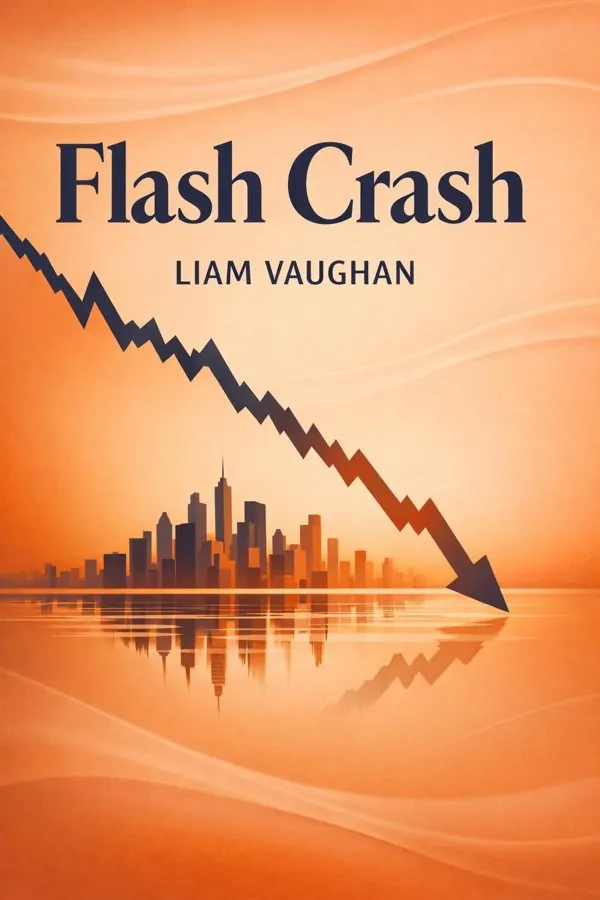
Flash Crash: A Trading Savant, a Global Manhunt, and the Most Mysterious Market Crash in History: Summary & Key Insights
by Liam Vaughan
 10 min9 chaptersAudio available
Key Takeaways from Flash Crash: A Trading Savant, a Global Manhunt, and the Most Mysterious Market Crash in History
Some market disasters unfold over months.
The most unsettling market actors are not always powerful insiders.
In modern markets, speed is not just a convenience.
Markets do not run only on actual buying and selling.
People prefer single causes because they make chaos easier to understand.
What Is Flash Crash: A Trading Savant, a Global Manhunt, and the Most Mysterious Market Crash in History About?
Flash Crash: A Trading Savant, a Global Manhunt, and the Most Mysterious Market Crash in History by Liam Vaughan is a finance book spanning 8 pages. Flash Crash is a gripping work of investigative financial journalism that turns an opaque market event into a human story of ambition, technology, and systemic risk. Liam Vaughan reconstructs the shocking events of May 6, 2010, when U.S. markets plunged and rebounded with terrifying speed, erasing nearly a trillion dollars in value in minutes and exposing how fragile modern finance had become. At the center of the mystery is Navinder Singh Sarao, a self-taught futures trader operating from his parents’ modest home in West London, who was later accused of using manipulative trading tactics that may have intensified the chaos. But Vaughan’s book is not a simplistic tale of one villain bringing down Wall Street. It is a nuanced exploration of high-frequency trading, regulation, market structure, and the dangerous gap between technological sophistication and institutional understanding. As a senior Bloomberg reporter with deep expertise in financial misconduct and market mechanics, Vaughan brings both authority and narrative flair. The result is a rare finance book that is as suspenseful as a thriller and as illuminating as a case study in modern market failure.
This FizzRead summary covers all 9 key chapters of Flash Crash: A Trading Savant, a Global Manhunt, and the Most Mysterious Market Crash in History in approximately 10 minutes, distilling the most important ideas, arguments, and takeaways from Liam Vaughan's work. Also available as an audio summary and Key Quotes Podcast.
Flash Crash: A Trading Savant, a Global Manhunt, and the Most Mysterious Market Crash in History
Flash Crash is a gripping work of investigative financial journalism that turns an opaque market event into a human story of ambition, technology, and systemic risk. Liam Vaughan reconstructs the shocking events of May 6, 2010, when U.S. markets plunged and rebounded with terrifying speed, erasing nearly a trillion dollars in value in minutes and exposing how fragile modern finance had become. At the center of the mystery is Navinder Singh Sarao, a self-taught futures trader operating from his parents’ modest home in West London, who was later accused of using manipulative trading tactics that may have intensified the chaos. But Vaughan’s book is not a simplistic tale of one villain bringing down Wall Street. It is a nuanced exploration of high-frequency trading, regulation, market structure, and the dangerous gap between technological sophistication and institutional understanding. As a senior Bloomberg reporter with deep expertise in financial misconduct and market mechanics, Vaughan brings both authority and narrative flair. The result is a rare finance book that is as suspenseful as a thriller and as illuminating as a case study in modern market failure.
Who Should Read Flash Crash: A Trading Savant, a Global Manhunt, and the Most Mysterious Market Crash in History?
This book is perfect for anyone interested in finance and looking to gain actionable insights in a short read. Whether you're a student, professional, or lifelong learner, the key ideas from Flash Crash: A Trading Savant, a Global Manhunt, and the Most Mysterious Market Crash in History by Liam Vaughan will help you think differently.
- ✓Readers who enjoy finance and want practical takeaways
- ✓Professionals looking to apply new ideas to their work and life
- ✓Anyone who wants the core insights of Flash Crash: A Trading Savant, a Global Manhunt, and the Most Mysterious Market Crash in History in just 10 minutes
Want the full summary?
Get instant access to this book summary and 100K+ more with Fizz Moment.
Get Free SummaryAvailable on App Store • Free to download
Key Chapters
Some market disasters unfold over months. The Flash Crash unfolded in minutes, which is precisely why it still matters. On May 6, 2010, U.S. equity markets suddenly spiraled downward, wiping out nearly a trillion dollars in value before recovering much of it almost as quickly. Famous companies briefly traded at absurd prices. Blue-chip stocks plunged, exchange-traded funds went haywire, and market participants were left staring at screens that no longer reflected anything close to economic reality. The event shattered the comforting assumption that modern financial markets, for all their complexity, were fundamentally stable.
Vaughan shows that the Flash Crash was not simply a bad day caused by investor panic. It was the product of a deeply interconnected market ecosystem in which algorithms, high-frequency traders, exchanges, and derivatives markets interacted at speeds humans could not meaningfully oversee. A large sell order in E-mini futures, thinning liquidity, and automated responses created a feedback loop. In that environment, a market could become detached from human judgment and governed instead by machine reflex.
The broader lesson reaches far beyond one day in 2010. In any system optimized for speed, resilience can quietly erode. Businesses, investors, and regulators often assume that more data and faster execution automatically produce better outcomes. Vaughan argues the opposite: systems can become more fragile as they become more efficient.
A practical application is to question any process that depends on constant liquidity, perfect connectivity, or uninterrupted automation. Whether you manage investments, run risk systems, or build digital platforms, stress-test for moments when everyone tries to exit at once.
Actionable takeaway: Treat extreme speed as a source of risk, not just advantage, and build safeguards for scenarios that seem too fast or too rare to happen.
In modern markets, speed is not just a convenience. It is a weapon, a moat, and a business model. One of Vaughan’s most important contributions is his explanation of how high-frequency trading transformed finance from a contest of analysis into a contest of latency. Firms spent millions on colocated servers, microwave towers, and algorithms designed to detect and react before rivals could blink. In such a world, being right matters, but being first matters more.
High-frequency trading, or HFT, is not inherently sinister. It often improves liquidity, narrows spreads, and makes markets more efficient under normal conditions. But Vaughan shows that the benefits come with hidden costs. When many firms use similar strategies to harvest tiny profits from rapid order placement and cancellation, markets may look deep and liquid until stress appears. Then the apparent stability can evaporate. Orders disappear, spreads widen, and machines that once supplied liquidity may suddenly become consumers of it.
This is where the story becomes especially relevant. The public often imagines markets as places where prices reflect thoughtful judgments about value. In reality, short-term price formation is often heavily shaped by microsecond competition among machines. That means market behavior during crises may reflect design choices in trading infrastructure as much as investor sentiment.
A useful analogy is traffic flow. A highway can move smoothly at high speed until one small disruption causes a cascading jam. Likewise, a hyper-optimized market can operate beautifully until it fails spectacularly.
Actionable takeaway: Whenever a system advertises frictionless speed, ask what happens when participants withdraw simultaneously and whether the promised liquidity is real under stress.
Markets do not run only on actual buying and selling. They also run on signals, expectations, and interpretations of intent. That is why spoofing is so disruptive. Vaughan explains that spoofing involves placing large orders with no intention of executing them, creating the illusion of supply or demand in order to influence other traders. The spoofer then cancels those orders and profits from the market reaction. In Sarao’s case, prosecutors argued that he used a modified automated strategy to layer large sell orders above the market, nudging prices and misleading others about true pressure.
What makes spoofing difficult to understand is that it sits at the intersection of technology and psychology. The fake order is still an order, visible to the market and processed by machines. But its purpose is deceptive. Instead of expressing genuine interest, it manipulates the information environment in which others make decisions. In electronic markets, where algorithms constantly scan order books for clues, false signals can have outsized effects.
Vaughan’s reporting also highlights a broader insight: the line between legitimate strategy and manipulation can become blurry in systems dominated by automation. Traders routinely place and cancel orders. Algorithms probe liquidity. Market makers adjust inventory rapidly. Determining when behavior crosses into fraud requires not only technical evidence but an understanding of intent and context.
Outside finance, the lesson applies to any environment where visible signals drive behavior. Social media metrics, online reviews, and demand indicators can all be gamed. When performance systems reward reaction, manipulation of appearance becomes tempting.
Actionable takeaway: Do not rely on visible activity alone; build decision processes that distinguish real commitment from strategic signaling and possible deception.
People prefer single causes because they make chaos easier to understand. Vaughan shows why that instinct fails here. The Flash Crash was not caused by one trader, one algorithm, or one bad decision. It was the result of a collision between market stress, automated execution, thin liquidity, fragmented exchanges, and predatory or defensive algorithmic behavior. Sarao may have contributed to the conditions, but the event itself revealed a system already primed for instability.
The book carefully reconstructs the tense context of May 6, 2010. Markets were already nervous over the European debt crisis. Liquidity was weaker than it appeared. A large institutional sell order in E-mini futures was executed using an automated strategy indifferent to market conditions. High-frequency firms initially absorbed flow, then recycled positions rapidly, amplifying volume without adding true stability. As prices fell, participants pulled back, and the market’s internal plumbing malfunctioned. What looked like depth turned out to be a mirage.
This matters because complex failures are often wrongly attributed to a convenient culprit. Organizations, regulators, and the public like stories with villains because they imply the system is otherwise sound. Vaughan resists that simplification. He argues, implicitly and explicitly, that the architecture of modern markets was itself part of the problem.
For leaders in any industry, the practical lesson is to examine interactions, not just components. A process may look safe when each part is reviewed separately but become dangerous when parts respond to each other under pressure.
Actionable takeaway: When assessing risk, focus less on isolated failures and more on cascading interactions between participants, rules, and automated responses.
One of the most remarkable aspects of the story is not merely that suspicious trading occurred, but how long it took authorities to identify and pursue the alleged source. Vaughan turns the investigation into a globe-spanning procedural thriller. U.S. regulators and law enforcement agencies sifted through oceans of market data, reconstructed order-book behavior, and eventually traced suspicious patterns to a lone trader in the UK. The journey exposed how difficult it is to police markets that are international, fragmented, and technologically opaque.
The hunt for Sarao demonstrated both the power and limitations of modern surveillance. On one hand, digital markets leave trails. Every order, cancellation, and execution can be timestamped and analyzed. On the other hand, the sheer scale of activity makes pattern recognition difficult, especially when agencies are under-resourced compared with the firms and traders they monitor. Cross-border cooperation introduces further complexity. A trader can sit in one country, access an exchange in another, use brokers in a third, and affect assets priced worldwide.
Vaughan also shows how narratives harden during investigations. Once authorities identify a suspect, the temptation is to fit the evidence into a coherent prosecutorial story. But in a system as complex as modern finance, certainty can be elusive. This tension animates the case against Sarao and raises important questions about fairness, proportionality, and causation.
The broader application is clear for industries that operate digitally across borders: enforcement lags innovation. Compliance cannot be treated as a local box-ticking exercise when the actual system is global.
Actionable takeaway: If you work in a cross-border digital industry, assume regulators will eventually connect the dots, and design your behavior, records, and controls for that level of scrutiny.
Legality is often clearer in hindsight than in real time. One of the book’s deepest strengths is that it does not reduce the legal case to a technical dispute. It asks a moral question: when a market rewards aggressive deception-like behavior, how much blame belongs to the individual and how much to the system? Sarao was accused of spoofing and market manipulation, and the evidence around his strategies became central to the case. Yet Vaughan repeatedly places those allegations inside a broader industry culture where speed, signaling, and order cancellation were already common.
This creates an uncomfortable tension. If many market participants exploit gray areas, the person eventually prosecuted can look either like a deserving wrongdoer or a selectively punished outlier. Vaughan does not excuse misconduct, but he challenges readers to confront the hypocrisy of a market structure that tolerates questionable behavior until one case becomes politically or symbolically useful.
The ethical problem extends beyond trading. In many sectors, incentives reward people for pushing right up to a blurry line. Sales teams stretch claims, platforms optimize engagement at social cost, and firms chase loopholes until regulators intervene. When that happens, public outrage focuses on individuals, while the incentive structure that produced the behavior receives less attention.
The practical lesson is that ethics cannot be outsourced to compliance manuals. If success depends on exploiting confusion, asymmetry, or misperception, the business model may be riskier than it looks.
Actionable takeaway: Regularly ask not only whether a tactic is technically allowed, but whether you would defend it publicly as fair, transparent, and consistent with the spirit of the rules.
Technology does not eliminate human weakness. It scales it. Vaughan’s narrative makes clear that algorithms are not autonomous moral agents; they are amplifiers of human design choices. Traders create systems to exploit patterns, engineers optimize them for speed, and firms deploy them into environments where milliseconds matter. That means greed, fear, pride, and overconfidence do not disappear in automated markets. They become embedded in code.
This insight matters because technological systems often carry an aura of objectivity. If an algorithm made the trade, people assume the process was rational or neutral. But an algorithm can be designed to intimidate, mislead, or overreact just as easily as a human can. In Sarao’s alleged spoofing strategy, software allowed him to place and adjust large orders with a precision and persistence that would have been impossible manually. Automation turned an individual tactic into a repeatable force.
At the same time, Vaughan suggests that institutions also hide behind automation. When something goes wrong, blame is diffused across programmers, traders, managers, brokers, and exchanges. The result is a dangerous mismatch: power is concentrated, but responsibility is diluted.
This applies far beyond finance. Recommendation engines, pricing systems, hiring tools, and ad platforms all magnify the intentions and blind spots of their creators. The more scalable the tool, the more important the governance.
A practical response is to audit algorithms not only for performance but for strategic behavior under stress. Ask what incentives they create and how they could be abused.
Actionable takeaway: Never treat automation as morally neutral; examine what human motives it encodes and what damage it could accelerate at scale.
After every crisis comes the promise that the lessons have been learned. Vaughan treats that promise with caution. In the aftermath of the Flash Crash, regulators introduced reforms such as circuit breakers, limit up-limit down rules, and closer scrutiny of manipulative practices like spoofing. These steps improved market resilience and created mechanisms to pause trading when prices move too violently. They also signaled that policymakers were finally taking market structure more seriously.
Yet the book makes clear that no reform can fully eliminate fragility from a highly complex, automated, fragmented global system. New rules often address the last failure rather than the next one. Market participants adapt. Strategies evolve. Technology advances faster than oversight. The conditions that produced the Flash Crash may not recur in exactly the same form, but the underlying vulnerability remains: markets depend on confidence, liquidity, and infrastructure that can behave unpredictably under stress.
This is why the book remains relevant long after the 2010 event. It is not only about what happened then; it is about what can happen whenever systems become too fast, too interdependent, and too poorly understood by the people responsible for governing them.
For investors and managers, the practical implication is humility. Risk models, compliance updates, and postmortem reforms are useful, but they are not guarantees. Resilient systems require continuous skepticism and adaptation.
Actionable takeaway: Do not confuse new rules with permanent safety; review crisis controls regularly and assume future disruptions will emerge from novel combinations of old weaknesses.
All Chapters in Flash Crash: A Trading Savant, a Global Manhunt, and the Most Mysterious Market Crash in History
About the Author
Liam Vaughan is a London-based senior reporter for Bloomberg News and one of the most respected investigative journalists covering global finance. He specializes in market manipulation, trading scandals, white-collar misconduct, and the hidden mechanics of modern financial systems. Vaughan has built a reputation for translating complex financial events into vivid, accessible narratives without sacrificing technical accuracy. His reporting often focuses on the intersection of money, technology, and power, making him especially well suited to tell the story behind the 2010 Flash Crash. In Flash Crash, he combines deep research, courtroom detail, and sharp storytelling to examine not only Navinder Singh Sarao’s extraordinary life, but also the broader vulnerabilities of electronic markets. His work appeals to both finance professionals and general readers interested in how opaque systems shape the modern world.
Get This Summary in Your Preferred Format
Read or listen to the Flash Crash: A Trading Savant, a Global Manhunt, and the Most Mysterious Market Crash in History summary by Liam Vaughan anytime, anywhere. FizzRead offers multiple formats so you can learn on your terms — all free.
Available formats: App · Audio · PDF · EPUB — All included free with FizzRead
Download Flash Crash: A Trading Savant, a Global Manhunt, and the Most Mysterious Market Crash in History PDF and EPUB Summary
Key Quotes from Flash Crash: A Trading Savant, a Global Manhunt, and the Most Mysterious Market Crash in History
“Some market disasters unfold over months.”
“The most unsettling market actors are not always powerful insiders.”
“In modern markets, speed is not just a convenience.”
“Markets do not run only on actual buying and selling.”
“People prefer single causes because they make chaos easier to understand.”
Frequently Asked Questions about Flash Crash: A Trading Savant, a Global Manhunt, and the Most Mysterious Market Crash in History
Flash Crash: A Trading Savant, a Global Manhunt, and the Most Mysterious Market Crash in History by Liam Vaughan is a finance book that explores key ideas across 9 chapters. Flash Crash is a gripping work of investigative financial journalism that turns an opaque market event into a human story of ambition, technology, and systemic risk. Liam Vaughan reconstructs the shocking events of May 6, 2010, when U.S. markets plunged and rebounded with terrifying speed, erasing nearly a trillion dollars in value in minutes and exposing how fragile modern finance had become. At the center of the mystery is Navinder Singh Sarao, a self-taught futures trader operating from his parents’ modest home in West London, who was later accused of using manipulative trading tactics that may have intensified the chaos. But Vaughan’s book is not a simplistic tale of one villain bringing down Wall Street. It is a nuanced exploration of high-frequency trading, regulation, market structure, and the dangerous gap between technological sophistication and institutional understanding. As a senior Bloomberg reporter with deep expertise in financial misconduct and market mechanics, Vaughan brings both authority and narrative flair. The result is a rare finance book that is as suspenseful as a thriller and as illuminating as a case study in modern market failure.
You Might Also Like




Browse by Category
Ready to read Flash Crash: A Trading Savant, a Global Manhunt, and the Most Mysterious Market Crash in History?
Get the full summary and 100K+ more books with Fizz Moment.