
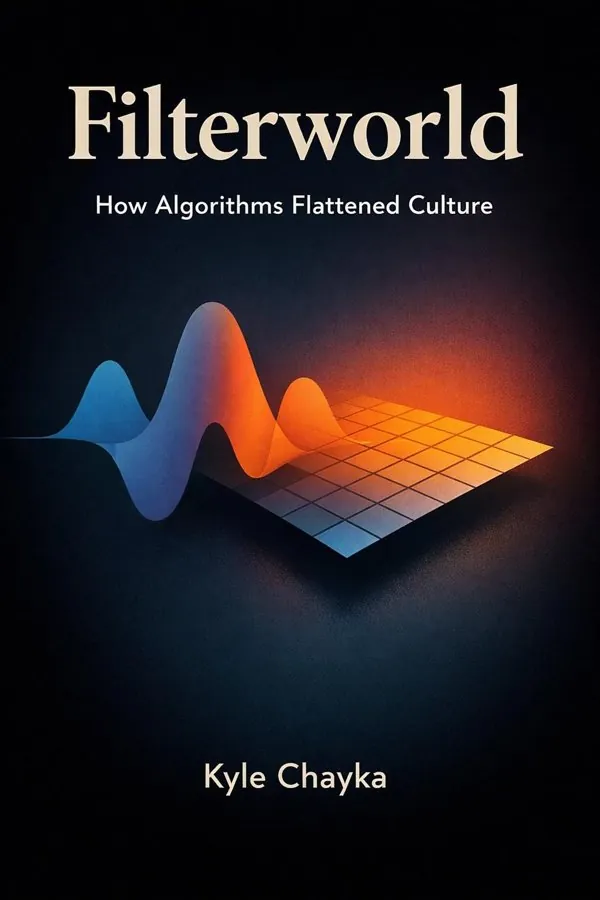
Filterworld: How Algorithms Flattened Culture: Summary & Key Insights
by Kyle Chayka
 10 min5 chaptersAudio available
What Is Filterworld: How Algorithms Flattened Culture About?
Filterworld: How Algorithms Flattened Culture by Kyle Chayka is a digital_culture book spanning 5 pages. Filterworld explores how algorithmic recommendation systems have reshaped global culture, influencing art, music, and personal taste. Kyle Chayka examines how digital platforms prioritize engagement and uniformity, leading to a homogenized cultural landscape. The book combines cultural criticism and technology analysis to reveal how algorithms affect creativity and individuality.
This FizzRead summary covers all 5 key chapters of Filterworld: How Algorithms Flattened Culture in approximately 10 minutes, distilling the most important ideas, arguments, and takeaways from Kyle Chayka's work. Also available as an audio summary and Key Quotes Podcast.
Filterworld: How Algorithms Flattened Culture
Filterworld explores how algorithmic recommendation systems have reshaped global culture, influencing art, music, and personal taste. Kyle Chayka examines how digital platforms prioritize engagement and uniformity, leading to a homogenized cultural landscape. The book combines cultural criticism and technology analysis to reveal how algorithms affect creativity and individuality.
Who Should Read Filterworld: How Algorithms Flattened Culture?
This book is perfect for anyone interested in digital_culture and looking to gain actionable insights in a short read. Whether you're a student, professional, or lifelong learner, the key ideas from Filterworld: How Algorithms Flattened Culture by Kyle Chayka will help you think differently.
- ✓Readers who enjoy digital_culture and want practical takeaways
- ✓Professionals looking to apply new ideas to their work and life
- ✓Anyone who wants the core insights of Filterworld: How Algorithms Flattened Culture in just 10 minutes
Want the full summary?
Get instant access to this book summary and 100K+ more with Fizz Moment.
Get Free SummaryAvailable on App Store • Free to download
Key Chapters
The story of Filterworld begins long before TikTok or Spotify playlists. In the 2000s, as digital platforms like Facebook, YouTube, and later Instagram, Twitter, and Netflix emerged, their early promise was decentralization — the democratization of culture. Anyone could share, connect, or create. But as the scale of content grew, a problem appeared: abundance without structure. Platforms needed a way to organize the flood of material and hold user attention. The algorithm arrived as the perfect solution. It promised to curate, to learn, to feed you precisely what you wanted.
At first, this seemed liberating. Users felt empowered by tailored recommendations; creators could find audiences without gatekeepers. Yet as the platforms optimized for engagement — clicks, shares, time on site — the recommendations began to shift. Content that provoked emotion or kept users scrolling was prioritized, while nuance and risk-taking receded. What began as curation turned into manipulation.
I watched as once-distinct cultural spaces began to merge into a common aesthetic zone. The painter in Berlin, the musician in Seoul, the influencer in New York — all began to produce in ways subtly tuned for algorithmic relevance. Songs shortened their intros to hook listeners before the skip. Café interiors aligned with Instagram color palettes. The algorithm didn’t just reflect culture; it started to create it.
Filterworld became, unknowingly, a global commons — a homogenized landscape built out of data feedback loops. Its logic was simple: smooth over difference, keep things flowing, eliminate friction. After all, friction costs engagement time. But culture thrives on friction; it’s the spark that makes something memorable, distinctive, and transformative. Algorithmic optimization quietly replaced that fire with an endless feed of the familiar.
At the heart of Filterworld lies a simple equation: engagement equals profit. Every platform measures success by how long you stay, how many things you click, how many ads you see. The algorithm, trained to maximize these metrics, learns your behavioral patterns — what makes you pause, what makes you react — and feeds you more of it. This mechanism doesn’t care about beauty, truth, or originality. It cares about retention.
The result is what I call the flattening of culture. Instead of a dynamic landscape full of competing styles and passions, we get a seamless, endlessly pleasant flow of content. Every platform begins to look like every other. Spotify’s chill playlists resemble Instagram’s pastel tones, which in turn match Airbnb’s minimalist interiors. Taste itself becomes algorithmic — led by convenience rather than curiosity.
What makes this so insidious is that it feels personal. We are told, after all, that the feed is ours — customized for us alone. Yet this personalization is largely illusion. The algorithms categorize you not as a complex individual but as a data bundle, a cluster that behaves like thousands of others. Each recommendation you receive reinforces what you already like, narrowing the circle of potential discovery. It is personalization without personhood.
Filterworld thus offers us comfort without challenge, familiarity without depth. Art becomes content, music becomes ambience, and culture turns into background noise that soothes rather than stirs. What disappears is the sense of encounter — that electrifying moment when something unexpected expands your world rather than confirming it.
+ 3 more chapters — available in the FizzRead app
All Chapters in Filterworld: How Algorithms Flattened Culture
About the Author
Kyle Chayka is an American writer and cultural critic whose work focuses on technology, art, and digital culture. He has written for The New Yorker, The New York Times Magazine, and other major publications. Chayka is also the author of 'The Longing for Less: Living with Minimalism'.
Get This Summary in Your Preferred Format
Read or listen to the Filterworld: How Algorithms Flattened Culture summary by Kyle Chayka anytime, anywhere. FizzRead offers multiple formats so you can learn on your terms — all free.
Available formats: App · Audio · PDF · EPUB — All included free with FizzRead
Download Filterworld: How Algorithms Flattened Culture PDF and EPUB Summary
Key Quotes from Filterworld: How Algorithms Flattened Culture
“The story of Filterworld begins long before TikTok or Spotify playlists.”
“At the heart of Filterworld lies a simple equation: engagement equals profit.”
Frequently Asked Questions about Filterworld: How Algorithms Flattened Culture
Filterworld: How Algorithms Flattened Culture by Kyle Chayka is a digital_culture book that explores key ideas across 5 chapters. Filterworld explores how algorithmic recommendation systems have reshaped global culture, influencing art, music, and personal taste. Kyle Chayka examines how digital platforms prioritize engagement and uniformity, leading to a homogenized cultural landscape. The book combines cultural criticism and technology analysis to reveal how algorithms affect creativity and individuality.
You Might Also Like

An Ugly Truth: Inside Facebook’s Battle for Domination
Sheera Frenkel, Cecilia Kang
10 min
Cyber Citizens
Ian Goodfellow
10 min
Digital Minimalism: Choosing a Focused Life in a Noisy World
Cal Newport
10 min
E‑Books & Beyond
Various Authors
10 min
The Future of Media
Various Authors
10 min
This Is Why We Can't Have Nice Things
Whitney Phillips
10 minBrowse by Category
Ready to read Filterworld: How Algorithms Flattened Culture?
Get the full summary and 100K+ more books with Fizz Moment.