
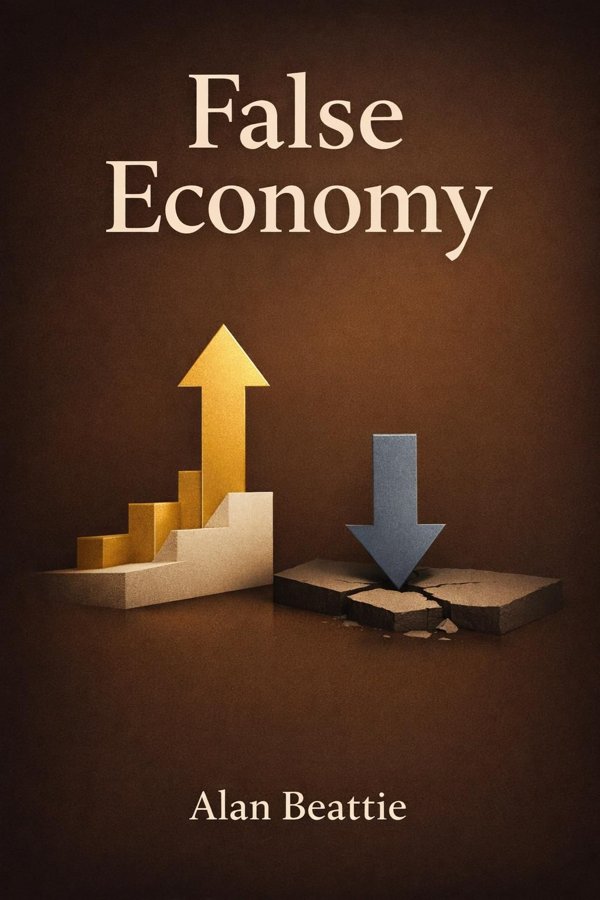
False Economy: A Surprising Economic History of the World: Summary & Key Insights
by Alan Beattie
 10 min12 chaptersAudio available
What Is False Economy: A Surprising Economic History of the World About?
False Economy: A Surprising Economic History of the World by Alan Beattie is a economics book spanning 12 pages. In this book, Alan Beattie explores the economic history of nations through vivid stories of success and failure. He examines how political decisions, cultural factors, and historical circumstances have shaped the prosperity or decline of countries around the world, offering insights into why some economies thrive while others falter.
This FizzRead summary covers all 12 key chapters of False Economy: A Surprising Economic History of the World in approximately 10 minutes, distilling the most important ideas, arguments, and takeaways from Alan Beattie's work. Also available as an audio summary and Key Quotes Podcast.
False Economy: A Surprising Economic History of the World
In this book, Alan Beattie explores the economic history of nations through vivid stories of success and failure. He examines how political decisions, cultural factors, and historical circumstances have shaped the prosperity or decline of countries around the world, offering insights into why some economies thrive while others falter.
Who Should Read False Economy: A Surprising Economic History of the World?
This book is perfect for anyone interested in economics and looking to gain actionable insights in a short read. Whether you're a student, professional, or lifelong learner, the key ideas from False Economy: A Surprising Economic History of the World by Alan Beattie will help you think differently.
- ✓Readers who enjoy economics and want practical takeaways
- ✓Professionals looking to apply new ideas to their work and life
- ✓Anyone who wants the core insights of False Economy: A Surprising Economic History of the World in just 10 minutes
Want the full summary?
Get instant access to this book summary and 100K+ more with Fizz Moment.
Get Free SummaryAvailable on App Store • Free to download
Key Chapters
Few stories illustrate my central argument better than Argentina’s. At the dawn of the twentieth century, Argentina was rich, modernizing rapidly, and exporting grain to feed the world. Buenos Aires was spoken of in the same breath as Paris and London. Yet, within decades, it became a byword for squandered opportunity. What happened? Politics, pure and simple.
Argentina’s downfall was not a mystery of economics but of governance. Its elites, fearing social unrest and addicted to protectionist privileges, suffocated competition. Populist nationalism turned economic policy into a theatre of ideology rather than rational planning. The state became both patron and jailer of commerce. Every crisis produced another promise of renewal, yet those promises always bent to political expediency. Argentina illustrates how democracy, without institutional responsibility, can repeatedly sacrifice long-term growth for short-term popularity.
I tell this story not just to lament but to warn: prosperity is fragile when politics hijack economics. Nations often believe they can bend markets to serve vested interests, but history shows that protectionism and corruption make even the richest soil barren. Argentina’s tragedy reminds us that good economics requires not only wealth but the courage to let that wealth circulate freely.
The American story is often told as destiny—a continent blessed with resources, a people gifted with ambition. But its rise owes more to flexible institutions and pragmatic innovation than to myth. The United States built prosperity by allowing newcomers and new ideas to flourish, by welcoming immigrants and entrusting much of its progress to entrepreneurial energy.
Unlike Argentina, America nurtured a political culture tolerant of creative destruction. Failure was not stigmatised, and diversity of thought became both its strength and its stabilizer. When crises struck—financial panics, depressions, even wars—its institutions adapted rather than collapsed. Property rights, the rule of law, and a culture of enterprise formed an ecosystem in which capitalism could reinvent itself. The lesson is that openness, both political and economic, sustains growth far better than control and uniformity.
America’s case demonstrates that success is rarely neat. Its progress was chaotic, its politics noisy. But that messiness was itself a form of resilience. The enduring message here is that prosperity belongs to nations that permit experimentation—where ideology yields to pragmatism, and institutions evolve as the world around them does.
+ 10 more chapters — available in the FizzRead app
All Chapters in False Economy: A Surprising Economic History of the World
About the Author
Alan Beattie is a British journalist and author known for his work as an economics correspondent for the Financial Times. He specializes in global economic policy and development issues, bringing clarity and narrative depth to complex economic topics.
Get This Summary in Your Preferred Format
Read or listen to the False Economy: A Surprising Economic History of the World summary by Alan Beattie anytime, anywhere. FizzRead offers multiple formats so you can learn on your terms — all free.
Available formats: App · Audio · PDF · EPUB — All included free with FizzRead
Download False Economy: A Surprising Economic History of the World PDF and EPUB Summary
Key Quotes from False Economy: A Surprising Economic History of the World
“Few stories illustrate my central argument better than Argentina’s.”
“The American story is often told as destiny—a continent blessed with resources, a people gifted with ambition.”
Frequently Asked Questions about False Economy: A Surprising Economic History of the World
False Economy: A Surprising Economic History of the World by Alan Beattie is a economics book that explores key ideas across 12 chapters. In this book, Alan Beattie explores the economic history of nations through vivid stories of success and failure. He examines how political decisions, cultural factors, and historical circumstances have shaped the prosperity or decline of countries around the world, offering insights into why some economies thrive while others falter.
You Might Also Like

Business Adventures
John Brooks
10 min
Nudge
Richard H. Thaler, Cass R. Sunstein
10 min
The Hitchhiker"s Guide to the Galaxy
Douglas Adams
10 minThe Muqaddimah
Ibn Khaldun
10 minThe Outsiders
William N. Thorndike
10 min
A Little History of Economics
Niall Kishtainy
10 minBrowse by Category
Ready to read False Economy: A Surprising Economic History of the World?
Get the full summary and 100K+ more books with Fizz Moment.