
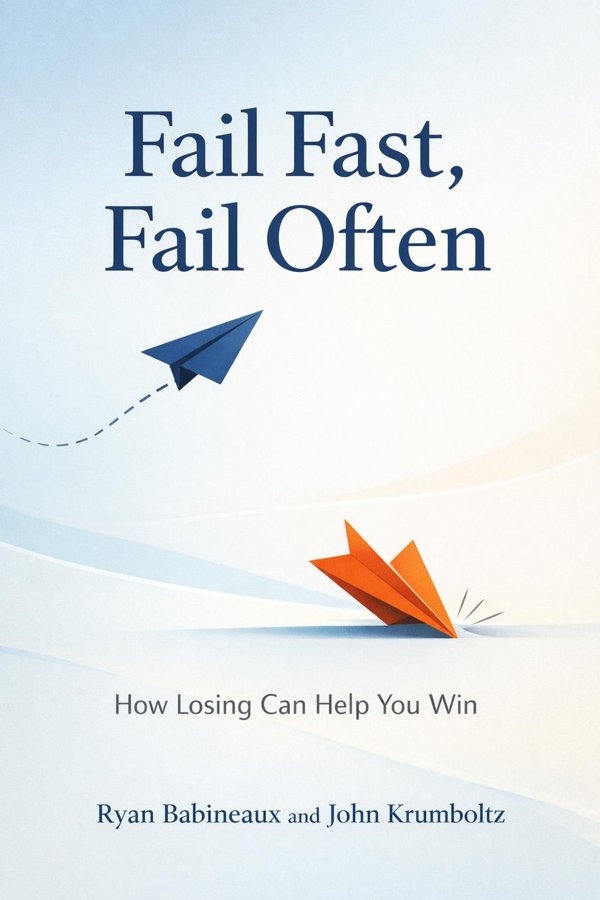
Fail Fast, Fail Often: How Losing Can Help You Win: Summary & Key Insights
by Ryan Babineaux, John Krumboltz
 10 min10 chaptersAudio available
What Is Fail Fast, Fail Often: How Losing Can Help You Win About?
Fail Fast, Fail Often: How Losing Can Help You Win by Ryan Babineaux and John Krumboltz is a mindset book spanning 10 pages. This book encourages readers to embrace failure as a necessary step toward success. Drawing on psychological research and real-world examples, the authors argue that taking action, experimenting, and learning from mistakes lead to greater creativity, confidence, and fulfillment. It challenges the fear of failure and promotes a mindset of continuous learning and resilience.
This FizzRead summary covers all 10 key chapters of Fail Fast, Fail Often: How Losing Can Help You Win in approximately 10 minutes, distilling the most important ideas, arguments, and takeaways from Ryan Babineaux and John Krumboltz's work. Also available as an audio summary and Key Quotes Podcast.
Fail Fast, Fail Often: How Losing Can Help You Win
This book encourages readers to embrace failure as a necessary step toward success. Drawing on psychological research and real-world examples, the authors argue that taking action, experimenting, and learning from mistakes lead to greater creativity, confidence, and fulfillment. It challenges the fear of failure and promotes a mindset of continuous learning and resilience.
Who Should Read Fail Fast, Fail Often: How Losing Can Help You Win?
This book is perfect for anyone interested in mindset and looking to gain actionable insights in a short read. Whether you're a student, professional, or lifelong learner, the key ideas from Fail Fast, Fail Often: How Losing Can Help You Win by Ryan Babineaux and John Krumboltz will help you think differently.
- ✓Readers who enjoy mindset and want practical takeaways
- ✓Professionals looking to apply new ideas to their work and life
- ✓Anyone who wants the core insights of Fail Fast, Fail Often: How Losing Can Help You Win in just 10 minutes
Want the full summary?
Get instant access to this book summary and 100K+ more with Fizz Moment.
Get Free SummaryAvailable on App Store • Free to download
Key Chapters
From childhood, most of us are conditioned to avoid mistakes. Teachers mark errors in red ink; workplaces celebrate flawless performance; parents reward success. Over time, failure becomes a sign of personal inadequacy rather than a natural part of growth. This fear of failure silently shapes our choices — we take fewer risks, avoid new experiences, and unknowingly limit our potential.
But here’s what we learned through decades of counseling students and professionals: the fear of failure is more destructive than failure itself. People who wait until conditions are perfect rarely begin anything meaningful. Real life is messy, unpredictable, and much kinder to those who act boldly than to those who plan endlessly. When you dare to fail, you’re choosing to live. When you hold back, you deny yourself the chance to learn who you really are.
Understanding this fear is the first step toward freeing yourself from it. It’s not about never feeling afraid, but about learning to move forward anyway. Fear and action can coexist. Confidence doesn’t precede courageous steps; it grows from them. The people we admire most — innovators, inventors, creators — didn’t succeed because they knew they would win. They succeeded because they were willing to lose and learn. The key is reframing failure not as a verdict, but as feedback — valuable information that guides your next move.
One of the core messages of this book is simple: thinking too much can ruin good opportunities. We’re taught to deliberate, to plan carefully, to wait for certainty. But in reality, clarity comes through action. When you take even a small step forward, you gain insights that no amount of reflection could provide.
I once counseled a graduate student who spent months trying to decide on the perfect career. Every day she analyzed possibilities, made lists, and sought advice. Yet, she remained stuck. Finally, we encouraged her to stop researching and start experimenting. She spent a summer shadowing a startup founder, volunteering at a nonprofit, and taking an online design course. Within weeks, she discovered what inspired her — something no spreadsheet could have revealed. Her clarity came not from contemplation, but from experience.
Action is powerful because it breaks inertia. It transforms the abstract into the concrete. Every small step, however imperfect, builds momentum. And momentum has its own intelligence — it opens doors, sparks creativity, and reveals options you could never foresee from the safety of the sidelines. The most successful people don’t wait for the perfect plan; they create it in motion.
+ 8 more chapters — available in the FizzRead app
All Chapters in Fail Fast, Fail Often: How Losing Can Help You Win
About the Authors
Ryan Babineaux, Ph.D., is a career counselor and educator specializing in creativity and innovation. John D. Krumboltz, Ph.D., was a professor of education and psychology at Stanford University, known for his work in career development and learning theory.
Get This Summary in Your Preferred Format
Read or listen to the Fail Fast, Fail Often: How Losing Can Help You Win summary by Ryan Babineaux and John Krumboltz anytime, anywhere. FizzRead offers multiple formats so you can learn on your terms — all free.
Available formats: App · Audio · PDF · EPUB — All included free with FizzRead
Download Fail Fast, Fail Often: How Losing Can Help You Win PDF and EPUB Summary
Key Quotes from Fail Fast, Fail Often: How Losing Can Help You Win
“From childhood, most of us are conditioned to avoid mistakes.”
“One of the core messages of this book is simple: thinking too much can ruin good opportunities.”
Frequently Asked Questions about Fail Fast, Fail Often: How Losing Can Help You Win
Fail Fast, Fail Often: How Losing Can Help You Win by Ryan Babineaux and John Krumboltz is a mindset book that explores key ideas across 10 chapters. This book encourages readers to embrace failure as a necessary step toward success. Drawing on psychological research and real-world examples, the authors argue that taking action, experimenting, and learning from mistakes lead to greater creativity, confidence, and fulfillment. It challenges the fear of failure and promotes a mindset of continuous learning and resilience.
You Might Also Like


Browse by Category
Ready to read Fail Fast, Fail Often: How Losing Can Help You Win?
Get the full summary and 100K+ more books with Fizz Moment.