
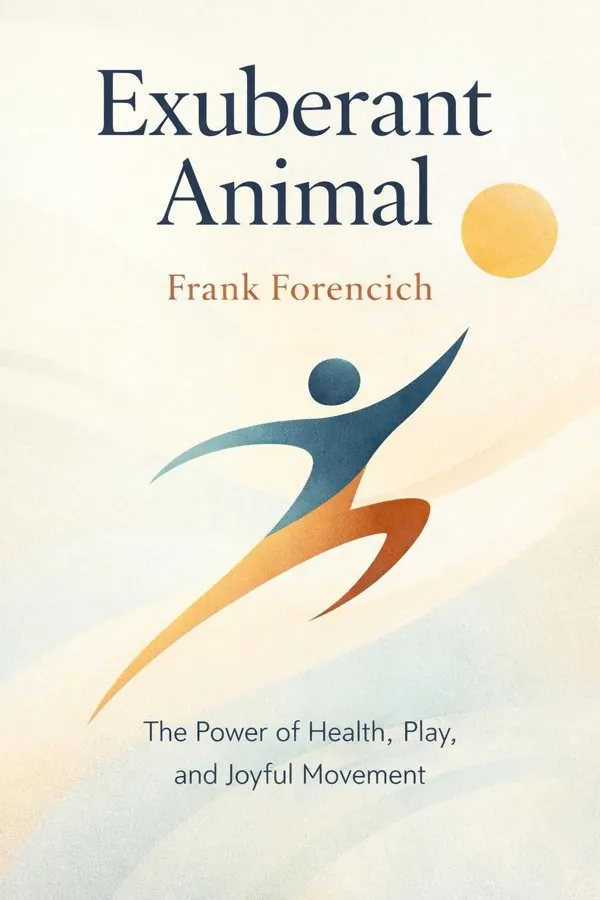
Exuberant Animal: The Power of Health, Play, and Joyful Movement: Summary & Key Insights
 10 min9 chaptersAudio available
Key Takeaways from Exuberant Animal: The Power of Health, Play, and Joyful Movement
A useful way to understand the modern body is to remember that it was not built for furniture, but for terrain.
Convenience can quietly become a form of captivity.
Play is often treated as childish, but Forencich presents it as one of the most intelligent functions of a healthy organism.
You cannot care well for a body you barely inhabit.
Fitness is not just about how much you move, but about the environment of movement you create around yourself.
What Is Exuberant Animal: The Power of Health, Play, and Joyful Movement About?
Exuberant Animal: The Power of Health, Play, and Joyful Movement by Frank Forencich is a wellness book spanning 11 pages. Exuberant Animal is a passionate invitation to reclaim a more alive, capable, and joyful way of being in the body. In this book, Frank Forencich argues that many of the problems people associate with modern health—fatigue, stiffness, anxiety, disconnection, and lack of vitality—are not simply personal failings or medical issues. They are often the result of living in environments that suppress our natural design as active, playful, adaptive creatures. Drawing on evolutionary biology, anthropology, physical culture, and practical movement training, Forencich shows that human beings evolved to move widely, play often, and engage richly with the world around them. His central claim is simple but powerful: health is not just the absence of disease, but the presence of exuberance. That makes this book especially relevant for readers who feel trapped by sedentary routines or sterile fitness advice. Forencich writes with the authority of an educator deeply immersed in movement, performance, and human potential, offering a perspective that is both intellectually grounded and immediately practical.
This FizzRead summary covers all 9 key chapters of Exuberant Animal: The Power of Health, Play, and Joyful Movement in approximately 10 minutes, distilling the most important ideas, arguments, and takeaways from Frank Forencich's work. Also available as an audio summary and Key Quotes Podcast.
Exuberant Animal: The Power of Health, Play, and Joyful Movement
Exuberant Animal is a passionate invitation to reclaim a more alive, capable, and joyful way of being in the body. In this book, Frank Forencich argues that many of the problems people associate with modern health—fatigue, stiffness, anxiety, disconnection, and lack of vitality—are not simply personal failings or medical issues. They are often the result of living in environments that suppress our natural design as active, playful, adaptive creatures. Drawing on evolutionary biology, anthropology, physical culture, and practical movement training, Forencich shows that human beings evolved to move widely, play often, and engage richly with the world around them. His central claim is simple but powerful: health is not just the absence of disease, but the presence of exuberance. That makes this book especially relevant for readers who feel trapped by sedentary routines or sterile fitness advice. Forencich writes with the authority of an educator deeply immersed in movement, performance, and human potential, offering a perspective that is both intellectually grounded and immediately practical.
Who Should Read Exuberant Animal: The Power of Health, Play, and Joyful Movement?
This book is perfect for anyone interested in wellness and looking to gain actionable insights in a short read. Whether you're a student, professional, or lifelong learner, the key ideas from Exuberant Animal: The Power of Health, Play, and Joyful Movement by Frank Forencich will help you think differently.
- ✓Readers who enjoy wellness and want practical takeaways
- ✓Professionals looking to apply new ideas to their work and life
- ✓Anyone who wants the core insights of Exuberant Animal: The Power of Health, Play, and Joyful Movement in just 10 minutes
Want the full summary?
Get instant access to this book summary and 100K+ more with Fizz Moment.
Get Free SummaryAvailable on App Store • Free to download
Key Chapters
A useful way to understand the modern body is to remember that it was not built for furniture, but for terrain. Forencich begins with an evolutionary perspective: human beings emerged in dynamic landscapes that demanded walking, climbing, carrying, balancing, crawling, and quick responses to changing conditions. Survival depended on movement variety, environmental awareness, and physical resilience. In that world, exercise was not a separate activity. It was simply life.
This idea matters because it reframes many modern complaints. Chronic tightness, low energy, poor coordination, and metabolic decline are not random misfortunes. They often arise when a body designed for diversity is restricted to repetitive, seated, highly controlled routines. From an evolutionary standpoint, the problem is not that people are lazy; it is that modern environments remove movement from ordinary living.
Forencich encourages readers to think less like gym members and more like adaptable animals. That means valuing natural human actions: taking the stairs, squatting on the ground, walking on uneven surfaces, carrying groceries without a cart, getting up and down from the floor, or playing physically with children. These are not trivial activities. They restore the movement richness our bodies expect.
A practical application is to audit your week for movement monotony. If most of your activity happens sitting, driving, typing, or doing one repetitive workout, your movement ecology is too narrow. Add variety by walking different routes, spending time outdoors, practicing ground movements, and using your body in multiple planes and speeds.
Actionable takeaway: treat movement as a biological necessity, not an optional hobby, and deliberately add more natural variety to your daily life.
Convenience can quietly become a form of captivity. One of Forencich’s strongest observations is that modern civilization has made life more efficient while often making bodies and minds less alive. Climate-controlled buildings, prolonged sitting, digital entertainment, rigid schedules, and overmanaged routines reduce the need for spontaneous action. As a result, people may appear comfortable while becoming physically dull, emotionally flat, and increasingly disconnected from their own energy.
Forencich does not reject technology outright. Instead, he asks readers to notice the hidden cost of environments that eliminate challenge, texture, and embodied engagement. Human systems thrive on interaction with real conditions: gravity, weather, terrain, objects, animals, and other people. When those inputs disappear, health is reduced to maintenance rather than lived aliveness.
This modern disconnect also affects motivation. Many people say they struggle to exercise regularly, but Forencich suggests the issue is deeper than discipline. Sedentary living can weaken our appetite for movement itself. The less we move, the less movement feels natural. The body becomes deconditioned, and the imagination follows.
Practical changes do not require abandoning modern life. You can introduce friction and engagement back into your day by walking for errands, standing during calls, taking movement breaks every hour, working in different postures, spending time outdoors in varied weather, and choosing recreation that involves real physical participation instead of passive consumption.
Actionable takeaway: identify the conveniences that reduce your aliveness and replace some of them with habits that reintroduce challenge, sensation, and embodied participation.
Play is often treated as childish, but Forencich presents it as one of the most intelligent functions of a healthy organism. In animals and humans alike, play develops coordination, adaptability, social skills, emotional range, and resilience. It is not a waste of time after serious work is done. It is part of how bodies and brains become more capable.
What distinguishes play from mechanical exercise is its spirit. Play is exploratory, responsive, and pleasurable. It involves improvisation rather than strict repetition. A game of tag, a hike with obstacles, roughhousing with children, dancing in the kitchen, tossing a ball, or inventing movement challenges with friends can develop capacities that a rigid workout may miss. Through play, people learn timing, balance, creativity, risk calibration, and recovery from mistakes.
Forencich also suggests that adults suffer when they abandon playfulness. Life becomes overly serious, movement becomes punitive, and health becomes another duty. In contrast, playful movement draws people back into participation because it feels rewarding in itself. This is especially important for those who resist formal fitness programs. A person may hate treadmills but love climbing, martial arts, swimming in open water, or playing ultimate frisbee.
To apply this idea, think beyond exercise prescriptions. Ask what forms of movement make you curious, social, or joyful. Join a recreational sport, learn a physical skill, keep simple props like balls or jump ropes nearby, or create family rituals around active games. For children, protect time for unstructured outdoor movement instead of replacing it entirely with scheduled programs.
Actionable takeaway: choose at least one form of movement each week that feels playful rather than dutiful, and let enjoyment become part of your health strategy.
You cannot care well for a body you barely inhabit. Forencich emphasizes embodied awareness as a foundation for health, meaning the ability to sense posture, breath, tension, rhythm, balance, fatigue, and ease from within. In a culture dominated by screens and abstraction, many people live from the neck up, treating the body as a vehicle to drag around until it fails or demands repair.
Embodied awareness changes that relationship. It helps people notice when they are holding unnecessary tension, breathing shallowly, collapsing into chairs, moving mechanically, or ignoring signals of stress and overload. This is not mere self-observation for its own sake. Better awareness improves movement quality, injury prevention, emotional regulation, and decision-making. A person who can sense the difference between fatigue and laziness, effort and strain, or alertness and anxiety is better equipped to train wisely and live more fully.
Forencich’s broader point is that intelligence is not only cognitive. The body contains practical knowledge shaped by evolution and experience. Learning to listen to that knowledge means slowing down enough to feel your feet on the ground, your ribcage expanding, your spine adjusting, and your mood shifting with movement.
Practical methods include walking without headphones, practicing simple balance drills, sitting on the floor and changing positions often, scanning the body during the day for tension, and pairing movement with conscious breathing. Even ordinary acts like reaching, bending, and standing can become opportunities to recover sensation and presence.
Actionable takeaway: build short moments of body-checking into your day—notice breath, posture, and tension several times daily, then make one small adjustment toward ease and alertness.
Fitness is not just about how much you move, but about the environment of movement you create around yourself. Forencich uses the idea of movement ecology to describe the full range of conditions, habits, spaces, and social influences that shape physical behavior. A healthy movement life is not built from one workout program alone. It emerges from a rich ecosystem of opportunities to move in different ways.
This concept helps explain why some people remain active with little formal discipline while others struggle despite good intentions. If your home, commute, workplace, and leisure routines all encourage sitting, stillness, and convenience, then your movement ecology is poor. By contrast, if your environment includes walkable routes, accessible parks, floor space, tools for active play, standing options, and friends who enjoy physical activity, movement becomes normal rather than exceptional.
Forencich invites readers to become designers of their own ecology. Rearrange spaces so activity is easier: keep shoes by the door, set up a pull-up bar, store a yoga mat in plain sight, place seating and workstations at varied heights, or create inviting outdoor areas. Social ecology matters too. Join communities where movement is shared rather than isolated—walking groups, climbing clubs, dance classes, martial arts schools, or neighborhood play gatherings.
The goal is not perfection but density of opportunity. When movement is woven into the environment, you need less willpower. The body responds to cues, options, and invitations.
Actionable takeaway: redesign one part of your daily environment this week so that moving, stretching, walking, or playing becomes the easiest available choice.
Not all movement produces the same result. Forencich argues that joyful movement has a special power because it nourishes the whole person, not just muscles or cardiovascular markers. When movement is linked with pleasure, curiosity, connection, and meaning, it becomes restorative rather than merely extractive. People recover not only fitness, but enthusiasm for being alive.
This idea challenges a common assumption in wellness culture: that health must be earned through grim discipline, self-criticism, or endless optimization. Forencich does not deny the value of effort. He simply insists that effort works better when it is embedded in positive engagement. A person who hikes with friends, dances freely, practices a beloved sport, or explores trails with genuine delight is often building more sustainable health than someone who drags themselves through exercise they resent.
Joyful movement also changes the nervous system. Pleasure can reduce fear, soften chronic tension, and increase willingness to experiment. That matters for people recovering from injury, burnout, or years of inactivity. When movement feels punishing, many avoid it. When it feels rewarding, they return.
Practical applications include replacing at least some obligatory workouts with movement you actually enjoy, listening to your emotional response to different activities, and broadening your definition of valid exercise. Gardening, paddling, recreational skating, mobility flow, partner games, or movement-based arts can all contribute to health if they awaken energy and participation.
Actionable takeaway: make enjoyment one of your training criteria—keep the activities that leave you feeling more alive, and reduce those that consistently make movement feel like a burden.
The purpose of training is not simply to produce a better-looking body; it is to create a more responsive, capable, and spirited human being. Forencich uses the term exuberance to describe a state of vitality expressed through movement quality, confidence, adaptability, and eagerness to engage with life. Training, in this view, should increase your readiness for living, not narrow you into a specialist who performs well only under controlled conditions.
That means effective training includes more than strength or endurance. It should also build mobility, balance, coordination, rhythm, agility, resilience, and the ability to recover. A person who can lift heavy weights but cannot squat comfortably, move fluidly on the ground, or play without stiffness may be fit in one sense but underprepared in another. Exuberant training respects the body as a whole organism.
Forencich encourages diverse practice: lifting and carrying, sprinting and walking, climbing and hanging, crawling and rolling, balancing and throwing. He also values unpredictability. Real life is variable, so training should occasionally involve novel tasks, outdoor conditions, and playful challenges that require adaptation rather than rote execution.
For everyday readers, this could mean combining formal workouts with movement snacks, practicing getting up from the floor without using your hands, carrying odd objects, adding short bursts of speed to walks, or learning a physical discipline that demands skill as well as effort.
Actionable takeaway: evaluate your current routine by one question—does it make you more capable in daily life? If not, add training elements that improve versatility, coordination, and real-world readiness.
Human vitality is social. Forencich reminds readers that movement, play, and health have historically been embedded in culture—in shared labor, group games, rituals, celebrations, and outdoor life. Modern wellness often isolates people, turning health into a private self-improvement project managed through apps, metrics, and solo routines. While those tools can help, they cannot fully replace the power of belonging.
Community shapes behavior in profound ways. People move more when movement is part of shared identity. They persist longer when activity is tied to friendship, contribution, and mutual encouragement. They also experience joy more readily when effort is collective. A pickup game in the park, a neighborhood walking group, a family hike, or a class where people laugh and struggle together can generate motivation that solitary discipline rarely sustains.
Forencich’s cultural critique runs deeper: societies that undervalue play, embodiment, and outdoor life produce citizens who are easier to manage but less fully alive. Reclaiming exuberance therefore has social implications. Schools can protect recess and physical literacy. Workplaces can normalize movement breaks and walking meetings. Cities can create parks, paths, and public spaces that invite participation. Families can choose rituals that involve activity rather than only consumption.
At the personal level, one of the fastest ways to change your habits is to change your tribe. Seek people who make movement normal, fun, and meaningful.
Actionable takeaway: join or create one recurring social activity built around movement—something simple, regular, and welcoming enough that it becomes part of your culture, not just your schedule.
To rewild the human experience does not mean abandoning civilization and moving into the forest. Forencich uses the idea more subtly: it means restoring contact with the conditions that help human beings feel integrated, awake, and whole. Nature, unpredictability, sensory richness, and direct engagement all remind the body-mind system what it evolved for.
This is where the book’s themes converge. Movement, play, awareness, training, and community are not separate wellness categories. Together they create mind-body integration. When people move outdoors, navigate real terrain, breathe fresh air, use their senses, and share effort with others, they often experience improvements in mood, attention, coordination, and meaning all at once. Health stops being compartmentalized.
Rewilding can begin modestly. Take walks on trails instead of only on treadmills. Sit on the ground in a park. Practice barefoot time where safe. Watch how weather changes your energy. Let children climb, balance, and get dirty. Replace some indoor entertainment with outdoor exploration. Forencich’s point is not nostalgia for the past, but recovery of capacities the modern world tends to mute.
This approach is especially valuable for people who feel fragmented—mentally overstimulated but physically underused, informed about wellness but unable to feel well. Rewilding shifts the focus from more information to better experience.
Actionable takeaway: schedule one recurring weekly practice that reconnects you with the natural world through movement, even if it is only a long walk in a local park without devices.
All Chapters in Exuberant Animal: The Power of Health, Play, and Joyful Movement
About the Author
Frank Forencich is a writer, educator, and movement advocate whose work explores the relationship between human evolution, physical vitality, health, and performance. He is known for challenging sedentary modern habits and for promoting a broader, more life-affirming view of wellness—one that includes play, environmental engagement, and embodied intelligence. Drawing from anthropology, biology, movement practice, and physical culture, Forencich writes about how human beings can recover resilience and aliveness in a world that often encourages passivity and disconnection. His work appeals to readers interested in natural movement, personal transformation, and the deeper meaning of health. Through books, teaching, and public speaking, he has become a respected voice in the conversation about what it means to live well in the modern world.
Get This Summary in Your Preferred Format
Read or listen to the Exuberant Animal: The Power of Health, Play, and Joyful Movement summary by Frank Forencich anytime, anywhere. FizzRead offers multiple formats so you can learn on your terms — all free.
Available formats: App · Audio · PDF · EPUB — All included free with FizzRead
Download Exuberant Animal: The Power of Health, Play, and Joyful Movement PDF and EPUB Summary
Key Quotes from Exuberant Animal: The Power of Health, Play, and Joyful Movement
“A useful way to understand the modern body is to remember that it was not built for furniture, but for terrain.”
“Convenience can quietly become a form of captivity.”
“Play is often treated as childish, but Forencich presents it as one of the most intelligent functions of a healthy organism.”
“You cannot care well for a body you barely inhabit.”
“Fitness is not just about how much you move, but about the environment of movement you create around yourself.”
Frequently Asked Questions about Exuberant Animal: The Power of Health, Play, and Joyful Movement
Exuberant Animal: The Power of Health, Play, and Joyful Movement by Frank Forencich is a wellness book that explores key ideas across 9 chapters. Exuberant Animal is a passionate invitation to reclaim a more alive, capable, and joyful way of being in the body. In this book, Frank Forencich argues that many of the problems people associate with modern health—fatigue, stiffness, anxiety, disconnection, and lack of vitality—are not simply personal failings or medical issues. They are often the result of living in environments that suppress our natural design as active, playful, adaptive creatures. Drawing on evolutionary biology, anthropology, physical culture, and practical movement training, Forencich shows that human beings evolved to move widely, play often, and engage richly with the world around them. His central claim is simple but powerful: health is not just the absence of disease, but the presence of exuberance. That makes this book especially relevant for readers who feel trapped by sedentary routines or sterile fitness advice. Forencich writes with the authority of an educator deeply immersed in movement, performance, and human potential, offering a perspective that is both intellectually grounded and immediately practical.
You Might Also Like

How We Heal: Uncover Your Power and Set Yourself Free
Alexandra Elle
10 min
A Year of Self-Care: Daily Practices and Inspiration for Caring for Yourself
Zoe Shaw
10 min
Biohacker’s Handbook: Upgrade Your Life
Olli Sovijärvi, Teemu Arina, Jaakko Halmetoja
10 min
Bliss More: How to Succeed in Meditation Without Really Trying
Light Watkins
10 min
Body Kindness: Transform Your Health from the Inside Out—and Never Say Diet Again
Rebecca Scritchfield
10 min
Cook, Eat, Run: Cook Fast, Boost Performance with 75 Ultimate Recipes for Runners
Charlie Watson
10 minFeatured In
Browse by Category
Ready to read Exuberant Animal: The Power of Health, Play, and Joyful Movement?
Get the full summary and 100K+ more books with Fizz Moment.