
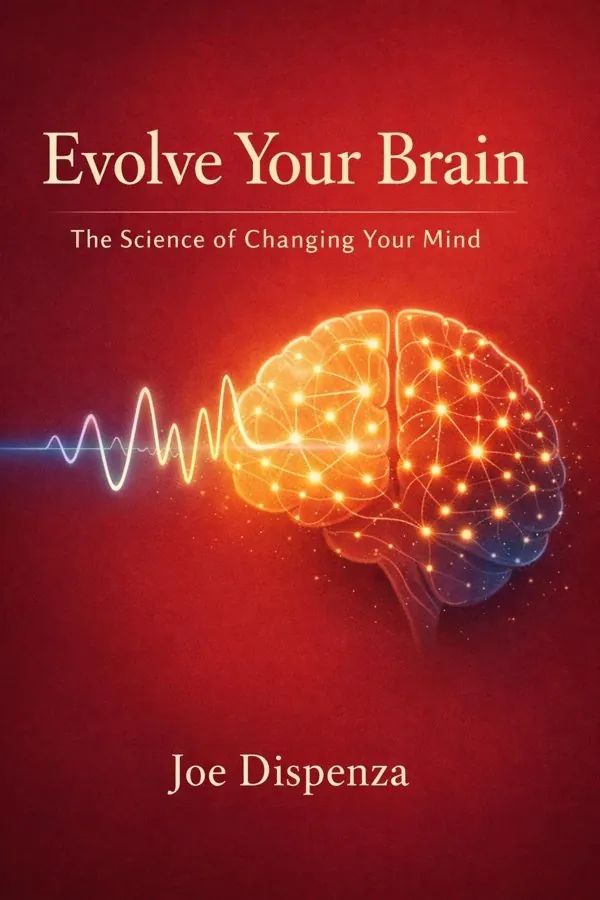
Evolve Your Brain: The Science of Changing Your Mind: Summary & Key Insights
by Joe Dispenza
 10 min8 chaptersAudio available
What Is Evolve Your Brain: The Science of Changing Your Mind About?
Evolve Your Brain: The Science of Changing Your Mind by Joe Dispenza is a neuroscience book spanning 8 pages. This book explores the intersection of neuroscience, biology, and psychology to explain how thoughts can physically alter the brain and body. Joe Dispenza presents scientific insights into neuroplasticity and the mind-body connection, offering practical methods for transforming habits and emotional patterns through conscious thought and meditation.
This FizzRead summary covers all 8 key chapters of Evolve Your Brain: The Science of Changing Your Mind in approximately 10 minutes, distilling the most important ideas, arguments, and takeaways from Joe Dispenza's work. Also available as an audio summary and Key Quotes Podcast.
Evolve Your Brain: The Science of Changing Your Mind
This book explores the intersection of neuroscience, biology, and psychology to explain how thoughts can physically alter the brain and body. Joe Dispenza presents scientific insights into neuroplasticity and the mind-body connection, offering practical methods for transforming habits and emotional patterns through conscious thought and meditation.
Who Should Read Evolve Your Brain: The Science of Changing Your Mind?
This book is perfect for anyone interested in neuroscience and looking to gain actionable insights in a short read. Whether you're a student, professional, or lifelong learner, the key ideas from Evolve Your Brain: The Science of Changing Your Mind by Joe Dispenza will help you think differently.
- ✓Readers who enjoy neuroscience and want practical takeaways
- ✓Professionals looking to apply new ideas to their work and life
- ✓Anyone who wants the core insights of Evolve Your Brain: The Science of Changing Your Mind in just 10 minutes
Want the full summary?
Get instant access to this book summary and 100K+ more with Fizz Moment.
Get Free SummaryAvailable on App Store • Free to download
Key Chapters
At the heart of this journey lies neuroplasticity—the brain’s innate ability to alter its structure and function based on repeated mental and experiential inputs. I start by showing that every thought activates specific neural circuits, and the more those circuits fire, the stronger their connections become. This process is sometimes expressed as ‘neurons that fire together wire together.’ In neuroscience, this principle explains how learning, memory, and habit formation occur.
Through experience, the brain evolves. A musician’s sensory cortex expands to accommodate fine motor skills; a taxi driver’s hippocampus develops sharper spatial mapping capability. But it’s not limited to physical activities—the same adaptation applies to mental and emotional states. When we rehearse feelings of anxiety or resentment, we reinforce those neural pathways, sculpting a brain predisposed to those emotions. Conversely, when we practice gratitude or compassion, we strengthen circuits that foster calm and connection.
The key insight is that change is not a matter of force or willpower; it’s a matter of creating new experiences—internally through thought, and externally through action—that the brain then encodes. Once you understand this mechanism, you begin to see that your identity—your habits, even your personality—emerge from neural circuitry you can consciously reshape. The mind becomes both the sculptor and the clay, and evolution occurs from within.
Before transformation can begin, we must understand the biological machinery of thought. Neurons are the brain’s messengers—electrical cells that communicate via synapses by releasing chemicals called neurotransmitters. Each thought corresponds to a network of these cells firing in synchrony. When a neuron is repeatedly activated, it grows new branches, increasing its connections to others. These microstructural changes form the neural basis of learning and memory.
I often describe the brain as an orchestra whose instruments are constantly tuning themselves. Neurons send electrical impulses, neurotransmitters carry signals across synapses, and glial cells support and refine the communication. Dopamine, serotonin, acetylcholine—all these chemicals form the symphony of your mental states. The mind uses this biological framework to encode experiences, and the more emotionally charged an event, the stronger its imprint on neural pathways.
By walking you through the biology, I want you to appreciate that emotions are not abstract—they are tangible biochemical processes shaping your reality. When you feel fear, your amygdala directs a cascade of stress hormones. When you experience joy, dopamine lights up the reward circuits. You are not at the mercy of these reactions; when understood, they become tools for transformation. By consciously recognizing emotional triggers and choosing new responses, you begin to alter these chemical dialogues. You start teaching your brain a new language—and it responds by rewiring itself to speak it fluently.
+ 6 more chapters — available in the FizzRead app
All Chapters in Evolve Your Brain: The Science of Changing Your Mind
About the Author
Joe Dispenza is an American neuroscientist, chiropractor, and author known for his work on the mind-body connection and personal transformation. He lectures internationally on the science of change and meditation, combining research in neuroscience, epigenetics, and quantum physics.
Get This Summary in Your Preferred Format
Read or listen to the Evolve Your Brain: The Science of Changing Your Mind summary by Joe Dispenza anytime, anywhere. FizzRead offers multiple formats so you can learn on your terms — all free.
Available formats: App · Audio · PDF · EPUB — All included free with FizzRead
Download Evolve Your Brain: The Science of Changing Your Mind PDF and EPUB Summary
Key Quotes from Evolve Your Brain: The Science of Changing Your Mind
“At the heart of this journey lies neuroplasticity—the brain’s innate ability to alter its structure and function based on repeated mental and experiential inputs.”
“Before transformation can begin, we must understand the biological machinery of thought.”
Frequently Asked Questions about Evolve Your Brain: The Science of Changing Your Mind
Evolve Your Brain: The Science of Changing Your Mind by Joe Dispenza is a neuroscience book that explores key ideas across 8 chapters. This book explores the intersection of neuroscience, biology, and psychology to explain how thoughts can physically alter the brain and body. Joe Dispenza presents scientific insights into neuroplasticity and the mind-body connection, offering practical methods for transforming habits and emotional patterns through conscious thought and meditation.
More by Joe Dispenza
You Might Also Like

Anxious
Joseph LeDoux
10 min
Hallucinations
Oliver Sacks
10 min
The Biological Mind: How Brain, Body, and Environment Collaborate to Make Us Who We Are
Alan Jasanoff
10 min
The Feeling of Life Itself: Why Consciousness Is Widespread but Can't Be Computed
Christof Koch
10 min
The No-Nonsense Meditation Book
Steven Laureys
10 min
A General Theory of Love
Thomas Lewis, Fari Amini, Richard Lannon
10 minBrowse by Category
Ready to read Evolve Your Brain: The Science of Changing Your Mind?
Get the full summary and 100K+ more books with Fizz Moment.