
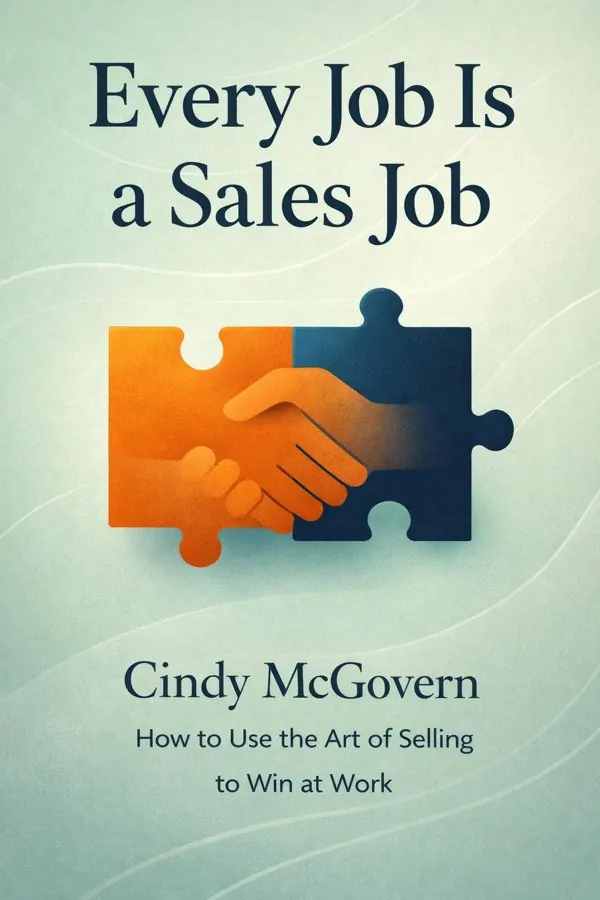
Every Job Is a Sales Job: How to Use the Art of Selling to Win at Work: Summary & Key Insights
 10 min10 chaptersAudio available
Key Takeaways from Every Job Is a Sales Job: How to Use the Art of Selling to Win at Work
The biggest barrier to becoming effective at sales is often emotional, not technical.
Many career opportunities are lost not because people lack talent, but because they fail to recognize the moments when influence is required.
People rarely say yes because of logic alone.
One of the most common mistakes in selling is talking before understanding.
Influence is rarely effective when it is purely reactive.
What Is Every Job Is a Sales Job: How to Use the Art of Selling to Win at Work About?
Every Job Is a Sales Job: How to Use the Art of Selling to Win at Work by Cindy McGovern is a leadership book spanning 10 pages. In Every Job Is a Sales Job, Cindy McGovern makes a bold but persuasive claim: whether or not your title includes the word “sales,” your success depends on your ability to influence people, communicate value, and earn trust. From pitching an idea in a meeting to gaining buy-in from a team, asking for resources, negotiating deadlines, or convincing a customer to stay, modern work is full of sales moments. McGovern’s message is that selling is not manipulation or pressure. At its best, it is the skill of helping others see a better path forward. That reframing matters because many professionals avoid “selling” while doing it every day without a system. McGovern gives readers that system. Drawing on her experience as a leadership consultant, speaker, and CEO, she translates classic sales principles into practical tools anyone can use, including managers, entrepreneurs, customer service professionals, and individual contributors. The result is a highly accessible guide to workplace influence. Rather than teaching readers how to be aggressive, the book teaches them how to be prepared, observant, empathetic, and clear—qualities that not only drive performance but also strengthen relationships and careers.
This FizzRead summary covers all 10 key chapters of Every Job Is a Sales Job: How to Use the Art of Selling to Win at Work in approximately 10 minutes, distilling the most important ideas, arguments, and takeaways from Cindy McGovern's work. Also available as an audio summary and Key Quotes Podcast.
Every Job Is a Sales Job: How to Use the Art of Selling to Win at Work
In Every Job Is a Sales Job, Cindy McGovern makes a bold but persuasive claim: whether or not your title includes the word “sales,” your success depends on your ability to influence people, communicate value, and earn trust. From pitching an idea in a meeting to gaining buy-in from a team, asking for resources, negotiating deadlines, or convincing a customer to stay, modern work is full of sales moments. McGovern’s message is that selling is not manipulation or pressure. At its best, it is the skill of helping others see a better path forward.
That reframing matters because many professionals avoid “selling” while doing it every day without a system. McGovern gives readers that system. Drawing on her experience as a leadership consultant, speaker, and CEO, she translates classic sales principles into practical tools anyone can use, including managers, entrepreneurs, customer service professionals, and individual contributors. The result is a highly accessible guide to workplace influence. Rather than teaching readers how to be aggressive, the book teaches them how to be prepared, observant, empathetic, and clear—qualities that not only drive performance but also strengthen relationships and careers.
Who Should Read Every Job Is a Sales Job: How to Use the Art of Selling to Win at Work?
This book is perfect for anyone interested in leadership and looking to gain actionable insights in a short read. Whether you're a student, professional, or lifelong learner, the key ideas from Every Job Is a Sales Job: How to Use the Art of Selling to Win at Work by Cindy McGovern will help you think differently.
- ✓Readers who enjoy leadership and want practical takeaways
- ✓Professionals looking to apply new ideas to their work and life
- ✓Anyone who wants the core insights of Every Job Is a Sales Job: How to Use the Art of Selling to Win at Work in just 10 minutes
Want the full summary?
Get instant access to this book summary and 100K+ more with Fizz Moment.
Get Free SummaryAvailable on App Store • Free to download
Key Chapters
The biggest barrier to becoming effective at sales is often emotional, not technical. Many people resist the idea of selling because they associate it with pressure, scripts, or self-serving persuasion. McGovern challenges that assumption from the start. She argues that sales, in its healthiest form, is not about pushing people into decisions. It is about understanding what would genuinely help them and then communicating that value clearly enough for them to act.
This shift in mindset matters because people avoid skills they believe are morally compromised. A project manager who dislikes “selling” may fail to advocate for a needed budget increase. An employee who dislikes “self-promotion” may struggle to communicate their achievements. A leader who sees influence as manipulation may hesitate to rally a team around a necessary change. In each case, the problem is not lack of value. It is discomfort with the label.
McGovern’s reframing turns sales into service. If your product, idea, recommendation, or request solves a real problem, then not presenting it well may actually do a disservice to others. For example, a nurse persuading a patient to follow a treatment plan, a teacher encouraging a student to try a new strategy, or an engineer advocating for a safer design are all selling. They are guiding others toward better outcomes.
This perspective also improves ethics. When sales is defined as helping rather than winning at all costs, trust becomes central. You stop asking, “How do I get them to say yes?” and start asking, “What do they actually need, and can I help?” That question changes the tone of every interaction.
Actionable takeaway: Replace the word “sell” with “help” in your thinking for one week, and notice how much easier it becomes to advocate for your ideas, requests, and solutions.
People rarely say yes because of logic alone. They say yes because they trust the person making the case. McGovern makes relationship-building a core sales skill, not a nice extra. In any profession, your ability to influence depends heavily on the quality of your connections with coworkers, customers, partners, and leaders.
This is especially important because many professionals focus too quickly on the transaction. They want approval, commitment, action, or agreement before they have established credibility and rapport. But in real workplaces, relationships shape how your message is received. A direct request from someone who has been reliable, responsive, and thoughtful lands differently than the same request from someone who only shows up when they need something.
McGovern’s approach to relationships is practical rather than sentimental. Building relationships means learning what matters to people, following through consistently, respecting their time, and creating positive interactions before a high-stakes moment arrives. A manager who regularly listens to team concerns will find it easier to gain support during change. A consultant who invests time in understanding a client’s business will be more trusted when offering recommendations. A peer who makes others look good and shares credit builds social capital that later increases influence.
Strong relationships also improve your ability to tailor communication. When you know how someone thinks, what pressures they face, and what outcomes they care about, your message becomes more relevant. That is the essence of effective sales.
Importantly, relationship-building is not networking theater. It is long-term trust creation. Small acts matter: remembering details, checking in, being honest, delivering on promises, and making interactions useful rather than extractive.
Actionable takeaway: Choose five key people in your work life and identify one simple way to strengthen each relationship this month, such as a follow-up note, a helpful introduction, or a conversation focused on their goals.
One of the most common mistakes in selling is talking before understanding. McGovern stresses that people often present solutions based on assumptions rather than real needs. They describe features, credentials, or ideas without first discovering what problem matters most to the other person. That approach weakens influence because relevance, not volume, drives persuasion.
The discipline of understanding needs begins with questions. Good sellers ask open-ended questions, listen carefully, and resist the urge to jump in too early. They want to know not only what someone says they need, but why it matters, what obstacles exist, what success looks like, and what emotions may be involved. In a workplace context, this can change everything. A manager asking for more staff may assume the executive team needs a staffing argument, when in fact they need a productivity and retention argument. A vendor may assume a client wants the lowest price, while the client actually values implementation speed and reliability.
McGovern encourages readers to become problem detectives. If a teammate resists your proposal, the issue may not be the proposal itself. It may be timing, budget anxiety, fear of extra work, or lack of clarity. If a customer hesitates, they may not doubt the offering. They may doubt whether it fits their priorities. Understanding these nuances helps you address the real issue rather than the surface objection.
This mindset improves internal communication too. Instead of entering a meeting ready to defend your idea, enter ready to learn. Ask what concerns exist, what outcomes matter most, and what constraints are nonnegotiable. The better your diagnosis, the stronger your recommendation.
Actionable takeaway: Before your next important ask or pitch, prepare five questions to uncover goals, concerns, and decision criteria. Use those answers to reshape your message before presenting your solution.
Influence is rarely effective when it is purely reactive. McGovern recommends creating a personal sales plan so that you are intentional about where, when, and how you build influence in your career. This is one of the book’s most useful ideas because it transforms sales from an occasional skill into a repeatable professional practice.
A personal sales plan does not need to look like a formal corporate document. It is a practical framework for identifying your goals, your audiences, the value you bring, and the actions required to create momentum. For example, if you want to earn a promotion, your plan should identify who needs to see your leadership, what results they care about, and how you will consistently communicate your contributions. If you are trying to grow a business unit, your plan might include target relationships, recurring touchpoints, and the problems your team is best positioned to solve.
McGovern’s broader message is that success often goes to people who prepare. They do not wait for the right moment and hope they will improvise effectively. They think ahead. They clarify what they want. They map stakeholders. They anticipate objections. They define follow-up steps. This level of planning makes you calmer and more credible because you are not guessing your way through important conversations.
A personal sales plan also forces honesty. It reveals gaps in your network, your message, or your understanding of decision-makers. That is valuable. Once the gaps are visible, you can address them.
The strongest plans are simple enough to use regularly. Think goals, target people, value proposition, communication strategy, and next actions. Over time, this habit helps you manage your career with more purpose and less passivity.
Actionable takeaway: Write a one-page personal sales plan for the next 90 days that names one major goal, three key stakeholders, the value you offer them, and the specific actions you will take each week.
People are not persuaded by information alone. They are persuaded when they understand why something matters to them. McGovern emphasizes that many professionals make the mistake of describing what they do rather than translating it into meaningful value. Features explain. Value convinces.
This principle applies far beyond traditional selling. Suppose you are proposing new software. Saying it has automation tools and reporting capabilities is not enough. What matters is that it will save employees six hours a week, reduce errors, and help managers make faster decisions. Or imagine you are advocating for your own promotion. Listing responsibilities is less effective than showing how your work improved retention, shortened turnaround times, or strengthened client relationships.
McGovern pushes readers to connect their message to the listener’s priorities. A finance leader may care about cost control and risk reduction. A frontline manager may care about speed and ease of implementation. A customer may care about confidence, convenience, or peace of mind. The same solution should be framed differently depending on who is listening.
Clear value communication also requires simplicity. People are busy. Overexplaining can dilute your point. Strong workplace sellers can state the problem, the solution, and the benefit in terms that are concrete and memorable. They avoid jargon unless it helps. They use examples, outcomes, and comparisons to make the payoff obvious.
This skill is particularly important for people with technical expertise. Deep knowledge is useful, but influence comes from translating that knowledge into outcomes others understand. If you cannot explain why your idea matters, others may assume it does not.
Actionable takeaway: For your next important conversation, answer this sentence in plain language: “This matters to you because…” Build your message around that benefit rather than around your process, features, or effort.
Objections are often treated like threats, but McGovern presents them as useful information. When someone hesitates, questions, or pushes back, they are not necessarily rejecting you. They are revealing what still needs to be addressed before they can move forward. That makes objections part of the process, not evidence of failure.
The wrong response is defensiveness. Many people hear an objection and immediately start arguing, overexplaining, or repeating their point more loudly. That usually makes resistance stronger. McGovern recommends a calmer and more curious approach. First, listen fully. Then clarify. Ask whether the concern is about cost, timing, trust, complexity, competing priorities, or something else. Only after you understand the real issue should you respond.
In the workplace, objections often mask deeper concerns. A leader who says “we don’t have the budget” may really mean “I don’t yet see the return.” A colleague who says “this won’t work” may actually fear extra workload or loss of control. A client who says “we need to think about it” may be uncertain about risk. By treating objections as diagnostic clues, you can respond with relevance instead of pressure.
McGovern’s approach also protects relationships. People want to feel heard, not handled. A respectful response might sound like: “That makes sense. Can you tell me more about what concerns you most?” This keeps the conversation open and creates room for trust.
Strong sellers prepare for objections in advance, but they do not sound scripted. They stay flexible, acknowledge concerns honestly, and respond with evidence, empathy, and options. Sometimes the right move is not to overcome the objection immediately but to give the person time, clarity, or support.
Actionable takeaway: Before your next high-stakes conversation, list the top three objections you might hear and prepare one clarifying question for each so you can respond thoughtfully rather than react defensively.
Many people think closing is a dramatic moment where someone is pressured into a yes. McGovern reframes it as helping people move from interest to action. In this view, closing is not about force. It is about clarity, confidence, and making the next step simple enough for someone to take.
A lot of good ideas stall not because people disagree, but because the path forward is vague. Meetings end with enthusiasm but no owner, no deadline, and no specific commitment. A customer likes the solution but is unsure how implementation begins. A manager supports a proposal in principle but has not been asked for a concrete decision. McGovern shows that effective sellers do not leave action to chance. They guide the conversation toward a clear next move.
This can be as simple as asking, “Would it make sense to pilot this with one team next month?” or “If this meets your goals, can we set a time next week to review the proposal?” In internal settings, it might mean summarizing decisions, assigning responsibilities, and confirming deadlines before the conversation ends. Closing works best when it feels like a natural continuation of the value already discussed.
McGovern also highlights the importance of confidence. Many professionals weaken their own close by becoming apologetic or ambiguous at the critical moment. If you have listened well, established value, and addressed concerns, it is appropriate to ask for commitment. Otherwise, all the previous effort remains unrealized.
A good close is specific, low-friction, and appropriate to the situation. Not every close is a final yes. Often it is a meeting, a trial, a follow-up, or a decision timeline. Progress matters.
Actionable takeaway: End important conversations by proposing one specific next step with a time frame, owner, and desired outcome so momentum does not fade into good intentions.
Too many people treat success as the moment of agreement, but McGovern argues that the real long-term advantage comes afterward. Once someone says yes—to your idea, your service, your recommendation, or your leadership—the relationship enters its most important phase. Maintaining trust after the decision is what turns one-time wins into enduring influence.
Post-agreement behavior reveals character. Do you follow through on promises? Do you communicate clearly during implementation? Do you remain available when problems arise? Do you check whether the expected value is actually being delivered? These actions matter because buyers, teammates, and stakeholders remember the experience after the commitment more vividly than the pitch itself.
In workplace settings, this principle is essential. If you persuade your team to adopt a new process but then disappear when issues surface, your credibility suffers. If you win a client and neglect service, future business becomes unlikely. If you ask a manager to support your development and then fail to execute, you weaken future trust. Good sellers understand that delivery is part of selling.
McGovern’s emphasis on maintenance also points to repeat value. Strong relationships create referrals, renewals, expanded opportunities, and broader support because people trust those who continue to show up. Follow-up does not need to be elaborate. It can mean checking outcomes, sharing useful updates, solving small issues quickly, and staying genuinely invested in the other person’s success.
This is where ethical sales proves itself. If your goal was truly to help, your responsibility does not end at agreement. It continues through results.
Actionable takeaway: For every major commitment you secure, schedule at least two follow-up touchpoints in advance—one to support implementation and one to confirm outcomes—so trust keeps growing after the yes.
McGovern’s broadest point is that sales is not just a work skill. It is a life skill. Wherever people need alignment, motivation, cooperation, or change, sales principles apply. Parents persuade children, leaders inspire teams, partners negotiate priorities, and friends advocate for decisions. In each case, success depends on understanding needs, communicating value, addressing concerns, and asking for commitment.
This wider lens makes the book especially relevant for leaders. Leadership is, in many ways, continuous selling. Leaders sell vision, priorities, cultural norms, strategic change, accountability, and hope. They cannot rely on authority alone. Even when they have formal power, real commitment requires buy-in. A team may comply with instructions, but it commits when the leader explains the why, listens to concerns, and connects action to shared goals.
The same is true in personal development. If you want others to believe in your capability, you must communicate your value without arrogance. If you want support for a boundary, an idea, or a goal, you need influence skills. McGovern’s argument helps readers see sales not as a specialized business function but as a practical framework for human interaction.
This does not mean every conversation should feel strategic or transactional. Quite the opposite. The more naturally you understand people, frame value, and build trust, the less “salesy” you become. Influence becomes a byproduct of empathy and clarity.
By the end of the book, sales emerges as a discipline of service, communication, and intentional action. It is useful in meetings, interviews, negotiations, change initiatives, customer relationships, and personal choices. In that sense, nearly every meaningful outcome involves some form of selling.
Actionable takeaway: Identify one area outside formal sales—leadership, parenting, teamwork, or career growth—where you need more influence, and apply the same sequence: understand needs, communicate value, address concerns, and ask for a clear next step.
All Chapters in Every Job Is a Sales Job: How to Use the Art of Selling to Win at Work
About the Author
Dr. Cindy McGovern is a sales expert, keynote speaker, consultant, and entrepreneur best known for making sales skills accessible to professionals in every field. Often referred to as the “First Lady of Sales,” she is the founder and CEO of Orange Leaf Consulting, a firm that helps organizations improve sales culture, leadership communication, and business performance. McGovern holds a doctorate in organizational communication, a background that informs her practical approach to influence, trust, and human behavior at work. Her work focuses on the idea that selling is not confined to revenue teams but is a universal skill that supports leadership, collaboration, and career growth. Through speaking, consulting, and writing, she has helped companies and individuals rethink sales as an ethical, service-centered discipline.
Get This Summary in Your Preferred Format
Read or listen to the Every Job Is a Sales Job: How to Use the Art of Selling to Win at Work summary by Cindy McGovern anytime, anywhere. FizzRead offers multiple formats so you can learn on your terms — all free.
Available formats: App · Audio · PDF · EPUB — All included free with FizzRead
Download Every Job Is a Sales Job: How to Use the Art of Selling to Win at Work PDF and EPUB Summary
Key Quotes from Every Job Is a Sales Job: How to Use the Art of Selling to Win at Work
“The biggest barrier to becoming effective at sales is often emotional, not technical.”
“Many career opportunities are lost not because people lack talent, but because they fail to recognize the moments when influence is required.”
“People rarely say yes because of logic alone.”
“One of the most common mistakes in selling is talking before understanding.”
“Influence is rarely effective when it is purely reactive.”
Frequently Asked Questions about Every Job Is a Sales Job: How to Use the Art of Selling to Win at Work
Every Job Is a Sales Job: How to Use the Art of Selling to Win at Work by Cindy McGovern is a leadership book that explores key ideas across 10 chapters. In Every Job Is a Sales Job, Cindy McGovern makes a bold but persuasive claim: whether or not your title includes the word “sales,” your success depends on your ability to influence people, communicate value, and earn trust. From pitching an idea in a meeting to gaining buy-in from a team, asking for resources, negotiating deadlines, or convincing a customer to stay, modern work is full of sales moments. McGovern’s message is that selling is not manipulation or pressure. At its best, it is the skill of helping others see a better path forward. That reframing matters because many professionals avoid “selling” while doing it every day without a system. McGovern gives readers that system. Drawing on her experience as a leadership consultant, speaker, and CEO, she translates classic sales principles into practical tools anyone can use, including managers, entrepreneurs, customer service professionals, and individual contributors. The result is a highly accessible guide to workplace influence. Rather than teaching readers how to be aggressive, the book teaches them how to be prepared, observant, empathetic, and clear—qualities that not only drive performance but also strengthen relationships and careers.
You Might Also Like

Extreme Ownership
Jocko Willink
10 min
Dare to Lead
Brene Brown
10 min
Leaders Eat Last
Simon Sinek
10 min
The 21 Irrefutable Laws of Leadership
John Maxwell
10 min
Start With Why
Simon Sinek
10 min
How to Lead When You're Not in Charge
Clay Scroggins
10 minBrowse by Category
Ready to read Every Job Is a Sales Job: How to Use the Art of Selling to Win at Work?
Get the full summary and 100K+ more books with Fizz Moment.