
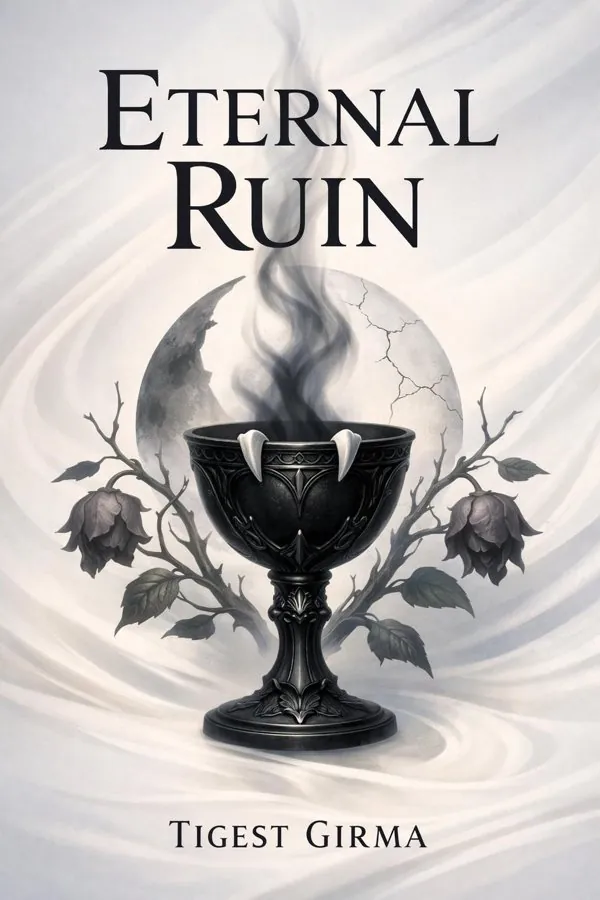
Eternal Ruin: Summary & Key Insights
by Tigest Girma
 10 min8 chaptersAudio available
Key Takeaways from Eternal Ruin
One of the most unsettling truths in fantasy is also one of the most human: every gain costs something.
The most dangerous monsters are often the ones that awaken something hidden within us.
Loyalty sounds noble until competing obligations make it impossible to honor everyone at once.
We like to think identity is something we discover, but Eternal Ruin argues that identity is often something we build under pressure.
Love in Eternal Ruin is never soft decoration; it is an active force capable of salvation and devastation.
What Is Eternal Ruin About?
Eternal Ruin by Tigest Girma is a bestsellers book. Some fantasy sequels simply continue a story. Eternal Ruin deepens it, darkens it, and forces every character to confront the cost of power, loyalty, and desire. As the second installment in Tigest Girma’s Immortal Dark series, this novel expands a world shaped by ancient forces, dangerous alliances, and the emotional fallout of choices that cannot be undone. It is not only a continuation of a high-stakes fantasy narrative, but also a sharper exploration of identity, grief, ambition, and the seductive nature of destruction. What makes Eternal Ruin matter is the way it combines sweeping worldbuilding with intimate emotional conflict. Girma does not rely solely on plot twists or supernatural spectacle. Instead, she builds tension through complicated relationships, moral ambiguity, and the painful realization that survival often demands transformation. Readers are drawn into a story where darkness is never merely external; it lives inside wounds, memories, and impossible decisions. Tigest Girma has emerged as a distinctive voice in fantasy through her atmospheric storytelling, layered characters, and ability to merge mythic scale with personal stakes. In Eternal Ruin, she proves why series fiction can feel both thrilling and emotionally resonant.
This FizzRead summary covers all 8 key chapters of Eternal Ruin in approximately 10 minutes, distilling the most important ideas, arguments, and takeaways from Tigest Girma's work. Also available as an audio summary and Key Quotes Podcast.
Eternal Ruin
Some fantasy sequels simply continue a story. Eternal Ruin deepens it, darkens it, and forces every character to confront the cost of power, loyalty, and desire. As the second installment in Tigest Girma’s Immortal Dark series, this novel expands a world shaped by ancient forces, dangerous alliances, and the emotional fallout of choices that cannot be undone. It is not only a continuation of a high-stakes fantasy narrative, but also a sharper exploration of identity, grief, ambition, and the seductive nature of destruction.
What makes Eternal Ruin matter is the way it combines sweeping worldbuilding with intimate emotional conflict. Girma does not rely solely on plot twists or supernatural spectacle. Instead, she builds tension through complicated relationships, moral ambiguity, and the painful realization that survival often demands transformation. Readers are drawn into a story where darkness is never merely external; it lives inside wounds, memories, and impossible decisions.
Tigest Girma has emerged as a distinctive voice in fantasy through her atmospheric storytelling, layered characters, and ability to merge mythic scale with personal stakes. In Eternal Ruin, she proves why series fiction can feel both thrilling and emotionally resonant.
Who Should Read Eternal Ruin?
This book is perfect for anyone interested in bestsellers and looking to gain actionable insights in a short read. Whether you're a student, professional, or lifelong learner, the key ideas from Eternal Ruin by Tigest Girma will help you think differently.
- ✓Readers who enjoy bestsellers and want practical takeaways
- ✓Professionals looking to apply new ideas to their work and life
- ✓Anyone who wants the core insights of Eternal Ruin in just 10 minutes
Want the full summary?
Get instant access to this book summary and 100K+ more with Fizz Moment.
Get Free SummaryAvailable on App Store • Free to download
Key Chapters
One of the most unsettling truths in fantasy is also one of the most human: every gain costs something. In Eternal Ruin, power is never presented as a clean reward or a simple tool. It arrives tangled with sacrifice, moral compromise, and consequences that ripple through relationships and entire communities. Girma treats power as both temptation and burden, asking what happens when someone gains the ability to shape fate but loses pieces of themselves in the process.
This idea matters because the novel refuses the easy fantasy that strength automatically brings freedom. Characters who seek control often find themselves controlled by the very forces they wanted to master. Political influence, magical ability, and emotional leverage all operate under the same rule: what you wield eventually leaves a mark on you. That creates a narrative tension that feels urgent and believable. The characters are not merely trying to win; they are trying to decide what they can live with after the victory.
In practical terms, this theme mirrors real life. Career advancement may require long hours that strain personal bonds. Leadership can bring authority but also isolation. Even in ordinary conflicts, getting what we want may cost trust, peace, or self-respect. Girma’s story dramatizes this universal exchange through a heightened fantasy lens.
As readers follow the escalating stakes, the book encourages a more mature question than “How can I become powerful?” It asks, “What am I willing to give up, and what must I refuse to sacrifice?” That distinction is crucial.
Actionable takeaway: before pursuing any major goal, define your non-negotiables. Decide in advance which values, relationships, and parts of your identity are not worth trading away.
The most dangerous monsters are often the ones that awaken something hidden within us. Eternal Ruin excels at showing that darkness is not only an enemy lurking in the world; it is also an emotional and psychological force carried by the characters themselves. Fear, grief, rage, longing, and resentment do not remain private feelings. In Girma’s storytelling, they shape perception, fuel decisions, and sometimes invite catastrophe.
This is what gives the novel its emotional depth. Rather than separating good and evil into neat camps, Girma suggests that ruin begins when pain goes unexamined. A character may think they are acting out of duty when they are really driven by vengeance. Another may call their obsession love when it is actually possession or desperation. By blurring these internal lines, the book becomes more than a supernatural adventure. It becomes a study of how people rationalize destructive choices.
That complexity resonates beyond fiction. In everyday life, people often project their inner conflicts onto outer battles. A workplace disagreement may really be about insecurity. A fractured friendship may stem from old wounds neither person has named. The novel reminds readers that confronting external threats without addressing internal turmoil is rarely enough.
Girma’s handling of darkness also prevents the story from becoming simplistic. Characters are not reduced to heroes or villains. They are people under pressure, capable of tenderness and cruelty, insight and self-deception. That moral ambiguity keeps readers engaged because it feels emotionally true.
Actionable takeaway: when a conflict feels overwhelming, pause to ask what inner fear or unresolved hurt may be intensifying your reaction. Naming the internal darkness is often the first step toward preventing external damage.
Loyalty sounds noble until competing obligations make it impossible to honor everyone at once. In Eternal Ruin, loyalty is not a fixed virtue but a volatile force tested by love, fear, memory, and survival. Characters must choose between people, causes, promises, and versions of themselves. Those choices are painful precisely because loyalty is rarely divided between right and wrong. More often, it is divided between two deeply meaningful commitments.
Girma uses this tension to build suspense and emotional realism. Alliances shift not because characters are inconsistent, but because circumstances expose fault lines that were always present. A vow made in one context becomes unbearable in another. Protecting one person may endanger many others. Standing by the past may betray the future. The result is a story that understands loyalty as a source of identity and also as a trap.
This theme has practical relevance because modern life is full of conflicting loyalties. Professionals balance loyalty to employers with loyalty to personal ethics. Family expectations can clash with individual aspirations. Friends may ask for support in situations where honesty is the more loving choice. Eternal Ruin captures the emotional strain of these dilemmas by showing that loyalty without reflection can become a form of self-erasure.
Importantly, the novel does not dismiss loyalty. Instead, it asks readers to distinguish between loyalty rooted in love and loyalty rooted in fear, guilt, or habit. That difference shapes whether devotion becomes strength or destruction.
The characters’ hardest decisions emerge when they realize that staying loyal to everyone is impossible. Maturity lies in choosing consciously rather than clinging blindly.
Actionable takeaway: review your strongest commitments and ask whether each one reflects your values today. Real loyalty should be chosen with clear eyes, not preserved automatically at the expense of truth or well-being.
We like to think identity is something we discover, but Eternal Ruin argues that identity is often something we build under pressure. Across the novel, characters are forced into moments where indecision is no longer possible. In those moments, they do not simply reveal who they are; they become who they are through action. Choice, especially painful choice, becomes the forge of selfhood.
This idea gives the novel much of its dramatic weight. Characters cannot remain suspended between contradictory desires forever. As threats intensify, they must decide what they stand for, whom they trust, and what kind of person they will be after loss reshapes them. Girma portrays transformation not as a clean arc from weakness to strength, but as a messy process involving regret, doubt, and unintended consequences. That realism makes character development feel earned.
The theme also carries practical value. Many people wait for clarity before acting, assuming that certainty should come first. But real life often works the other way around. We become reliable by keeping a promise, courageous by speaking when silence would be easier, or compassionate by choosing mercy when anger feels justified. Identity grows through repeated decisions.
In Eternal Ruin, labels and roles matter less than behavior under strain. A person may carry a title, lineage, or reputation, but the story suggests that those inherited markers are secondary to what one actually chooses when power, fear, and desire collide.
This perspective is empowering because it shifts focus away from destiny and toward responsibility. Even in a world shaped by ancient forces, the self remains something actively made.
Actionable takeaway: if you feel uncertain about who you are becoming, focus less on abstract self-definition and more on the next meaningful choice. Your habits and decisions are already writing your identity.
Love in Eternal Ruin is never soft decoration; it is an active force capable of salvation and devastation. Girma portrays love as something deeply intertwined with vulnerability, attachment, and risk. The same bond that gives a character reason to endure can also become the very pressure point through which they are manipulated, broken, or driven toward ruin. This duality is one of the novel’s greatest strengths.
Rather than presenting romance or devotion as automatically redemptive, the book asks what kind of love is actually being offered. Is it rooted in respect, honesty, and mutual freedom? Or is it driven by need, control, fear of abandonment, or the desire to possess? These distinctions matter because the emotional stakes of the story hinge on them. Characters do not merely ask whom they love, but what their love turns them into.
This insight applies widely. In everyday life, love can inspire growth, patience, and courage. Yet unhealthy attachment can lead people to excuse harm, abandon boundaries, or confuse intensity with intimacy. Girma’s storytelling captures this complexity by refusing to sentimentalize connection. Even the most tender relationships carry potential for pain when shaped by secrecy or unresolved wounds.
What makes the novel compelling is that love remains worth fighting for despite these risks. Girma does not reduce it to weakness. Instead, she presents love as powerful precisely because it exposes what matters most. That exposure can heal if handled with truth. It can consume if tangled with obsession.
Readers come away with a sharper sense that emotional closeness is not automatically virtuous; its quality depends on the values sustaining it.
Actionable takeaway: examine your closest relationships and ask whether they create more freedom, honesty, and steadiness in your life. Healthy love should deepen your integrity, not diminish it.
No matter how far characters run, Eternal Ruin insists that unresolved history always returns. The past in this novel is not background information; it is a living force. Old betrayals, inherited legacies, unprocessed grief, and hidden truths shape present choices at every turn. Girma builds a world where memory is political, personal, and dangerous, showing how yesterday’s violence can become today’s crisis.
This gives the book both narrative momentum and thematic depth. Characters are not simply reacting to immediate threats. They are moving through consequences set in motion long before the current conflict escalated. Family histories, prior allegiances, and buried wounds create patterns that repeat until someone confronts them directly. In that sense, the novel treats the past as something that must be understood, not escaped.
The idea is deeply relevant beyond fantasy. Individuals often repeat relational patterns inherited from childhood. Communities carry historical traumas that continue shaping institutions and identities. Organizations ignore old mistakes only to watch them reappear in new forms. Eternal Ruin illustrates that denial may delay consequences, but it never cancels them.
What is especially compelling is Girma’s refusal to portray confrontation with the past as easy closure. Truth can destabilize. Memory can wound before it heals. Yet the novel makes clear that refusing to look back leaves characters vulnerable to manipulation and repetition. Awareness becomes a form of power.
This theme also enriches the emotional experience of the series. Every revelation matters not only because it advances plot, but because it redefines how characters understand themselves and one another.
Actionable takeaway: identify one unresolved pattern, secret, or old hurt influencing your current decisions. Addressing it honestly may feel uncomfortable, but ignoring it allows the past to keep directing your future.
Sometimes the version of yourself that got you through one crisis cannot carry you through the next. Eternal Ruin repeatedly shows that survival is not merely about endurance; it is about adaptation. Characters face situations so extreme that clinging to old assumptions, identities, or strategies becomes a liability. To survive, they must reinvent how they think, trust, fight, and love.
This theme makes the novel feel especially dynamic. Girma does not allow characters to remain emotionally or morally static while the world changes around them. The escalating danger demands transformation. Some characters evolve by confronting painful truths. Others harden in ways that preserve them temporarily but threaten to deform them long term. Reinvention is therefore presented as necessary, yet never neutral. How someone changes matters as much as the fact of change itself.
In practical life, this insight is highly applicable. Major disruptions such as grief, illness, career upheaval, or the end of a relationship often make old coping mechanisms insufficient. A person who once survived by staying guarded may need vulnerability to build a better future. Someone who relied on control may need flexibility instead. Growth requires leaving behind identities that once felt protective.
Eternal Ruin captures the fear embedded in that process. Reinvention can feel like betrayal of the self, especially when familiar patterns are tied to survival. But Girma suggests that refusing to change can become its own kind of surrender. The challenge is to adapt without losing one’s moral center.
That balance between transformation and integrity is one of the novel’s most resonant ideas.
Actionable takeaway: ask whether your current habits still serve your present reality. If they were built for an earlier version of your life, choose one deliberate adjustment that better matches who you need to become now.
Clear answers may comfort us, but ambiguity is what gives Eternal Ruin its emotional and philosophical power. Girma does not flatten her world into tidy moral lessons. Instead, she allows uncertainty to remain where certainty would feel false. Motivations are mixed, consequences are uneven, and even necessary choices leave damage behind. That ambiguity is not a weakness in the narrative. It is the source of its maturity.
Readers are asked to inhabit discomfort. A character can deserve sympathy and still cause harm. A decision can be strategically right and emotionally devastating. A victory can contain the seeds of future loss. By resisting simple binaries, the novel more accurately reflects the complexity of real human conflict. People are rarely consistent. Circumstances distort judgment. Good intentions do not erase consequences.
This matters because stories shape how we interpret our own lives. If we expect every conflict to sort cleanly into innocence and guilt, heroism and villainy, we are poorly prepared for actual relationships, institutions, and ethical dilemmas. Eternal Ruin trains readers to tolerate nuance. It encourages discernment instead of quick judgment.
In everyday contexts, ambiguity appears everywhere: in leadership decisions, family tensions, political debates, and personal regrets. The novel’s emotional sophistication lies in showing that uncertainty does not prevent action; it simply makes action more responsible. People must still choose, even when no option is pure.
That is part of what makes the book linger after the final page. It offers not only suspense, but also a richer way of thinking about accountability, compassion, and consequence.
Actionable takeaway: when facing a difficult judgment, resist the urge to oversimplify. List the competing truths in the situation first. Better decisions often emerge when you allow complexity to stay visible.
All Chapters in Eternal Ruin
About the Author
Tigest Girma is a fantasy author recognized for crafting dark, atmospheric fiction that pairs imaginative worldbuilding with emotionally layered storytelling. Her work often explores power, grief, longing, identity, and the moral complexity of survival, making her a compelling voice for readers who want fantasy that feels both epic and intimate. Girma has earned attention for her ability to create tense, immersive narratives in which character relationships carry as much weight as supernatural or political conflict. In the Immortal Dark series, she demonstrates a distinctive talent for blending haunting mood, high stakes, and psychological depth. Her writing appeals to fans of contemporary fantasy who appreciate morally ambiguous characters, rich emotional tension, and stories unafraid to examine the seductive pull of darkness.
Get This Summary in Your Preferred Format
Read or listen to the Eternal Ruin summary by Tigest Girma anytime, anywhere. FizzRead offers multiple formats so you can learn on your terms — all free.
Available formats: App · Audio · PDF · EPUB — All included free with FizzRead
Download Eternal Ruin PDF and EPUB Summary
Key Quotes from Eternal Ruin
“One of the most unsettling truths in fantasy is also one of the most human: every gain costs something.”
“The most dangerous monsters are often the ones that awaken something hidden within us.”
“Loyalty sounds noble until competing obligations make it impossible to honor everyone at once.”
“We like to think identity is something we discover, but Eternal Ruin argues that identity is often something we build under pressure.”
“Love in Eternal Ruin is never soft decoration; it is an active force capable of salvation and devastation.”
Frequently Asked Questions about Eternal Ruin
Eternal Ruin by Tigest Girma is a bestsellers book that explores key ideas across 8 chapters. Some fantasy sequels simply continue a story. Eternal Ruin deepens it, darkens it, and forces every character to confront the cost of power, loyalty, and desire. As the second installment in Tigest Girma’s Immortal Dark series, this novel expands a world shaped by ancient forces, dangerous alliances, and the emotional fallout of choices that cannot be undone. It is not only a continuation of a high-stakes fantasy narrative, but also a sharper exploration of identity, grief, ambition, and the seductive nature of destruction. What makes Eternal Ruin matter is the way it combines sweeping worldbuilding with intimate emotional conflict. Girma does not rely solely on plot twists or supernatural spectacle. Instead, she builds tension through complicated relationships, moral ambiguity, and the painful realization that survival often demands transformation. Readers are drawn into a story where darkness is never merely external; it lives inside wounds, memories, and impossible decisions. Tigest Girma has emerged as a distinctive voice in fantasy through her atmospheric storytelling, layered characters, and ability to merge mythic scale with personal stakes. In Eternal Ruin, she proves why series fiction can feel both thrilling and emotionally resonant.
You Might Also Like
The Godfather
Mario Puzo
10 min
The Handmaid's Tale
Margaret Atwood
10 min
The Hunger Games
Suzanne Collins
10 min
The Nightingale
Kristin Hannah
10 min
The Seven Husbands of Evelyn Hugo
Taylor Jenkins Reid
10 min
Backwater Justice
Fern Michaels
10 minBrowse by Category
Ready to read Eternal Ruin?
Get the full summary and 100K+ more books with Fizz Moment.