
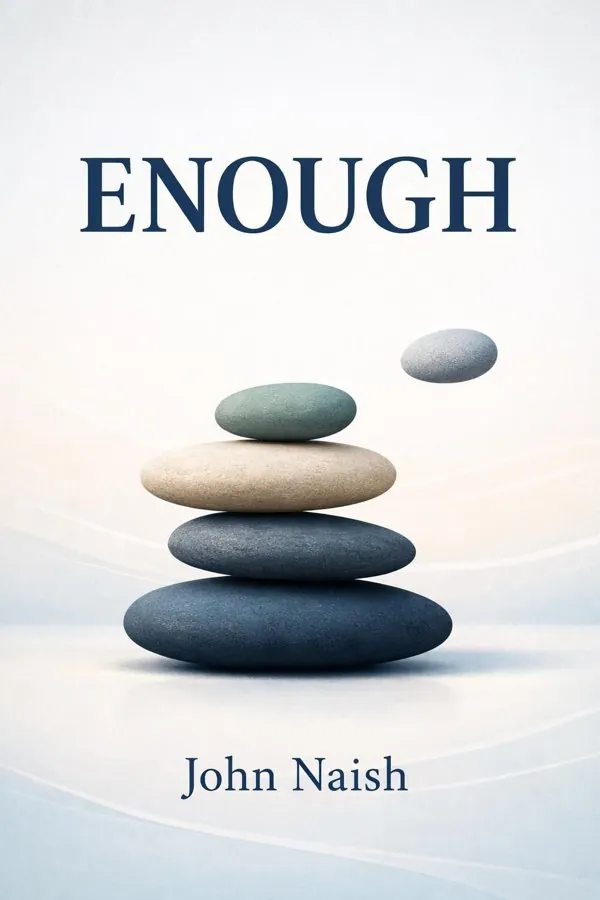
Enough: Breaking Free from the World of Excess: Summary & Key Insights
by John Naish
 10 min9 chaptersAudio available
What Is Enough: Breaking Free from the World of Excess About?
Enough: Breaking Free from the World of Excess by John Naish is a mindset book spanning 9 pages. In this thought-provoking book, John Naish explores the modern obsession with excess—of information, possessions, food, and ambition—and argues for the power of 'enough.' Drawing on psychology, economics, and cultural analysis, Naish shows how the pursuit of more often leads to stress, waste, and dissatisfaction, and offers practical ways to embrace sufficiency and contentment in everyday life.
This FizzRead summary covers all 9 key chapters of Enough: Breaking Free from the World of Excess in approximately 10 minutes, distilling the most important ideas, arguments, and takeaways from John Naish's work. Also available as an audio summary and Key Quotes Podcast.
Enough: Breaking Free from the World of Excess
In this thought-provoking book, John Naish explores the modern obsession with excess—of information, possessions, food, and ambition—and argues for the power of 'enough.' Drawing on psychology, economics, and cultural analysis, Naish shows how the pursuit of more often leads to stress, waste, and dissatisfaction, and offers practical ways to embrace sufficiency and contentment in everyday life.
Who Should Read Enough: Breaking Free from the World of Excess?
This book is perfect for anyone interested in mindset and looking to gain actionable insights in a short read. Whether you're a student, professional, or lifelong learner, the key ideas from Enough: Breaking Free from the World of Excess by John Naish will help you think differently.
- ✓Readers who enjoy mindset and want practical takeaways
- ✓Professionals looking to apply new ideas to their work and life
- ✓Anyone who wants the core insights of Enough: Breaking Free from the World of Excess in just 10 minutes
Want the full summary?
Get instant access to this book summary and 100K+ more with Fizz Moment.
Get Free SummaryAvailable on App Store • Free to download
Key Chapters
Our story begins long before shopping malls and smartphones—back in the savannahs where our ancestors learned that survival depended on acquisition. Those who gathered more food, sought more territory, and accumulated more resources survived periods of scarcity. Evolution rewarded the impulse for 'more.' It made sense then; abundance was a rare gift, and greed a form of precaution.
But in the modern world, those survival instincts persist within an environment of constant abundance. The same neural circuits that once prompted us to grab one more fruit now tell us to scroll for one more update, buy one more gadget, or chase one more promotion. The trouble is, our environment has changed, but our inner software hasn’t. We have become 'mismatch creatures,' driven by instincts that no longer serve the conditions we inhabit.
The psychological mechanics of this drive have been well studied. Dopamine rewards anticipation more than satisfaction. That means that our pleasure systems are tuned not to what we gain but to the search for gain itself. We live on the hook. This ancient circuitry explains why people feel restless, why even after success we feel compelled to reach further. Understanding this isn’t just biology—it’s liberation. Realizing that your agitation for more isn’t moral weakness but evolutionary hangover lets you begin to edit your own code.
For me, 'enough' begins with awareness: the recognition that your impulse to accumulate is natural but not always necessary. By seeing it as inherited software, you can choose when to override it. This is the first freedom—the freedom to pause before pursuing another 'more' and ask whether it genuinely serves your survival or simply feeds an obsolete urge.
Information excess is the modern form of overconsumption, invisible but pervasive. Each ping, each update, each breaking story calls us to feed the mind’s craving for novelty, yet often leaves us more scattered and less informed. In early journalism days, I saw how news cycles spun faster and reality thinned. We confuse knowing many fragments with understanding, and our minds, drowned in trivia, lose depth.
Human attention is finite; the brain evolved for pattern and focus, not endless data streams. Yet technology monetizes our attention by stretching it beyond capacity. We spend evenings chasing online mirages of connection, accumulating 'info-fat'—mental clutter that dulls reflection. As psychological studies show, information overload triggers stress hormones just like physical danger. Our nervous systems can’t distinguish between a predator rustling in bushes and a notification buzz at midnight.
Breaking free from information excess doesn’t mean ignorance. It means curation. 'Enough' knowledge enriches thought; 'too much' dissolves it. Turn information into understanding—by choosing silence occasionally, by allowing gaps where meaning can form. I’ve learned that peace arrives not when the stream stops but when we cease to drown in it. When you trust that you already know enough to act wisely, every new bit of information becomes optional rather than compulsory.
+ 7 more chapters — available in the FizzRead app
All Chapters in Enough: Breaking Free from the World of Excess
About the Author
John Naish is a British journalist and author known for his work on health, culture, and sustainability. He has written for The Times and other major UK publications, focusing on how modern lifestyles affect well-being and the environment.
Get This Summary in Your Preferred Format
Read or listen to the Enough: Breaking Free from the World of Excess summary by John Naish anytime, anywhere. FizzRead offers multiple formats so you can learn on your terms — all free.
Available formats: App · Audio · PDF · EPUB — All included free with FizzRead
Download Enough: Breaking Free from the World of Excess PDF and EPUB Summary
Key Quotes from Enough: Breaking Free from the World of Excess
“Our story begins long before shopping malls and smartphones—back in the savannahs where our ancestors learned that survival depended on acquisition.”
“Information excess is the modern form of overconsumption, invisible but pervasive.”
Frequently Asked Questions about Enough: Breaking Free from the World of Excess
Enough: Breaking Free from the World of Excess by John Naish is a mindset book that explores key ideas across 9 chapters. In this thought-provoking book, John Naish explores the modern obsession with excess—of information, possessions, food, and ambition—and argues for the power of 'enough.' Drawing on psychology, economics, and cultural analysis, Naish shows how the pursuit of more often leads to stress, waste, and dissatisfaction, and offers practical ways to embrace sufficiency and contentment in everyday life.
You Might Also Like
Browse by Category
Ready to read Enough: Breaking Free from the World of Excess?
Get the full summary and 100K+ more books with Fizz Moment.