
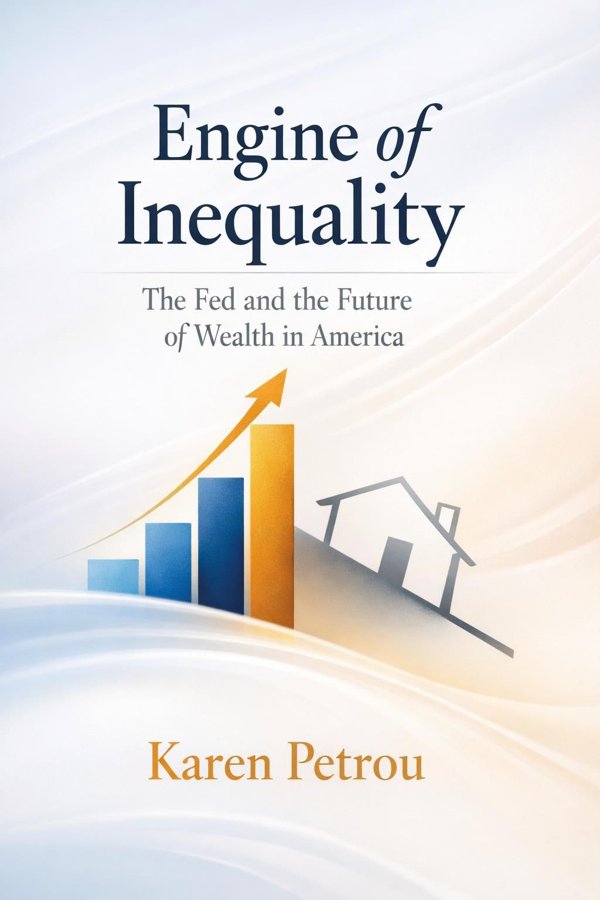
Engine of Inequality: The Fed and the Future of Wealth in America: Summary & Key Insights
by Karen Petrou
 10 min8 chaptersAudio available
Key Takeaways from Engine of Inequality: The Fed and the Future of Wealth in America
Institutions built for one era often struggle when asked to solve the problems of another.
Emergency measures are supposed to be temporary, yet in modern finance they have a way of becoming the new normal.
When central banks raise asset prices, they do not distribute gains evenly—they amplify the advantages of those who start with assets.
What helps borrowers can quietly hurt savers, and prolonged low rates reveal that trade-off with unusual force.
Policies meant to stabilize finance can also reshape who controls it.
What Is Engine of Inequality: The Fed and the Future of Wealth in America About?
Engine of Inequality: The Fed and the Future of Wealth in America by Karen Petrou is a economics book spanning 7 pages. Why has economic recovery in the United States so often translated into rising stock portfolios, soaring home prices, and growing billionaire fortunes, while many working families still struggle to build savings, buy homes, or withstand financial shocks? In Engine of Inequality, Karen Petrou argues that a major part of the answer lies in an institution most Americans rarely think about day to day: the Federal Reserve. Her central claim is not that the Fed intends to deepen inequality, but that the tools it has increasingly relied on—especially ultra-low interest rates and large-scale asset purchases—have had unequal effects across society. Petrou brings unusual authority to this argument. As a longtime analyst of financial regulation and co-founder of Federal Financial Analytics, she has spent decades studying how monetary policy, banking rules, and market structure shape the real economy. She connects technical central-bank decisions to everyday outcomes: retirement security, wages, access to credit, and the ability to accumulate wealth. The result is a timely, provocative examination of how modern monetary policy can stabilize markets while simultaneously weakening the economic foundations of the middle class.
This FizzRead summary covers all 8 key chapters of Engine of Inequality: The Fed and the Future of Wealth in America in approximately 10 minutes, distilling the most important ideas, arguments, and takeaways from Karen Petrou's work. Also available as an audio summary and Key Quotes Podcast.
Engine of Inequality: The Fed and the Future of Wealth in America
Why has economic recovery in the United States so often translated into rising stock portfolios, soaring home prices, and growing billionaire fortunes, while many working families still struggle to build savings, buy homes, or withstand financial shocks? In Engine of Inequality, Karen Petrou argues that a major part of the answer lies in an institution most Americans rarely think about day to day: the Federal Reserve. Her central claim is not that the Fed intends to deepen inequality, but that the tools it has increasingly relied on—especially ultra-low interest rates and large-scale asset purchases—have had unequal effects across society.
Petrou brings unusual authority to this argument. As a longtime analyst of financial regulation and co-founder of Federal Financial Analytics, she has spent decades studying how monetary policy, banking rules, and market structure shape the real economy. She connects technical central-bank decisions to everyday outcomes: retirement security, wages, access to credit, and the ability to accumulate wealth. The result is a timely, provocative examination of how modern monetary policy can stabilize markets while simultaneously weakening the economic foundations of the middle class.
Who Should Read Engine of Inequality: The Fed and the Future of Wealth in America?
This book is perfect for anyone interested in economics and looking to gain actionable insights in a short read. Whether you're a student, professional, or lifelong learner, the key ideas from Engine of Inequality: The Fed and the Future of Wealth in America by Karen Petrou will help you think differently.
- ✓Readers who enjoy economics and want practical takeaways
- ✓Professionals looking to apply new ideas to their work and life
- ✓Anyone who wants the core insights of Engine of Inequality: The Fed and the Future of Wealth in America in just 10 minutes
Want the full summary?
Get instant access to this book summary and 100K+ more with Fizz Moment.
Get Free SummaryAvailable on App Store • Free to download
Key Chapters
Institutions built for one era often struggle when asked to solve the problems of another. Petrou begins by showing that the Federal Reserve was created in 1913 to provide monetary stability, support liquidity in times of stress, and strengthen the banking system. Over time, its responsibilities expanded. Congress gave it the dual mandate of stable prices and maximum employment, and financial crises pushed it even further into roles that looked part central bank, part market rescuer, and part economic manager.
This evolution matters because the Fed’s tools were never designed to address inequality directly. Interest-rate policy and liquidity support can influence borrowing, spending, and investment, but they are blunt instruments. When policymakers rely on them to sustain growth over long stretches, they may stabilize the economy in aggregate while producing very uneven outcomes beneath the surface. Petrou argues that once the Fed became the institution expected to backstop markets and support recovery at all costs, it also became a hidden architect of wealth distribution.
A practical example is the way the Fed’s crisis interventions gradually moved from helping banks maintain liquidity to supporting broader financial markets. That may prevent panic, but it also gives enormous weight to asset prices as indicators of economic health. If markets rise while wages stagnate, policymakers may still view conditions as improving.
The takeaway is simple: before judging Fed policy as successful, ask not only whether inflation is controlled or markets are calm, but also who benefits most from the tools being used.
Emergency measures are supposed to be temporary, yet in modern finance they have a way of becoming the new normal. Petrou argues that the 2008 financial crisis transformed the Fed from a conventional central bank into an institution heavily dependent on extraordinary intervention. Near-zero interest rates and quantitative easing were initially presented as crisis responses. But rather than fading away once markets stabilized, these policies shaped the next decade of economic management.
The logic behind them was straightforward: lower interest rates to encourage borrowing and spending, and buy large quantities of Treasury and mortgage-backed securities to push down long-term rates and support markets. These steps likely helped avert a deeper collapse. Petrou does not deny that. Her concern is what happened after rescue became regime. When cheap money persists for years, financial markets adapt to it, investors take on more risk, and policymakers become reluctant to normalize conditions for fear of disrupting asset prices.
The practical effect is visible in how strongly markets reacted whenever the Fed hinted at tightening. Investors came to expect support, and the central bank became increasingly sensitive to market declines. This changed the balance of power in the economy: Wall Street conditions became tightly linked to monetary decisions, while workers, renters, and savers had far less direct influence.
Readers can apply this insight by being skeptical of any policy framed as temporary but extended indefinitely. In economic policy, duration changes impact. A tool that saves the system in a panic may distort opportunity if used as a standing framework for growth.
When central banks raise asset prices, they do not distribute gains evenly—they amplify the advantages of those who start with assets. This is one of Petrou’s core arguments. Quantitative easing and low interest rates tend to increase the value of stocks, bonds, and real estate by pushing investors into higher-yielding assets and lowering borrowing costs. That may look like prosperity from a distance, but ownership in America is highly unequal.
Households at the top hold the vast majority of financial assets. They are more likely to own diversified portfolios, investment properties, and businesses. Middle-income households may have some home equity and retirement savings, but often far less exposure to appreciating assets. Lower-income households may have almost none. As a result, when monetary policy lifts asset values, it disproportionately expands the wealth of already-wealthy households.
A practical example is the post-2008 period, when stock markets recovered far faster than labor-market security for many families. Those with brokerage accounts, retirement portfolios, or significant real estate wealth saw balance sheets improve. Meanwhile, households living paycheck to paycheck gained little from higher equities and often faced rising housing costs instead.
Petrou’s broader point is that rising markets should not be confused with broad-based wealth creation. Asset inflation can widen gaps even during recovery. An actionable takeaway is to evaluate economic headlines more carefully: when you hear that markets are booming, ask how much of that gain is reaching wage earners, renters, first-time homebuyers, and households without financial buffers.
What helps borrowers can quietly hurt savers, and prolonged low rates reveal that trade-off with unusual force. Petrou shows that while very low interest rates reduce borrowing costs and can stimulate demand, they also weaken the returns available to households that depend on savings, fixed-income investments, or conservative retirement strategies. This matters deeply for middle-class families, retirees, and anyone trying to build financial security without speculative investing.
For many households, wealth accumulation does not begin with a stock portfolio. It begins with bank deposits, certificates of deposit, money-market funds, pensions, and the slow discipline of saving. When rates remain near zero, these traditional paths to financial stability become less rewarding. Savers may be pushed toward riskier assets they do not fully understand, or they may simply fall behind as inflation and living costs erode the value of cautious choices.
Petrou also links this to labor outcomes. Cheap money does not automatically generate strong wage growth, especially when structural issues weaken worker bargaining power. So the people least able to benefit from asset appreciation may face both weak savings returns and limited income gains.
Consider a retiree living on fixed-income investments versus a high-net-worth investor with leveraged real estate and equities. The same rate environment that boosts the investor’s wealth can reduce the retiree’s income. Policy can therefore widen inequality even without directly transferring money upward.
The takeaway is practical: financial conditions should be judged by their effects on everyday balance sheets, not just macroeconomic averages. A healthy economy should reward prudent saving as well as strategic investing.
Policies meant to stabilize finance can also reshape who controls it. Petrou argues that post-crisis monetary policy and regulation contributed to a more concentrated financial system in which the largest institutions, firms, and market actors became even more central. This is important because concentration changes who captures gains, who gets access to capital, and whose interests policymakers hear most clearly.
Large firms are better positioned to benefit from low-cost financing, issue debt at attractive rates, and navigate complex market structures. Big asset managers and major financial intermediaries often gain scale advantages when central-bank support lifts securities markets. Smaller banks, local lenders, and community-oriented institutions may struggle to compete in an environment dominated by capital markets and scale economics.
That concentration has real-world effects. A giant corporation can refinance cheaply, buy back shares, or acquire competitors. A small business, by contrast, still depends heavily on local credit conditions and may not experience the same monetary transmission. The result is that headline liquidity does not always become broad-based opportunity.
Petrou’s concern is not simply market power in the abstract. It is that concentrated finance can distort democracy and policy formation. If economic stability is increasingly understood through the health of major markets and institutions, then communities outside those channels become less visible.
An actionable lesson is to pay attention not only to whether credit is available, but to whom it is available on favorable terms. Broad prosperity requires financial structures that support local businesses, households, and smaller institutions—not only the largest players in national and global markets.
Wealth inequality is not just a balance-sheet issue; it changes the texture of social and economic life. Petrou argues that the effects of Fed-driven inequality extend well beyond portfolio values. When the gains from recovery are concentrated at the top, the consequences show up in homeownership, educational access, retirement security, family formation, health resilience, and political trust.
A family with appreciating assets can borrow against them, move to better school districts, fund tuition, withstand emergencies, and help children with down payments or business launches. A family without such assets faces a very different set of choices. Even if both households live in the same nominal economy, they experience different levels of security, mobility, and bargaining power.
Petrou emphasizes that these cumulative differences can weaken the social fabric. If large parts of the population see years of “recovery” without meaningful wealth gains, faith in institutions declines. Economic systems begin to feel rigged, even when no single policymaker intended that result. This is one reason the book connects monetary policy to broader concerns about social cohesion and democratic legitimacy.
You can see this in housing markets where low rates push prices higher, benefiting owners while making entry harder for younger or lower-income buyers. The policy appears expansionary, yet it can increase intergenerational inequality.
The takeaway is to think of inequality as a compounding system, not a single statistic. Any serious policy discussion should ask how today’s monetary choices affect social mobility, resilience, and trust five or ten years later.
One of Petrou’s most important insights is that the Fed is often asked to compensate for failures elsewhere in government. When fiscal policy is weak, housing policy is exclusionary, labor policy is fragmented, and public investment is insufficient, the central bank becomes the default responder. But monetary policy is a poor substitute for structural reform.
Interest rates can influence aggregate demand, but they cannot directly build affordable housing, improve worker training, modernize infrastructure, reform tax incentives, or redesign the safety net. Yet in recent decades, policymakers have often leaned on the Fed because it can act quickly, while Congress is slow and politically divided. The result is an unhealthy imbalance: the central bank becomes overused, and the deeper causes of inequality remain unaddressed.
Petrou’s critique is therefore broader than anti-Fed rhetoric. She is warning against policy dependency. If every slowdown is met primarily with easier money, then asset holders repeatedly benefit while structural bottlenecks persist. Employment may recover, but the distribution of gains remains skewed.
A practical example is small-business vitality. Lower rates may help at the margin, but they do not solve barriers such as healthcare costs, regulatory burden, weak local demand, or unequal access to startup capital. Similarly, low mortgage rates do little for families without savings for a down payment.
The actionable takeaway is to match policy tools to policy problems. Monetary policy can support stability, but reducing inequality requires coordinated fiscal, labor, housing, and financial reforms rather than expecting the Fed to do everything through interest rates alone.
If the problem is built into the way modern monetary policy works, then better outcomes require more than minor adjustments. Petrou outlines alternatives aimed at making the financial system less dependent on asset-price support and more responsive to broad-based economic needs. Her proposals are not simplistic attacks on the Fed; they are attempts to reconnect economic stabilization with household prosperity.
A key theme is that policy should channel credit more effectively into productive activity rather than relying on indirect wealth effects from rising markets. That means thinking seriously about how finance reaches small businesses, moderate-income borrowers, and underserved communities. It also means reducing the assumption that higher asset prices are the primary transmission mechanism of economic recovery.
Petrou encourages a stronger role for fiscal policy and public investment, which can target needs more directly than central-bank easing. She also points toward reforms in banking and credit allocation that could widen access to capital without depending so heavily on securities markets. In her framework, a more equitable system would reward savings, expand opportunity for non-asset holders, and reduce the economy’s dependence on constant monetary accommodation.
For readers, the practical application is to rethink what counts as successful policy. A good policy response should not only calm markets quickly; it should also improve the ability of ordinary households to save, borrow reasonably, and build wealth over time.
The takeaway is to support economic frameworks that measure success in terms of resilience and inclusion, not just market performance and short-term liquidity.
All Chapters in Engine of Inequality: The Fed and the Future of Wealth in America
About the Author
Karen Petrou is the co-founder and managing partner of Federal Financial Analytics, a Washington, D.C.-based consultancy specializing in financial regulation, banking policy, and monetary affairs. Widely recognized for her expertise on the U.S. financial system, she has spent decades analyzing how decisions made by regulators and central bankers affect markets, institutions, and the broader economy. Petrou is a frequent commentator on issues such as financial stability, systemic risk, and economic inequality, and her work is known for connecting technical policy debates to real-world consequences. In Engine of Inequality, she draws on that deep professional experience to examine how Federal Reserve actions shape wealth distribution in America, offering a perspective that is both analytically rigorous and highly relevant to contemporary economic debates.
Get This Summary in Your Preferred Format
Read or listen to the Engine of Inequality: The Fed and the Future of Wealth in America summary by Karen Petrou anytime, anywhere. FizzRead offers multiple formats so you can learn on your terms — all free.
Available formats: App · Audio · PDF · EPUB — All included free with FizzRead
Download Engine of Inequality: The Fed and the Future of Wealth in America PDF and EPUB Summary
Key Quotes from Engine of Inequality: The Fed and the Future of Wealth in America
“Institutions built for one era often struggle when asked to solve the problems of another.”
“Emergency measures are supposed to be temporary, yet in modern finance they have a way of becoming the new normal.”
“When central banks raise asset prices, they do not distribute gains evenly—they amplify the advantages of those who start with assets.”
“What helps borrowers can quietly hurt savers, and prolonged low rates reveal that trade-off with unusual force.”
“Policies meant to stabilize finance can also reshape who controls it.”
Frequently Asked Questions about Engine of Inequality: The Fed and the Future of Wealth in America
Engine of Inequality: The Fed and the Future of Wealth in America by Karen Petrou is a economics book that explores key ideas across 8 chapters. Why has economic recovery in the United States so often translated into rising stock portfolios, soaring home prices, and growing billionaire fortunes, while many working families still struggle to build savings, buy homes, or withstand financial shocks? In Engine of Inequality, Karen Petrou argues that a major part of the answer lies in an institution most Americans rarely think about day to day: the Federal Reserve. Her central claim is not that the Fed intends to deepen inequality, but that the tools it has increasingly relied on—especially ultra-low interest rates and large-scale asset purchases—have had unequal effects across society. Petrou brings unusual authority to this argument. As a longtime analyst of financial regulation and co-founder of Federal Financial Analytics, she has spent decades studying how monetary policy, banking rules, and market structure shape the real economy. She connects technical central-bank decisions to everyday outcomes: retirement security, wages, access to credit, and the ability to accumulate wealth. The result is a timely, provocative examination of how modern monetary policy can stabilize markets while simultaneously weakening the economic foundations of the middle class.
You Might Also Like

Business Adventures
John Brooks
10 min
Nudge
Richard H. Thaler, Cass R. Sunstein
10 min
The Hitchhiker"s Guide to the Galaxy
Douglas Adams
10 minThe Muqaddimah
Ibn Khaldun
10 minThe Outsiders
William N. Thorndike
10 min
A Little History of Economics
Niall Kishtainy
10 minBrowse by Category
Ready to read Engine of Inequality: The Fed and the Future of Wealth in America?
Get the full summary and 100K+ more books with Fizz Moment.