
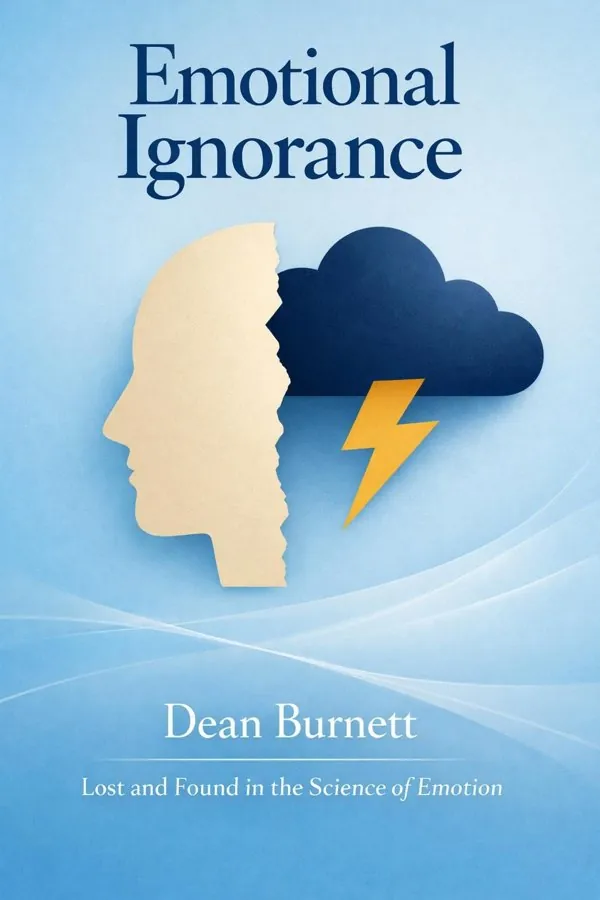
Emotional Ignorance: Lost and Found in the Science of Emotion: Summary & Key Insights
by Dean Burnett
 10 min9 chaptersAudio available
Key Takeaways from Emotional Ignorance: Lost and Found in the Science of Emotion
The first surprise in the science of emotion is that experts still argue about what an emotion actually is.
It is tempting to imagine that each emotion lives in one neat part of the brain, but the brain rarely works so cleanly.
Emotions are not random inconveniences added to human life; they are ancient adaptations shaped by evolution.
Emotions may have biological roots, but they are never purely biological.
One of the most persistent myths about the mind is that reason is good and emotion is bad.
What Is Emotional Ignorance: Lost and Found in the Science of Emotion About?
Emotional Ignorance: Lost and Found in the Science of Emotion by Dean Burnett is a neuroscience book spanning 7 pages. Emotions feel immediate and obvious, yet they remain some of the most difficult phenomena in science to explain. In Emotional Ignorance, neuroscientist Dean Burnett takes readers into that uncertainty with honesty, wit, and unusual personal depth. Rather than pretending that science has already solved emotion, he shows how messy, contested, and fascinating the subject really is. The book blends neuroscience, psychology, evolutionary theory, and lived experience to examine what emotions are, where they come from, and why they so often seem to override reason. What makes this book especially powerful is Burnett’s perspective. He is not only a trained neuroscientist skilled at translating complex research for general readers, but also someone writing from the deeply human experience of grief and emotional upheaval. That dual lens gives the book both authority and humility. Burnett explains the brain mechanisms behind feeling while acknowledging that no diagram or scan can fully capture what sorrow, fear, love, or shame actually feel like from the inside. The result is a smart, accessible exploration of emotion that matters to anyone trying to understand behavior, mental health, relationships, and the complicated inner lives we all carry.
This FizzRead summary covers all 9 key chapters of Emotional Ignorance: Lost and Found in the Science of Emotion in approximately 10 minutes, distilling the most important ideas, arguments, and takeaways from Dean Burnett's work. Also available as an audio summary and Key Quotes Podcast.
Emotional Ignorance: Lost and Found in the Science of Emotion
Emotions feel immediate and obvious, yet they remain some of the most difficult phenomena in science to explain. In Emotional Ignorance, neuroscientist Dean Burnett takes readers into that uncertainty with honesty, wit, and unusual personal depth. Rather than pretending that science has already solved emotion, he shows how messy, contested, and fascinating the subject really is. The book blends neuroscience, psychology, evolutionary theory, and lived experience to examine what emotions are, where they come from, and why they so often seem to override reason.
What makes this book especially powerful is Burnett’s perspective. He is not only a trained neuroscientist skilled at translating complex research for general readers, but also someone writing from the deeply human experience of grief and emotional upheaval. That dual lens gives the book both authority and humility. Burnett explains the brain mechanisms behind feeling while acknowledging that no diagram or scan can fully capture what sorrow, fear, love, or shame actually feel like from the inside. The result is a smart, accessible exploration of emotion that matters to anyone trying to understand behavior, mental health, relationships, and the complicated inner lives we all carry.
Who Should Read Emotional Ignorance: Lost and Found in the Science of Emotion?
This book is perfect for anyone interested in neuroscience and looking to gain actionable insights in a short read. Whether you're a student, professional, or lifelong learner, the key ideas from Emotional Ignorance: Lost and Found in the Science of Emotion by Dean Burnett will help you think differently.
- ✓Readers who enjoy neuroscience and want practical takeaways
- ✓Professionals looking to apply new ideas to their work and life
- ✓Anyone who wants the core insights of Emotional Ignorance: Lost and Found in the Science of Emotion in just 10 minutes
Want the full summary?
Get instant access to this book summary and 100K+ more with Fizz Moment.
Get Free SummaryAvailable on App Store • Free to download
Key Chapters
The first surprise in the science of emotion is that experts still argue about what an emotion actually is. We use words like fear, anger, joy, and grief as if they refer to clearly bounded mental events, but once researchers try to define them precisely, the certainty disappears. Are emotions bodily reactions, patterns of thought, social signals, survival tools, or subjective feelings? The answer may be all of these at once.
Burnett shows that emotion sits at the crossroads of many disciplines. Psychologists often focus on behavior and experience. Neuroscientists look at brain activity and physiology. Philosophers ask whether emotions are judgments, sensations, or something more complex. Because each field studies a different slice of the phenomenon, no single definition fully captures it. That does not mean emotion is unreal; it means emotion is layered. A racing heart, a fearful interpretation, a facial expression, and a desire to escape may all be parts of one emotional event.
This matters in everyday life because people often treat emotions as simple truths: “I feel it, therefore I understand it.” But emotion can be ambiguous. Anxiety may look like anger. Exhaustion may feel like sadness. Excitement may resemble fear. In relationships, misunderstandings often happen because we assume our labels are accurate when they may only be partial.
A practical application is emotional granularity: learning to describe feelings more precisely. Instead of saying “I’m stressed,” ask whether you feel overwhelmed, ashamed, uncertain, threatened, or mentally depleted. Better labels can lead to better decisions, clearer communication, and more effective coping.
Actionable takeaway: When a strong feeling arises, pause and name it in more specific terms. Precision is the first step toward emotional understanding.
It is tempting to imagine that each emotion lives in one neat part of the brain, but the brain rarely works so cleanly. Burnett challenges the familiar myth of tidy emotional centers, such as the idea that the amygdala is simply the brain’s fear button. In reality, emotions emerge from interacting systems spread across multiple brain regions, bodily responses, memories, and interpretations.
The amygdala does play an important role in detecting salience and threat, but fear is not generated there alone. The prefrontal cortex helps evaluate context and regulate response. The hippocampus contributes memory, letting past experiences shape present feelings. The insula processes bodily states, such as tension or nausea, that influence emotional awareness. Hormones and autonomic nervous system activity also affect what emotions feel like and how intensely they are experienced.
This network view helps explain why emotions can be inconsistent. You may know rationally that public speaking is safe, yet your body still responds as if danger is near. Or you may feel suddenly uneasy in a situation that resembles a past negative experience, even if you cannot consciously identify the reason. The brain is integrating perception, memory, bodily sensation, and prediction all at once.
This also has implications for self-control. If emotions are distributed processes rather than isolated switches, managing them requires more than “thinking positively.” Sleep, movement, breathing, routines, environment, and social support all matter because they influence the systems involved in emotional processing.
Actionable takeaway: Stop treating emotion as a single glitch in one part of your brain. When you feel emotionally overwhelmed, address the full system: body, thoughts, context, and habits.
Emotions are not random inconveniences added to human life; they are ancient adaptations shaped by evolution. Burnett explains that emotional responses developed because they helped organisms respond quickly to important challenges and opportunities. Fear mobilizes avoidance, disgust protects against contamination, attachment supports caregiving, and anger can defend boundaries or signal injustice.
From this perspective, emotions are less about objective truth than functional usefulness. Fear does not need to be accurate in every case to be valuable. It only needs to help an organism avoid enough danger often enough to improve survival. That is why emotional systems can seem exaggerated or irrational in modern life. A brain built to detect threats in uncertain environments may overreact to emails, social rejection, or financial instability because these situations trigger older survival circuits.
Evolutionary thinking also clarifies why unpleasant emotions are not design flaws. Anxiety, jealousy, guilt, and shame can be painful, but they may have evolved because they encouraged vigilance, relationship protection, social repair, or group conformity. The problem is not that these emotions exist; the problem is that they can become overactive, misdirected, or maladaptive in environments unlike those in which they evolved.
For example, social media can hijack ancient needs for status and belonging, amplifying envy or exclusion far beyond what our nervous systems were built to manage. Understanding this can reduce self-judgment. Feeling threatened by modern pressures does not mean you are weak; it may mean your emotional systems are doing old jobs in new conditions.
Actionable takeaway: Ask what purpose an emotion may be trying to serve. Instead of fighting the feeling immediately, identify the underlying need or perceived threat it is responding to.
Emotions may have biological roots, but they are never purely biological. Burnett emphasizes that culture, language, upbringing, and social norms strongly influence how emotions are recognized, expressed, and interpreted. People do not simply have feelings; they learn what feelings mean, when they are acceptable, and how they should appear in public.
Different cultures encourage different emotional habits. In some settings, open enthusiasm is rewarded; in others, restraint signals maturity. Some families treat anger as dangerous and unacceptable, while others use it freely. Some societies frame sadness as a private burden, while others treat grief as a communal process. These differences affect not just outward expression but internal experience. If your culture gives you rich language for certain feelings and very little for others, your emotional life will be shaped accordingly.
Social context matters too. We often catch emotions from others through tone, expression, and group atmosphere. A tense workplace can make neutral events feel threatening. A supportive friend can help make a painful feeling feel bearable. Emotion is therefore not just something inside the skull; it is constantly influenced by interaction.
This insight is especially useful in relationships. People often assume others feel the same emotion in the same way. But what counts as love, respect, embarrassment, or emotional honesty may vary dramatically across backgrounds. Misunderstandings are often social and cultural, not just personal.
Actionable takeaway: Be curious about emotional differences instead of assuming your way is the normal way. Ask how family, culture, and environment may have shaped both your emotional habits and those of the people around you.
One of the most persistent myths about the mind is that reason is good and emotion is bad. Burnett dismantles this false divide. Emotions are not the enemy of rational thought; they are often essential to it. Without emotion, decision-making becomes impaired, motivation weakens, and priorities lose clarity. Reason needs emotion to know what matters.
Research in neuroscience has shown that people with damage to brain systems involved in emotion do not become perfectly logical machines. Instead, they may struggle to make even simple choices because they cannot assign value effectively. Emotion helps mark options as important, risky, attractive, or morally significant. It provides the weight behind judgment.
Of course, emotions can also bias reasoning. Fear can make us overestimate danger. Anger can narrow attention and increase certainty. Shame can distort self-perception. But bias does not mean emotion is separate from cognition. It means cognition is always emotionally colored. Even the desire to be objective usually reflects emotional commitments to accuracy, fairness, or control.
This has practical implications for work, leadership, and personal choices. A manager who ignores the emotional climate of a team may make technically sound but socially disastrous decisions. A person trying to make a life change may fail if they rely only on logic without considering motivation, dread, pride, or hope. Better decisions come from integrating feeling with reflection.
Actionable takeaway: When facing an important choice, ask two questions: What do the facts suggest, and what is the emotion telling me matters here? Wise judgment requires both.
Many mental health conditions can be understood, at least in part, as disruptions in emotional processing. Burnett explores how anxiety, depression, trauma, and related difficulties are not just problems of thought but of feeling, regulation, interpretation, and bodily response. Emotions can become too intense, too blunted, poorly matched to reality, or difficult to recover from once triggered.
In anxiety, threat detection may become hypersensitive, producing fear and vigilance even when danger is low. In depression, reward and motivation systems may flatten, making pleasure, hope, or emotional momentum harder to access. Trauma can alter how the brain predicts safety, leaving the body prepared for threat long after the event has ended. These patterns are not signs of weakness; they reflect deeply embedded interactions among brain circuits, learning, stress, and experience.
Burnett’s approach is valuable because it avoids both reductionism and mystification. He does not claim that a mental illness is “just chemicals,” nor does he imply that people can think their way out of serious distress. Instead, he shows how biology, personal history, and emotional life intersect. This helps reduce stigma. Emotional suffering is real, patterned, and scientifically meaningful.
The practical lesson is that emotional struggles deserve support, not shame. Therapy, medication, social connection, sleep, and structured routines can all help because they target different layers of emotional functioning. Understanding the emotional basis of distress can also help people identify triggers and develop more realistic self-expectations.
Actionable takeaway: If your emotions feel chronically unmanageable, treat that as valid health information. Seek support early rather than waiting for emotional patterns to become a crisis.
Some of the book’s deepest insight comes from Burnett’s personal confrontation with grief after losing his father. This experience exposes a humbling truth: scientific knowledge can explain mechanisms, but it cannot cancel suffering. Knowing how the brain processes grief does not exempt anyone from heartbreak. In fact, intense personal loss can make the gap between explanation and experience painfully obvious.
Burnett uses grief to show why emotion resists complete reduction. Neuroscience can identify stress responses, memory systems, attachment mechanisms, and hormonal changes. Psychology can describe stages, patterns, and coping processes. But none of that fully captures what it feels like when the world is suddenly rearranged by absence. The map is useful, yet it is not the terrain.
This does not mean science fails. It means science has boundaries. It can clarify, normalize, and guide, but it cannot replace meaning-making, mourning, ritual, or human connection. Grief especially demonstrates that emotions are lived phenomena embedded in relationships, memory, and identity. The person lost is not merely an external object but part of how one understands oneself.
This idea has broad relevance. When someone is suffering, offering only explanation can feel cold. People often need understanding before analysis. Likewise, when we are in pain ourselves, we may need to stop demanding perfect intellectual clarity and allow emotion to unfold.
Actionable takeaway: Use science to inform your emotional life, not to invalidate it. In moments of grief or pain, prioritize compassion, connection, and patience over the urge to explain everything away.
A troubling but liberating idea runs through Burnett’s work: people are often unreliable interpreters of their own emotions. We usually assume that because feelings occur inside us, we understand them best. Yet emotional awareness is frequently incomplete. We feel the effects before we understand the cause, and we often construct explanations after the fact.
This happens because emotional processing is fast, layered, and partially unconscious. The brain constantly predicts and reacts before deliberate thought catches up. A person may feel irritable because of poor sleep, unresolved anxiety, sensory overload, or hunger, but interpret that state as moral certainty about someone else’s behavior. Another may call a feeling “stress” when it is really disappointment or loneliness. In many cases, we sense emotional intensity clearly while misunderstanding what generated it.
This is why self-knowledge takes work. Journaling, therapy, reflective conversation, and body awareness can reveal patterns that are hard to spot in the moment. You may notice that certain social settings consistently trigger shame, or that specific tasks evoke dread because they threaten your identity, not because they are objectively difficult. Recognizing such patterns can transform emotional life from something chaotic into something more interpretable.
This idea also encourages humility in conflict. If emotions can be misread internally, then certainty during arguments should be treated carefully. Feeling wronged does not always mean your interpretation is complete.
Actionable takeaway: Build a habit of emotional reflection. After strong reactions, ask not just “What did I feel?” but “What else might have contributed to that reaction?”
If there is a practical thread tying the whole book together, it is that emotional literacy matters. The better we understand emotions as biological, psychological, and social processes, the better equipped we are to navigate work, family, health, and identity. Burnett does not promise emotional mastery, but he does suggest that greater understanding can reduce confusion, shame, and avoidable conflict.
Emotional literacy includes several skills: noticing bodily signals, identifying feelings accurately, understanding triggers, tolerating discomfort, communicating clearly, and responding rather than reacting. These skills are useful in ordinary situations. A parent who recognizes that a child’s outburst may reflect overwhelm rather than defiance can respond more effectively. A professional who can distinguish burnout from boredom can make smarter career choices. A partner who can say “I feel dismissed” rather than turning silently resentful can improve communication.
Importantly, emotional literacy is not about becoming endlessly introspective or turning every feeling into a major event. It is about developing enough awareness to make better judgments. Sometimes the best use of emotional insight is simply recognizing that you are too tired to interpret a conversation fairly. At other times, it means acknowledging grief, seeking support, or changing an unhealthy environment.
Burnett’s broader message is encouraging: emotion is complicated, but not inaccessible. We may never fully solve it, yet we can become less ignorant and more skillful in living with it.
Actionable takeaway: Choose one emotional skill to practice this week, such as naming feelings more precisely, pausing before reacting, or asking someone else about their emotional perspective.
All Chapters in Emotional Ignorance: Lost and Found in the Science of Emotion
About the Author
Dean Burnett is a British neuroscientist, author, and science communicator best known for translating complex brain science into engaging, accessible writing. Trained in neuroscience and experienced as a lecturer and researcher, he has built a wide readership through books, journalism, and media commentary on psychology, emotion, and mental health. Burnett’s style blends scientific rigor with humor and candor, making difficult topics approachable without oversimplifying them. He is the author of several popular science works and has written for major publications on subjects ranging from cognition and behavior to stress and wellbeing. In Emotional Ignorance, his authority comes not only from academic expertise but also from his willingness to examine emotion through personal experience, giving his analysis unusual depth and humanity.
Get This Summary in Your Preferred Format
Read or listen to the Emotional Ignorance: Lost and Found in the Science of Emotion summary by Dean Burnett anytime, anywhere. FizzRead offers multiple formats so you can learn on your terms — all free.
Available formats: App · Audio · PDF · EPUB — All included free with FizzRead
Download Emotional Ignorance: Lost and Found in the Science of Emotion PDF and EPUB Summary
Key Quotes from Emotional Ignorance: Lost and Found in the Science of Emotion
“The first surprise in the science of emotion is that experts still argue about what an emotion actually is.”
“It is tempting to imagine that each emotion lives in one neat part of the brain, but the brain rarely works so cleanly.”
“Emotions are not random inconveniences added to human life; they are ancient adaptations shaped by evolution.”
“Emotions may have biological roots, but they are never purely biological.”
“One of the most persistent myths about the mind is that reason is good and emotion is bad.”
Frequently Asked Questions about Emotional Ignorance: Lost and Found in the Science of Emotion
Emotional Ignorance: Lost and Found in the Science of Emotion by Dean Burnett is a neuroscience book that explores key ideas across 9 chapters. Emotions feel immediate and obvious, yet they remain some of the most difficult phenomena in science to explain. In Emotional Ignorance, neuroscientist Dean Burnett takes readers into that uncertainty with honesty, wit, and unusual personal depth. Rather than pretending that science has already solved emotion, he shows how messy, contested, and fascinating the subject really is. The book blends neuroscience, psychology, evolutionary theory, and lived experience to examine what emotions are, where they come from, and why they so often seem to override reason. What makes this book especially powerful is Burnett’s perspective. He is not only a trained neuroscientist skilled at translating complex research for general readers, but also someone writing from the deeply human experience of grief and emotional upheaval. That dual lens gives the book both authority and humility. Burnett explains the brain mechanisms behind feeling while acknowledging that no diagram or scan can fully capture what sorrow, fear, love, or shame actually feel like from the inside. The result is a smart, accessible exploration of emotion that matters to anyone trying to understand behavior, mental health, relationships, and the complicated inner lives we all carry.
You Might Also Like
Anxious
Joseph LeDoux
10 min
Hallucinations
Oliver Sacks
10 min
The Biological Mind: How Brain, Body, and Environment Collaborate to Make Us Who We Are
Alan Jasanoff
10 min
The Feeling of Life Itself: Why Consciousness Is Widespread but Can't Be Computed
Christof Koch
10 min
The No-Nonsense Meditation Book
Steven Laureys
10 min
A General Theory of Love
Thomas Lewis, Fari Amini, Richard Lannon
10 minBrowse by Category
Ready to read Emotional Ignorance: Lost and Found in the Science of Emotion?
Get the full summary and 100K+ more books with Fizz Moment.