
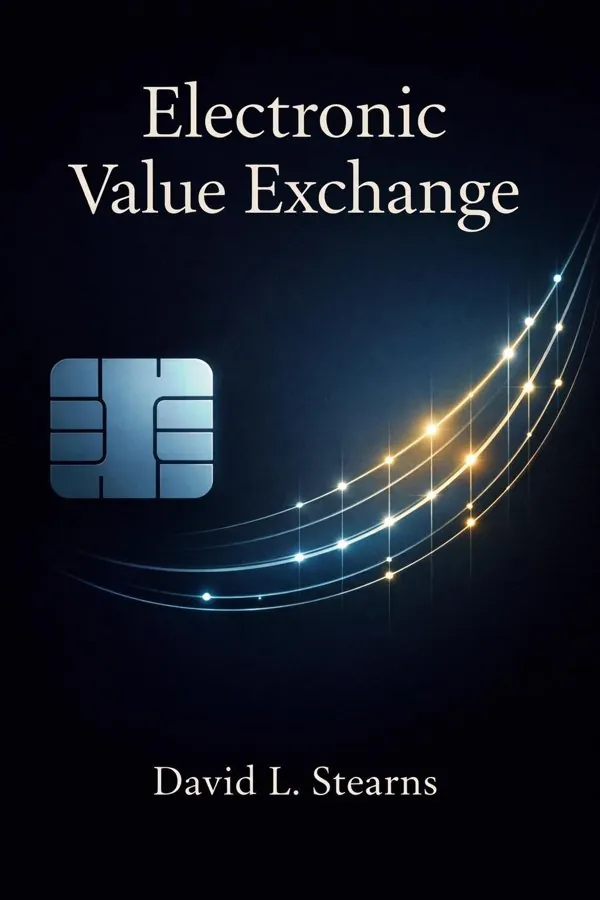
Electronic Value Exchange: Origins of the VISA Electronic Payment System: Summary & Key Insights
 10 min13 chaptersAudio available
What Is Electronic Value Exchange: Origins of the VISA Electronic Payment System About?
Electronic Value Exchange: Origins of the VISA Electronic Payment System by David L. Stearns is a economics book spanning 13 pages. Electronic Value Exchange: Origins of the VISA Electronic Payment System explores the transformation of the VISA network from a fragmented, paper-based credit card system into a unified, global electronic payment infrastructure. David L. Stearns traces the technological, organizational, and economic developments that enabled this evolution, offering a detailed historical account of how electronic value exchange became a cornerstone of modern commerce.
This FizzRead summary covers all 13 key chapters of Electronic Value Exchange: Origins of the VISA Electronic Payment System in approximately 10 minutes, distilling the most important ideas, arguments, and takeaways from David L. Stearns's work. Also available as an audio summary and Key Quotes Podcast.
Electronic Value Exchange: Origins of the VISA Electronic Payment System
Electronic Value Exchange: Origins of the VISA Electronic Payment System explores the transformation of the VISA network from a fragmented, paper-based credit card system into a unified, global electronic payment infrastructure. David L. Stearns traces the technological, organizational, and economic developments that enabled this evolution, offering a detailed historical account of how electronic value exchange became a cornerstone of modern commerce.
Who Should Read Electronic Value Exchange: Origins of the VISA Electronic Payment System?
This book is perfect for anyone interested in economics and looking to gain actionable insights in a short read. Whether you're a student, professional, or lifelong learner, the key ideas from Electronic Value Exchange: Origins of the VISA Electronic Payment System by David L. Stearns will help you think differently.
- ✓Readers who enjoy economics and want practical takeaways
- ✓Professionals looking to apply new ideas to their work and life
- ✓Anyone who wants the core insights of Electronic Value Exchange: Origins of the VISA Electronic Payment System in just 10 minutes
Want the full summary?
Get instant access to this book summary and 100K+ more with Fizz Moment.
Get Free SummaryAvailable on App Store • Free to download
Key Chapters
In the 1950s and early 1960s, credit card systems were far from streamlined. Most operated within silos: department stores issued their own cards, gasoline companies had proprietary systems, and banks were only beginning to imagine their own instruments of consumer credit. Transactions required paper slips—often called 'charge slips'—that had to be physically transported and reconciled. Fraud was rampant, errors frequent, and merchants bore heavy costs from delayed payments and high administrative burdens.
During this time, banks recognized the potential of extending revolving credit to consumers, but lacked an efficient infrastructure to manage the logistical complexity. Each purchase set off a chain of manual operations: the merchant submitted paper receipts to a local bank, which forwarded them to the issuing institution; clerks manually processed the payments, often taking weeks to credit or bill accounts. This system was not scalable. As participation grew, so did the inefficiencies. Yet this very friction spurred the initial wave of innovation.
The notion of 'electronic' processing—then barely imaginable—offered a theoretical solution: if authorization could be granted instantly and records exchanged digitally, both risk and delay could be minimized. But turning this vision into reality required not just new technologies, but new forms of cooperation among institutions that barely trusted one another.
Bank of America’s entry into the credit card landscape was transformative and turbulent. Launched in 1958 as the BankAmericard program, it was one of the first large-scale efforts to create a general-purpose credit card. The project involved mailing over 60,000 unsolicited cards to California consumers—a bold, even reckless act that rapidly expanded the cardholder base but also produced startling levels of fraud and delinquency. Early chaos nearly sank the program.
However, Bank of America’s leadership saw opportunity amid disaster. By studying the failure, they began identifying the weak links: inadequate merchant verification, poor data management, insufficient fraud controls. They started to systematize operations, introducing more disciplined approaches to tracking purchases and settlements between merchants and the bank. The experience taught them that broad adoption demanded more than issuance—it required infrastructure and trust.
It also became clear that a single bank could not scale nationwide alone. Fragmentation persisted because other banks refused to surrender control to Bank of America’s proprietary network. Thus, the evolution of BankAmericard became a study in institutional adaptation: transforming a unilateral corporate venture into a cooperative, multi-bank system. The seeds of VISA were planted in this recognition.
+ 11 more chapters — available in the FizzRead app
All Chapters in Electronic Value Exchange: Origins of the VISA Electronic Payment System
About the Author
David L. Stearns is a researcher and author specializing in the history of computing and financial technology. His work focuses on the intersection of information systems, banking, and the evolution of digital payment infrastructures.
Get This Summary in Your Preferred Format
Read or listen to the Electronic Value Exchange: Origins of the VISA Electronic Payment System summary by David L. Stearns anytime, anywhere. FizzRead offers multiple formats so you can learn on your terms — all free.
Available formats: App · Audio · PDF · EPUB — All included free with FizzRead
Download Electronic Value Exchange: Origins of the VISA Electronic Payment System PDF and EPUB Summary
Key Quotes from Electronic Value Exchange: Origins of the VISA Electronic Payment System
“In the 1950s and early 1960s, credit card systems were far from streamlined.”
“Bank of America’s entry into the credit card landscape was transformative and turbulent.”
Frequently Asked Questions about Electronic Value Exchange: Origins of the VISA Electronic Payment System
Electronic Value Exchange: Origins of the VISA Electronic Payment System by David L. Stearns is a economics book that explores key ideas across 13 chapters. Electronic Value Exchange: Origins of the VISA Electronic Payment System explores the transformation of the VISA network from a fragmented, paper-based credit card system into a unified, global electronic payment infrastructure. David L. Stearns traces the technological, organizational, and economic developments that enabled this evolution, offering a detailed historical account of how electronic value exchange became a cornerstone of modern commerce.
You Might Also Like

Business Adventures
John Brooks
10 min
Nudge
Richard H. Thaler, Cass R. Sunstein
10 min
The Hitchhiker"s Guide to the Galaxy
Douglas Adams
10 minThe Muqaddimah
Ibn Khaldun
10 minThe Outsiders
William N. Thorndike
10 min
A Little History of Economics
Niall Kishtainy
10 minBrowse by Category
Ready to read Electronic Value Exchange: Origins of the VISA Electronic Payment System?
Get the full summary and 100K+ more books with Fizz Moment.