
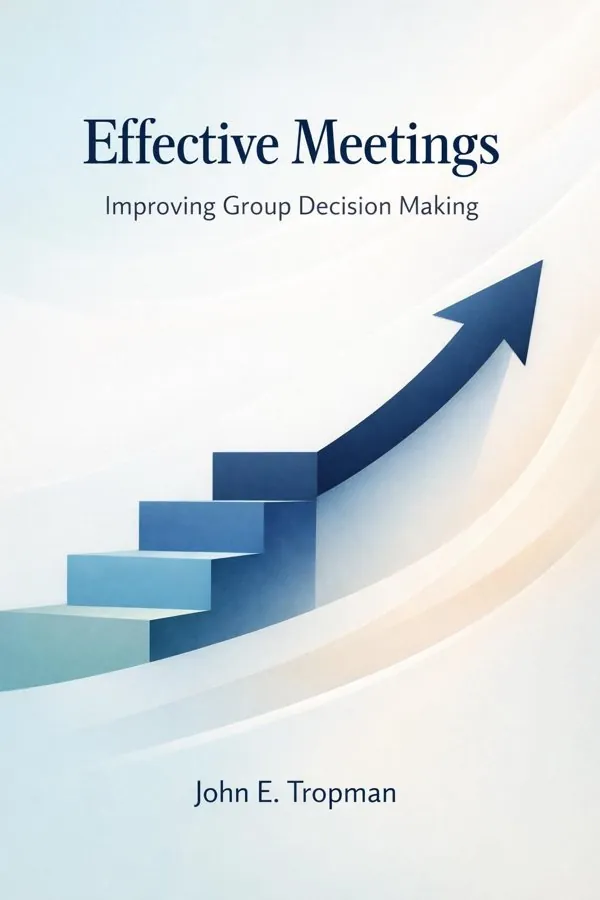
Effective Meetings: Improving Group Decision Making: Summary & Key Insights
 10 min11 chaptersAudio available
What Is Effective Meetings: Improving Group Decision Making About?
Effective Meetings: Improving Group Decision Making by John E. Tropman is a leadership book spanning 11 pages. This book provides a comprehensive framework for improving the productivity and decision-making quality of group meetings. It explores the dynamics of group interaction, leadership roles, and facilitation techniques that lead to effective outcomes. The author offers practical tools and strategies for structuring meetings, managing participation, and ensuring that decisions are implemented successfully.
This FizzRead summary covers all 11 key chapters of Effective Meetings: Improving Group Decision Making in approximately 10 minutes, distilling the most important ideas, arguments, and takeaways from John E. Tropman's work. Also available as an audio summary and Key Quotes Podcast.
Effective Meetings: Improving Group Decision Making
This book provides a comprehensive framework for improving the productivity and decision-making quality of group meetings. It explores the dynamics of group interaction, leadership roles, and facilitation techniques that lead to effective outcomes. The author offers practical tools and strategies for structuring meetings, managing participation, and ensuring that decisions are implemented successfully.
Who Should Read Effective Meetings: Improving Group Decision Making?
This book is perfect for anyone interested in leadership and looking to gain actionable insights in a short read. Whether you're a student, professional, or lifelong learner, the key ideas from Effective Meetings: Improving Group Decision Making by John E. Tropman will help you think differently.
- ✓Readers who enjoy leadership and want practical takeaways
- ✓Professionals looking to apply new ideas to their work and life
- ✓Anyone who wants the core insights of Effective Meetings: Improving Group Decision Making in just 10 minutes
Want the full summary?
Get instant access to this book summary and 100K+ more with Fizz Moment.
Get Free SummaryAvailable on App Store • Free to download
Key Chapters
If you’ve ever left a meeting asking yourself, “What did we actually decide?” you’re not alone. Most organizations live with meetings that consume valuable time but yield little progress. The root problems are surprisingly consistent: unclear goals, poor facilitation, vague accountability, and mismanaged participation.
The problem begins before the meeting even starts. When the purpose of a meeting is not defined clearly—whether it’s to decide, to inform, or to brainstorm—participants arrive with mismatched expectations. One person assumes decisions will be made, another expects only updates, and a third believes it’s a forum for open discussion. This confusion affects energy and attention from the start.
Then comes facilitation. The quality of conversation matters immensely, but many leaders mistake a meeting for a lecture or a negotiation. An effective facilitator doesn’t dominate; they create space for others to speak, summarize threads of conversation, and maintain the direction toward outcomes. Without this, meetings become arenas of competing voices. Individuals with strong personalities take over, while quieter members withdraw, sensing their contributions won’t be valued.
I’ve seen that inefficiency is rarely caused by lack of intelligence. It’s caused by misaligned process. Time is wasted on tangents, unresolved decisions move from week to week, and emotional undercurrents remain unaddressed. The simplest remedy begins with preparation: defining the purpose, setting realistic time frames, and clarifying decision roles before convening the group. Preparation is not bureaucratic—it is respect for everyone’s time.
To understand meetings as social systems is to recognize that every inefficiency reflects a breakdown in communication and shared meaning. When you introduce structure and transparency, people engage more openly, decisions become traceable, and the sense of competence rises. My message is: Don’t settle for meetings as mere rituals. They can—and should—be moments of disciplined collaboration.
A meeting is not just a conversation; it is a decision-making system composed of interdependent elements—structure, process, and outcome. Think of these as gears in a clock: each must turn smoothly for time to flow accurately.
Structure is the skeleton. It includes the agenda, roles, and norms that shape the experience. I often emphasize that every meeting should begin with clarity on what kind of decision is being sought. Are we exploring options, reaching consensus, or ratifying a prior recommendation? This determines how discussion unfolds. Without structural clarity, even the best intentions drift.
Process is the bloodstream. It governs how information circulates and how input becomes collective understanding. Productive processes are not spontaneous; they are consciously managed. Active facilitation ensures balanced contribution, guiding attention from problem identification toward actionable resolution. Constructive processes depend on mutual respect, good listening, and the capacity to synthesize differing views.
Outcome is the muscle—the tangible result that leaves the group stronger. Every decision must be actionable, assigned, and monitored. A meeting that generates ideas but no implementation plan is incomplete. Effective meetings always close with clarity: who will do what, by when, and how success will be measured.
When I describe meetings as decision-making systems, I am urging leaders to think about them as integrated designs rather than isolated events. You must plan each meeting as a miniature production cycle, where inputs (information and participation) are transformed into outputs (commitments and actions). This mindset prevents drift and ensures accountability.
The most productive organizations I’ve studied treat meetings as strategic instruments—feedback loops that capture intelligence from multiple levels and translate it into coordinated action. Efficiency here does not mean speed; it means purposefulness. The system operates so every participant contributes meaningfully and understands how their voice fits into decisions. When structure, process, and outcome align, meetings become engines of organizational productivity rather than drains on it.
+ 9 more chapters — available in the FizzRead app
All Chapters in Effective Meetings: Improving Group Decision Making
About the Author
John E. Tropman is a professor of social work at the University of Michigan. His research focuses on organizational behavior, decision-making, and management in human service organizations. He has authored numerous books and articles on leadership, group processes, and nonprofit management.
Get This Summary in Your Preferred Format
Read or listen to the Effective Meetings: Improving Group Decision Making summary by John E. Tropman anytime, anywhere. FizzRead offers multiple formats so you can learn on your terms — all free.
Available formats: App · Audio · PDF · EPUB — All included free with FizzRead
Download Effective Meetings: Improving Group Decision Making PDF and EPUB Summary
Key Quotes from Effective Meetings: Improving Group Decision Making
“If you’ve ever left a meeting asking yourself, “What did we actually decide?”
“A meeting is not just a conversation; it is a decision-making system composed of interdependent elements—structure, process, and outcome.”
Frequently Asked Questions about Effective Meetings: Improving Group Decision Making
Effective Meetings: Improving Group Decision Making by John E. Tropman is a leadership book that explores key ideas across 11 chapters. This book provides a comprehensive framework for improving the productivity and decision-making quality of group meetings. It explores the dynamics of group interaction, leadership roles, and facilitation techniques that lead to effective outcomes. The author offers practical tools and strategies for structuring meetings, managing participation, and ensuring that decisions are implemented successfully.
You Might Also Like

Extreme Ownership
Jocko Willink
10 min
Dare to Lead
Brene Brown
10 min
Leaders Eat Last
Simon Sinek
10 min
The 21 Irrefutable Laws of Leadership
John Maxwell
10 min
Start With Why
Simon Sinek
10 min
How to Lead When You're Not in Charge
Clay Scroggins
10 minBrowse by Category
Ready to read Effective Meetings: Improving Group Decision Making?
Get the full summary and 100K+ more books with Fizz Moment.