
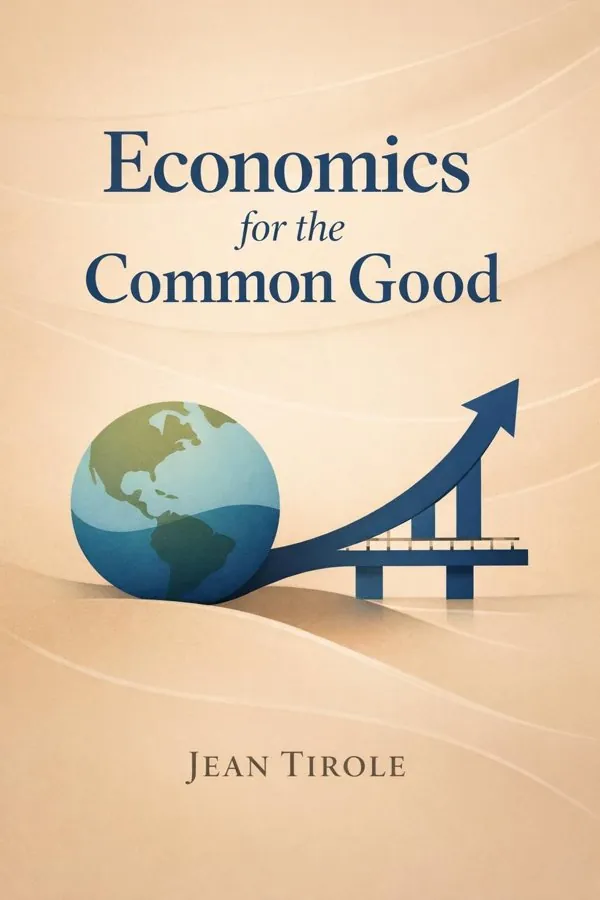
Economics for the Common Good: Summary & Key Insights
by Jean Tirole
 10 min10 chaptersAudio available
Key Takeaways from Economics for the Common Good
A society gets into trouble when it treats economics as a political tribe rather than a method of inquiry.
Expertise becomes valuable only when it accepts public responsibility.
A free market without rules does not guarantee freedom; it can just as easily produce abuse, opacity, and concentrated power.
The digital economy feels frictionless to users, but beneath that convenience lies a new architecture of power.
Financial systems create prosperity when they allocate capital well, but they become dangerous when profits are private and losses are public.
What Is Economics for the Common Good About?
Economics for the Common Good by Jean Tirole is a economics book spanning 11 pages. In Economics for the Common Good, Nobel Prize–winning economist Jean Tirole makes a bold and timely case: economics, at its best, is not a cold defense of markets or profit, but a practical discipline for improving collective life. Drawing on decades of research in regulation, market power, incentives, finance, and public policy, Tirole shows how economic thinking can help societies tackle some of their hardest problems, including climate change, unemployment, inequality, digital monopolies, financial instability, and failures of political governance. What makes this book especially valuable is its refusal to settle for slogans. Tirole insists that good intentions are not enough; policies must be designed with a realistic understanding of incentives, information, and human behavior. At the same time, he argues that economics must remain ethically grounded and socially accountable. Rather than treating markets and states as opposing forces, he explores how both can be structured to serve the public interest. For readers who want a serious but accessible guide to how modern economies work—and how they might work better—this book offers clarity, rigor, and genuine civic purpose.
This FizzRead summary covers all 10 key chapters of Economics for the Common Good in approximately 10 minutes, distilling the most important ideas, arguments, and takeaways from Jean Tirole's work. Also available as an audio summary and Key Quotes Podcast.
Economics for the Common Good
In Economics for the Common Good, Nobel Prize–winning economist Jean Tirole makes a bold and timely case: economics, at its best, is not a cold defense of markets or profit, but a practical discipline for improving collective life. Drawing on decades of research in regulation, market power, incentives, finance, and public policy, Tirole shows how economic thinking can help societies tackle some of their hardest problems, including climate change, unemployment, inequality, digital monopolies, financial instability, and failures of political governance. What makes this book especially valuable is its refusal to settle for slogans. Tirole insists that good intentions are not enough; policies must be designed with a realistic understanding of incentives, information, and human behavior. At the same time, he argues that economics must remain ethically grounded and socially accountable. Rather than treating markets and states as opposing forces, he explores how both can be structured to serve the public interest. For readers who want a serious but accessible guide to how modern economies work—and how they might work better—this book offers clarity, rigor, and genuine civic purpose.
Who Should Read Economics for the Common Good?
This book is perfect for anyone interested in economics and looking to gain actionable insights in a short read. Whether you're a student, professional, or lifelong learner, the key ideas from Economics for the Common Good by Jean Tirole will help you think differently.
- ✓Readers who enjoy economics and want practical takeaways
- ✓Professionals looking to apply new ideas to their work and life
- ✓Anyone who wants the core insights of Economics for the Common Good in just 10 minutes
Want the full summary?
Get instant access to this book summary and 100K+ more with Fizz Moment.
Get Free SummaryAvailable on App Store • Free to download
Key Chapters
A society gets into trouble when it treats economics as a political tribe rather than a method of inquiry. One of Tirole’s central arguments is that economics should not be confused with blind faith in markets, hostility to government, or abstract mathematical games detached from ordinary life. Properly understood, economics is a language for thinking about trade-offs, incentives, scarcity, and interdependence. It helps explain why well-meaning policies sometimes fail, why unintended consequences appear, and why private decisions can create public costs.
This matters because public debate often turns economics into a caricature. Some people see economists as defenders of inequality or corporate power; others expect them to produce simple technical fixes for complex social problems. Tirole rejects both views. Economics cannot replace ethics, democracy, or political judgment, but it can sharpen them. It can reveal where prices fail to reflect social costs, where monopolies distort choices, where information is hidden, and where public intervention is necessary.
Consider rent control, fuel subsidies, or blanket price caps. These may seem compassionate at first glance, yet they can reduce housing supply, encourage wasteful energy use, or create shortages if they ignore incentives. On the other hand, leaving everything to the market can also fail when pollution, market power, or unequal access shape outcomes. The point is not that markets are always right, but that policies must be tested against how people and institutions actually behave.
Actionable takeaway: when evaluating any economic proposal, ask three questions: what incentives does it create, who bears the hidden costs, and what evidence shows it will improve social welfare?
Expertise becomes valuable only when it accepts public responsibility. Tirole reflects on a question many citizens ask: what do economists actually do for society? His answer is neither self-congratulatory nor defensive. Economists serve the common good when they identify the mechanisms behind social problems, clarify trade-offs honestly, and help design institutions that align private behavior with public goals.
This role is demanding because economists work in politically charged territory. Advising on tax policy, labor rules, financial regulation, or climate measures means entering debates shaped by ideology, vested interests, and mistrust. Tirole argues that economists must therefore be transparent about assumptions, modest about what they know, and independent from partisan convenience. Their task is not to tell citizens what to value, but to explain the consequences of different choices.
For example, if a government wants lower emissions, economists can compare carbon taxes, regulation, and subsidies, showing which tools are likely to reduce pollution most effectively and at lowest cost. If policymakers want to reduce inequality, economists can distinguish between policies that merely redistribute after the fact and those that expand opportunity through education, competition, and labor market access. In each case, the economist’s contribution is analytical discipline, not moral monopoly.
Tirole also emphasizes communication. Research locked in journals does little for society unless it becomes understandable to voters, journalists, and leaders. The common good requires public-facing economics: clear language, evidence-based reasoning, and willingness to engage criticism.
Actionable takeaway: seek out economic arguments that explain trade-offs openly, disclose uncertainties, and connect technical analysis to real social outcomes rather than political talking points.
A free market without rules does not guarantee freedom; it can just as easily produce abuse, opacity, and concentrated power. Tirole’s work on regulation is one of the book’s foundations, and he shows why markets often need carefully designed oversight to deliver socially desirable outcomes. This is especially true when firms hold market power, when consumers lack information, or when one party can shift risks onto others.
The challenge is not simply to regulate more, but to regulate better. Heavy-handed rules can stifle innovation, protect incumbents, or create bureaucratic inefficiency. Weak rules, however, allow monopolistic pricing, poor quality, exploitation, or hidden risk-taking. The regulator’s task is to design incentives so that companies pursuing profit also improve public welfare.
Utilities provide a clear example. Electricity, telecommunications, rail, and water often involve high fixed costs and limited competition. If regulators do nothing, firms may overcharge or underinvest in service quality. If regulators dictate every detail, firms may lose incentives to improve efficiency. Tirole’s contribution is to show how contracts, benchmarking, pricing rules, and performance incentives can balance these concerns.
The same logic applies in healthcare, banking, insurance, and consumer platforms. Good regulation recognizes information asymmetries: firms usually know more than regulators and customers, so policy must account for strategic behavior, not assume perfect compliance. Effective rules create accountability without crushing adaptation.
Actionable takeaway: support regulation that targets concrete market failures, measures results, and preserves incentives for innovation, rather than rules driven mainly by outrage, lobbying, or political theater.
The digital economy feels frictionless to users, but beneath that convenience lies a new architecture of power. Tirole explores how platforms such as search engines, social networks, e-commerce marketplaces, and app ecosystems operate in markets where network effects are strong: the more users a platform has, the more valuable it becomes. This can generate enormous benefits—lower transaction costs, broader access, better matching between buyers and sellers—but it can also entrench dominance and weaken competition.
Traditional economic models do not always fit these businesses neatly. Many digital services are offered at zero monetary price to users while attention, data, and behavior become the real currency. A platform may subsidize one side of the market, such as consumers, while monetizing another side, such as advertisers or merchants. This makes it harder to judge market power using old indicators alone.
Tirole warns that digital markets raise urgent questions: who controls data, how transparent are algorithms, when does a platform become gatekeeper, and how should competition policy respond? For example, a dominant marketplace might favor its own products, a social platform may amplify harmful content because engagement drives revenue, or a large ecosystem may lock users in through technical dependence rather than superior value.
Yet Tirole does not argue for reflexive hostility to technology. Digital platforms create real efficiencies and opportunities for entrepreneurship. The goal is to ensure contestability, portability, interoperability, and fair oversight so innovation remains open rather than captured.
Actionable takeaway: when judging digital businesses, look beyond whether services are cheap or free and ask who controls data, access, and market entry—and whether users can realistically switch.
Goodwill alone will not solve climate change if the economy keeps rewarding pollution. Tirole presents environmental degradation as a classic and urgent market failure: emitters do not fully bear the social cost of the damage they create. As a result, carbon-intensive activities appear cheaper than they truly are, and individuals, firms, and nations consume and invest in ways that worsen collective harm.
The book strongly favors policies that put a meaningful price on carbon. A carbon tax or a well-designed cap-and-trade system forces polluters to internalize costs that were previously shifted onto everyone else. This not only reduces emissions directly but also stimulates innovation by making cleaner technologies more competitive. Compared with scattered subsidies, symbolic bans, or vague commitments, pricing carbon sends a clearer signal across the whole economy.
Tirole also highlights the political and international difficulties. Climate policy creates visible costs now to avoid larger but less immediate damages later. Citizens may resist higher energy prices, and countries may hesitate if they fear losing competitiveness while others free-ride. That is why climate policy must be paired with transparent revenue use, support for vulnerable households, and international coordination.
Examples include using carbon tax revenues to reduce other taxes, fund green infrastructure, or compensate lower-income households facing higher heating and transport costs. Policy design matters because fairness affects legitimacy, and legitimacy affects durability.
Actionable takeaway: favor climate measures that change incentives economy-wide, and always ask whether a proposal reduces emissions at scale, shares burdens fairly, and can survive politically long enough to matter.
Unemployment is not merely a statistic; it is a loss of dignity, security, and social belonging. Tirole treats labor markets as institutions that must reconcile efficiency with fairness. Too often, debate is trapped between simplistic extremes: either labor should be fully flexible, or workers should be protected through rigid rules that make adaptation difficult. Tirole argues for a more nuanced approach.
Labor markets face multiple frictions. Firms hesitate to hire when dismissal is costly or uncertain. Workers struggle when skills become obsolete, information about opportunities is poor, or social protection is tied too tightly to traditional employment. Meanwhile, inequality rises when technological change rewards highly skilled workers while leaving others behind. The answer is not to freeze the economy in place, but to build systems that support mobility, training, and security during change.
This can include active labor market policies, portable benefits, apprenticeship systems, unemployment insurance linked to reintegration, and education that strengthens adaptable skills rather than narrow credentials alone. Tirole emphasizes that protecting jobs and protecting people are not always the same thing. Sometimes preserving an inefficient job harms long-term opportunity, while supporting the worker through transition serves both fairness and productivity better.
For example, a region losing industrial employment may need retraining, relocation support, entrepreneurship incentives, and local investment rather than indefinite subsidies to failing firms. The goal is dynamic inclusion, not passive preservation.
Actionable takeaway: evaluate labor policy by asking whether it helps people move into productive work with dignity, rather than simply whether it resists change in the short term.
Many of the things societies value most are precisely the things markets alone struggle to provide. Tirole examines public goods and collective action problems to show why issues such as national defense, basic research, public health, environmental protection, and institutional trust require cooperation beyond individual self-interest. These are areas where benefits are shared broadly, while costs are concentrated, creating strong temptations to free-ride.
This logic applies internationally as well as domestically. Every country benefits when others reduce emissions, share scientific knowledge, or maintain financial stability, but each has incentives to undercontribute if others do the work. The result is chronic underprovision unless institutions align incentives and create credible commitments.
Tirole’s insight is that the common good cannot rest on moral appeals alone. Citizens and governments need rules, transparency, and trust-building mechanisms that make cooperation feasible. Vaccination campaigns, for instance, depend on both public confidence and collective participation. Basic scientific research often requires public funding because private firms cannot capture all the gains. Anti-corruption systems matter because citizens are less willing to contribute taxes or comply with rules when they believe elites are exempt.
The quality of institutions therefore becomes central. When states are competent and trustworthy, collective action is easier. When they are captured, opaque, or inconsistent, social cooperation erodes. Economics helps explain why institutional design matters so deeply for civic outcomes.
Actionable takeaway: support policies that strengthen trust—clear rules, accountability, and visible fairness—because collective action succeeds when people believe others, including leaders, are also doing their part.
A policy that ignores morality is dangerous, but a policy that ignores incentives is often ineffective. Tirole repeatedly returns to the relationship between ethics and economics, arguing that the two are not enemies. Economics explains how people respond to constraints and rewards; ethics helps determine what goals institutions should pursue. The common good depends on connecting the two rather than pretending one can replace the other.
This matters because public discourse often swings between cynical realism and moral idealism. One side assumes people are self-interested and institutions should simply harness that fact. The other assumes that if goals are noble enough, behavior will follow. Tirole rejects both simplifications. Individuals are motivated by self-interest, norms, identity, fairness, and reputation all at once. Good institutions recognize this complexity.
Consider executive compensation, tax compliance, organ donation, or academic integrity. In each case, incentives matter, but so do legitimacy and social norms. A company may legally reward short-term performance while encouraging harmful risk-taking. A tax system may be economically efficient on paper but undermine compliance if citizens perceive it as unjust. Environmental behavior may improve not only through prices but also through norms of responsibility.
Tirole’s broader point is that economics should not be used to excuse selfishness. Instead, it should help design frameworks in which decent behavior is easier, opportunism is less rewarding, and social values are reinforced rather than undermined.
Actionable takeaway: when assessing institutions, ask not only whether they reward the right behaviors, but also whether they are perceived as fair enough to sustain voluntary cooperation and moral commitment.
Globalization has created wealth, lowered prices, and expanded opportunity, yet it has also produced dislocation, insecurity, and political backlash. Tirole treats this tension seriously. He does not romanticize a borderless world, nor does he indulge fantasies of easy economic retreat. Instead, he argues that globalization should be governed so its gains are preserved while its harms are managed more fairly.
Trade and international investment allow specialization, scale, and diffusion of knowledge. Consumers gain from cheaper goods, firms access broader markets, and developing countries can accelerate growth. But these aggregate benefits do not automatically compensate workers, regions, or sectors that lose out. When adjustment mechanisms are weak, the social contract frays and resentment grows. Populist answers then exploit real suffering with simplistic scapegoats.
Tirole’s answer is not protectionism for its own sake. Blocking trade may protect some jobs temporarily while raising costs, reducing innovation, and triggering retaliation. A better strategy is to combine openness with robust domestic institutions: retraining, mobility support, competition policy, tax fairness, and international agreements that limit regulatory arbitrage and environmental dumping.
He also stresses that many problems labeled as globalization failures are in fact governance failures. If multinational firms avoid taxes, labor protections erode, or financial flows escape oversight, the issue is often that rules have not kept up with integration. The challenge is political coordination, not denial of economic reality.
Actionable takeaway: judge globalization not by slogans for or against it, but by whether institutions distribute gains broadly, protect adjustment losers, and prevent cross-border free-riding.
All Chapters in Economics for the Common Good
About the Author
Jean Tirole is a French economist and one of the most influential thinkers in modern microeconomics, industrial organization, and regulation. He was awarded the 2014 Nobel Prize in Economic Sciences for his work on market power and the regulation of firms, especially in industries where competition is limited and information is imperfect. Tirole has written extensively on incentives, finance, game theory, corporate governance, and public policy. He is closely associated with the Toulouse School of Economics, where he has served in major leadership roles and helped build one of Europe’s leading economics research centers. Known for combining rigorous theory with practical policy relevance, Tirole has shaped debates on antitrust, digital platforms, climate policy, and institutional design. Economics for the Common Good reflects his broader mission to make economics more useful, responsible, and publicly engaged.
Get This Summary in Your Preferred Format
Read or listen to the Economics for the Common Good summary by Jean Tirole anytime, anywhere. FizzRead offers multiple formats so you can learn on your terms — all free.
Available formats: App · Audio · PDF · EPUB — All included free with FizzRead
Download Economics for the Common Good PDF and EPUB Summary
Key Quotes from Economics for the Common Good
“A society gets into trouble when it treats economics as a political tribe rather than a method of inquiry.”
“Expertise becomes valuable only when it accepts public responsibility.”
“A free market without rules does not guarantee freedom; it can just as easily produce abuse, opacity, and concentrated power.”
“The digital economy feels frictionless to users, but beneath that convenience lies a new architecture of power.”
“Financial systems create prosperity when they allocate capital well, but they become dangerous when profits are private and losses are public.”
Frequently Asked Questions about Economics for the Common Good
Economics for the Common Good by Jean Tirole is a economics book that explores key ideas across 10 chapters. In Economics for the Common Good, Nobel Prize–winning economist Jean Tirole makes a bold and timely case: economics, at its best, is not a cold defense of markets or profit, but a practical discipline for improving collective life. Drawing on decades of research in regulation, market power, incentives, finance, and public policy, Tirole shows how economic thinking can help societies tackle some of their hardest problems, including climate change, unemployment, inequality, digital monopolies, financial instability, and failures of political governance. What makes this book especially valuable is its refusal to settle for slogans. Tirole insists that good intentions are not enough; policies must be designed with a realistic understanding of incentives, information, and human behavior. At the same time, he argues that economics must remain ethically grounded and socially accountable. Rather than treating markets and states as opposing forces, he explores how both can be structured to serve the public interest. For readers who want a serious but accessible guide to how modern economies work—and how they might work better—this book offers clarity, rigor, and genuine civic purpose.
You Might Also Like

Business Adventures
John Brooks
10 min
Nudge
Richard H. Thaler, Cass R. Sunstein
10 min
The Hitchhiker"s Guide to the Galaxy
Douglas Adams
10 minThe Muqaddimah
Ibn Khaldun
10 minThe Outsiders
William N. Thorndike
10 min
A Little History of Economics
Niall Kishtainy
10 minBrowse by Category
Ready to read Economics for the Common Good?
Get the full summary and 100K+ more books with Fizz Moment.