
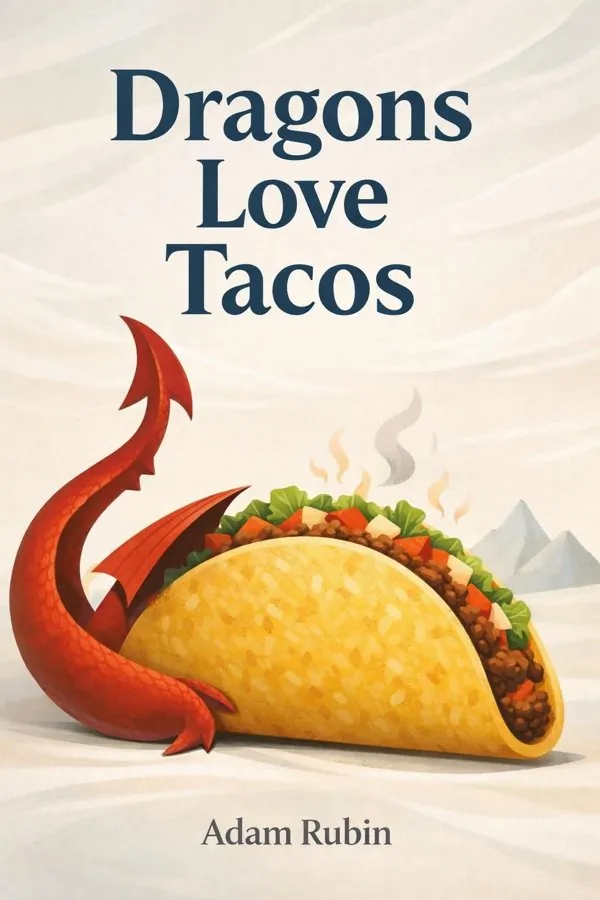
Dragons Love Tacos: Summary & Key Insights
by Adam Rubin
 10 min9 chaptersAudio available
Key Takeaways from Dragons Love Tacos
The fastest way into a child’s imagination is often through an idea that is delightfully ridiculous.
Children love hearing the same important rule repeated, especially when they sense that breaking it will cause trouble.
A story can hinge on one overlooked word, and Dragons Love Tacos turns that truth into comic catastrophe.
People remember rules more readily when those rules are attached to laughter.
Some books are not just read; they are performed, and Dragons Love Tacos thrives in that shared space between page and audience.
What Is Dragons Love Tacos About?
Dragons Love Tacos by Adam Rubin is a bestsellers book. Adam Rubin’s Dragons Love Tacos is a wildly funny picture book built on a simple but irresistible premise: dragons absolutely adore tacos, but they must never, ever eat spicy salsa. From that playful idea, Rubin creates a story that feels both absurd and perfectly logical in the way the best children’s books do. The book follows a child and a dog who learn the essential rules of hosting a taco party for dragons, only to discover what happens when one tiny mistake turns dinner into fiery chaos. Beneath the humor, the book offers something more lasting: a joyful lesson in reading carefully, paying attention to details, and embracing the unexpected. Rubin has become known for his inventive, laugh-out-loud storytelling, and this book showcases his talent for taking nonsense seriously enough that children fully believe in it. Paired with Daniel Salmieri’s expressive illustrations, Dragons Love Tacos has earned its place as a modern picture-book favorite. It matters because it turns reading into an event—one full of suspense, repetition, surprise, and shared laughter for children and adults alike.
This FizzRead summary covers all 9 key chapters of Dragons Love Tacos in approximately 10 minutes, distilling the most important ideas, arguments, and takeaways from Adam Rubin's work. Also available as an audio summary and Key Quotes Podcast.
Dragons Love Tacos
Adam Rubin’s Dragons Love Tacos is a wildly funny picture book built on a simple but irresistible premise: dragons absolutely adore tacos, but they must never, ever eat spicy salsa. From that playful idea, Rubin creates a story that feels both absurd and perfectly logical in the way the best children’s books do. The book follows a child and a dog who learn the essential rules of hosting a taco party for dragons, only to discover what happens when one tiny mistake turns dinner into fiery chaos. Beneath the humor, the book offers something more lasting: a joyful lesson in reading carefully, paying attention to details, and embracing the unexpected. Rubin has become known for his inventive, laugh-out-loud storytelling, and this book showcases his talent for taking nonsense seriously enough that children fully believe in it. Paired with Daniel Salmieri’s expressive illustrations, Dragons Love Tacos has earned its place as a modern picture-book favorite. It matters because it turns reading into an event—one full of suspense, repetition, surprise, and shared laughter for children and adults alike.
Who Should Read Dragons Love Tacos?
This book is perfect for anyone interested in bestsellers and looking to gain actionable insights in a short read. Whether you're a student, professional, or lifelong learner, the key ideas from Dragons Love Tacos by Adam Rubin will help you think differently.
- ✓Readers who enjoy bestsellers and want practical takeaways
- ✓Professionals looking to apply new ideas to their work and life
- ✓Anyone who wants the core insights of Dragons Love Tacos in just 10 minutes
Want the full summary?
Get instant access to this book summary and 100K+ more with Fizz Moment.
Get Free SummaryAvailable on App Store • Free to download
Key Chapters
The fastest way into a child’s imagination is often through an idea that is delightfully ridiculous. Dragons Love Tacos begins with a premise so unexpected and confident that readers instantly lean in: dragons love tacos. Not gold, not castles, not treasure—tacos. That contrast between the mythical and the ordinary is what gives the book its comic spark. Children are drawn to stories that make bold rules about impossible creatures, especially when those rules are repeated with certainty. The more seriously the narrator explains dragon taco preferences, the funnier the story becomes.
This technique matters because it shows how children’s literature can use nonsense to build deep engagement. A strange idea invites curiosity. Readers want to know why dragons love tacos, what kind of tacos they prefer, and what could go wrong. The book answers these questions with escalating detail, making the world feel consistent even while it stays absurd. That balance helps young readers practice prediction and attention. If dragons love tacos, then of course a taco party makes sense. If dragons hate spicy salsa, then of course danger is coming when salsa enters the picture.
Adults can apply this insight when reading aloud or creating learning experiences. Children often respond more eagerly when information is wrapped in surprise and play. A parent teaching rules might invent a humorous scenario. A teacher introducing a topic might start with a bizarre question. The point is not to be random, but to use imagination to make structure memorable.
Actionable takeaway: When trying to capture a child’s attention, lead with a playful, unexpected idea and then commit fully to its internal logic.
Children love hearing the same important rule repeated, especially when they sense that breaking it will cause trouble. In Dragons Love Tacos, the warning about spicy salsa appears again and again. Dragons love tacos, yes—but they absolutely must avoid spicy ingredients. This repetition does more than add humor. It trains readers to notice the central danger while making them feel smart for remembering it.
Repetition is one of the book’s most effective storytelling tools. Each time the narrator returns to the no-spicy-salsa rule, suspense grows. Children begin to anticipate the inevitable mistake long before it happens. That anticipation creates a satisfying reading experience because young readers are not passive listeners. They become active participants, mentally tracking the rule and waiting to see whether the characters will follow it. When the disaster finally arrives, it feels earned rather than random.
This pattern also supports early literacy. Repeated phrases help children absorb vocabulary, sentence rhythm, and story structure. They learn that stories often establish a pattern before disrupting it. In classrooms or homes, this can lead to valuable conversations: What rule keeps being repeated? Why do you think the author keeps mentioning it? What do you predict will happen next?
Beyond reading, repetition helps children retain important ideas in daily life. Whether the topic is safety, routines, or social behavior, repeating a clear message in memorable language can make it stick. The lesson from the book is not merely that dragons should avoid spicy salsa. It is that repeated language can be funny, comforting, and educational all at once.
Actionable takeaway: Use repetition intentionally when reading or teaching so children can remember key ideas, join in confidently, and predict what comes next.
A story can hinge on one overlooked word, and Dragons Love Tacos turns that truth into comic catastrophe. The crucial mistake in the book is not a giant misunderstanding but a failure to notice a small detail on the taco ingredients. The salsa appears safe—until readers discover that it contains spicy peppers. That tiny hidden element leads to huge consequences when dragons breathe fire and burn the house down.
This is one of the book’s smartest lessons. Children often hear adults talk about paying attention, but abstract advice can be hard to remember. Here, the idea becomes vivid and unforgettable. One overlooked label changes the entire outcome. The story demonstrates that details matter, not because adults say so, but because the plot proves it in a dramatic and hilarious way.
This concept has practical applications far beyond the page. Young readers can connect it to checking game instructions, reading recipes, following classroom directions, or making sure they bring home the right folder from school. Adults can use the book as a starting point for simple conversations about noticing labels, asking questions, and slowing down before acting. The story also encourages media literacy in an age of quick scanning. Sometimes what seems harmless at first glance contains something important beneath the surface.
What makes this lesson effective is that it never feels preachy. The consequence is exaggerated enough to be funny, yet logical enough within the story’s world to make sense. Children laugh, but they also understand. One hidden spicy ingredient can undo a carefully planned celebration.
Actionable takeaway: Encourage children to pause and check the small details—labels, instructions, and ingredients—before assuming everything is safe or correct.
People remember rules more readily when those rules are attached to laughter. Dragons Love Tacos is essentially a manual for dragon hospitality, but instead of sounding instructional, it feels playful and energetic. The narrator lays out facts about dragons and tacos with complete seriousness, and that deadpan tone is exactly what makes the book so funny. Readers are not simply told a rule; they experience the rule through comic build-up and eventual disaster.
This approach reveals why humor is so powerful in children’s books. It lowers resistance. A child who might tune out a direct lesson becomes eager to listen when the information is wrapped in absurdity. The warning about spicy salsa sticks because it is linked to the image of dragons panicking, breathing fire, and creating chaos. Laughter acts like glue for memory.
Parents, teachers, and caregivers can learn from this. If you want a child to remember something, making it emotionally vivid helps. A silly voice, a dramatic example, or a funny consequence can transform a forgettable instruction into something memorable. For example, reminding children to pack lunch might become a game about what would happen if a hungry dinosaur showed up with an empty lunchbox. The emotional charge of humor makes the lesson easier to recall later.
The book also models how to balance structure and freedom. There are clear rules in the story, but the tone remains joyful rather than controlling. Children absorb the message while still feeling entertained. That balance is especially important in read-aloud settings, where engagement often determines whether a lesson lands.
Actionable takeaway: Pair important rules with playful language or funny images so children remember them with delight rather than boredom.
In picture books, the funniest moments often happen in the gap between what the text says and what the illustrations reveal. Dragons Love Tacos is a perfect example. Daniel Salmieri’s artwork does not merely decorate Adam Rubin’s story; it expands and sharpens the humor. The dragons are expressive, the taco feasts are lavish, and the visual clues often heighten the absurd sincerity of the narration. Readers can see the dragons’ enthusiasm, confusion, and panic in ways that words alone could never fully capture.
This matters because young readers do not experience picture books as text first and art second. They read both at once. Illustrations help children decode tone, infer emotion, and notice foreshadowing. In this story, the images encourage readers to inspect ingredients, scan party scenes, and spot the dragons’ reactions before the plot explains them. That visual engagement trains observation and supports comprehension, especially for pre-readers or emerging readers.
Adults can use the book to teach visual literacy. Ask children what they notice in a scene before reading the page aloud. Invite them to compare what the narrator says with what the dragons’ faces seem to feel. Encourage them to find clues that hint at trouble ahead. These practices help children understand that reading involves interpretation, not just sounding out words.
The partnership between Rubin’s text and Salmieri’s art is also a reminder that children’s books are collaborative forms. A strong picture book works because language and image create a richer whole together. In Dragons Love Tacos, the art amplifies timing, exaggeration, and surprise.
Actionable takeaway: When sharing picture books, spend time on the illustrations and ask children to “read” the images for clues, emotions, and hidden jokes.
Even the silliest stories become satisfying when their events follow clear cause and effect. Dragons Love Tacos may seem delightfully chaotic, but its plot is carefully structured. First, readers learn that dragons adore tacos. Next, they learn the key limitation: spicy salsa is dangerous. Then a taco party is prepared, a hidden spicy ingredient slips in, the dragons eat it, and fiery disaster follows. Each event grows naturally from what came before.
This structure is one reason the book works so well for young children. It teaches narrative logic in a form that feels playful rather than instructional. Children can trace the chain of events and understand that outcomes have causes. The house does not burn down for no reason. It happens because a rule was ignored, whether intentionally or accidentally. This makes the story ideal for teaching prediction and sequencing.
Adults can use the book to discuss everyday cause and effect. What happens if you forget an ingredient in baking? What happens if you rush through instructions? What happens if you do not check your work? The dramatic dragon example makes these ideas easier to grasp. Children can also retell the story by identifying each step in order, building comprehension and memory.
Importantly, the story shows cause and effect without becoming moralistic. The mistake is funny, the result is exaggerated, and the tone stays light. That gives children room to think rather than simply absorb a lecture. They can laugh while still recognizing the logic underneath.
Actionable takeaway: Use the story to help children practice sequencing—identify what happened first, what happened next, and how one small choice led to the final result.
One of the book’s quiet triumphs is how it transforms a familiar food into the center of an epic fantasy. Tacos are ordinary, accessible, and easy for many children to recognize. Dragons, by contrast, belong to the realm of myth. By bringing these two worlds together, Dragons Love Tacos shows how imagination can make everyday life feel magical. Dinner becomes a celebration. Salsa becomes a source of suspense. A party becomes a legend.
This blending of the ordinary and extraordinary matters because it reflects how children naturally play. A blanket becomes a castle, a spoon becomes a rocket, and a taco becomes the key to dragon friendship. The book honors that mode of thinking instead of correcting it. It tells children that the familiar world around them is not separate from imagination; it is the raw material for it.
There are practical uses for this insight in homes and classrooms. Adults can spark creativity by inviting children to imagine what animals, monsters, or imaginary creatures might eat and why. Mealtime resistance can soften when food is reframed as part of a story. Writing prompts can emerge from simple objects: If unicorns loved sandwiches, what kind would they choose? If robots loved pancakes, what toppings would they need? Such exercises build language, play, and confidence.
The book also reminds adults not to underestimate the richness of everyday experiences. Children do not need elaborate settings to feel wonder. A kitchen table, a stack of tacos, and a room full of dragons are enough.
Actionable takeaway: Use ordinary objects and foods as starting points for imaginative play, storytelling, and conversation to help children see creativity in daily life.
A memorable children’s story does not end with disaster alone; it shows what comes after. In Dragons Love Tacos, the fiery destruction of the house is not the final emotional note. Instead, the story pivots toward recovery and continuation. There is surprise, laughter, and the sense that even a completely ruined taco party is not the end of the world. This gives the book resilience beneath its silliness.
That resilience is important for young readers. Children are still learning how to process mistakes, accidents, and unexpected outcomes. A story in which one error leads to chaos could feel upsetting if it ended only in loss. Instead, the book keeps its tone light and imaginative, suggesting that setbacks can be survived and stories can continue after things go wrong. This emotional pattern is reassuring. It tells children that mistakes matter, but they are not always final.
Adults can build on this idea by discussing what the characters might do next. How would they host a better taco party in the future? How could they double-check ingredients? What would a dragon-safe menu include? These questions encourage problem-solving rather than blame. In classrooms, the book can open conversations about fixing mistakes, making new plans, and trying again.
The broader message is subtle but useful: preparation matters, details matter, but flexibility matters too. Sometimes things go wrong despite good intentions. The best response is to adapt, learn, and keep going. That is a surprisingly rich lesson hidden inside a very funny picture book.
Actionable takeaway: After reading, ask children how the characters could recover and improve next time, helping them see mistakes as chances to solve problems and try again.
All Chapters in Dragons Love Tacos
About the Author
Adam Rubin is a bestselling American author known for creating playful, high-concept children’s books that blend absurd humor with strong read-aloud appeal. He gained widespread recognition with Dragons Love Tacos, a picture book that became a favorite among families, teachers, and librarians for its irresistible premise and comic timing. Rubin often collaborates with illustrator Daniel Salmieri, and together they have produced books celebrated for their lively imagination, memorable repetition, and visual wit. Before becoming a full-time author, Rubin worked in advertising, a background that likely helped shape his gift for concise, catchy storytelling. His books stand out because they take nonsense seriously enough to make children fully believe in it, while also giving adults something clever to enjoy. He remains one of the most recognizable voices in contemporary picture books.
Get This Summary in Your Preferred Format
Read or listen to the Dragons Love Tacos summary by Adam Rubin anytime, anywhere. FizzRead offers multiple formats so you can learn on your terms — all free.
Available formats: App · Audio · PDF · EPUB — All included free with FizzRead
Download Dragons Love Tacos PDF and EPUB Summary
Key Quotes from Dragons Love Tacos
“The fastest way into a child’s imagination is often through an idea that is delightfully ridiculous.”
“Children love hearing the same important rule repeated, especially when they sense that breaking it will cause trouble.”
“A story can hinge on one overlooked word, and Dragons Love Tacos turns that truth into comic catastrophe.”
“People remember rules more readily when those rules are attached to laughter.”
“Some books are not just read; they are performed, and Dragons Love Tacos thrives in that shared space between page and audience.”
Frequently Asked Questions about Dragons Love Tacos
Dragons Love Tacos by Adam Rubin is a bestsellers book that explores key ideas across 9 chapters. Adam Rubin’s Dragons Love Tacos is a wildly funny picture book built on a simple but irresistible premise: dragons absolutely adore tacos, but they must never, ever eat spicy salsa. From that playful idea, Rubin creates a story that feels both absurd and perfectly logical in the way the best children’s books do. The book follows a child and a dog who learn the essential rules of hosting a taco party for dragons, only to discover what happens when one tiny mistake turns dinner into fiery chaos. Beneath the humor, the book offers something more lasting: a joyful lesson in reading carefully, paying attention to details, and embracing the unexpected. Rubin has become known for his inventive, laugh-out-loud storytelling, and this book showcases his talent for taking nonsense seriously enough that children fully believe in it. Paired with Daniel Salmieri’s expressive illustrations, Dragons Love Tacos has earned its place as a modern picture-book favorite. It matters because it turns reading into an event—one full of suspense, repetition, surprise, and shared laughter for children and adults alike.
You Might Also Like

The Godfather
Mario Puzo
10 min
The Handmaid's Tale
Margaret Atwood
10 min
The Hunger Games
Suzanne Collins
10 min
The Nightingale
Kristin Hannah
10 min
The Seven Husbands of Evelyn Hugo
Taylor Jenkins Reid
10 min
Backwater Justice
Fern Michaels
10 minBrowse by Category
Ready to read Dragons Love Tacos?
Get the full summary and 100K+ more books with Fizz Moment.