
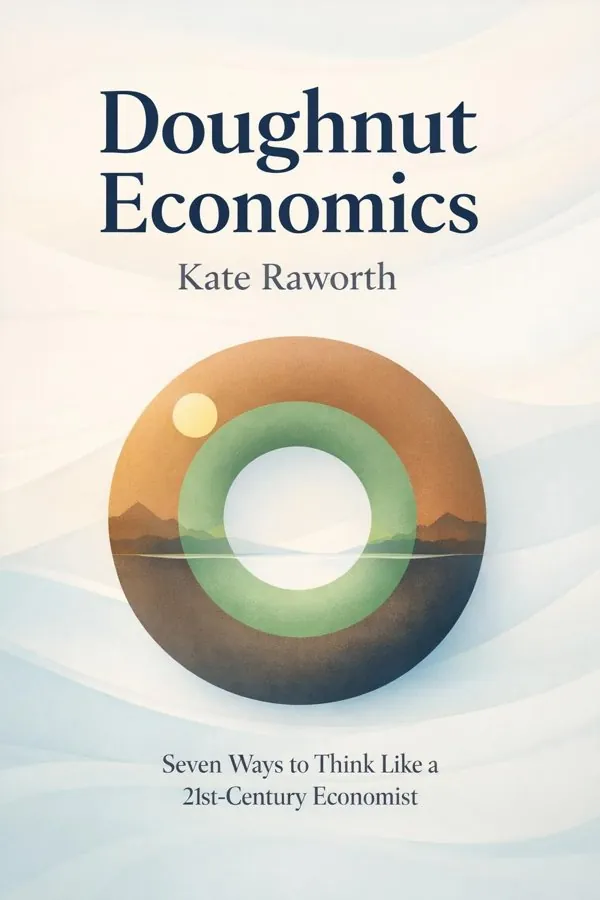
Doughnut Economics: Seven Ways to Think Like a 21st-Century Economist: Summary & Key Insights
by Kate Raworth
 10 min8 chaptersAudio available
Key Takeaways from Doughnut Economics: Seven Ways to Think Like a 21st-Century Economist
The most powerful thing an economic model can do is tell us what success looks like.
Economics becomes dangerous when it forgets everything it leaves out.
If you assume people are selfish, isolated, and endlessly calculating, you will build institutions that reward selfishness.
Many economic failures happen because leaders treat the economy like a machine when it behaves more like a living system.
An economy that grows first and distributes later often never truly distributes at all.
What Is Doughnut Economics: Seven Ways to Think Like a 21st-Century Economist About?
Doughnut Economics: Seven Ways to Think Like a 21st-Century Economist by Kate Raworth is a economics book. What if the central goal of economics were not endless growth, but helping humanity thrive within the limits of the living planet? In Doughnut Economics, Kate Raworth argues that the old economic story no longer fits the world we live in. Traditional models were built for a different era, yet they still shape policy, business, and education today. Raworth offers a new visual framework: a doughnut-shaped space where the inner ring represents the social foundation every person needs, such as food, health, housing, education, and political voice, while the outer ring marks the ecological ceiling we must not overshoot. Between these two boundaries lies the safe and just space for humanity. Drawing on her experience at Oxford, Oxfam, and the UN, Raworth combines economic insight with systems thinking, ecology, and social justice. The result is a bold and practical reimagining of economics for the 21st century. This book matters because it shifts the question from “How fast is the economy growing?” to “Is the economy helping people and planet flourish together?”
This FizzRead summary covers all 8 key chapters of Doughnut Economics: Seven Ways to Think Like a 21st-Century Economist in approximately 10 minutes, distilling the most important ideas, arguments, and takeaways from Kate Raworth's work. Also available as an audio summary and Key Quotes Podcast.
Doughnut Economics: Seven Ways to Think Like a 21st-Century Economist
What if the central goal of economics were not endless growth, but helping humanity thrive within the limits of the living planet? In Doughnut Economics, Kate Raworth argues that the old economic story no longer fits the world we live in. Traditional models were built for a different era, yet they still shape policy, business, and education today. Raworth offers a new visual framework: a doughnut-shaped space where the inner ring represents the social foundation every person needs, such as food, health, housing, education, and political voice, while the outer ring marks the ecological ceiling we must not overshoot. Between these two boundaries lies the safe and just space for humanity. Drawing on her experience at Oxford, Oxfam, and the UN, Raworth combines economic insight with systems thinking, ecology, and social justice. The result is a bold and practical reimagining of economics for the 21st century. This book matters because it shifts the question from “How fast is the economy growing?” to “Is the economy helping people and planet flourish together?”
Who Should Read Doughnut Economics: Seven Ways to Think Like a 21st-Century Economist?
This book is perfect for anyone interested in economics and looking to gain actionable insights in a short read. Whether you're a student, professional, or lifelong learner, the key ideas from Doughnut Economics: Seven Ways to Think Like a 21st-Century Economist by Kate Raworth will help you think differently.
- ✓Readers who enjoy economics and want practical takeaways
- ✓Professionals looking to apply new ideas to their work and life
- ✓Anyone who wants the core insights of Doughnut Economics: Seven Ways to Think Like a 21st-Century Economist in just 10 minutes
Want the full summary?
Get instant access to this book summary and 100K+ more with Fizz Moment.
Get Free SummaryAvailable on App Store • Free to download
Key Chapters
The most powerful thing an economic model can do is tell us what success looks like. For decades, modern economies have treated GDP growth as the defining measure of progress, as if rising output automatically meant rising well-being. Raworth challenges that assumption at its root. She argues that growth is not a goal in itself; it is at best a means, and often a misleading one. An economy can grow while inequality widens, mental health worsens, communities fracture, and ecosystems collapse. If the goal is wrong, even efficient policies can move society in the wrong direction.
Raworth replaces the goal of endless growth with the image of the doughnut. Its inner ring is the social foundation: the minimum standards of human dignity, including food, water, energy, health care, education, income, gender equality, housing, and political voice. Its outer ring is the ecological ceiling, defined by planetary boundaries such as climate stability, biodiversity, freshwater use, land conversion, and chemical pollution. The aim is to bring everyone into the space between those rings, where human needs are met without breaching Earth’s life-support systems.
This shift changes how we judge success. A city is not successful simply because property values rise; it is successful if people can afford housing, breathe clean air, access transport, and live in resilient neighborhoods. A nation is not thriving merely because exports increase; it is thriving if prosperity is broadly shared and environmental damage is declining.
In practice, governments, businesses, and communities can adopt dashboards that track social and ecological indicators together instead of fixating on one growth number. The actionable takeaway: redefine success in your own work by asking two questions before any decision: does this improve human well-being, and does it respect ecological limits?
Economics becomes dangerous when it forgets everything it leaves out. Traditional textbook diagrams often place the market at the center and treat households, society, and nature as background conditions. Raworth argues that this framing is deeply distorted. Markets are only one part of economic life. Around them sit households, the commons, the state, and the natural world, all constantly shaping what gets produced, shared, valued, and sustained.
By broadening the picture, Raworth exposes how unpaid care work, public services, social norms, and ecological systems make formal markets possible. A business can sell products only because families raise workers, roads and courts exist, ecosystems provide materials, and communities maintain trust. Yet standard economics often counts paid transactions while ignoring caregiving, volunteer work, and environmental depletion. What is measured appears valuable; what is ignored becomes invisible.
Seeing the whole system leads to better decisions. Consider childcare. If policymakers focus only on market prices, they may treat it as a private consumer issue. If they see the wider economy, they recognize childcare as social infrastructure that supports families, labor participation, child development, and long-term social health. Or consider a forest. Market logic may value timber sales, while a broader view includes carbon storage, water regulation, biodiversity, recreation, and cultural meaning.
This idea also reshapes personal thinking. Not all value comes through wages or profits. Housework, caregiving, mentoring, and community organizing are economically real even when unpaid. The actionable takeaway: whenever you analyze a policy, business, or personal decision, map the full system around it by asking what roles are being played by households, government, commons, and nature, not just markets.
Many economic failures happen because leaders treat the economy like a machine when it behaves more like a living system. Raworth urges readers to move beyond linear cause-and-effect thinking and embrace systems thinking. Economies are made of interconnected networks, feedback loops, delays, tipping points, and emergent behavior. That means interventions often produce side effects, and small changes in one area can trigger major consequences elsewhere.
Traditional equilibrium models suggest that markets tend naturally toward balance if left alone. Raworth argues that real economies are dynamic and often unstable. Financial bubbles, climate risks, housing crises, and supply chain shocks do not look like smooth adjustments around equilibrium. They look like system failures amplified by reinforcing loops. For example, rising house prices encourage speculative buying, which pushes prices even higher, locking out residents and increasing debt. In environmental systems, emissions accumulate over time, and delayed policy responses can make future correction far more difficult.
Systems thinking helps decision-makers focus on structure rather than symptoms. If traffic congestion worsens, simply widening roads may invite more cars and deepen the problem. If obesity rises, blaming individuals misses the food systems, urban design, advertising, and income pressures that shape behavior. If poverty persists, it may reflect debt traps, weak public services, poor housing, and exclusionary institutions, not lack of effort.
Useful tools include feedback-loop diagrams, resilience analysis, and scenario planning. Businesses can test supply networks for fragility. Cities can design neighborhoods around mixed transport, green space, and local services. Governments can watch for indicators of systemic risk instead of waiting for crises.
The actionable takeaway: when facing a recurring problem, stop asking only “What event caused this?” and start asking “What system keeps producing this outcome?”
An economy that grows first and distributes later often never truly distributes at all. Raworth challenges the familiar promise that inequality can be tolerated in the short term because wealth will eventually trickle down. Instead of relying on redistribution after the fact, she advocates designing economies to be distributive by intention. That means shaping how wealth, power, opportunity, and assets are created and shared from the start.
This idea goes beyond taxes and welfare, though those remain important. It includes ownership structures, labor rights, access to land, public services, education, digital infrastructure, and financial systems. Who owns productive assets? Who captures the gains from technology? Who gets a voice in decisions? If wealth is concentrated in a few hands, political influence often follows, reinforcing the rules that preserve that concentration.
Distributive design can take many forms. Employee ownership gives workers a share in profits and governance. Community land trusts can keep housing affordable across generations. Open-source technologies spread innovation more widely. Public banking can channel finance toward long-term local needs rather than speculative returns. Strong public health and education systems expand real opportunity far more effectively than growth statistics alone.
Raworth’s point is not that every outcome must be equal, but that economic architecture matters. If value is extracted upward while risks are pushed downward, social cohesion erodes. More broadly shared prosperity creates resilience, trust, and political stability.
For organizations, this principle suggests examining pay ratios, supplier relationships, governance rights, and access barriers. For policymakers, it means asking whether institutions widen participation or lock people out.
The actionable takeaway: look upstream. Instead of asking only how to compensate the losers after economic change, ask how to redesign ownership, rules, and opportunity so that value is shared more fairly from the beginning.
Waste is not just an environmental issue; it is evidence of bad economic design. Raworth argues that 20th-century industry largely operated on a degenerative model: take resources, make products, use them briefly, and throw them away, while assuming nature can absorb the damage. A 21st-century economy must be regenerative instead. That means working with cycles, restoring living systems, and designing production so that materials, energy, and nutrients flow in ways that rebuild rather than deplete.
In nature, there is no landfill. One process feeds another. Regenerative economics draws inspiration from this logic. Renewable energy replaces fossil dependence. Circular manufacturing reduces extraction by designing products for reuse, repair, remanufacture, and recycling. Regenerative agriculture rebuilds soil health, water retention, and biodiversity instead of treating land as a short-term yield machine. Urban planning can incorporate green roofs, public transit, wetlands restoration, and energy-efficient buildings to lower ecological pressure while improving quality of life.
This approach changes business incentives. A company that sells durable, repairable goods may earn less from rapid replacement but more from long-term trust and service relationships. Farmers using regenerative practices may improve resilience to drought and reduce fertilizer dependence over time. Cities investing in tree cover and floodplains may avoid costly damage later.
Regeneration also means recognizing that ecosystems are foundational assets, not externalities. Polluted air, eroded soil, and depleted fisheries are not side effects outside the economy; they are signs that the economy is undermining its own base.
The actionable takeaway: in any project or purchase, ask where resources come from, how long products last, what happens after use, and whether the system restores or degrades the natural systems it depends on.
The question is not whether growth is always bad, but why modern economies are so dependent on it. Raworth does not simply call for “degrowth” in every context; instead, she urges societies to become agnostic about growth. In other words, economies should be able to thrive whether GDP rises, stabilizes, or falls, as long as people’s needs are met within ecological boundaries. The real problem is growth dependence: jobs, public revenue, financial stability, and political legitimacy often become tied to continual expansion.
This dependence creates a trap. Governments pursue growth to avoid unemployment and debt crises, even when additional growth brings diminishing social benefits and worsening environmental costs. Businesses seek shareholder returns that require constant expansion. Consumers are pushed toward ever more spending to keep the system moving. Raworth asks us to imagine economies built for stability, sufficiency, and resilience rather than addiction to throughput.
To get there, institutions must change. Financial systems may need to favor patient, long-term investment over speculative extraction. Tax structures may need to shift away from over-reliance on labor income and toward pollution, land value, or wealth. Working hours can become more flexible so productivity gains translate into time, not only output. Public services can reduce pressure for household income to keep rising just to secure basic needs.
This idea is especially relevant in wealthy countries where further consumption often adds little to life satisfaction but significantly increases ecological damage. In poorer regions, material growth may still be necessary to meet basic needs. Raworth’s framework allows for this difference while rejecting one-size-fits-all growth worship.
The actionable takeaway: stop treating growth as the unquestioned answer. In decisions large and small, ask what kind of prosperity you actually want, and whether more output is the best path to it.
Every era inherits economic ideas, but not every era should keep them. Raworth’s seven ways of thinking form a broader invitation: economists, policymakers, business leaders, and citizens must update their mental models for a century defined by inequality, ecological overshoot, technological disruption, and global interdependence. The old diagrams still dominate classrooms and institutions, yet they were built in a world that knew less about climate change, systems dynamics, unpaid care, and planetary boundaries.
Thinking like a 21st-century economist means replacing simplistic stories with richer ones. It means using visual frameworks that ordinary people can understand, not equations that hide ethical choices behind technical language. It means integrating economics with ecology, politics, sociology, and design. It means recognizing that the economy is embedded in society, and society is embedded in the living world.
This mindset is already influencing real places. Cities such as Amsterdam have explored doughnut-based planning to balance residents’ needs with environmental impact. Businesses are experimenting with circular supply chains, benefit governance, and stakeholder models. Educators are redesigning economics courses to include feminist economics, ecological economics, and systems thinking. Communities use the doughnut as a conversation tool because it is accessible, visual, and action-oriented.
Raworth’s contribution is not merely a critique of orthodox economics. It is a practical reframing that gives people a new compass. Once the goal changes and the system becomes visible, different questions become possible: What should be enough? What should be shared? What should be restored? What should be measured?
The actionable takeaway: adopt the doughnut as a decision tool. Whether you lead a team, teach students, build a business, or vote in elections, use it to evaluate whether choices move people into a safe and just space for humanity.
All Chapters in Doughnut Economics: Seven Ways to Think Like a 21st-Century Economist
About the Author
Kate Raworth is a British economist, author, and public thinker best known for creating the Doughnut Economics framework. She studied economics at Oxford and later built a career that bridged academia, international development, and public policy. Raworth has worked with the United Nations and Oxfam, where she focused on global poverty, inequality, and environmental sustainability. She has also served as a senior associate at Oxford University’s Environmental Change Institute and has taught on innovative economics programs. Her work is widely recognized for making complex economic ideas visual, practical, and accessible to non-specialists. Through writing, speaking, and collaboration with cities and organizations, Raworth has become a leading voice in the movement to redesign economies so they meet human needs while respecting planetary boundaries.
Get This Summary in Your Preferred Format
Read or listen to the Doughnut Economics: Seven Ways to Think Like a 21st-Century Economist summary by Kate Raworth anytime, anywhere. FizzRead offers multiple formats so you can learn on your terms — all free.
Available formats: App · Audio · PDF · EPUB — All included free with FizzRead
Download Doughnut Economics: Seven Ways to Think Like a 21st-Century Economist PDF and EPUB Summary
Key Quotes from Doughnut Economics: Seven Ways to Think Like a 21st-Century Economist
“The most powerful thing an economic model can do is tell us what success looks like.”
“Economics becomes dangerous when it forgets everything it leaves out.”
“If you assume people are selfish, isolated, and endlessly calculating, you will build institutions that reward selfishness.”
“Many economic failures happen because leaders treat the economy like a machine when it behaves more like a living system.”
“An economy that grows first and distributes later often never truly distributes at all.”
Frequently Asked Questions about Doughnut Economics: Seven Ways to Think Like a 21st-Century Economist
Doughnut Economics: Seven Ways to Think Like a 21st-Century Economist by Kate Raworth is a economics book that explores key ideas across 8 chapters. What if the central goal of economics were not endless growth, but helping humanity thrive within the limits of the living planet? In Doughnut Economics, Kate Raworth argues that the old economic story no longer fits the world we live in. Traditional models were built for a different era, yet they still shape policy, business, and education today. Raworth offers a new visual framework: a doughnut-shaped space where the inner ring represents the social foundation every person needs, such as food, health, housing, education, and political voice, while the outer ring marks the ecological ceiling we must not overshoot. Between these two boundaries lies the safe and just space for humanity. Drawing on her experience at Oxford, Oxfam, and the UN, Raworth combines economic insight with systems thinking, ecology, and social justice. The result is a bold and practical reimagining of economics for the 21st century. This book matters because it shifts the question from “How fast is the economy growing?” to “Is the economy helping people and planet flourish together?”
You Might Also Like
Business Adventures
John Brooks
10 min
Nudge
Richard H. Thaler, Cass R. Sunstein
10 min
The Hitchhiker"s Guide to the Galaxy
Douglas Adams
10 minThe Muqaddimah
Ibn Khaldun
10 minThe Outsiders
William N. Thorndike
10 min
A Little History of Economics
Niall Kishtainy
10 minBrowse by Category
Ready to read Doughnut Economics: Seven Ways to Think Like a 21st-Century Economist?
Get the full summary and 100K+ more books with Fizz Moment.