
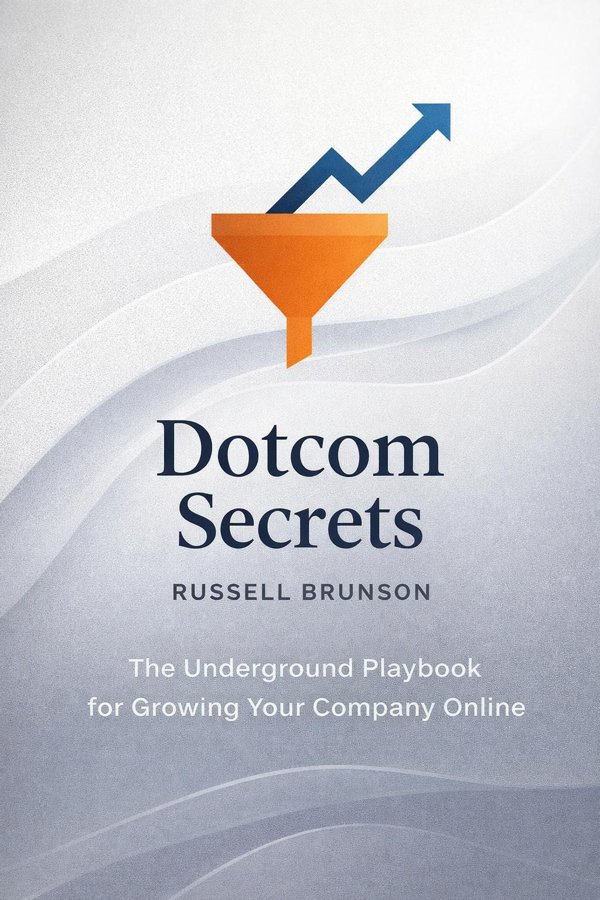
Dotcom Secrets: The Underground Playbook for Growing Your Company Online: Summary & Key Insights
 10 min8 chaptersAudio available
Key Takeaways from Dotcom Secrets: The Underground Playbook for Growing Your Company Online
Most businesses do not have a traffic problem first; they have a journey problem.
The fastest way to stall growth is to ask strangers for a big commitment too soon.
People do not buy from the most technically correct brand; they buy from the one they remember, trust, and relate to.
Traffic is often treated like the goal, but Brunson reminds readers that traffic is only valuable when it is matched with the right message and funnel.
Not all offers should be sold the same way.
What Is Dotcom Secrets: The Underground Playbook for Growing Your Company Online About?
Dotcom Secrets: The Underground Playbook for Growing Your Company Online by Russell Brunson is a marketing book spanning 11 pages. What if online growth were less about luck, virality, or expensive advertising and more about guiding people through a deliberate sequence of decisions? That is the central promise of Dotcom Secrets. In this influential marketing playbook, Russell Brunson argues that successful online businesses do not simply sell products; they build systems that attract attention, create trust, present the right offer at the right moment, and increase customer value over time. The book focuses on sales funnels, messaging, offer design, email follow-up, and scaling strategies that can turn casual visitors into loyal buyers. Why does this matter? Because many businesses fail not from lack of effort, but from confusing traffic with revenue and tactics with strategy. Brunson offers a more structured approach: understand your audience deeply, map their journey, and design each step intentionally. His credibility comes from years of building high-performing funnels and co-founding ClickFunnels, one of the most widely used funnel-building platforms in digital marketing. Whether you run an e-commerce brand, coaching business, software company, or personal brand, Dotcom Secrets offers a practical framework for growing online with clarity and consistency.
This FizzRead summary covers all 8 key chapters of Dotcom Secrets: The Underground Playbook for Growing Your Company Online in approximately 10 minutes, distilling the most important ideas, arguments, and takeaways from Russell Brunson's work. Also available as an audio summary and Key Quotes Podcast.
Dotcom Secrets: The Underground Playbook for Growing Your Company Online
What if online growth were less about luck, virality, or expensive advertising and more about guiding people through a deliberate sequence of decisions? That is the central promise of Dotcom Secrets. In this influential marketing playbook, Russell Brunson argues that successful online businesses do not simply sell products; they build systems that attract attention, create trust, present the right offer at the right moment, and increase customer value over time. The book focuses on sales funnels, messaging, offer design, email follow-up, and scaling strategies that can turn casual visitors into loyal buyers.
Why does this matter? Because many businesses fail not from lack of effort, but from confusing traffic with revenue and tactics with strategy. Brunson offers a more structured approach: understand your audience deeply, map their journey, and design each step intentionally. His credibility comes from years of building high-performing funnels and co-founding ClickFunnels, one of the most widely used funnel-building platforms in digital marketing. Whether you run an e-commerce brand, coaching business, software company, or personal brand, Dotcom Secrets offers a practical framework for growing online with clarity and consistency.
Who Should Read Dotcom Secrets: The Underground Playbook for Growing Your Company Online?
This book is perfect for anyone interested in marketing and looking to gain actionable insights in a short read. Whether you're a student, professional, or lifelong learner, the key ideas from Dotcom Secrets: The Underground Playbook for Growing Your Company Online by Russell Brunson will help you think differently.
- ✓Readers who enjoy marketing and want practical takeaways
- ✓Professionals looking to apply new ideas to their work and life
- ✓Anyone who wants the core insights of Dotcom Secrets: The Underground Playbook for Growing Your Company Online in just 10 minutes
Want the full summary?
Get instant access to this book summary and 100K+ more with Fizz Moment.
Get Free SummaryAvailable on App Store • Free to download
Key Chapters
Most businesses do not have a traffic problem first; they have a journey problem. Russell Brunson’s core argument is that customers rarely buy because they landed on a beautiful homepage. They buy because they were guided through a sequence that matched their level of awareness, trust, and desire. That sequence is the sales funnel.
A funnel is not just a technical setup. It is a psychological path. At the top, people may only be curious. In the middle, they compare options and begin forming trust. At the bottom, they are ready to act if the offer feels relevant and low-risk. Brunson urges readers to stop thinking in terms of generic websites and start thinking in terms of specific pages with specific jobs: a landing page to capture attention, an opt-in page to collect leads, a sales page to persuade, an order form to convert, and follow-up sequences to deepen the relationship.
For example, a fitness coach should not send cold traffic to a broad homepage. A more effective funnel might offer a free meal plan, then present a low-cost challenge, then invite buyers into a monthly coaching membership. Each step moves the prospect forward naturally.
This shift matters because funnels make marketing measurable. Instead of guessing why sales are low, you can inspect each stage and identify where people drop off. Actionable takeaway: map your customer journey from first click to repeat purchase, and define one clear purpose for every page or touchpoint in that sequence.
The fastest way to stall growth is to ask strangers for a big commitment too soon. Brunson’s Value Ladder framework solves this by organizing your offers into ascending steps of price, depth, and transformation. Customers begin with something easy to say yes to, and over time move toward higher-value products or services as trust increases.
At the bottom of the ladder might be free content, a lead magnet, or a trial offer. Above that could sit an inexpensive workshop, book, or starter product. Higher rungs may include a core course, consulting package, software subscription, mastermind, or premium done-for-you service. The logic is simple: each step should prepare the buyer emotionally and practically for the next one.
Consider a business consultant. Instead of leading with a $10,000 engagement, they might offer a free diagnostic checklist, then a $27 mini-training, then a $297 strategy workshop, followed by a $2,000 coaching program and finally a premium implementation package. This creates a natural progression rather than a jarring leap.
The Value Ladder also changes how you think about profitability. Not every front-end offer needs to maximize margin. Some offers exist to acquire customers and qualify serious buyers. The real growth comes from increasing lifetime value, not just winning a single sale.
Actionable takeaway: list all your current and potential offers, place them into a ladder from lowest commitment to highest transformation, and make sure each rung logically leads to the next.
People do not buy from the most technically correct brand; they buy from the one they remember, trust, and relate to. Brunson combines audience clarity with the idea of the Attractive Character, a public persona that gives your business a voice people can follow. This does not mean inventing a fake identity. It means expressing your values, story, and perspective in a way that creates connection.
The first part is understanding your target audience deeply. What do they fear, desire, struggle with, and believe already? What language do they use to describe their problem? If you sell productivity software to freelancers, your audience may not be looking for "workflow optimization." They may want to "stop drowning in client deadlines." Strong marketing starts by entering the conversation already happening in the customer’s mind.
The Attractive Character gives those insights emotional force. Brunson suggests that people often follow leaders who fit familiar roles: the adventurer, the expert, the reluctant hero, or the reporter. A personal trainer, for instance, could position themselves as the former overworked parent who discovered a realistic health system. That story makes the message more human and persuasive.
When your market definition and character align, your content, emails, and offers become more magnetic. You stop sounding generic and start sounding specific.
Actionable takeaway: write a one-page audience profile describing your ideal customer’s pains, desires, and objections, then define the voice and backstory your brand will use consistently across content and campaigns.
Traffic is often treated like the goal, but Brunson reminds readers that traffic is only valuable when it is matched with the right message and funnel. He categorizes traffic into three broad types: owned, earned, and paid. Each plays a different role in growth.
Owned traffic includes your email list, followers, customers, and communities you can reach directly. This is your most stable asset because you are not dependent on an algorithm. Earned traffic comes from referrals, podcasts, guest appearances, press, SEO, affiliates, and social sharing. It carries credibility because someone else helped create the attention. Paid traffic includes ads on search engines, social platforms, newsletters, or other placements that let you scale quickly.
The mistake many businesses make is trying to buy traffic before their funnel is proven. If your landing page converts poorly or your offer is unclear, more traffic only amplifies waste. On the other hand, if you have a compelling lead magnet and a solid follow-up sequence, paid traffic can accelerate results dramatically.
A practical example: a software founder might use LinkedIn content to generate earned attention, a newsletter to build owned traffic, and retargeting ads to bring back warm visitors who did not convert initially. The power comes from combining channels, not relying on one.
Actionable takeaway: audit your current traffic sources, classify them as owned, earned, or paid, and choose one channel to strengthen only after confirming that your funnel converts at each major step.
Not all offers should be sold the same way. One of Brunson’s most useful contributions is showing that different business goals require different funnel structures. A webinar funnel, product launch funnel, application funnel, tripwire funnel, and membership funnel each serve a distinct purpose because they match different buyer behaviors.
A tripwire funnel is useful when you want to turn leads into first-time buyers with a low-cost offer. A webinar funnel works well for more complex products that require teaching before selling, such as software, coaching, or financial education. An application funnel is better for high-ticket services where you want to qualify prospects before speaking with them. A membership funnel is ideal when recurring revenue and community are central to the business model.
For instance, a designer selling templates may do well with a low-cost front-end offer followed by upsells. But a leadership coach charging premium rates would likely need a content-driven funnel ending in an application call. The product is not the only variable; the required level of trust and explanation matters just as much.
This idea saves businesses from forcing every offer into the same template. Instead of asking, "What page should I build?" Brunson asks, "What behavior am I trying to create?" Once that is clear, the funnel structure becomes more obvious.
Actionable takeaway: identify your main offer and desired customer action, then choose a funnel model that fits its complexity, price point, and trust requirements rather than copying a format that works for someone else.
People resist being sold to, but they lean in when they feel understood. Brunson emphasizes that the most effective funnels are not collections of random headlines and bullet points. They are structured conversations built around story, belief shifts, and persuasive sequencing. His funnel scripting approach helps marketers explain why the offer matters, why now is the right time, and why this solution is different.
A strong script usually begins by naming the problem in a vivid way. It then introduces a backstory, epiphany, or discovery that reframes the issue. Next, it breaks false beliefs: maybe the customer thinks they need more discipline, when they actually need a simpler system; maybe they think the market is saturated, when the real issue is unclear positioning. Only after those mental barriers are addressed does the offer become compelling.
This is why stories outperform feature lists. A founder saying, "Our platform has automation and analytics" is less persuasive than explaining how missing follow-up once cost them thousands until they built a simple system that recovered abandoned leads automatically. The story gives emotional context to the features.
Brunson does not advocate manipulation; he advocates clarity through narrative. Stories organize information in a form the brain remembers and trusts.
Actionable takeaway: rewrite your main sales message as a journey: the problem, the failed old way, the discovery, the new opportunity, and the next step your prospect should take today.
Many sales are lost not because prospects are uninterested, but because they are not ready yet. Brunson treats email as one of the most valuable tools in online business because it extends the conversation beyond the first visit. He highlights two especially useful sequence styles: Soap Opera and Seinfeld emails.
Soap Opera emails are high-drama, story-driven messages designed to build anticipation and emotional investment over several days. They often follow a sequence such as setting the stage, introducing conflict, revealing an epiphany, and making an offer. This style is especially effective after someone joins your list or enters a launch campaign because it creates momentum.
Seinfeld emails are lighter, more frequent, and built around everyday observations that connect back to your product or philosophy. Their purpose is not just immediate selling, but staying memorable and relevant. A business owner might tell a simple story about a missed flight, a customer conversation, or a lesson from parenting, then tie it to a broader business insight and soft call to action.
The real lesson is that follow-up should not be an afterthought. It should nurture, educate, entertain, and convert. Businesses that email only when they have something to promote often struggle, while those that build a consistent relationship stay top of mind.
Actionable takeaway: create a short onboarding sequence for new subscribers and a regular ongoing email cadence that blends useful stories, insights, and offers instead of relying on occasional promotional blasts.
Innovation is overrated when you do not yet understand what already works. Brunson encourages readers to practice funnel hacking, which means studying successful competitors ethically to identify patterns in their offers, messaging, page flow, pricing, and follow-up systems. The goal is not copying blindly. It is reverse-engineering effective principles and applying them to your own market.
If several top brands in your niche lead with a quiz before making an offer, that may signal that segmentation improves conversion. If they all use strong guarantees, customer stories, and urgency near checkout, those elements are worth testing. Funnel hacking is about pattern recognition. It gives you a faster path to competence because the market has already revealed what resonates.
But observation alone is not enough. Brunson stresses optimization through numbers. You need to track opt-in rates, sales conversion, average order value, cart abandonment, email open rates, and customer lifetime value. A funnel can be profitable with mediocre front-end conversions if follow-up is strong. Likewise, a funnel with lots of leads can still fail if the offer does not monetize.
Once the economics work, scale and automation become meaningful. Use tools for lead capture, segmentation, onboarding, upsells, and follow-up so growth does not create chaos. Yet automation should support authenticity, not replace it. Customers still need relevant messaging and genuine value.
Actionable takeaway: choose one successful competitor to study, document their funnel structure, then identify one metric in your own funnel to improve through testing before increasing spend or expanding channels.
All Chapters in Dotcom Secrets: The Underground Playbook for Growing Your Company Online
About the Author
Russell Brunson is an American entrepreneur, author, speaker, and digital marketing strategist best known as the co-founder of ClickFunnels, a widely used platform for building online sales funnels. Over the years, he has become one of the most recognizable voices in direct response and online business education, helping entrepreneurs package their expertise, create offers, and improve conversions. Brunson built his reputation through hands-on experimentation in traffic generation, funnel design, and customer acquisition, then translated those lessons into books, events, and training programs. His writing is especially known for making complex marketing systems feel actionable for small business owners, creators, and startups. Through Dotcom Secrets and his other books, he has played a major role in popularizing funnel-based thinking in modern digital marketing.
Get This Summary in Your Preferred Format
Read or listen to the Dotcom Secrets: The Underground Playbook for Growing Your Company Online summary by Russell Brunson anytime, anywhere. FizzRead offers multiple formats so you can learn on your terms — all free.
Available formats: App · Audio · PDF · EPUB — All included free with FizzRead
Download Dotcom Secrets: The Underground Playbook for Growing Your Company Online PDF and EPUB Summary
Key Quotes from Dotcom Secrets: The Underground Playbook for Growing Your Company Online
“Most businesses do not have a traffic problem first; they have a journey problem.”
“The fastest way to stall growth is to ask strangers for a big commitment too soon.”
“People do not buy from the most technically correct brand; they buy from the one they remember, trust, and relate to.”
“Traffic is often treated like the goal, but Brunson reminds readers that traffic is only valuable when it is matched with the right message and funnel.”
“Not all offers should be sold the same way.”
Frequently Asked Questions about Dotcom Secrets: The Underground Playbook for Growing Your Company Online
Dotcom Secrets: The Underground Playbook for Growing Your Company Online by Russell Brunson is a marketing book that explores key ideas across 8 chapters. What if online growth were less about luck, virality, or expensive advertising and more about guiding people through a deliberate sequence of decisions? That is the central promise of Dotcom Secrets. In this influential marketing playbook, Russell Brunson argues that successful online businesses do not simply sell products; they build systems that attract attention, create trust, present the right offer at the right moment, and increase customer value over time. The book focuses on sales funnels, messaging, offer design, email follow-up, and scaling strategies that can turn casual visitors into loyal buyers. Why does this matter? Because many businesses fail not from lack of effort, but from confusing traffic with revenue and tactics with strategy. Brunson offers a more structured approach: understand your audience deeply, map their journey, and design each step intentionally. His credibility comes from years of building high-performing funnels and co-founding ClickFunnels, one of the most widely used funnel-building platforms in digital marketing. Whether you run an e-commerce brand, coaching business, software company, or personal brand, Dotcom Secrets offers a practical framework for growing online with clarity and consistency.
More by Russell Brunson

You Might Also Like
Captivology: The Science of Capturing People's Attention
Ben Parr
10 min
Marketing 5.0: Technology for Humanity
Philip Kotler, Hermawan Kartajaya, Iwan Setiawan
10 min
Marketing Strategy
Paul Fifield
10 min
UnMarketing: Stop Marketing. Start Engaging.
Scott Stratten
10 min
$100M Leads: How to Get Strangers to Want to Buy Your Stuff
Alex Hormozi
10 min
80/20 Sales and Marketing: The Definitive Guide to Working Less and Making More
Perry Marshall
10 minBrowse by Category
Ready to read Dotcom Secrets: The Underground Playbook for Growing Your Company Online?
Get the full summary and 100K+ more books with Fizz Moment.