
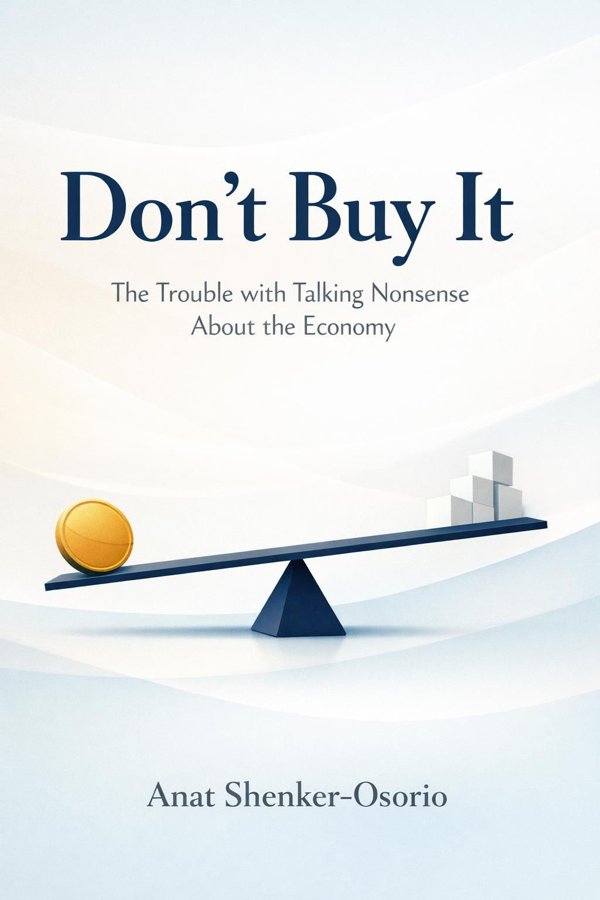
Don't Buy It: The Trouble with Talking Nonsense About the Economy: Summary & Key Insights
 10 min8 chaptersAudio available
What Is Don't Buy It: The Trouble with Talking Nonsense About the Economy About?
Don't Buy It: The Trouble with Talking Nonsense About the Economy by Anat Shenker-Osorio is a economics book spanning 8 pages. In this book, communications strategist Anat Shenker-Osorio examines how the language used to discuss the economy shapes public perception and policy. She argues that common economic metaphors and narratives often mislead people into accepting inequality and austerity as natural or inevitable. Through research and analysis, she proposes alternative ways to frame economic issues that emphasize fairness, shared prosperity, and collective responsibility.
This FizzRead summary covers all 8 key chapters of Don't Buy It: The Trouble with Talking Nonsense About the Economy in approximately 10 minutes, distilling the most important ideas, arguments, and takeaways from Anat Shenker-Osorio's work. Also available as an audio summary and Key Quotes Podcast.
Don't Buy It: The Trouble with Talking Nonsense About the Economy
In this book, communications strategist Anat Shenker-Osorio examines how the language used to discuss the economy shapes public perception and policy. She argues that common economic metaphors and narratives often mislead people into accepting inequality and austerity as natural or inevitable. Through research and analysis, she proposes alternative ways to frame economic issues that emphasize fairness, shared prosperity, and collective responsibility.
Who Should Read Don't Buy It: The Trouble with Talking Nonsense About the Economy?
This book is perfect for anyone interested in economics and looking to gain actionable insights in a short read. Whether you're a student, professional, or lifelong learner, the key ideas from Don't Buy It: The Trouble with Talking Nonsense About the Economy by Anat Shenker-Osorio will help you think differently.
- ✓Readers who enjoy economics and want practical takeaways
- ✓Professionals looking to apply new ideas to their work and life
- ✓Anyone who wants the core insights of Don't Buy It: The Trouble with Talking Nonsense About the Economy in just 10 minutes
Want the full summary?
Get instant access to this book summary and 100K+ more with Fizz Moment.
Get Free SummaryAvailable on App Store • Free to download
Key Chapters
One of the most pervasive metaphors in economic discourse is the economy as a machine—something to be fixed, fueled, or fine-tuned. We often hear phrases like ‘jumpstarting the economy,’ ‘keeping the engine running,’ or ‘oil in the system.’ This framing makes economic life sound mechanical, governed by cold laws rather than human choices. It implies that if we just tweak a knob or replace a part, prosperity will smoothly return.
But machines have no moral dimension. When we say the economy is a machine, we strip away responsibility and empathy. Machines can break, they can overheat, but they cannot exploit. Under this metaphor, inequality ceases to be a matter of ethics—it becomes a technical glitch. As I show in the book, this managerial language distances people from seeing themselves as participants. Citizens become passive spectators waiting for experts to repair the engine.
The consequences of this metaphor are political. Policies that cause suffering—like austerity—are justified as mechanical necessities. Politicians argue that cutting social spending ‘rebalances’ the system, as if justice were an algorithm. Yet economies are the outcomes of deliberate choices, not neutral circuits. Framing the economy as alive, as a network of relationships, opens space for moral accountability. When we shift the metaphor to something organic, something relational, we remind ourselves that the economy serves people—not the other way around.
Few political soundbites are as seductive as ‘the government must tighten its belt like a family does.’ This analogy invokes comforting images of responsibility and prudence. Yet it is profoundly misleading. Families cannot issue currency or influence employment levels; governments can. The analogy collapses macroeconomics into kitchen-table concerns, converting complex fiscal policy into moral theater.
When leaders say we must ‘live within our means,’ they evoke personal virtue—hard work, restraint, sacrifice. But what begins as a moral story about the household transforms into a harmful myth about public life. It equates deficits with moral failure and spending with indulgence. This rhetoric has justified waves of austerity that hurt the poorest most, all under the banner of common sense.
In my research, people exposed to this frame tended to accept cuts to social programs—even those they depended on—as signs of discipline. The family frame disarms empathy because it equates government aid with irresponsibility. To counter this, we need new language that connects public spending to shared investment. Government budgets are not household checkbooks; they are statements of collective priorities. When we speak of spending as care—investing in the infrastructure that lets all families thrive—we shift the conversation from self-sacrifice to solidarity. That reframing is not linguistic ornament; it changes what voters believe government should do.
+ 6 more chapters — available in the FizzRead app
All Chapters in Don't Buy It: The Trouble with Talking Nonsense About the Economy
About the Author
Anat Shenker-Osorio is an American communications consultant and researcher known for her work on political messaging and framing. She has advised progressive organizations and campaigns around the world on how to use language effectively to promote social and economic justice.
Get This Summary in Your Preferred Format
Read or listen to the Don't Buy It: The Trouble with Talking Nonsense About the Economy summary by Anat Shenker-Osorio anytime, anywhere. FizzRead offers multiple formats so you can learn on your terms — all free.
Available formats: App · Audio · PDF · EPUB — All included free with FizzRead
Download Don't Buy It: The Trouble with Talking Nonsense About the Economy PDF and EPUB Summary
Key Quotes from Don't Buy It: The Trouble with Talking Nonsense About the Economy
“One of the most pervasive metaphors in economic discourse is the economy as a machine—something to be fixed, fueled, or fine-tuned.”
“Few political soundbites are as seductive as ‘the government must tighten its belt like a family does.”
Frequently Asked Questions about Don't Buy It: The Trouble with Talking Nonsense About the Economy
Don't Buy It: The Trouble with Talking Nonsense About the Economy by Anat Shenker-Osorio is a economics book that explores key ideas across 8 chapters. In this book, communications strategist Anat Shenker-Osorio examines how the language used to discuss the economy shapes public perception and policy. She argues that common economic metaphors and narratives often mislead people into accepting inequality and austerity as natural or inevitable. Through research and analysis, she proposes alternative ways to frame economic issues that emphasize fairness, shared prosperity, and collective responsibility.
You Might Also Like
Business Adventures
John Brooks
10 min
Nudge
Richard H. Thaler, Cass R. Sunstein
10 min
The Hitchhiker"s Guide to the Galaxy
Douglas Adams
10 minThe Muqaddimah
Ibn Khaldun
10 minThe Outsiders
William N. Thorndike
10 min
A Little History of Economics
Niall Kishtainy
10 minBrowse by Category
Ready to read Don't Buy It: The Trouble with Talking Nonsense About the Economy?
Get the full summary and 100K+ more books with Fizz Moment.