
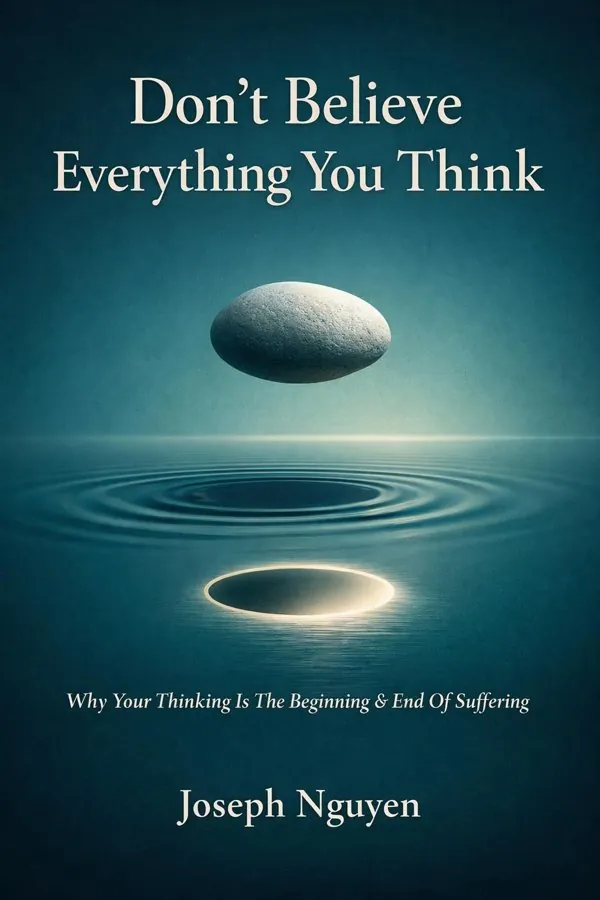
Don't Believe Everything You Think: Why Your Thinking Is The Beginning & End Of Suffering: Summary & Key Insights
 10 min9 chaptersAudio available
Key Takeaways from Don't Believe Everything You Think: Why Your Thinking Is The Beginning & End Of Suffering
Two people can live through the same moment and experience entirely different worlds.
One of the book’s most liberating insights is that the thinker is not the whole of who you are.
Much of modern life is built on the promise that if we think hard enough, plan carefully enough, and avoid mistakes skillfully enough, we can secure peace.
What we call the ego is often less a solid entity than a collection of thoughts believed over time.
Suffering often persists because thought runs unconsciously.
What Is Don't Believe Everything You Think: Why Your Thinking Is The Beginning & End Of Suffering About?
Don't Believe Everything You Think: Why Your Thinking Is The Beginning & End Of Suffering by Joseph Nguyen is a mindset book spanning 7 pages. Joseph Nguyen’s Don’t Believe Everything You Think is a concise but powerful exploration of one of the most overlooked causes of human suffering: our unquestioned belief in thought. Rather than arguing that pain comes primarily from events, people, or circumstances, Nguyen shows that suffering is intensified—and often created—by the stories the mind builds around those experiences. The book invites readers to see that thoughts are not facts, identity is not fixed, and inner peace is not something to be earned through perfect control of life. What makes this book especially relevant is its simplicity. In a world obsessed with productivity hacks, mindset optimization, and emotional self-management, Nguyen offers a more radical insight: freedom does not come from mastering every thought, but from recognizing that you are not your thinking. Drawing from mindfulness, self-inquiry, and the distinction between awareness and mental activity, he presents a practical path toward calm, clarity, and emotional freedom. For readers who feel trapped in overthinking, anxiety, self-judgment, or endless mental noise, this book offers a liberating perspective that is both accessible and deeply transformative.
This FizzRead summary covers all 9 key chapters of Don't Believe Everything You Think: Why Your Thinking Is The Beginning & End Of Suffering in approximately 10 minutes, distilling the most important ideas, arguments, and takeaways from Joseph Nguyen's work. Also available as an audio summary and Key Quotes Podcast.
Don't Believe Everything You Think: Why Your Thinking Is The Beginning & End Of Suffering
Joseph Nguyen’s Don’t Believe Everything You Think is a concise but powerful exploration of one of the most overlooked causes of human suffering: our unquestioned belief in thought. Rather than arguing that pain comes primarily from events, people, or circumstances, Nguyen shows that suffering is intensified—and often created—by the stories the mind builds around those experiences. The book invites readers to see that thoughts are not facts, identity is not fixed, and inner peace is not something to be earned through perfect control of life.
What makes this book especially relevant is its simplicity. In a world obsessed with productivity hacks, mindset optimization, and emotional self-management, Nguyen offers a more radical insight: freedom does not come from mastering every thought, but from recognizing that you are not your thinking. Drawing from mindfulness, self-inquiry, and the distinction between awareness and mental activity, he presents a practical path toward calm, clarity, and emotional freedom. For readers who feel trapped in overthinking, anxiety, self-judgment, or endless mental noise, this book offers a liberating perspective that is both accessible and deeply transformative.
Who Should Read Don't Believe Everything You Think: Why Your Thinking Is The Beginning & End Of Suffering?
This book is perfect for anyone interested in mindset and looking to gain actionable insights in a short read. Whether you're a student, professional, or lifelong learner, the key ideas from Don't Believe Everything You Think: Why Your Thinking Is The Beginning & End Of Suffering by Joseph Nguyen will help you think differently.
- ✓Readers who enjoy mindset and want practical takeaways
- ✓Professionals looking to apply new ideas to their work and life
- ✓Anyone who wants the core insights of Don't Believe Everything You Think: Why Your Thinking Is The Beginning & End Of Suffering in just 10 minutes
Want the full summary?
Get instant access to this book summary and 100K+ more with Fizz Moment.
Get Free SummaryAvailable on App Store • Free to download
Key Chapters
Two people can live through the same moment and experience entirely different worlds. That simple fact reveals a profound truth: we do not suffer only because of what happens, but because of how the mind interprets what happens. Joseph Nguyen argues that the mind is constantly assigning meaning, labeling events, predicting outcomes, and turning neutral facts into personal narratives. What we call “reality” is often reality filtered through thought.
If a colleague sends a brief message, one person may read it as efficient and neutral, while another may see it as cold or disapproving. The external event is the same, but the inner experience changes based on interpretation. This process happens so quickly that it feels automatic and unquestionable. We assume our thoughts are giving us truth, when in many cases they are only giving us conditioned perception.
Nguyen’s point is not that events never matter. Loss, disappointment, and uncertainty are real. But mental suffering expands when the mind adds layers such as “This always happens to me,” “I’m not enough,” or “My future is ruined.” These interpretations create emotional weight far beyond the original moment.
Practically, this means learning to pause between event and interpretation. When you feel upset, ask: What actually happened, and what story am I telling about it? Separating facts from mental commentary creates immediate space. Instead of reacting from assumption, you become able to respond from clarity.
Actionable takeaway: The next time you feel triggered, write down the raw facts of the situation in one sentence, then write the story your mind is adding. Notice how much of your suffering comes from interpretation rather than reality itself.
One of the book’s most liberating insights is that the thinker is not the whole of who you are. Most people live as if every thought deserves belief, obedience, or emotional investment. Nguyen challenges this habit by distinguishing between thought and consciousness. Thoughts arise, change, contradict one another, and disappear. Consciousness is the silent awareness in which those thoughts appear.
This distinction matters because identification with thought is the root of psychological suffering. When the mind says, “I’m failing,” “I’ll never be loved,” or “Something bad is about to happen,” we often merge with the statement. We do not hear it as a passing mental event; we hear it as truth about self and life. But if thoughts can be observed, then they cannot be the observer. The very fact that you can notice a thought means you exist prior to it.
In practical terms, this shifts your relationship with mental chatter. Instead of trying to stop every negative thought, you learn to witness thoughts without becoming them. During stress, for example, you may notice the sentence “I can’t handle this.” Rather than fighting it or obeying it, you can simply recognize: that is a thought arising in awareness. This recognition weakens its grip.
Nguyen does not suggest passivity or emotional numbness. He suggests freedom through disidentification. When you stop treating every thought as self, you gain room for wisdom, compassion, and presence.
Actionable takeaway: Spend two minutes each day noticing thoughts and mentally labeling them as “thinking.” This simple practice strengthens awareness and reminds you that thoughts happen within you, but they are not you.
Much of modern life is built on the promise that if we think hard enough, plan carefully enough, and avoid mistakes skillfully enough, we can secure peace. Nguyen turns this assumption upside down. He argues that the compulsive need to control outcomes is itself a major source of suffering. The more tightly we attach our wellbeing to specific results, the more vulnerable we become to fear, anxiety, and disappointment.
Attachment forms when the mind says, “I need this to happen in order to be okay.” That “this” could be approval, success, certainty, money, love, health, or even spiritual progress. Once the mind ties peace to an external condition, life becomes a constant negotiation. We monitor, strategize, compare, and worry because our emotional safety seems dependent on outcomes we cannot fully control.
Consider a job interview. Preparation is wise, but suffering begins when the mind insists, “If I don’t get this, I’m falling behind,” or “This opportunity defines my worth.” Now the event carries psychological weight far beyond its practical importance. Fear intensifies because identity and peace have become attached to the result.
Nguyen’s message is not to stop caring. It is to care without clinging. We can take meaningful action while letting go of the belief that our wholeness depends on how things unfold. This shift allows effort without inner struggle and engagement without desperation.
Actionable takeaway: Notice one area where you are emotionally gripping for a certain outcome. Ask yourself, “Can I still do my best here without making my peace dependent on the result?” Practice releasing the demand while keeping the commitment.
What we call the ego is often less a solid entity than a collection of thoughts believed over time. Nguyen presents the ego as the mental construct that forms when awareness identifies with labels, memories, fears, roles, and preferences. It says, “This is who I am,” and then spends enormous energy defending, enhancing, and proving that identity.
The problem is not having a functional sense of self. We need names, roles, and personal history to navigate the world. The problem begins when these become absolute. If you believe you are only your achievements, criticism feels like annihilation. If you believe you are your past wounds, growth feels threatening. If you believe you are the image others have of you, authenticity becomes difficult.
The ego thrives on comparison and separation. It asks whether you are ahead or behind, better or worse, admired or ignored. This creates chronic tension because no constructed identity is ever fully secure. There is always another standard to reach, another threat to avoid, another story to maintain.
Nguyen invites readers to see the ego not as an enemy to destroy, but as a thought-made identity to stop worshipping. When you observe self-images instead of unconsciously defending them, they begin to loosen. You can still play your roles—parent, professional, partner, creator—without becoming imprisoned by them.
In daily life, this may look like receiving criticism without collapsing, changing your mind without shame, or letting go of being “the capable one” when you need help.
Actionable takeaway: Identify one label you cling to strongly, such as successful, smart, independent, or spiritual. Ask, “Who am I if this label is not threatened and not required?” Let that question open space beyond identity.
Suffering often persists because thought runs unconsciously. A painful feeling arises, the mind interprets it, more thoughts appear, emotions intensify, and the cycle feeds itself. Nguyen emphasizes that awareness is the turning point. The moment you become conscious of the process, you are no longer completely trapped inside it.
Awareness does not mean analyzing yourself endlessly. It means directly noticing what is happening without immediately judging, resisting, or explaining it. For example, instead of becoming lost in “Why am I always anxious?” you might notice tightness in the chest, racing thoughts about the future, and the impulse to seek reassurance. That observation itself creates space. The cycle slows because it is being seen.
This is why awareness is so powerful: unconscious thought feels like reality, while conscious thought becomes an object of attention. Once you can notice a pattern, you are less likely to be controlled by it. You begin to detect recurring mental habits such as catastrophizing, mind-reading, or replaying old conversations. These habits lose intensity when exposed to awareness.
Nguyen’s approach is deeply practical. You do not need a perfect meditation practice or a silent mind. You need moments of remembering. In the middle of conflict, stress, or self-doubt, simply noticing “My mind is creating a story right now” can prevent escalation.
Over time, awareness becomes less of an emergency tool and more of a natural way of being. Life still happens, but you no longer disappear into every passing mental storm.
Actionable takeaway: Set three reminders on your phone each day with one question: “What is happening in my mind right now?” Use those pauses to observe, not fix, your current mental state.
Many people assume acceptance means resignation, weakness, or giving up. Nguyen reframes it as something far more intelligent: the willingness to stop arguing internally with what already exists. Suffering deepens when pain is met with resistance—when the mind says, “This should not be happening,” “I cannot allow this,” or “I need this feeling gone immediately.” Resistance adds a second layer of suffering on top of the original experience.
Acceptance does not mean approving of loss, injustice, or difficulty. It means acknowledging reality before trying to change it. If you deny what is present, your action becomes distorted by fear and reactivity. If you accept what is here now, your response becomes clearer and more grounded.
Imagine you feel grief after a breakup. Resistance says, “I shouldn’t still feel this way,” or “I need to move on now.” Acceptance says, “Grief is here.” The feeling may still hurt, but the battle around it softens. The same applies to stress at work, disappointment in a plan, or discomfort in uncertainty. The mind often suffers more from refusing the moment than from the moment itself.
Nguyen links surrender with peace because surrender dissolves the illusion that inner struggle changes reality. It does not. It only exhausts us. Acceptance creates the conditions for wise action because we stop wasting energy fighting facts.
Actionable takeaway: When discomfort appears, practice the phrase, “This is what is here right now.” Repeat it gently before deciding what to do next. Let acceptance come first, action second.
One of the most hopeful claims in the book is that peace is not something we manufacture; it is what remains when unnecessary mental agitation quiets down. Nguyen suggests that clarity, joy, and ease are not distant achievements but natural qualities of being that become visible when we are no longer entangled in compulsive thinking.
This idea is important because many people chase peace as if it were another goal. They believe they must fix themselves, resolve every insecurity, and optimize every area of life before they can rest. But if peace depends on perfection, it will always stay out of reach. Nguyen points readers back to the present, where peace can be glimpsed in the spaces between thoughts, in simple awareness, and in moments without psychological resistance.
Think about a time you were fully absorbed in nature, music, exercise, prayer, or a quiet morning. For a moment, the mind was not narrating, comparing, or worrying. Nothing external may have changed dramatically, yet there was relief. This points to a deeper truth: peace often appears not when life becomes ideal, but when thought becomes less dominant.
That does not mean life will never be noisy again. It means peace is always available beneath the noise. The practice is not to force silence, but to stop feeding mental disturbance with endless belief and identification.
Actionable takeaway: Build one small “thought-light” ritual into your day—such as a walk without your phone, five quiet breaths before meals, or a minute of stillness in the morning—to reconnect with peace beneath mental activity.
Emotions can feel absolute, especially when they are intense. Nguyen’s perspective helps loosen that grip by showing how feelings are often intertwined with thought. Emotions are real experiences in the body, but they do not always reveal objective truth about the world. When we confuse feeling with fact, we strengthen suffering.
For example, feeling rejected does not necessarily mean you are unworthy. Feeling afraid does not necessarily mean danger is present. Feeling hopeless does not prove the future is doomed. Often a feeling has been amplified by the mind’s interpretation of events, memory, and anticipation. The emotional charge is real, but the conclusions drawn from it may not be.
This insight encourages a healthier relationship with emotion. Instead of suppressing feelings or acting from them impulsively, we can listen with curiosity. Ask: What am I feeling? What thought may be feeding this feeling? What does this emotion need from me right now—space, rest, honesty, boundaries, compassion? This turns emotion into information rather than identity.
A practical example: after receiving feedback, you may feel shame. Instead of spiraling into “I’m incompetent,” you can notice the physical sensation, name the emotion, and question the story attached to it. That process allows growth without self-destruction.
Nguyen’s broader point is that emotional freedom is not emotional avoidance. It is the ability to feel fully without becoming mentally imprisoned by what you feel.
Actionable takeaway: The next time a strong emotion arises, use this sequence: name the feeling, locate it in the body, identify the thought connected to it, and delay major decisions until the emotional wave settles.
The mind often lives in imagined futures and remembered pasts, and much suffering is generated in those psychological time zones. Nguyen repeatedly points toward the present as the only place where life is actually happening. The present moment is usually far simpler than the mental worlds we create around it.
When thought rushes ahead, it invents scenarios, prepares for disaster, and rehearses conversations that may never happen. When thought moves backward, it replays regrets, injuries, and alternate histories. In both cases, the body responds as if the mental story is happening now. Stress rises, peace fades, and life becomes crowded with abstraction.
Returning to the present does not mean abandoning planning or reflection. It means recognizing when useful thinking has turned into needless suffering. Washing dishes can just be washing dishes. Breathing can just be breathing. Listening can just be listening. These moments seem ordinary, but they restore contact with reality before thought distorts it.
The power of present-moment simplicity is that it interrupts psychological momentum. If you are overwhelmed, ask yourself: What is actually required of me in this moment? Often the answer is far smaller than the mind suggests—send one email, take one breath, have one conversation, rest for ten minutes. Presence reduces life from a giant concept to a livable now.
Actionable takeaway: Whenever you catch yourself spiraling, ground yourself with five concrete observations: what you see, hear, feel physically, smell, and the single next step in front of you.
All Chapters in Don't Believe Everything You Think: Why Your Thinking Is The Beginning & End Of Suffering
About the Author
Joseph Nguyen is a writer and speaker whose work focuses on mindfulness, self-awareness, and the relationship between thought and suffering. He is known for translating contemplative and psychological insights into clear, accessible guidance for everyday life. Rather than emphasizing constant self-improvement through force or mental control, Nguyen encourages readers to examine the nature of thought itself and discover a deeper sense of peace through awareness. His writing resonates with people seeking relief from overthinking, anxiety, and identity-based struggle. Through his books and teachings, he offers a practical approach to inner freedom rooted in presence, observation, and the realization that we do not have to believe every thought our minds produce.
Get This Summary in Your Preferred Format
Read or listen to the Don't Believe Everything You Think: Why Your Thinking Is The Beginning & End Of Suffering summary by Joseph Nguyen anytime, anywhere. FizzRead offers multiple formats so you can learn on your terms — all free.
Available formats: App · Audio · PDF · EPUB — All included free with FizzRead
Download Don't Believe Everything You Think: Why Your Thinking Is The Beginning & End Of Suffering PDF and EPUB Summary
Key Quotes from Don't Believe Everything You Think: Why Your Thinking Is The Beginning & End Of Suffering
“Two people can live through the same moment and experience entirely different worlds.”
“One of the book’s most liberating insights is that the thinker is not the whole of who you are.”
“Much of modern life is built on the promise that if we think hard enough, plan carefully enough, and avoid mistakes skillfully enough, we can secure peace.”
“What we call the ego is often less a solid entity than a collection of thoughts believed over time.”
“Suffering often persists because thought runs unconsciously.”
Frequently Asked Questions about Don't Believe Everything You Think: Why Your Thinking Is The Beginning & End Of Suffering
Don't Believe Everything You Think: Why Your Thinking Is The Beginning & End Of Suffering by Joseph Nguyen is a mindset book that explores key ideas across 9 chapters. Joseph Nguyen’s Don’t Believe Everything You Think is a concise but powerful exploration of one of the most overlooked causes of human suffering: our unquestioned belief in thought. Rather than arguing that pain comes primarily from events, people, or circumstances, Nguyen shows that suffering is intensified—and often created—by the stories the mind builds around those experiences. The book invites readers to see that thoughts are not facts, identity is not fixed, and inner peace is not something to be earned through perfect control of life. What makes this book especially relevant is its simplicity. In a world obsessed with productivity hacks, mindset optimization, and emotional self-management, Nguyen offers a more radical insight: freedom does not come from mastering every thought, but from recognizing that you are not your thinking. Drawing from mindfulness, self-inquiry, and the distinction between awareness and mental activity, he presents a practical path toward calm, clarity, and emotional freedom. For readers who feel trapped in overthinking, anxiety, self-judgment, or endless mental noise, this book offers a liberating perspective that is both accessible and deeply transformative.
You Might Also Like



Browse by Category
Ready to read Don't Believe Everything You Think: Why Your Thinking Is The Beginning & End Of Suffering?
Get the full summary and 100K+ more books with Fizz Moment.