
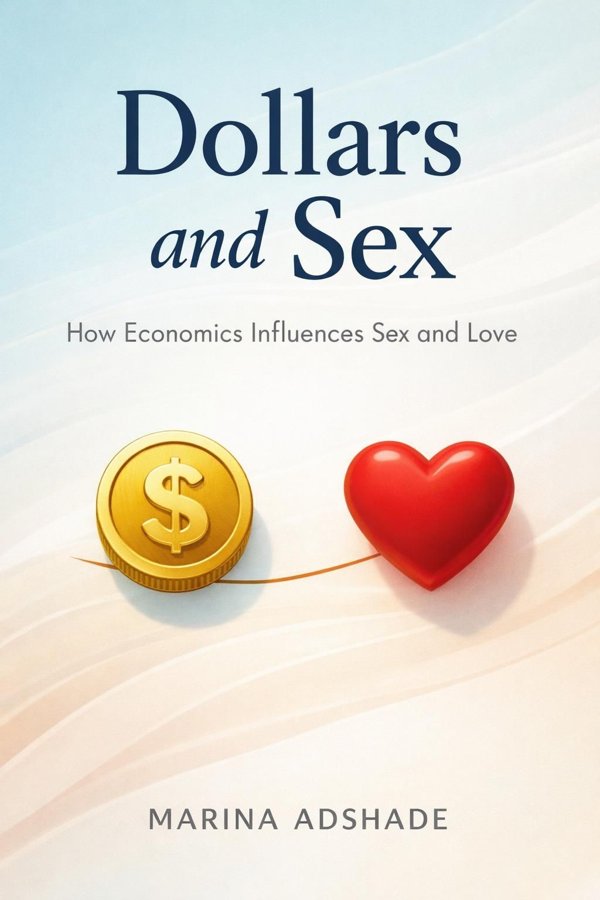
Dollars and Sex: How Economics Influences Sex and Love: Summary & Key Insights
 10 min10 chaptersAudio available
What Is Dollars and Sex: How Economics Influences Sex and Love About?
Dollars and Sex: How Economics Influences Sex and Love by Marina Adshade is a economics book spanning 10 pages. In this engaging and provocative book, economist Marina Adshade explores how economic principles shape our most intimate decisions about sex, love, marriage, and family. Drawing on data and research, she reveals how market forces influence dating behavior, fertility choices, and relationship dynamics in the modern world.
This FizzRead summary covers all 10 key chapters of Dollars and Sex: How Economics Influences Sex and Love in approximately 10 minutes, distilling the most important ideas, arguments, and takeaways from Marina Adshade's work. Also available as an audio summary and Key Quotes Podcast.
Dollars and Sex: How Economics Influences Sex and Love
In this engaging and provocative book, economist Marina Adshade explores how economic principles shape our most intimate decisions about sex, love, marriage, and family. Drawing on data and research, she reveals how market forces influence dating behavior, fertility choices, and relationship dynamics in the modern world.
Who Should Read Dollars and Sex: How Economics Influences Sex and Love?
This book is perfect for anyone interested in economics and looking to gain actionable insights in a short read. Whether you're a student, professional, or lifelong learner, the key ideas from Dollars and Sex: How Economics Influences Sex and Love by Marina Adshade will help you think differently.
- ✓Readers who enjoy economics and want practical takeaways
- ✓Professionals looking to apply new ideas to their work and life
- ✓Anyone who wants the core insights of Dollars and Sex: How Economics Influences Sex and Love in just 10 minutes
Want the full summary?
Get instant access to this book summary and 100K+ more with Fizz Moment.
Get Free SummaryAvailable on App Store • Free to download
Key Chapters
When people enter the dating scene, they instinctively start making choices that economists would recognize immediately as market behavior. In any 'dating market,' there are buyers and sellers, even if that language feels unromantic. The supply and demand for desirable traits—physical attractiveness, intelligence, kindness, career potential—create equilibrium patterns that shape who ends up with whom.
Part of this stems from what I call the 'market ratio'—the balance between men and women in a given dating environment. In a city where there are far more single women than men, men hold greater bargaining power, and vice versa. This imbalance affects not only dating strategies but also the definition of standards. For example, when women outnumber men, they often face pressure to adjust expectations or compete more intensely. Conversely, when men are more abundant, women gain leverage to be more selective.
Attraction itself has its own economics. We can think of looks, personality, and resources as attributes with measurable economic value. Studies have shown correlations between physical attractiveness and income, but also between attractiveness and selectivity in partners. These findings suggest that the 'price' of being single or partnered shifts depending on how a person is valued in this market. Yet this doesn’t mean romance is reduced to calculation—it simply means that our feelings emerge within a system of incentives we subconsciously understand.
Competition is an unavoidable feature of any market, including the market for love. People enhance their 'dating capital'—what I describe as the combination of their social status, physical attributes, and emotional intelligence—to improve their chances. What’s fascinating is how this competition drives social behavior, from fashion and fitness to the cultivation of social networks.
Economic framing helps explain why shifts in gender roles or economic independence can change dating behavior. For instance, as women’s earning power rises, their preferences—and men’s—begin to shift. Women with higher incomes tend to be more selective, valuing compatibility and emotional stability over financial security. Meanwhile, men seek partners whose values align with egalitarian lifestyles, reflecting new definitions of what partnership means.
Competition also helps explain cultural norms that evolve over time. When opportunities expand for both genders, partnership ceases to be an economic necessity and becomes a choice grounded in shared fulfillment. This shift in incentives explains, in part, why marriage rates decline as societies grow wealthier and more gender-equal. When the rewards of single life grow comparable to those of married life, people make different—but equally rational—choices.
+ 8 more chapters — available in the FizzRead app
All Chapters in Dollars and Sex: How Economics Influences Sex and Love
About the Author
Marina Adshade is a Canadian economist and professor at the University of British Columbia. Her research focuses on the intersection of economics and human relationships, particularly how economic incentives affect sexual behavior and family formation.
Get This Summary in Your Preferred Format
Read or listen to the Dollars and Sex: How Economics Influences Sex and Love summary by Marina Adshade anytime, anywhere. FizzRead offers multiple formats so you can learn on your terms — all free.
Available formats: App · Audio · PDF · EPUB — All included free with FizzRead
Download Dollars and Sex: How Economics Influences Sex and Love PDF and EPUB Summary
Key Quotes from Dollars and Sex: How Economics Influences Sex and Love
“When people enter the dating scene, they instinctively start making choices that economists would recognize immediately as market behavior.”
“Competition is an unavoidable feature of any market, including the market for love.”
Frequently Asked Questions about Dollars and Sex: How Economics Influences Sex and Love
Dollars and Sex: How Economics Influences Sex and Love by Marina Adshade is a economics book that explores key ideas across 10 chapters. In this engaging and provocative book, economist Marina Adshade explores how economic principles shape our most intimate decisions about sex, love, marriage, and family. Drawing on data and research, she reveals how market forces influence dating behavior, fertility choices, and relationship dynamics in the modern world.
You Might Also Like

Business Adventures
John Brooks
10 min
Nudge
Richard H. Thaler, Cass R. Sunstein
10 min
The Hitchhiker"s Guide to the Galaxy
Douglas Adams
10 minThe Muqaddimah
Ibn Khaldun
10 minThe Outsiders
William N. Thorndike
10 min
A Little History of Economics
Niall Kishtainy
10 minBrowse by Category
Ready to read Dollars and Sex: How Economics Influences Sex and Love?
Get the full summary and 100K+ more books with Fizz Moment.