
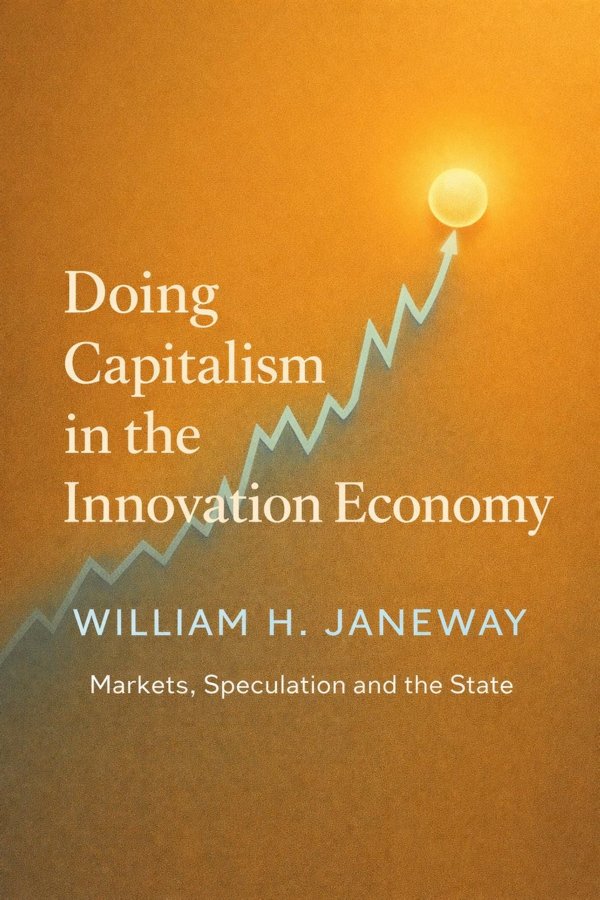
Doing Capitalism in the Innovation Economy: Markets, Speculation and the State: Summary & Key Insights
 10 min11 chaptersAudio available
What Is Doing Capitalism in the Innovation Economy: Markets, Speculation and the State About?
Doing Capitalism in the Innovation Economy: Markets, Speculation and the State by William H. Janeway is a economics book spanning 11 pages. In this influential work, William H. Janeway explores the interplay between markets, speculation, and state intervention in driving innovation and economic growth. Drawing on his extensive experience in both academia and venture capital, Janeway examines how financial bubbles and government investment have historically fueled technological revolutions and shaped the modern innovation economy.
This FizzRead summary covers all 11 key chapters of Doing Capitalism in the Innovation Economy: Markets, Speculation and the State in approximately 10 minutes, distilling the most important ideas, arguments, and takeaways from William H. Janeway's work. Also available as an audio summary and Key Quotes Podcast.
Doing Capitalism in the Innovation Economy: Markets, Speculation and the State
In this influential work, William H. Janeway explores the interplay between markets, speculation, and state intervention in driving innovation and economic growth. Drawing on his extensive experience in both academia and venture capital, Janeway examines how financial bubbles and government investment have historically fueled technological revolutions and shaped the modern innovation economy.
Who Should Read Doing Capitalism in the Innovation Economy: Markets, Speculation and the State?
This book is perfect for anyone interested in economics and looking to gain actionable insights in a short read. Whether you're a student, professional, or lifelong learner, the key ideas from Doing Capitalism in the Innovation Economy: Markets, Speculation and the State by William H. Janeway will help you think differently.
- ✓Readers who enjoy economics and want practical takeaways
- ✓Professionals looking to apply new ideas to their work and life
- ✓Anyone who wants the core insights of Doing Capitalism in the Innovation Economy: Markets, Speculation and the State in just 10 minutes
Want the full summary?
Get instant access to this book summary and 100K+ more with Fizz Moment.
Get Free SummaryAvailable on App Store • Free to download
Key Chapters
Looking backward reveals the truth that the innovation economy was born not in private boardrooms but in public laboratories. Modern science-based industries—from computing to biotechnology—owe their origins to state-sponsored research. During both world wars, governments mobilized intellectual and material resources at unprecedented scale. The Manhattan Project, radar technologies, and postwar nuclear research were not the accidental by-products of market forces; they were deliberate mobilizations of national capacity for existential purposes. When the Cold War began, the United States in particular institutionalized this dynamic. Federal agencies such as the National Science Foundation, DARPA, and NASA sustained a continuous pipeline of fundamental inquiry and practical engineering. Private companies later commercialized the discoveries, but it was government risk-taking that created the fertile ground.
I often remind readers that this is no anomaly. The state has always played the role of 'first risk-taker' when the uncertainty of returns was too high for market investors. From the railways of the nineteenth century to the telecommunications networks of the twentieth, governments built frameworks—legal, physical, and educational—that enabled private innovation. The moral here is clear: innovation thrives not in laissez-faire isolation but in a dense ecology of public commitments and private initiative. The narrative of state versus market is therefore false; the two are intertwined partners in the long history of capitalist evolution.
Speculation occupies a paradoxical space in my story. It is simultaneously the source of innovation's greatest funding and its most notorious excess. I learned as an investor that genuine innovation cannot be financed on the same terms as predictable, linear businesses. Breakthrough technology is inherently uncertain; its payoffs are incalculable. Only the enthusiasm—sometimes the mania—of speculative markets can mobilize sufficient capital. The railway boom of the 1840s, the radio and automobile bubbles of the early twentieth century, the dot-com frenzy of the 1990s—all were periods of overinvestment and eventual collapse. Yet they left behind assets, infrastructure, and knowledge that permanently altered productive capacity.
Critics view bubbles only as evidence of irrationality, but to dismiss them is to misunderstand capitalism’s creative energy. A bubble is the means by which vast social resources are concentrated on building something new before its outcome can be justified by expected returns. In this sense, speculation functions as a societal research and development fund, albeit an unintentional one. When the market’s fever breaks, the surviving technologies emerge as the pillars of new industries. I call this the productivity of financial excess—an uncomfortable but empirically undeniable reality.
+ 9 more chapters — available in the FizzRead app
All Chapters in Doing Capitalism in the Innovation Economy: Markets, Speculation and the State
About the Author
William H. Janeway is an economist, venture capitalist, and author. He has served as a senior advisor at Warburg Pincus and as a teaching faculty member at the University of Cambridge. His work focuses on the intersection of finance, innovation, and public policy.
Get This Summary in Your Preferred Format
Read or listen to the Doing Capitalism in the Innovation Economy: Markets, Speculation and the State summary by William H. Janeway anytime, anywhere. FizzRead offers multiple formats so you can learn on your terms — all free.
Available formats: App · Audio · PDF · EPUB — All included free with FizzRead
Download Doing Capitalism in the Innovation Economy: Markets, Speculation and the State PDF and EPUB Summary
Key Quotes from Doing Capitalism in the Innovation Economy: Markets, Speculation and the State
“Looking backward reveals the truth that the innovation economy was born not in private boardrooms but in public laboratories.”
“Speculation occupies a paradoxical space in my story.”
Frequently Asked Questions about Doing Capitalism in the Innovation Economy: Markets, Speculation and the State
Doing Capitalism in the Innovation Economy: Markets, Speculation and the State by William H. Janeway is a economics book that explores key ideas across 11 chapters. In this influential work, William H. Janeway explores the interplay between markets, speculation, and state intervention in driving innovation and economic growth. Drawing on his extensive experience in both academia and venture capital, Janeway examines how financial bubbles and government investment have historically fueled technological revolutions and shaped the modern innovation economy.
You Might Also Like

Business Adventures
John Brooks
10 min
Nudge
Richard H. Thaler, Cass R. Sunstein
10 min
The Hitchhiker"s Guide to the Galaxy
Douglas Adams
10 minThe Muqaddimah
Ibn Khaldun
10 minThe Outsiders
William N. Thorndike
10 min
A Little History of Economics
Niall Kishtainy
10 minBrowse by Category
Ready to read Doing Capitalism in the Innovation Economy: Markets, Speculation and the State?
Get the full summary and 100K+ more books with Fizz Moment.