
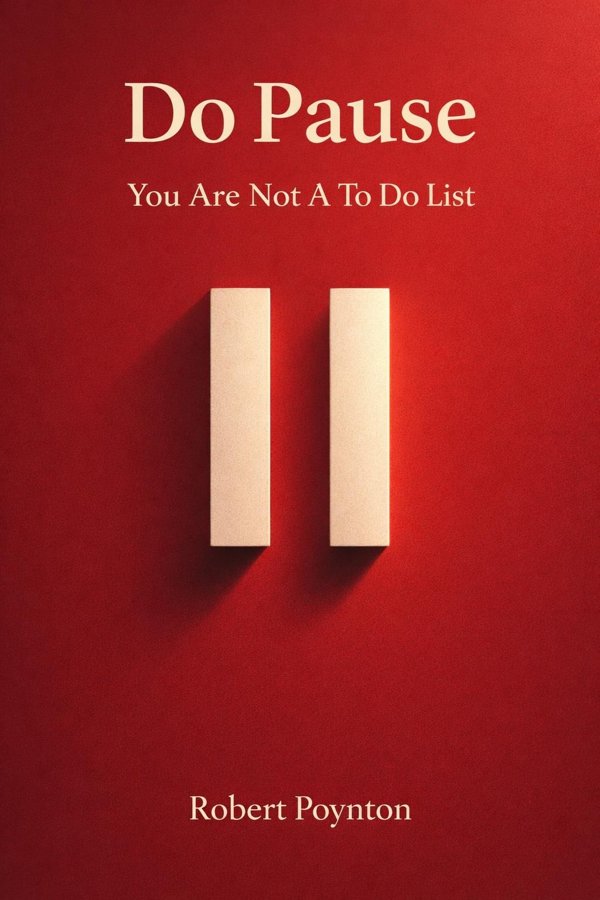
Do Pause: You Are Not A To Do List: Summary & Key Insights
 10 min9 chaptersAudio available
Key Takeaways from Do Pause: You Are Not A To Do List
One of the most dangerous myths of modern life is that a full schedule proves a meaningful life.
A pause is easy to overlook because it often appears small, almost invisible.
Good thinking rarely comes from a crowded mind.
Many communication problems are not caused by lack of intelligence but by lack of pause.
Creativity is often imagined as a matter of talent, but Poynton reminds us that it also depends on conditions.
What Is Do Pause: You Are Not A To Do List About?
Do Pause: You Are Not A To Do List by Robert Poynton is a mindset book spanning 9 pages. Do Pause: You Are Not A To Do List is a short but powerful invitation to rethink one of modern life’s deepest assumptions: that constant activity is the same as progress. In a culture that rewards speed, responsiveness, and visible productivity, Robert Poynton argues that the ability to pause is not a weakness or indulgence, but a practical skill for living and working well. A pause creates space to notice what is happening, choose more wisely, and respond with greater clarity rather than mere habit. Throughout the book, Poynton shows how pausing can improve communication, deepen relationships, support creativity, and restore a sense of presence that busy routines often erode. His approach is grounded, reflective, and highly usable, blending observation with simple practices readers can apply immediately. As a facilitator, writer, and teacher of improvisation and creative thinking, Poynton brings unusual authority to the subject. He understands that better decisions, better conversations, and better ideas often emerge not from doing more, but from stopping long enough to see what truly matters.
This FizzRead summary covers all 9 key chapters of Do Pause: You Are Not A To Do List in approximately 10 minutes, distilling the most important ideas, arguments, and takeaways from Robert Poynton's work. Also available as an audio summary and Key Quotes Podcast.
Do Pause: You Are Not A To Do List
Do Pause: You Are Not A To Do List is a short but powerful invitation to rethink one of modern life’s deepest assumptions: that constant activity is the same as progress. In a culture that rewards speed, responsiveness, and visible productivity, Robert Poynton argues that the ability to pause is not a weakness or indulgence, but a practical skill for living and working well. A pause creates space to notice what is happening, choose more wisely, and respond with greater clarity rather than mere habit. Throughout the book, Poynton shows how pausing can improve communication, deepen relationships, support creativity, and restore a sense of presence that busy routines often erode. His approach is grounded, reflective, and highly usable, blending observation with simple practices readers can apply immediately. As a facilitator, writer, and teacher of improvisation and creative thinking, Poynton brings unusual authority to the subject. He understands that better decisions, better conversations, and better ideas often emerge not from doing more, but from stopping long enough to see what truly matters.
Who Should Read Do Pause: You Are Not A To Do List?
This book is perfect for anyone interested in mindset and looking to gain actionable insights in a short read. Whether you're a student, professional, or lifelong learner, the key ideas from Do Pause: You Are Not A To Do List by Robert Poynton will help you think differently.
- ✓Readers who enjoy mindset and want practical takeaways
- ✓Professionals looking to apply new ideas to their work and life
- ✓Anyone who wants the core insights of Do Pause: You Are Not A To Do List in just 10 minutes
Want the full summary?
Get instant access to this book summary and 100K+ more with Fizz Moment.
Get Free SummaryAvailable on App Store • Free to download
Key Chapters
One of the most dangerous myths of modern life is that a full schedule proves a meaningful life. Robert Poynton begins by challenging the cultural worship of busyness, where people wear exhaustion like a medal and measure worth by how much they can cram into a day. The problem is not simply that we are busy, but that busyness has become an identity. When every moment is occupied, there is little room left for reflection, curiosity, or genuine choice. We become reactive rather than intentional, moving from task to task without asking whether those tasks deserve our energy in the first place.
Poynton suggests that this state of constant motion narrows our perception. When we are always rushing, we stop noticing our inner life, the needs of others, and the wider context of our actions. Work may get done, but depth, imagination, and emotional presence suffer. A packed calendar can hide confusion as easily as it displays competence. The real question is not whether we are active, but whether our activity aligns with what matters.
This insight applies everywhere. A manager who answers emails all day may feel productive while avoiding strategic thinking. A parent who organizes every detail may miss the chance to truly listen. A student who studies continuously may retain less than one who builds in time to think.
The first step is to stop treating busyness as proof of importance. Actionable takeaway: for one week, notice when you say or think “I’m so busy,” and replace it with a more precise description of what is actually demanding your attention.
A pause is easy to overlook because it often appears small, almost invisible. Yet Poynton shows that its power lies not in duration but in intention. A pause can be a breath before speaking, a silent moment before entering a meeting, a walk between tasks, or a weekend without constant digital interruption. What makes it meaningful is that it interrupts automatic momentum and creates a brief opening in which awareness can return.
This matters because much of daily life is lived on autopilot. We answer too quickly, commit too quickly, react too quickly, and often discover too late that our response was driven by habit rather than choice. A pause slows the sequence just enough for us to notice what is happening. Instead of being swept along by urgency, we regain the ability to choose. That is why pausing is not passivity. It is a deliberate act that makes wiser action possible.
Poynton’s definition is broad and practical. He is not arguing that everyone needs long retreats or radical life changes. He is showing that meaningful pauses can be woven into ordinary routines. Before sending an important message, pause and read it again. Before saying yes to a request, pause and ask what the commitment will cost. Before reacting defensively, pause and notice your emotions.
Over time, these small interruptions reshape how life is lived. They turn reaction into response and speed into discernment. Actionable takeaway: choose one recurring moment each day, such as before meals or before opening your inbox, and use it as a cue to pause for three conscious breaths.
Good thinking rarely comes from a crowded mind. Poynton argues that space is not empty in the negative sense; it is the condition that allows something new to appear. When every minute is scheduled and every gap filled with stimulation, there is no room for insight to land. Space is where perspective develops, patterns become visible, and fresh possibilities can be noticed.
This is especially important in a world of constant digital noise. Many people move from phone to laptop to conversation to entertainment without a single unclaimed moment. They may feel occupied, but mentally they are overcrowded. Poynton invites readers to see space as productive in a deeper sense. The unscheduled interval is not wasted time. It is where understanding catches up with experience.
In practice, space can take many forms. A leader might leave ten minutes between meetings instead of stacking them back to back, allowing time to reflect on what was said and what matters next. A writer might stop forcing words and take a walk, trusting that distance can clarify thought. A couple in conversation might allow silence instead of rushing to fill it, discovering that the pause brings honesty.
Space also changes the quality of attention. When we stop cramming, we listen more carefully, observe more accurately, and become less trapped by immediate pressures. This makes our eventual action stronger, not weaker.
Actionable takeaway: create one small pocket of unfilled space in your day, even just fifteen minutes without devices, and resist the urge to “use” it for anything except noticing what arises.
Many communication problems are not caused by lack of intelligence but by lack of pause. Poynton shows that conversations often go wrong because people reply before they have really listened. They prepare counterarguments while the other person is speaking, jump in to fix, defend, or impress, and miss what is actually being said. A pause changes the rhythm of interaction and creates the conditions for better understanding.
In communication, silence is often treated as awkward or unproductive. Yet a well-placed pause can signal attention, respect, and thoughtfulness. It gives words time to settle. It allows emotion to soften. It prevents the kind of immediate reaction that escalates conflict. In meetings, negotiations, interviews, and personal relationships, those who can pause tend to respond with more precision and empathy.
Consider how often emails are sent too quickly and later regretted. A short pause before hitting send can reveal a defensive tone, an unclear request, or an unnecessary escalation. In a tense conversation, taking one breath before answering may be enough to avoid saying the sharp thing that cannot be unsaid. Even in public speaking, pauses give authority to the speaker and make ideas easier for others to absorb.
Poynton’s insight is that better communication is not only about better words. It is also about better timing. The gap between stimulus and response is where listening becomes possible.
Actionable takeaway: in your next important conversation, wait two seconds after the other person finishes speaking before you answer, and notice how that small pause changes the quality of the exchange.
Creativity is often imagined as a matter of talent, but Poynton reminds us that it also depends on conditions. One of the most important of those conditions is pause. New ideas rarely appear when the mind is under relentless pressure to produce on command. They tend to emerge in moments of looseness, drift, and interruption, when attention relaxes enough to make unexpected connections.
This is why people often get ideas in the shower, on a walk, or while traveling. The pause from focused effort allows the subconscious to keep working. In contrast, a schedule packed with deadlines, notifications, and performance anxiety can make imagination contract. The result is repetition rather than originality.
Poynton does not romanticize waiting for inspiration. He values practice and engagement. But he argues that creativity has a rhythm: effort and release, focus and pause, doing and stepping back. Without the second half of that rhythm, ideas become forced. A designer may improve a concept by leaving it overnight. A team may solve a difficult problem after breaking for lunch. An individual facing a life decision may see more clearly after time away from analysis.
The practical implication is simple but often ignored: if you want better ideas, stop trying to squeeze them from a mind that never rests. Build pauses into creative work as part of the process, not as a reward after the real work is done.
Actionable takeaway: when you feel stuck on a problem, stop pushing for fifteen minutes and switch to a low-stimulation activity like walking, stretching, or sitting quietly before returning to it.
It is possible to move through an entire day without really being there for any of it. Poynton connects pausing with presence, the capacity to inhabit the moment rather than merely pass through it. Presence is not mystical or abstract. It is the simple but increasingly rare experience of paying attention to what is happening now: your thoughts, your body, the people around you, the atmosphere in a room, the meaning of what you are doing.
Constant activity pulls us away from this. We rush through meals, half-listen in conversations, think about the next task while doing the current one, and live in anticipation rather than contact. A pause interrupts that drift. It returns us to our senses. We notice our breathing, our posture, our mood, our assumptions. We become available to life again.
This shift has practical benefits. Presence improves judgment because we are more aware of context. It improves relationships because people can feel when they are truly being attended to. It improves well-being because life stops feeling like an endless conveyor belt of obligations. Even ordinary moments become richer when they are actually experienced.
Poynton suggests that pause is a doorway to this quality of attention. You do not need elaborate techniques. You need brief, intentional moments of stopping that allow awareness to catch up. Washing dishes can become a pause. Waiting in line can become a pause. Standing before opening a door can become a pause.
Actionable takeaway: pick one routine activity each day and do it without multitasking, simply noticing sensations, thoughts, and surroundings as a way to practice presence through pause.
A pause becomes sustainable when it is built into the shape of life rather than left to chance. Poynton emphasizes practical ways to pause, not as dramatic escapes but as repeatable rituals that gently interrupt the rush of the day. The goal is not perfection or purity. It is to create reliable points of return.
These rituals can be tiny. Begin the day without immediately checking your phone. Sit for one minute before starting work. Leave a gap between meetings. Step outside before lunch. Close your laptop and take a breath before moving from work mode to home mode. Keep one evening a week less programmed. Each of these actions says: I do not have to be carried helplessly by momentum.
What matters is consistency and fit. A useful pause practice is one that matches the reality of your life. A parent with young children may not have long stretches of silence, but may still find meaningful pauses in the car before going indoors. A busy professional may schedule thinking time on the calendar. A student may end study sessions with two minutes of review instead of instantly switching to distraction.
Poynton’s broader message is that pauses can be designed. We often treat the day as something that happens to us, but small rituals give us agency over its rhythm. They help create boundaries, restore attention, and reduce the sense of endless blur.
Actionable takeaway: choose two daily transition points, such as waking up and finishing work, and attach a simple pause ritual to each so that stopping becomes a habit rather than an occasional accident.
If pausing is so beneficial, why do so many people resist it? Poynton explores this honestly. The barrier is not usually lack of information, but discomfort. Pausing can feel unproductive, selfish, or risky in a culture that prizes speed. More personally, a pause may confront us with what constant activity helps us avoid: uncertainty, fatigue, sadness, dissatisfaction, or the uncomfortable question of whether our lives are aligned with our values.
In this sense, nonstop doing can function as a defense. As long as we keep moving, we do not have to examine where we are headed. A pause threatens the illusion that everything is under control. That is why some people instinctively reach for their phone the moment there is silence, or fill every gap with entertainment, errands, or work.
Poynton invites readers to meet this resistance with curiosity rather than self-criticism. The discomfort is not a sign that pausing is wrong. It may be evidence that the pause is revealing something important. Perhaps you are more tired than you admit. Perhaps a commitment needs renegotiating. Perhaps your pace is no longer sustainable.
Learning to pause therefore requires courage. It means tolerating stillness long enough to hear what life has been trying to tell you. Start small, because resistance often weakens when pause becomes familiar rather than dramatic.
Actionable takeaway: the next time you feel the urge to fill an empty moment, delay that impulse for sixty seconds and ask yourself, “What am I avoiding by not pausing right now?”
Poynton’s final contribution is to show that pause is not merely a technique but a way of living. The deeper message of the book is that a good life has rhythm, not just output. It includes movement and stillness, speech and silence, effort and recovery, engagement and reflection. When these opposites fall out of balance, life becomes thin and mechanical. We may achieve a great deal while feeling disconnected from ourselves and from others.
To live with pause means redesigning our relationship to time. Instead of seeing every gap as a problem to eliminate, we begin to see intervals as essential. Instead of valuing only visible activity, we appreciate the invisible processes that nourish wise action: reflection, digestion, listening, and rest. This shift can transform work, leadership, family life, and inner life.
A person who lives with pause does not become passive or unambitious. On the contrary, they often become more effective because their action is less scattered. They say yes more carefully, attend more fully, and recover more intelligently. Their decisions tend to be rooted rather than rushed. Their days may not look dramatically slower, but they feel less frantic because there is more awareness inside them.
Ultimately, the title says it clearly: you are not a to do list. Your life cannot be reduced to completed tasks. A fuller measure includes attention, meaning, relationship, and aliveness.
Actionable takeaway: review your week and identify one area where pace has replaced purpose, then make one deliberate change that restores rhythm, such as adding recovery time, reducing commitments, or protecting reflective space.
All Chapters in Do Pause: You Are Not A To Do List
About the Author
Robert Poynton is a British writer, facilitator, and teacher whose work focuses on creativity, change, collaboration, and learning. He is especially known for applying the principles of improvisation to leadership, communication, and everyday life, helping people respond with greater awareness and flexibility in uncertain situations. Poynton has taught in a wide range of settings, from businesses and creative organizations to universities, and has been associated with the University of Oxford as an associate fellow. He is also the author of several books in the Do Books series, including titles on improvisation and pausing. His writing stands out for its calm, reflective style and practical wisdom. In Do Pause, he draws on years of facilitation and observation to show how stopping can become a powerful tool for clearer thinking and more intentional living.
Get This Summary in Your Preferred Format
Read or listen to the Do Pause: You Are Not A To Do List summary by Robert Poynton anytime, anywhere. FizzRead offers multiple formats so you can learn on your terms — all free.
Available formats: App · Audio · PDF · EPUB — All included free with FizzRead
Download Do Pause: You Are Not A To Do List PDF and EPUB Summary
Key Quotes from Do Pause: You Are Not A To Do List
“One of the most dangerous myths of modern life is that a full schedule proves a meaningful life.”
“A pause is easy to overlook because it often appears small, almost invisible.”
“Good thinking rarely comes from a crowded mind.”
“Many communication problems are not caused by lack of intelligence but by lack of pause.”
“Creativity is often imagined as a matter of talent, but Poynton reminds us that it also depends on conditions.”
Frequently Asked Questions about Do Pause: You Are Not A To Do List
Do Pause: You Are Not A To Do List by Robert Poynton is a mindset book that explores key ideas across 9 chapters. Do Pause: You Are Not A To Do List is a short but powerful invitation to rethink one of modern life’s deepest assumptions: that constant activity is the same as progress. In a culture that rewards speed, responsiveness, and visible productivity, Robert Poynton argues that the ability to pause is not a weakness or indulgence, but a practical skill for living and working well. A pause creates space to notice what is happening, choose more wisely, and respond with greater clarity rather than mere habit. Throughout the book, Poynton shows how pausing can improve communication, deepen relationships, support creativity, and restore a sense of presence that busy routines often erode. His approach is grounded, reflective, and highly usable, blending observation with simple practices readers can apply immediately. As a facilitator, writer, and teacher of improvisation and creative thinking, Poynton brings unusual authority to the subject. He understands that better decisions, better conversations, and better ideas often emerge not from doing more, but from stopping long enough to see what truly matters.
You Might Also Like
Browse by Category
Ready to read Do Pause: You Are Not A To Do List?
Get the full summary and 100K+ more books with Fizz Moment.