
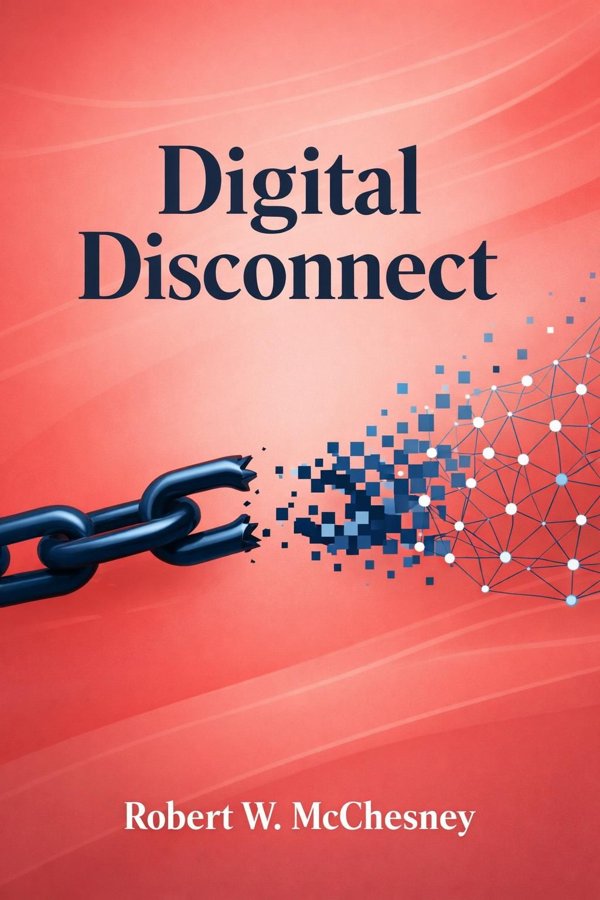
Digital Disconnect: How Capitalism Is Turning the Internet Against Democracy: Summary & Key Insights
 10 min9 chaptersAudio available
What Is Digital Disconnect: How Capitalism Is Turning the Internet Against Democracy About?
Digital Disconnect: How Capitalism Is Turning the Internet Against Democracy by Robert W. McChesney is a digital_culture book spanning 9 pages. In this book, Robert W. McChesney examines how the internet, once hailed as a revolutionary force for democracy and equality, has been transformed by corporate power into a tool that reinforces inequality and undermines democratic institutions. He explores the political economy of digital media, showing how capitalism shapes the online world and limits its democratic potential.
This FizzRead summary covers all 9 key chapters of Digital Disconnect: How Capitalism Is Turning the Internet Against Democracy in approximately 10 minutes, distilling the most important ideas, arguments, and takeaways from Robert W. McChesney's work. Also available as an audio summary and Key Quotes Podcast.
Digital Disconnect: How Capitalism Is Turning the Internet Against Democracy
In this book, Robert W. McChesney examines how the internet, once hailed as a revolutionary force for democracy and equality, has been transformed by corporate power into a tool that reinforces inequality and undermines democratic institutions. He explores the political economy of digital media, showing how capitalism shapes the online world and limits its democratic potential.
Who Should Read Digital Disconnect: How Capitalism Is Turning the Internet Against Democracy?
This book is perfect for anyone interested in digital_culture and looking to gain actionable insights in a short read. Whether you're a student, professional, or lifelong learner, the key ideas from Digital Disconnect: How Capitalism Is Turning the Internet Against Democracy by Robert W. McChesney will help you think differently.
- ✓Readers who enjoy digital_culture and want practical takeaways
- ✓Professionals looking to apply new ideas to their work and life
- ✓Anyone who wants the core insights of Digital Disconnect: How Capitalism Is Turning the Internet Against Democracy in just 10 minutes
Want the full summary?
Get instant access to this book summary and 100K+ more with Fizz Moment.
Get Free SummaryAvailable on App Store • Free to download
Key Chapters
To understand how we arrived at the current digital landscape, we must revisit the origins of the internet itself. It did not begin as a commercial venture—it was a publicly funded project, born of government research through initiatives like ARPANET. The internet’s foundations were laid by scientists and engineers working within a publicly accountable framework, guided by ideals of collaboration and open access. In this environment, the priority was not profit but connectivity and innovation as a public good.
The transformation began in the 1990s when the U.S. government and allied institutions embraced privatization. An infrastructure built at great public expense was effectively handed over to private corporations, whose interests lay in monetization and control. This moment marked a critical turning point. The language of democracy and empowerment remained, but the underlying architecture shifted toward economic concentration. Silicon Valley’s rise was hailed as entrepreneurial triumph, yet beneath the rhetoric, what unfolded was a systematic enclosure of the digital commons.
As I traced this history, I saw how the neoliberal revolution—the belief that markets solve all problems—extended into cyberspace. Deregulation policies and intellectual property regimes encouraged corporations to build proprietary platforms and advertising markets. The result was not a free internet in the democratic sense but a privatized internet operating under the imperatives of capital accumulation. Once the logic of profit took hold, the social potential of the internet began to contract.
This history matters because it dispels the myth that our digital world is inherently democratic or neutral. Every protocol, platform, and policy choice reflects the underlying economic order. Without that understanding, we cannot grasp why the internet today rewards surveillance and manipulation over truth and participation.
In the heart of *Digital Disconnect* lies the framework I call the political economy of communication. It is a way of seeing how the structures of ownership, production, and profit shape the flow of information. Communication does not exist in a vacuum—it is produced within an economic system that privileges certain voices and silences others.
Capitalism, especially in its contemporary monopoly form, does not merely coexist with media—it defines its contours. Decisions about content, design, and distribution follow from the imperative to maximize return on investment. This means platforms are not neutral conduits but machines optimized for profitability. They harvest attention, convert it into data, and sell that data to advertisers. In this logic, users are not citizens—they are commodities.
I emphasize this because the internet is often treated as a space of liberation, detached from the old hierarchies of media. But structurally, it replicates and intensifies them. Just as corporate media in the twentieth century narrowed the bounds of public discourse, digital networks today concentrate power in the hands of a few giants. Understanding the political economy of communication allows us to see the continuity between these eras. It is not technology that determines democratic possibility—it is ownership and governance.
The key insight is that democracy requires an independent communication system—one not beholden to concentrated economic interests. When the economy of communication is dominated by private monopolies, public dialogue and political equality struggle to survive. Only by examining this economic infrastructure can we begin to imagine truly democratic alternatives.
+ 7 more chapters — available in the FizzRead app
All Chapters in Digital Disconnect: How Capitalism Is Turning the Internet Against Democracy
About the Author
Robert W. McChesney is an American professor of communication at the University of Illinois at Urbana-Champaign and a leading scholar in media studies. He is known for his critical analyses of media ownership, political economy, and the relationship between capitalism and communication systems.
Get This Summary in Your Preferred Format
Read or listen to the Digital Disconnect: How Capitalism Is Turning the Internet Against Democracy summary by Robert W. McChesney anytime, anywhere. FizzRead offers multiple formats so you can learn on your terms — all free.
Available formats: App · Audio · PDF · EPUB — All included free with FizzRead
Download Digital Disconnect: How Capitalism Is Turning the Internet Against Democracy PDF and EPUB Summary
Key Quotes from Digital Disconnect: How Capitalism Is Turning the Internet Against Democracy
“To understand how we arrived at the current digital landscape, we must revisit the origins of the internet itself.”
“In the heart of *Digital Disconnect* lies the framework I call the political economy of communication.”
Frequently Asked Questions about Digital Disconnect: How Capitalism Is Turning the Internet Against Democracy
Digital Disconnect: How Capitalism Is Turning the Internet Against Democracy by Robert W. McChesney is a digital_culture book that explores key ideas across 9 chapters. In this book, Robert W. McChesney examines how the internet, once hailed as a revolutionary force for democracy and equality, has been transformed by corporate power into a tool that reinforces inequality and undermines democratic institutions. He explores the political economy of digital media, showing how capitalism shapes the online world and limits its democratic potential.
You Might Also Like
An Ugly Truth: Inside Facebook’s Battle for Domination
Sheera Frenkel, Cecilia Kang
10 min
Cyber Citizens
Ian Goodfellow
10 min
Digital Minimalism: Choosing a Focused Life in a Noisy World
Cal Newport
10 min
E‑Books & Beyond
Various Authors
10 min
The Future of Media
Various Authors
10 min
This Is Why We Can't Have Nice Things
Whitney Phillips
10 minBrowse by Category
Ready to read Digital Disconnect: How Capitalism Is Turning the Internet Against Democracy?
Get the full summary and 100K+ more books with Fizz Moment.