
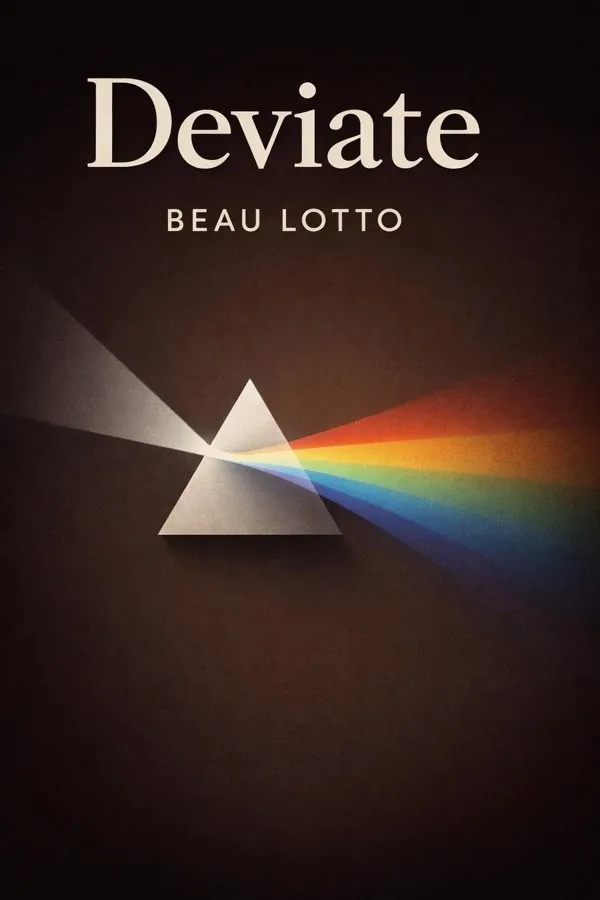
Deviate: The Science of Seeing Differently: Summary & Key Insights
by Beau Lotto
 10 min9 chaptersAudio available
What Is Deviate: The Science of Seeing Differently About?
Deviate: The Science of Seeing Differently by Beau Lotto is a neuroscience book spanning 9 pages. Deviate: The Science of Seeing Differently explores how perception shapes our understanding of reality. Neuroscientist Beau Lotto explains that our brains do not perceive the world as it is, but as it is useful to us. Through engaging examples from science, art, and everyday life, Lotto demonstrates how embracing uncertainty and challenging assumptions can lead to creativity and innovation.
This FizzRead summary covers all 9 key chapters of Deviate: The Science of Seeing Differently in approximately 10 minutes, distilling the most important ideas, arguments, and takeaways from Beau Lotto's work. Also available as an audio summary and Key Quotes Podcast.
Deviate: The Science of Seeing Differently
Deviate: The Science of Seeing Differently explores how perception shapes our understanding of reality. Neuroscientist Beau Lotto explains that our brains do not perceive the world as it is, but as it is useful to us. Through engaging examples from science, art, and everyday life, Lotto demonstrates how embracing uncertainty and challenging assumptions can lead to creativity and innovation.
Who Should Read Deviate: The Science of Seeing Differently?
This book is perfect for anyone interested in neuroscience and looking to gain actionable insights in a short read. Whether you're a student, professional, or lifelong learner, the key ideas from Deviate: The Science of Seeing Differently by Beau Lotto will help you think differently.
- ✓Readers who enjoy neuroscience and want practical takeaways
- ✓Professionals looking to apply new ideas to their work and life
- ✓Anyone who wants the core insights of Deviate: The Science of Seeing Differently in just 10 minutes
Want the full summary?
Get instant access to this book summary and 100K+ more with Fizz Moment.
Get Free SummaryAvailable on App Store • Free to download
Key Chapters
The story of perception begins not with humans but with life itself. Billions of years ago, early organisms had to survive in a constantly shifting environment. They developed the simplest form of sensing—the ability to detect light or chemical gradients—not to know the truth of the universe but to know how to act within it. Our brains evolved out of this same need: not to produce a faithful image of reality, but to generate useful interpretations that guide behavior.
When I look at the brain as a neuroscientist, I see a prediction machine. Every act of perception is a hypothesis about the world, an interpretation based on prior experience. We don’t see light; we see meaning—patterns that our ancestors found significant to survival. This evolutionary process explains why our visual system is biased, why illusions trick us so easily, and why we sometimes hold on to wrong ideas even when presented with contrary evidence. The brain’s goal isn’t truth; it’s adaptability.
Understanding perception this way transforms how we approach knowledge itself. It forces us to accept that even science—a field built on objectivity—depends on models born from the very same meaning-making system that misleads us daily. Our senses are less like windows and more like filters. This realization is humbling, but it is also empowering: it means that by changing our contexts and assumptions, we can literally change the worlds we inhabit.
Think of your brain as a storyteller rather than a camera. When light hits your eyes, or sound enters your ears, your brain receives patterns of data that have no meaning in themselves. It’s your history—personal, social, evolutionary—that gives them meaning. The same image can thus evoke differing emotions in two people because each person’s brain integrates the sensory input with prior knowledge.
One of the most striking lessons from my research is that perception is always relational. The brain constructs meaning not in isolation but through interaction with the environment. For instance, when you see color, you aren’t detecting a property of light; you are perceiving the relationship between wavelengths and their context. That relationship is a story your brain tells to make sense of its inputs. Meaning is the product of that story-making.
Once you see perception as a process of continuous meaning construction, everything changes. You begin to notice how judgments, beliefs, and even emotional responses are interpretations too. When we mistake these for facts, we become prisoners of our own neural narratives. But when we acknowledge perception’s subjectivity, we gain the possibility of revision—to rewrite our own meanings and open ourselves to new patterns of thought and creativity.
+ 7 more chapters — available in the FizzRead app
All Chapters in Deviate: The Science of Seeing Differently
About the Author
Beau Lotto is a neuroscientist and founder of the Lab of Misfits, known for his research on perception and creativity. His work bridges science, art, and design to explore how humans make meaning from the world around them.
Get This Summary in Your Preferred Format
Read or listen to the Deviate: The Science of Seeing Differently summary by Beau Lotto anytime, anywhere. FizzRead offers multiple formats so you can learn on your terms — all free.
Available formats: App · Audio · PDF · EPUB — All included free with FizzRead
Download Deviate: The Science of Seeing Differently PDF and EPUB Summary
Key Quotes from Deviate: The Science of Seeing Differently
“The story of perception begins not with humans but with life itself.”
“Think of your brain as a storyteller rather than a camera.”
Frequently Asked Questions about Deviate: The Science of Seeing Differently
Deviate: The Science of Seeing Differently by Beau Lotto is a neuroscience book that explores key ideas across 9 chapters. Deviate: The Science of Seeing Differently explores how perception shapes our understanding of reality. Neuroscientist Beau Lotto explains that our brains do not perceive the world as it is, but as it is useful to us. Through engaging examples from science, art, and everyday life, Lotto demonstrates how embracing uncertainty and challenging assumptions can lead to creativity and innovation.
You Might Also Like
Anxious
Joseph LeDoux
10 min
Hallucinations
Oliver Sacks
10 min
The Biological Mind: How Brain, Body, and Environment Collaborate to Make Us Who We Are
Alan Jasanoff
10 min
The Feeling of Life Itself: Why Consciousness Is Widespread but Can't Be Computed
Christof Koch
10 min
The No-Nonsense Meditation Book
Steven Laureys
10 min
A General Theory of Love
Thomas Lewis, Fari Amini, Richard Lannon
10 minBrowse by Category
Ready to read Deviate: The Science of Seeing Differently?
Get the full summary and 100K+ more books with Fizz Moment.