
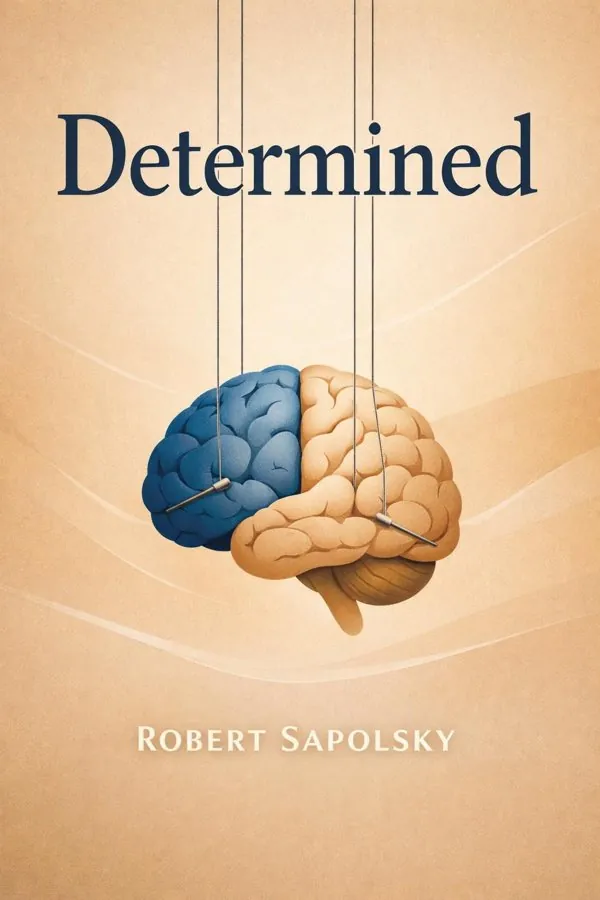
Determined: A Science of Life Without Free Will: Summary & Key Insights
 10 min9 chaptersAudio available
What Is Determined: A Science of Life Without Free Will About?
Determined: A Science of Life Without Free Will by Robert Sapolsky is a neuroscience book spanning 9 pages. In this groundbreaking work, neuroscientist Robert Sapolsky explores the implications of a world without free will. Drawing on decades of research in biology, psychology, and philosophy, he argues that human behavior is entirely determined by genetics and environment, challenging traditional notions of morality, responsibility, and justice. The book invites readers to reconsider how society should respond to human actions when choice itself may be an illusion.
This FizzRead summary covers all 9 key chapters of Determined: A Science of Life Without Free Will in approximately 10 minutes, distilling the most important ideas, arguments, and takeaways from Robert Sapolsky's work. Also available as an audio summary and Key Quotes Podcast.
Determined: A Science of Life Without Free Will
In this groundbreaking work, neuroscientist Robert Sapolsky explores the implications of a world without free will. Drawing on decades of research in biology, psychology, and philosophy, he argues that human behavior is entirely determined by genetics and environment, challenging traditional notions of morality, responsibility, and justice. The book invites readers to reconsider how society should respond to human actions when choice itself may be an illusion.
Who Should Read Determined: A Science of Life Without Free Will?
This book is perfect for anyone interested in neuroscience and looking to gain actionable insights in a short read. Whether you're a student, professional, or lifelong learner, the key ideas from Determined: A Science of Life Without Free Will by Robert Sapolsky will help you think differently.
- ✓Readers who enjoy neuroscience and want practical takeaways
- ✓Professionals looking to apply new ideas to their work and life
- ✓Anyone who wants the core insights of Determined: A Science of Life Without Free Will in just 10 minutes
Want the full summary?
Get instant access to this book summary and 100K+ more with Fizz Moment.
Get Free SummaryAvailable on App Store • Free to download
Key Chapters
For most of history, we’ve built our identities and societies on the belief that people choose how to act. Philosophy, religion, and law have all demanded a concept of agency to justify praise and blame. The ancient Greeks wrestled with fate and choice, Christianity enshrined moral responsibility under divine judgment, and Enlightenment thinkers refined free will into the cornerstone of human dignity. Yet even as those ideas flourished, cracks appeared. Spinoza suggested that freedom is simply understanding necessity; Hume wondered whether causality could coexist with choice. The 19th century brought Darwin, Freud, and Marx—all reducing autonomy to natural and psychological forces. The 20th century’s legal systems still clung to accountability, even as science made that stance increasingly untenable.
In *Determined*, I trace this intellectual lineage not as a museum tour but as a cautionary tale. Every era has feared what happens if we lose free will: chaos, moral collapse, irresponsibility. Yet reality ignored our fears. We reshaped theology, invented theories of punishment, and glorified personal merit—all while ignoring the growing evidence that every instant of human action flows from antecedent causes. Philosophy gave us admirable tools for introspection, but science now shows that the very sense of choosing is a post hoc story—a comforting narrative the brain fabricates after the fact. You feel as if you decided, when in truth your neurons decided before you felt anything at all.
The brain tells a deterministic story unambiguously. Experiments going back to Benjamin Libet and expanded through modern neuroimaging reveal that the brain initiates movements and decisions milliseconds before the conscious mind becomes aware of them. Our apparent moment of choice is actually the echo of processes that have already begun. In my own research and that of others, we’ve seen how complex networks—from the prefrontal cortex to the basal ganglia—form patterns based on prior reinforcement and genetic wiring that drive what feels like intention.
When you grasp this evidence, you realize consciousness isn’t a command center—it’s a commentary booth. The sensation of willing, deciding, choosing, is the product of brain modules interpreting signals already set in motion. Chemical messengers dictate emotional coloring, and neural circuits shaped by prior experience guide the possible paths. If the brain is a system obeying physical laws, there is no room for uncaused choice. The universe doesn’t pause for a moral deliberation—it unfolds according to what came before.
This doesn’t trivialize our inner life. It explains it. The beauty of neuroscience is that it reveals how rich and intricate causality truly is. Every impulse and hesitation is the sum of prior stimuli, learning, and physiology. When we see someone commit an act of hatred or generosity, we’re witnessing not moral freedom but the cascade of neural history. Once you accept this, moral arrogance dissolves—you stop asking, ‘Why didn’t they just choose differently?’ because you know they couldn’t.
+ 7 more chapters — available in the FizzRead app
All Chapters in Determined: A Science of Life Without Free Will
About the Author
Robert Sapolsky is an American neuroscientist, biologist, and author known for his research on stress, behavior, and the brain. He is a professor of biology, neurology, and neurosurgery at Stanford University and has written several acclaimed books that bridge science and human experience, including 'Behave' and 'Why Zebras Don't Get Ulcers'.
Get This Summary in Your Preferred Format
Read or listen to the Determined: A Science of Life Without Free Will summary by Robert Sapolsky anytime, anywhere. FizzRead offers multiple formats so you can learn on your terms — all free.
Available formats: App · Audio · PDF · EPUB — All included free with FizzRead
Download Determined: A Science of Life Without Free Will PDF and EPUB Summary
Key Quotes from Determined: A Science of Life Without Free Will
“For most of history, we’ve built our identities and societies on the belief that people choose how to act.”
“The brain tells a deterministic story unambiguously.”
Frequently Asked Questions about Determined: A Science of Life Without Free Will
Determined: A Science of Life Without Free Will by Robert Sapolsky is a neuroscience book that explores key ideas across 9 chapters. In this groundbreaking work, neuroscientist Robert Sapolsky explores the implications of a world without free will. Drawing on decades of research in biology, psychology, and philosophy, he argues that human behavior is entirely determined by genetics and environment, challenging traditional notions of morality, responsibility, and justice. The book invites readers to reconsider how society should respond to human actions when choice itself may be an illusion.
You Might Also Like
Anxious
Joseph LeDoux
10 min
Hallucinations
Oliver Sacks
10 min
The Biological Mind: How Brain, Body, and Environment Collaborate to Make Us Who We Are
Alan Jasanoff
10 min
The Feeling of Life Itself: Why Consciousness Is Widespread but Can't Be Computed
Christof Koch
10 min
The No-Nonsense Meditation Book
Steven Laureys
10 min
A General Theory of Love
Thomas Lewis, Fari Amini, Richard Lannon
10 minBrowse by Category
Ready to read Determined: A Science of Life Without Free Will?
Get the full summary and 100K+ more books with Fizz Moment.