
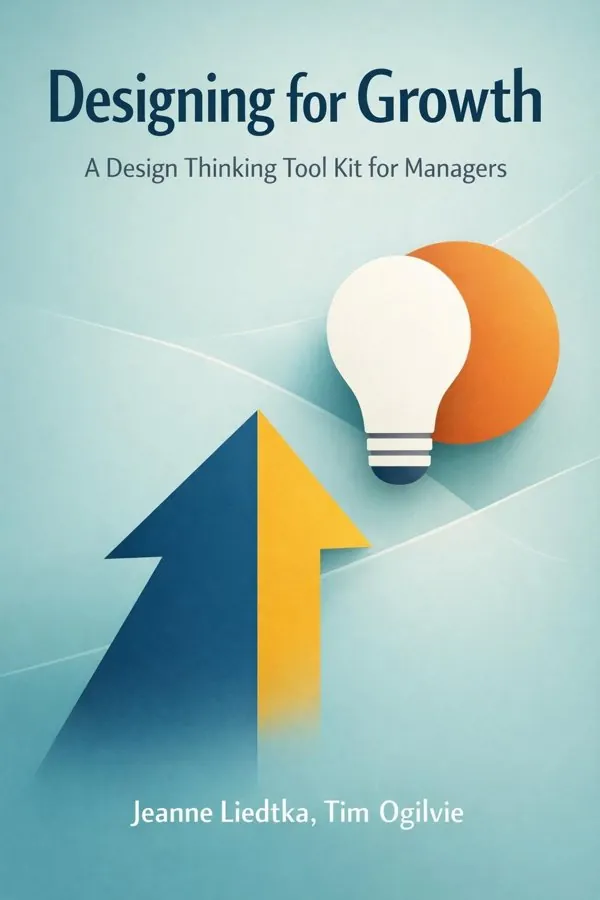
Designing for Growth: A Design Thinking Tool Kit for Managers: Summary & Key Insights
by Jeanne Liedtka, Tim Ogilvie
 10 min5 chapters
What Is Designing for Growth: A Design Thinking Tool Kit for Managers About?
Designing for Growth: A Design Thinking Tool Kit for Managers by Jeanne Liedtka, Tim Ogilvie is a leadership book spanning 5 pages. This book provides managers with a practical framework for applying design thinking to business challenges. It introduces tools and methods that help organizations innovate, improve customer experiences, and drive growth through human-centered design. The authors translate design principles into actionable steps that can be integrated into everyday management practice.
This FizzRead summary covers all 5 key chapters of Designing for Growth: A Design Thinking Tool Kit for Managers in approximately 10 minutes, distilling the most important ideas, arguments, and takeaways from Jeanne Liedtka, Tim Ogilvie's work.
Designing for Growth: A Design Thinking Tool Kit for Managers
This book provides managers with a practical framework for applying design thinking to business challenges. It introduces tools and methods that help organizations innovate, improve customer experiences, and drive growth through human-centered design. The authors translate design principles into actionable steps that can be integrated into everyday management practice.
Who Should Read Designing for Growth: A Design Thinking Tool Kit for Managers?
This book is perfect for anyone interested in leadership and looking to gain actionable insights in a short read. Whether you're a student, professional, or lifelong learner, the key ideas from Designing for Growth: A Design Thinking Tool Kit for Managers by Jeanne Liedtka, Tim Ogilvie will help you think differently.
- ✓Readers who enjoy leadership and want practical takeaways
- ✓Professionals looking to apply new ideas to their work and life
- ✓Anyone who wants the core insights of Designing for Growth: A Design Thinking Tool Kit for Managers in just 10 minutes
Want the full summary?
Get instant access to this book summary and 100K+ more with Fizz Moment.
Get Free SummaryAvailable on App Store • Free to download
Key Chapters
Every journey in design thinking begins by asking, “What is?” This is the question of discovery—the point where curiosity replaces assumptions. As a manager, you’ve likely been conditioned to start solving problems immediately, yet design thinking invites you to pause and truly understand the landscape before declaring what needs fixing. Our experience shows that the most successful innovations stem not from brilliant ideation alone but from richly informed insights into what customers are actually experiencing now.
The 'What is?' stage is about framing your understanding of the present. Here, observation becomes your most valuable managerial skill. It’s not enough to rely on market data or performance metrics; you must step into your customers’ world and see through their eyes. In this book, we teach tools like journey mapping—a visual depiction of the customer’s experience across touchpoints—and mind mapping, which helps uncover patterns in both behavior and emotion. These methods enable managers to move beyond surface-level analysis and explore the deeper needs and pain points that shape customer satisfaction.
For example, when we worked with service organizations struggling with declining customer loyalty, traditional metrics could only tell part of the story. Through journey mapping, teams discovered moments of emotional friction—long waiting times, unclear instructions, unmet expectations—that no spreadsheet could capture. By observing and analyzing these details, managers were able to reframe their challenge not as “reducing churn” but as “designing trust and ease.” That shift in framing opened new space for creative solutions.
The essence of this stage is empathy. As a manager, empathy means suspending judgment and listening with intention. It’s about approaching the world as your customers do, asking not only what they do but why they do it. We guide you through methods like 'day in the life' observation and stakeholder mapping, each aimed at expanding your perspective on the system your business operates within. You learn to recognize patterns, identify outliers, and discern opportunities hiding in plain sight.
By the end of the 'What is?' phase, you have a set of insights—stories, visuals, and connections—that redefine your problem. You now understand what your customers truly value and where they struggle. This understanding becomes the foundation for every subsequent step. It’s the difference between designing from abstraction and designing from reality.
Once you understand what is, the natural next question emerges: “What if?” This stage is about imagination and idea generation, but within a disciplined framework. In our experience, managers often struggle here because traditional business culture rewards analysis of the existing rather than exploration of the possible. Design thinking introduces techniques that allow you to reframe challenges, stretch what’s plausible, and experiment with alternative futures.
In this phase, we help managers learn to ask new kinds of questions. Instead of asking, “How do we fix what’s broken?” we encourage, “What if we could start fresh?” This subtle shift can unleash creativity that was previously suppressed by constraints. Through brainstorming and concept development exercises, teams explore multiple directions—sometimes wildly divergent—to uncover new potentials. The goal isn’t just to produce ideas but to generate meaningful possibilities anchored in the insights gathered from the 'What is?' stage.
For example, in a project with a financial services company, after uncovering customers’ frustration with complex digital interfaces, the team used 'What if?' sessions to imagine a service experience as simple as texting a friend. That imaginative leap eventually led to a prototype for conversational banking—a new concept that dramatically improved engagement. This illustrates how disciplined creative thinking leads to measurable innovation.
In this stage, reframing is key. We teach managers to redefine constraints not as barriers but as design parameters. Tools like visualization, storyboarding, and rapid concept sketches help teams make their ideas tangible early. The process transforms brainstorming from chaotic idea dumps into structured exploration rooted in empathy and insight.
As the author, I want you to remember: the 'What if?' stage is not about predicting the future but about creating possible futures. By exploring what could be, managers begin to see growth as a design challenge rather than a forecast. They learn that every strategy can be prototyped and tested before investing deeply. That mindset frees your organization to act boldly while minimizing risk. This is the power of turning imagination into a management discipline.
+ 3 more chapters — available in the FizzRead app
All Chapters in Designing for Growth: A Design Thinking Tool Kit for Managers
About the Authors
Jeanne Liedtka is a professor at the University of Virginia Darden School of Business, known for her work on design thinking and innovation in management. Tim Ogilvie is the CEO of Peer Insight, a firm specializing in service innovation and design thinking for business growth.
Get This Summary in Your Preferred Format
Read or listen to the Designing for Growth: A Design Thinking Tool Kit for Managers summary by Jeanne Liedtka, Tim Ogilvie anytime, anywhere. FizzRead offers multiple formats so you can learn on your terms — all free.
Available formats: App · Audio · PDF · EPUB — All included free with FizzRead
Download Designing for Growth: A Design Thinking Tool Kit for Managers PDF and EPUB Summary
Key Quotes from Designing for Growth: A Design Thinking Tool Kit for Managers
“Every journey in design thinking begins by asking, “What is?”
“Once you understand what is, the natural next question emerges: “What if?”
Frequently Asked Questions about Designing for Growth: A Design Thinking Tool Kit for Managers
Designing for Growth: A Design Thinking Tool Kit for Managers by Jeanne Liedtka, Tim Ogilvie is a leadership book that explores key ideas across 5 chapters. This book provides managers with a practical framework for applying design thinking to business challenges. It introduces tools and methods that help organizations innovate, improve customer experiences, and drive growth through human-centered design. The authors translate design principles into actionable steps that can be integrated into everyday management practice.
You Might Also Like

Extreme Ownership
Jocko Willink
10 min
Dare to Lead
Brene Brown
10 min
Leaders Eat Last
Simon Sinek
10 min
The 21 Irrefutable Laws of Leadership
John Maxwell
10 min
Start With Why
Simon Sinek
10 min
How to Lead When You're Not in Charge
Clay Scroggins
10 minBrowse by Category
Ready to read Designing for Growth: A Design Thinking Tool Kit for Managers?
Get the full summary and 100K+ more books with Fizz Moment.